Disability Pluralism: Understanding Many Ways of Being Human
Author: Ian C. Langtree - View Credentials
Published: 31 Oct 2026
Publication Type: Informative
Table of Contents:
Synopsis - Definition - Overview - FAQs - Insights, Updates - Related Content
Synopsis
Pluralism in the context of disability is the idea that disabled people represent legitimate ways of being human rather than broken versions of a single ideal body or mind. Rooted in the social model of disability and written into the United Nations Convention on the Rights of Persons with Disabilities, which names respect for difference as a core principle, pluralism shifts attention from fixing individuals to reshaping the environments, institutions and attitudes that exclude them. This paper explains where the concept came from, how it works in law, design and community life, and why it matters for the roughly 1.3 billion people the World Health Organization estimates live with significant disability. It also examines the honest disagreements over pain, cure and resources that keep the idea evolving.
At a Glance
- 1 - The World Federation of the Deaf estimates there are more than 70 million deaf people worldwide. Together they use more than 300 different sign languages.
- 2 - The term neurodiversity is generally credited to Australian sociologist Judy Singer in the late 1990s. It reframed autism, ADHD and dyslexia as natural variations in how brains work rather than diseases to be erased.
- 3 - On Martha's Vineyard from the 1700s into the early 1900s, hereditary deafness was so common that hearing and deaf residents alike used a local sign language. Deaf islanders married, worked, voted and held office much like their hearing neighbors.
- 4 - The WHO reports that some disabled people die up to 20 years earlier than nondisabled people, largely because of avoidable inequities rather than impairment. Since almost everyone is likely to experience disability at some point in life, it is a minority group anyone can join.
Topic Definition
- Pluralism (Disability)
Pluralism in the context of disability is the view that physical, sensory, cognitive, intellectual and psychiatric differences are part of the ordinary range of human variation, and that a just society should accommodate that range rather than measure everyone against a single standard of normal. It treats disabled people as members of diverse communities with their own identities, cultures and knowledge, such as Deaf signing communities or the neurodiversity movement, and it locates much of the disadvantage they face in barriers created by environments, institutions and attitudes. Pluralism does not deny that some impairments bring pain or limitation, but it rejects the assumption that a disabled life is automatically a lesser one, and it calls for law, design and public policy to make room for many different ways of living well.
Overview
A Thought Experiment at the Bus Stop
Picture three people waiting at the same bus stop. One uses a power wheelchair, one is Deaf and is signing to a friend on a video call, and one is an autistic teenager wearing noise-canceling headphones. A traditional textbook would sort them into three medical categories and describe each as a problem to be managed. A pluralist asks a different question: what if each of these people represents a legitimate way of being human, and the real puzzle is why the bus, the timetable announcement, and the crowded shelter were built for only one kind of body and mind?
That shift in the question is the heart of pluralism in the context of disability. It does not deny that impairments are real or that some of them hurt. It argues instead that human variation is the normal condition of our species, and that a fair society should be organized around that variety rather than around an imagined average person. This paper traces where the idea came from, how it shows up in law, culture, and design, where it runs into honest disagreement, and how it changes across different timescales.
What Pluralism Means Before Disability Enters the Picture
Pluralism is an old idea in political philosophy, and it helps to see its general shape before applying it to disability.
Pluralism is the view that a society can, and should, contain many different groups, identities, values, and ways of life, and that this diversity is a source of strength rather than a problem to be solved by forcing everyone toward a single norm.
In the United States, the philosopher Horace Kallen pushed back against the popular "melting pot" image of immigration in 1915, arguing that a democracy could be more like an orchestra in which different cultures keep their distinct voices while playing together (Kallen, 1915). A generation later, Isaiah Berlin developed what he called value pluralism, the idea that there are many genuine human goods, and that they cannot always be ranked on one scale or combined into one perfect life (Berlin, 1969).
Notice the two layers here. Cultural pluralism is about groups living side by side. Value pluralism is about the deeper claim that there is no single correct template for a good life. Disability pluralism borrows from both. It treats disabled people as communities with their own histories and cultures, and it insists that a life lived with a different body or mind is not automatically a lesser version of a "normal" one.
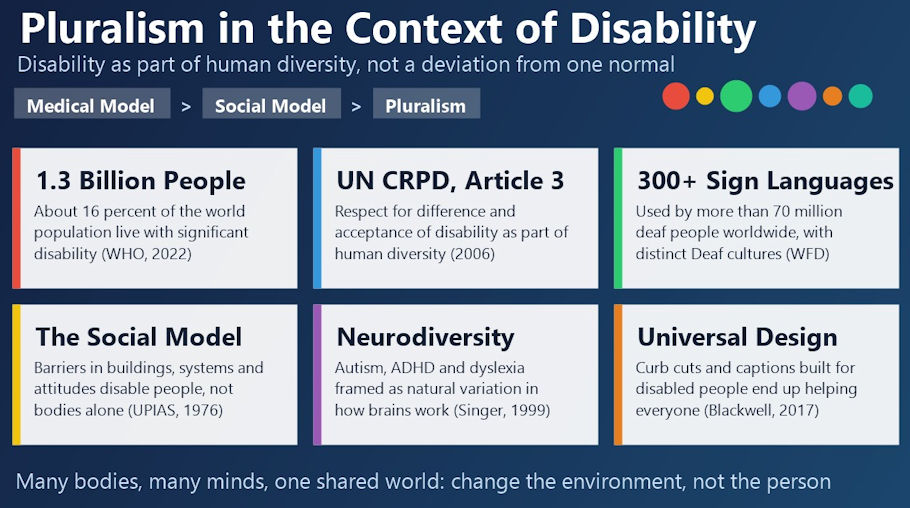
From Deficit to Diversity: How the Models Shifted
To understand why pluralism felt so radical when disabled activists began advancing it, we need to look at the frameworks it was reacting against. Scholars call these frameworks models of disability, and each one quietly answers the question, "Where does the problem live?"
The Medical Model
Under the medical model, disability is located inside the individual. It is a defect, illness, or abnormality, and the appropriate response is diagnosis, treatment, rehabilitation, or cure. The model is not useless. Medicine matters, and many disabled people rely on it daily. The difficulty is that when the medical model becomes the only lens, the person disappears behind the diagnosis, and the surrounding world is never asked to change.
The Social Model
In 1976, a British group called the Union of the Physically Impaired Against Segregation (UPIAS) drew a sharp line between impairment, meaning a difference in the body or mind, and disability, meaning the exclusion that society imposes on top of it. In their words, "it is society which disables physically impaired people" (UPIAS, 1976). The sociologist Mike Oliver later named this approach the social model of disability and made it a foundation of disability studies (Oliver, 1983, 1990).
Social model of disability: A framework holding that people are disabled mainly by barriers in the environment, such as inaccessible buildings, rigid institutions, and prejudiced attitudes, rather than by their impairments alone.
The social model is the doorway to pluralism. Once the "problem" moves from the body to the environment, difference itself stops being the enemy. A staircase becomes the barrier, not the wheelchair.
The Interactional and Biopsychosocial Middle Ground
Many scholars now prefer a blended view. The World Health Organization's International Classification of Functioning, Disability and Health, known as the ICF, describes disability as the outcome of an interaction between a health condition and contextual factors, both environmental and personal (World Health Organization [WHO], 2001). The philosopher and sociologist Tom Shakespeare argues for a similar interactional approach, warning that a purely social model can underplay the pain, fatigue, and limitation some impairments bring (Shakespeare, 2014).
Here is where systems thinking helps. Disability is not a property of a single part. It is an emergent property of a system, something that appears only when a particular body meets a particular environment under particular social rules. Change any one element and the outcome changes. Pluralism lives comfortably inside this systems view because it treats bodily and cognitive variety as a fixed feature of the system and asks designers, institutions, and communities to adjust the other variables.
The Core Claims of Disability Pluralism
Disability pluralism is less a single theory than a family of related arguments. Three of them carry most of the weight.
Disability as Mere Difference
The philosopher Elizabeth Barnes draws a useful contrast between two views. On a bad-difference view, being disabled makes a person worse off simply because of the disability itself. On a mere-difference view, disability makes a person different, much as being left-handed or gay does, and any disadvantage comes largely from how society responds (Barnes, 2016). Barnes defends the mere-difference view and links it to the long record of disabled people reporting that their lives are good, a finding that outsiders consistently fail to predict.
Disability paradox: The well documented gap between how nondisabled observers imagine life with a disability and the quality of life that disabled people themselves report, which is often much higher than outsiders expect.
Many Ways of Flourishing
The capabilities approach, developed by economist Amartya Sen and philosopher Martha Nussbaum, judges a society by what people are actually able to do and to be. Nussbaum argued that classic social contract theories struggle with disability because they imagine citizens as roughly equal in power and ability, and she proposed that justice must secure core capabilities for everyone, including people with significant cognitive impairments (Nussbaum, 2006). This fits pluralism neatly: the goal is not to make everyone function the same way but to make sure everyone has real routes to a flourishing life, even if those routes look different.
Misfits, Not Defects
Rosemarie Garland-Thomson offers a vivid metaphor. She describes disability as a misfit, the friction that occurs when a body and a world do not fit together, like a square peg and a round hole. The point is that neither shape is wrong on its own. The misfit is a relationship (Garland-Thomson, 2011). Elsewhere she argues for conserving disability, holding that disabled people contribute knowledge, perspectives, and forms of creativity that a world without them would lose (Garland-Thomson, 2012).
This is a good place to pause on the metaphor of biodiversity. Ecologists know that a forest with many species is more resilient than a monoculture, because variety lets a system respond to shocks it could not predict. Disability pluralism makes a parallel claim about human communities: a society that values many kinds of minds and bodies has more ways to solve problems, more perspectives to draw on, and more resilience when circumstances change.
Pluralism in Practice: Cultures, Communities, and Identities
Abstract arguments become concrete in the lives of particular communities. Three of them show how pluralism works on the ground.
Deaf Culture as a Linguistic Minority
Many Deaf people do not describe themselves as disabled at all. Writing the word with a capital D signals membership in a cultural and linguistic community with its own language, history, art, and social norms (Padden and Humphries, 1988). The scholar Paddy Ladd coined the term Deafhood to describe the ongoing process of claiming a Deaf identity rather than defining oneself by hearing loss (Ladd, 2003). The World Federation of the Deaf (n.d.) estimates there are more than 70 million deaf people worldwide, who together use more than 300 different sign languages.
A remarkable historical example comes from Martha's Vineyard in Massachusetts. Anthropologist Nora Ellen Groce documented how a high rate of hereditary deafness from the 1700s into the early 1900s led hearing and deaf residents alike to use a local sign language. Deaf islanders married, worked, voted, and held office much like their hearing neighbors, and many older residents Groce interviewed remembered them simply as fishermen or farmers, not as "the deaf" (Groce, 1985). The island was an accidental natural experiment in pluralism: when the whole community adapted, deafness lost most of its power to exclude.
Neurodiversity
The term neurodiversity is generally credited to Australian sociologist Judy Singer, who used it in the late 1990s to describe natural variation in human neurology (Singer, 1999). The neurodiversity movement, led largely by autistic people, argues that conditions such as autism, ADHD, and dyslexia are variations in how brains work rather than diseases that must be erased.
Neurodivergent: Describes a person whose brain functions in ways that differ from what is considered typical. Neurotypical describes someone whose neurology falls within those dominant expectations.
Neurodiversity is pluralism applied directly to the mind. It also illustrates a debate about language. Many autistic self-advocates prefer identity-first language ("autistic person"), treating autism as a core part of who they are, while many clinicians and some families use person-first language ("person with autism"). A pluralist approach respects that individuals and communities may choose differently.
Disability Justice and Intersectionality
Pluralism inside the disability community matters too. Early rights movements were often led by white men with physical disabilities, and critics pointed out that disabled people of color, queer and trans disabled people, and people with psychiatric or chronic illnesses had different experiences. In the mid 2000s, activists including Patty Berne, Mia Mingus, Stacey Milbern, Leroy Moore, Eli Clare, and Sebastian Margaret developed disability justice, a framework built on principles such as intersectionality, leadership of those most affected, and collective access (Sins Invalid, 2019). Alison Kafer's political/relational model similarly treats disability as a site of collective struggle and shared imagination rather than a fixed medical fact (Kafer, 2013).
The lesson is that pluralism works at more than one scale. It describes the relationship between disabled and nondisabled people, and it also describes the internal diversity of disabled communities themselves.
Pluralism Written Into Law and Policy
Ideas that begin in activist meetings and university seminars sometimes end up in international law. The clearest example is the United Nations Convention on the Rights of Persons with Disabilities (CRPD), adopted in 2006 and in force since 2008. Among its general principles, Article 3 lists "respect for difference and acceptance of persons with disabilities as part of human diversity and humanity" (United Nations, 2006). That phrase is pluralism in legal form.
The CRPD builds on this principle in several concrete ways:
- Reasonable accommodation (Article 2) requires necessary and appropriate adjustments so that disabled people can exercise their rights on an equal basis with others, as long as the adjustment does not impose a disproportionate burden.
- Universal design (Article 2) calls for products, environments, and services usable by all people, to the greatest extent possible, without the need for special adaptation.
- Cultural and linguistic identity (Article 30) states that persons with disabilities are entitled to recognition and support of their specific cultural and linguistic identity, including sign languages and Deaf culture.
In the United States, the Americans with Disabilities Act of 1990 moved in a similar direction by treating exclusion as discrimination rather than as an unfortunate side effect of impairment. It followed years of activism, including the 1977 Section 504 sit-in, when disabled protesters occupied a federal building in San Francisco for nearly four weeks to demand that existing anti-discrimination regulations be signed and enforced.
Design as Applied Pluralism
If pluralism is a philosophy, design is where it becomes physical. The architect Ronald Mace, who used a wheelchair himself, helped popularize universal design and worked with colleagues at North Carolina State University to publish seven principles in 1997, including equitable use, flexibility in use, and simple and intuitive use (Center for Universal Design, 1997).
The classic illustration is the curb cut. Disability activists in Berkeley, California, campaigned for curb ramps in the early 1970s so wheelchair users could cross streets. Today parents with strollers, travelers with rolling luggage, delivery workers, and cyclists rely on them daily. Policy writer Angela Glover Blackwell called this the curb-cut effect: designs that solve a problem for one group often benefit far more people than expected (Blackwell, 2017). Captions on videos, text-to-speech, and voice assistants follow the same pattern.
Curb-cut effect: The phenomenon in which changes designed to help a specific disadvantaged group end up benefiting society as a whole.
Design reveals the deeper logic of pluralism. A world built for a single average user is fragile, because almost nobody is truly average. A world built for a range of users is sturdier for everyone.
Tensions and Honest Disagreements
A serious account of pluralism has to acknowledge where it is contested. These debates are not signs that the idea has failed. They are the places where it is still being worked out.
Pain, Impairment, and the Limits of Celebration
Some disabled people experience chronic pain, progressive decline, or exhaustion that no ramp or attitude change can remove. Shakespeare (2014) argues that some impairments are intrinsically limiting, and that pretending otherwise can leave such people feeling erased by their own movement. A careful pluralism can hold both truths: disability is a valid form of human difference, and some impairments still bring real suffering that deserves medical attention and compassion.
Cure, Prevention, and Reproductive Choice
Pluralism raises hard questions about genetics and medicine. The bioethicist Adrienne Asch argued that prenatal testing followed by selective abortion can send a troubling message that a single trait outweighs everything else about a potential person (Asch, 1999). Others respond that respecting disabled lives and respecting reproductive autonomy are both important values. Cochlear implants, which some Deaf community members once saw as a threat to Deaf culture, show how these debates can shift over time as families, clinicians, and communities find ways to combine medical options with sign language and cultural belonging.
Recognition Versus Redistribution
The philosopher Nancy Fraser described a tension in social justice movements between recognition, meaning respect for group identity, and redistribution, meaning a fair share of material resources (Fraser, 1995). Disability pluralism is strong on recognition. Critics warn that celebrating difference without funding personal assistance, accessible housing, and adequate income can leave disabled people respected in principle but still poor and excluded in practice. Most advocates now argue that the two must travel together.
Reading Across Timescales: How Pluralism Evolves
One of the most useful ways to understand disability pluralism is to watch how it operates at different speeds. The same pattern, a body or mind meeting a world that may or may not fit it, repeats at every level.
- The moment: At the scale of seconds and minutes, pluralism is a single interaction. Does a teacher allow a student to stand during a lesson? Does a shop clerk write a note for a Deaf customer? Inclusion or exclusion is experienced here first.
- The lifespan: Over decades, disability is often fluid. People acquire disabilities through injury, illness, or aging, and some move in and out of disability. Activists sometimes use the phrase temporarily able-bodied to remind others that disability is a category almost anyone may enter.
- The generation: Over twenty or thirty years, cultures and laws shift. The span from the UPIAS statement in 1976 to the adoption of the CRPD in 2006 is roughly one generation, and in that time the global conversation moved from charity toward rights.
- The long arc: Over centuries, ideas of normality themselves change. The statistical concept of a "normal" human, built on averages, emerged mainly in the nineteenth century. Pluralism can be read as a long correction to that relatively recent way of thinking.
Seen together, these scales form a nested system. Daily interactions add up to institutional habits, institutional habits become laws and norms, and those norms reshape what people expect in the next moment. Pluralism is coherent precisely because it gives the same answer at each level: make room for variation and adjust the environment, rather than forcing people to disappear into an average.
Why the Concept Matters Now
The scale of the issue is easy to underestimate. The World Health Organization estimates that about 1.3 billion people, roughly 16 percent of the global population, experience significant disability, and that some disabled people die up to 20 years earlier than nondisabled people, largely because of avoidable inequities in health systems and society rather than impairment alone (WHO, 2022). In the United States, the Centers for Disease Control and Prevention reports that more than one in four adults has some type of disability (Centers for Disease Control and Prevention [CDC], 2024).
Numbers like these change the framing. Disability is not a rare exception affecting a small minority on the edge of society. It is one of the largest and most varied forms of human diversity. Pluralism asks us to design schools, workplaces, health systems, digital tools, and public spaces with that reality in mind from the start, and to listen to disabled people as experts on their own lives, a principle captured in the movement slogan "Nothing about us without us" (Charlton, 1998).
Frequently Asked Questions
Is disability pluralism the same as inclusion?
Not exactly. Inclusion usually describes the practice of bringing disabled people into existing settings such as classrooms or workplaces, while pluralism is the underlying belief that disabled ways of living are valid in their own right. Pluralism often pushes inclusion further by asking that the settings themselves be redesigned rather than expecting disabled people to adapt.
Does supporting pluralism mean opposing medical treatment?
No. Most pluralists support access to medical care, therapy and assistive technology, and they defend the right of each person to decide which treatments fit their own goals. The objection is to treatment being imposed or presented as the only acceptable response to difference.
How can employers apply a pluralist approach to disability?
Employers can offer flexible schedules, remote work options, accessible software and clear processes for requesting adjustments without demanding excessive medical proof. They can also involve disabled employees in policy decisions and treat accommodations as ordinary tools for productivity rather than special favors.
What is Disability Pride Month?
Disability Pride Month is observed in July in the United States, marking the anniversary of the Americans with Disabilities Act being signed on July 26, 1990. It celebrates disability as a source of identity and community, which reflects pluralist thinking about difference.
How does pluralism apply to invisible disabilities?
Many disabilities, including chronic pain, mental health conditions, learning disabilities and some chronic illnesses, are not visible to others. Pluralism encourages people to accept that disability takes many forms and to avoid judging whether someone looks disabled enough to deserve access or support.
Can a person value their disability identity and still wish some symptoms were gone?
Yes. Many disabled people feel pride in their community and identity while also wanting relief from pain, fatigue or other difficult symptoms. Pluralism makes room for this mixed experience rather than requiring a single attitude toward disability.
How does pluralism influence classroom teaching?
In education, pluralism often appears through Universal Design for Learning, which offers multiple ways for students to access material, engage with lessons and show what they know. This reduces the need for individual exceptions because flexibility is built into each lesson from the start.
How can families support a pluralist view of disability at home?
Families can connect disabled children with disabled adults and peer communities, use the language their child prefers and focus on access rather than on making the child appear typical. Listening to the child as the expert on their own experience is one of the most important steps.
References:
Asch, A. (1999). Prenatal diagnosis and selective abortion: A challenge to practice and policy. American Journal of Public Health, 89(11), 1649-1657.
Barnes, E. (2016). The minority body: A theory of disability. Oxford University Press.
Berlin, I. (1969). Four essays on liberty. Oxford University Press.
Blackwell, A. G. (2017). The curb-cut effect. Stanford Social Innovation Review, 15(1), 28-33.
Center for Universal Design. (1997). The principles of universal design (Version 2.0). North Carolina State University.
Centers for Disease Control and Prevention. (2024). Disability impacts all of us. U.S. Department of Health and Human Services.
Charlton, J. I. (1998). Nothing about us without us: Disability oppression and empowerment. University of California Press.
Fraser, N. (1995). From redistribution to recognition? Dilemmas of justice in a post-socialist age. New Left Review, 212, 68-93.
Garland-Thomson, R. (2011). Misfits: A feminist materialist disability concept. Hypatia, 26(3), 591-609.
Garland-Thomson, R. (2012). The case for conserving disability. Journal of Bioethical Inquiry, 9(3), 339-355.
Groce, N. E. (1985). Everyone here spoke sign language: Hereditary deafness on Martha's Vineyard. Harvard University Press.
Kafer, A. (2013). Feminist, queer, crip. Indiana University Press.
Kallen, H. M. (1915, February 25). Democracy versus the melting-pot. The Nation, 100, 190-194.
Ladd, P. (2003). Understanding Deaf culture: In search of Deafhood. Multilingual Matters.
Nussbaum, M. C. (2006). Frontiers of justice: Disability, nationality, species membership. Harvard University Press.
Oliver, M. (1983). Social work with disabled people. Macmillan.
Oliver, M. (1990). The politics of disablement. Macmillan.
Padden, C., and Humphries, T. (1988). Deaf in America: Voices from a culture. Harvard University Press.
Shakespeare, T. (2014). Disability rights and wrongs revisited (2nd ed.). Routledge.
Singer, J. (1999). Why can't you be normal for once in your life? From a problem with no name to the emergence of a new category of difference. In M. Corker and S. French (Eds.), Disability discourse (pp. 59-67). Open University Press.
Sins Invalid. (2019). Skin, tooth, and bone: The basis of movement is our people (2nd ed.). Sins Invalid.
Union of the Physically Impaired Against Segregation. (1976). Fundamental principles of disability. UPIAS.
United Nations. (2006). Convention on the Rights of Persons with Disabilities. United Nations.
World Federation of the Deaf. (n.d.). Our work. World Federation of the Deaf.
World Health Organization. (2001). International classification of functioning, disability and health. World Health Organization.
World Health Organization. (2022). Global report on health equity for persons with disabilities. World Health Organization.
Insights, Analysis, and Developments
Editorial Note: Pluralism does not ask anyone to pretend that disability is always easy, nor does it dismiss the value of medicine, therapy or personal choice. What it challenges is the quiet assumption that there is one correct way to move, sense, think or communicate, and that everyone else must earn their place by coming as close to it as possible. The strongest evidence for the idea may be practical rather than philosophical: when communities have adjusted, from a Massachusetts island that learned sign language to cities that cut ramps into their curbs, disability lost much of its power to exclude and everyone gained something. As populations age and more people move in and out of disability across a lifetime, pluralism looks less like a niche position and more like a realistic description of who we already are.
 Author Credentials: Ian C. Langtree is a writer, editor, and the founder and Editor-in-Chief of Disabled World, which he established in 2004 as one of the longest-running independent resources for disability news and information. Over more than two decades, he has written and edited thousands of articles on disability rights, health, accessibility, and assistive technology. Drawing on a global perspective shaped by extensive travel and lived experience, Ian is a committed advocate of the Social Model of Disability, the framework developed by disabled activists in the 1970s that focuses on removing societal barriers rather than on individual impairments. His writing is grounded in that framework and in a lasting commitment to disability rights, accessibility, and social inclusion. To learn more about Ian's background, expertise, and accomplishments, visit his full biography.