Kinesiologist vs Physiotherapist: What's the Difference
Author: Ian C. Langtree - Writer/Editor for Disabled World (DW)
Published: 22 Jul 2026 - Updated: 7 Aug 2026
Publication Type: Informative
Table of Contents:
Synopsis - Definition - Overview - FAQs - Insights, Updates - Related Content
Synopsis
They share a hallway, a squat rack, and a goal, yet a kinesiologist and a physiotherapist are not the same professional - one is a movement-science coach who rebuilds you through active exercise, the other a primary healthcare practitioner licensed to diagnose and treat, and knowing which is which decides who leads your recovery, who can bill your insurer, and who guides a person through the long work of living well with disability.
At a Glance
- 1 - Kinesiology is a regulated health profession only in the province of Ontario within Canada.
- 2 - In Australia, kinesiology means a complementary muscle-testing therapy, not exercise science.
- 3 - Physiotherapists can legally assess and diagnose conditions, while kinesiologists generally cannot.
- 4 - Kinesiologists frequently deliver the active exercise portion of a physiotherapist's rehabilitation plan.
Topic Definition
- Kinesiologist
A kinesiologist is a university-trained health professional who specializes in human movement, applying the science of biomechanics, anatomy, and exercise physiology to assess how the body moves and to improve, restore, or protect that movement through active, exercise-based care. Rather than diagnosing disease or performing invasive procedures, a kinesiologist designs and coaches individualized programs that build strength, mobility, and endurance, whether the aim is preventing injury, managing a chronic condition, returning to work, or supporting a person living with disability.
Overview
Two Movement Professions, One Shared Destination
If you have ever stood in a clinic hallway wondering whether the person about to help you rebuild a wrecked knee is a kinesiologist or a physiotherapist, you are not alone. The two titles sound like cousins, they often work in the same room, and they frequently prescribe the same squat. Yet they sit at different points on the healthcare map, with different legal authority, different training, and different relationships to the people they serve. Understanding the distinction is not academic hair-splitting - it changes who can diagnose your condition, who can bill your insurer, and who leads your care.
Both professions belong to a family called allied health, the group of university-trained clinicians who are neither doctors nor nurses but who deliver much of the hands-on work of modern healthcare. To see how they differ, it helps to zoom between scales: the immediate encounter (what happens in the treatment room), the system level (how each profession is regulated and funded), and the conceptual level (how each thinks about the human body). Coherence between those layers is exactly where the confusion lives, so we will move through them deliberately.
Scope of practice
The range of services a professional is educated, trained, competent, and legally authorized to provide. It is the single most useful lens for telling any two health professions apart.
What a Kinesiologist Does
A kinesiologist is, at heart, a specialist in human movement. The discipline draws on biomechanics, exercise physiology, anatomy, and motor control to answer a deceptively simple question: how does this body move, and how can that movement be improved, restored, or protected? In its regulated Canadian form, the scope is defined as the assessment of human movement and performance and its rehabilitation and management to maintain, rehabilitate, or enhance movement and performance (College of Kinesiologists of Ontario, 2023).
In practice, that means kinesiologists live in the world of active care. They assess how you walk, lift, and balance, then design and coach exercise programs to close the gap between where your body is and where it needs to be. You will find them running return-to-work conditioning after a workplace injury, building strength programs for people managing diabetes or heart disease, correcting the ergonomics of an office desk, and guiding athletes through injury prevention. The Canadian Kinesiology Alliance frames the profession as science-based practice spanning prevention, fitness, rehabilitation, education, and performance (Canadian Kinesiology Alliance, 2024).
What a kinesiologist generally does not do is diagnose a medical condition or perform invasive procedures. In the regulated Ontario model, kinesiologists are not authorized to perform controlled acts - the legally restricted, higher-risk interventions such as communicating a diagnosis or putting a needle beneath the skin (College of Kinesiologists of Ontario, 2023). That single boundary explains most of what separates them from physiotherapists.
What a Physiotherapist Does
A physiotherapist (called a physical therapist in the United States) is a primary healthcare professional trained to examine, assess, diagnose, treat, and manage a wide range of physical conditions. World Physiotherapy, the global federation of the profession, describes entry-level physiotherapists as primary contact autonomous practitioners, able to assess, evaluate, diagnose, treat, and discharge patients without a referral from another health professional (World Physiotherapy, 2023a).
Primary contact (first contact) practitioner
A clinician a person can go to directly, without a doctor's referral, because the profession is trusted to triage, diagnose within its scope, and refer on when needed.
Where the kinesiologist is anchored in active exercise, the physiotherapist carries a larger toolbox. It includes exercise, but also passive techniques applied to the patient rather than performed by them: manual therapy, joint mobilization and manipulation, soft-tissue work, and in many jurisdictions modalities such as dry needling or acupuncture, electrotherapy, and wound care. Several of these are formal controlled acts. In Ontario, for example, physiotherapists are legally authorized to communicate a diagnosis, perform spinal manipulation, and put an instrument or needle past the skin under defined conditions (College of Physiotherapists of Ontario, 2023). The physiotherapist can therefore name what is wrong, treat it directly, and only then hand the active-loading phase to an exercise professional.
Training and Regulation: Where the Paths Diverge
The clearest fork in the road is education. A kinesiologist typically holds a four-year bachelor's degree in kinesiology or human kinetics. A physiotherapist, in most modern systems, completes an undergraduate degree and then a professional master's in physiotherapy - roughly six to seven years of study in total - before qualifying (World Physiotherapy, 2023b). That extra training is not decorative; it is what underwrites the authority to diagnose and to perform controlled acts.
Regulation is the second fork, and here the two professions are strikingly asymmetrical. Physiotherapy is a regulated health profession almost everywhere it is practiced, with protected titles and mandatory registration - through provincial colleges in Canada, the Physiotherapy Board under AHPRA in Australia, the Health and Care Professions Council in the United Kingdom, and state licensure in the United States. Kinesiology, by contrast, is regulated in far fewer places. In Canada it is a regulated health profession in only one province, Ontario, where the title kinesiologist is protected under the Kinesiology Act, 2007 and reserved for registrants of the College of Kinesiologists of Ontario (College of Kinesiologists of Ontario, 2023). Outside Ontario, anyone may, in principle, use the label, which places more responsibility on the client to check qualifications.
Controlled act
A specific, higher-risk health activity that the law permits only certain authorized professionals to perform. Diagnosing, ordering imaging, and inserting a needle are classic examples. Physiotherapists hold several; kinesiologists typically hold none.
Where the Two Professions Overlap
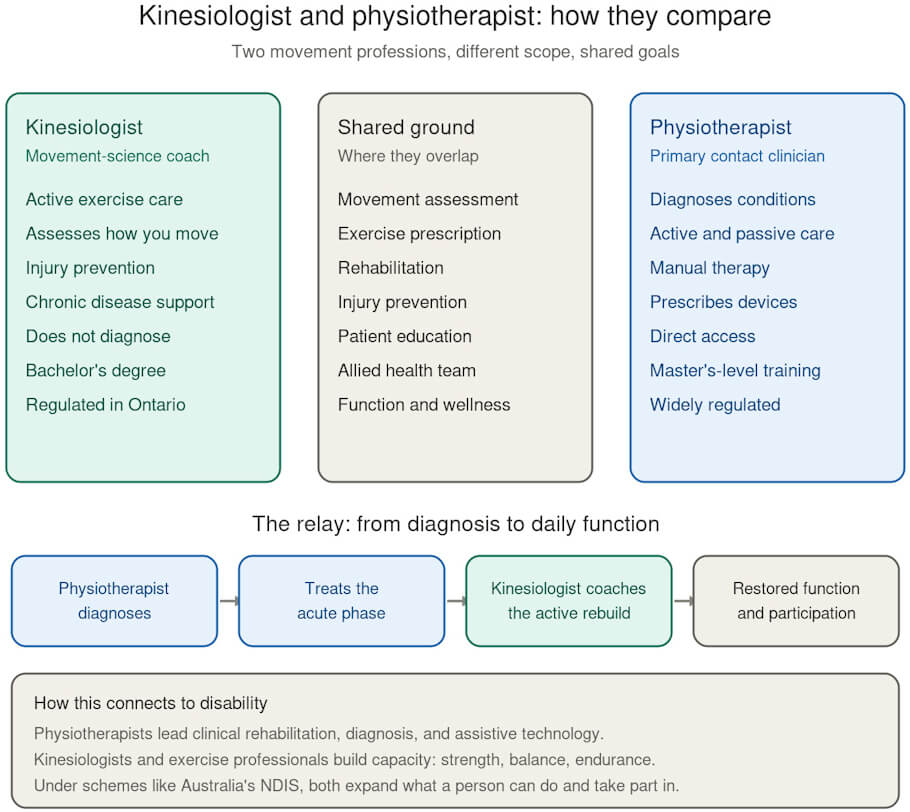
For all these differences, the overlap is real and it is large. Both professionals assess movement, both prescribe therapeutic exercise, both educate clients on posture and load management, both work in chronic disease management and injury prevention, and both aim squarely at restoring function. Hand either one a client with a deconditioned shoulder and a goal of returning to work, and the exercise program they build may look almost identical.
This is why the two so often operate as a relay team rather than as rivals. A common division of labor sees the physiotherapist diagnose the problem, manage the acute and painful early phase with hands-on treatment, and set the rehabilitation plan - then hand the progressive, active strengthening phase to a kinesiologist who has the time and the exercise expertise to coach it week after week. In many clinics the kinesiologist is, in effect, the person who delivers the active exercise portion of the physiotherapist's plan. The professions are complementary layers of a single system of care, not competing versions of the same job.
Active Versus Passive: A Useful Mental Model
If you remember one idea from this paper, make it this contrast. Passive care is done to you: a therapist mobilizes a stiff joint, releases a tight muscle, or applies a modality while you rest. Active care is done by you: you perform the exercise, and the clinician coaches, progresses, and corrects. Physiotherapists move fluidly across both modes; kinesiologists specialize almost entirely in the active one. Think of it as the difference between a mechanic who repairs the engine and a driving coach who trains you to drive the repaired car well. Recovery usually needs both, in sequence, and knowing which mode you are in tells you which professional you are talking to.
How This Relates to Disability
Disability is where these two professions become genuinely important, and where their differences translate into different roles. It helps to borrow the World Health Organization's framework, the International Classification of Functioning, Disability and Health, which understands disability not as a fixed medical defect but as the product of interaction between a health condition and a person's body functions, activities, participation, and environment (World Health Organization, 2001). Under that biopsychosocial view, the goal of care is not merely to fix tissue but to expand what a person can do and take part in - which is precisely the shared territory of movement professionals.
Biopsychosocial model
A view of health and disability that weighs biological, psychological, and social and environmental factors together, rather than reducing a person to a diagnosis.
Physiotherapists sit at the clinical center of disability rehabilitation. They assess and manage the physical and neurological conditions that underlie many disabilities, work to improve mobility, strength, and balance, manage pain, and recommend assistive technology such as wheelchairs, braces, and walking aids, along with home modifications that make an environment more accessible (World Physiotherapy, 2023a). Because they can diagnose and practice autonomously, they often anchor a person's rehabilitation plan.
Movement and exercise professionals then carry that plan into daily life. In Australia's National Disability Insurance Scheme, for instance, funded exercise professionals design individualized programs that account for a participant's specific abilities, limitations, and goals, delivered in the home or by telehealth to build capacity over time (Exercise and Sports Science Australia, 2023). For a person living with a long-term disability, that steady, active, capacity-building work - improving the strength to transfer from a chair, the endurance to get through a day, the balance to move safely - is often exactly what a kinesiologist or exercise professional provides, while the physiotherapist supervises the clinical direction. The two roles are not interchangeable, but together they cover both the diagnosis-and-treatment layer and the long-term function-and-participation layer of disability support.
Regional Nuance: The Same Word, Different Meanings
One warning before you book an appointment. The word kinesiologist does not mean the same thing everywhere, and this trips up even careful readers. In Canada and the United States it denotes a university-trained movement-science professional of the kind described above. In Australia, however, kinesiology commonly refers to a complementary therapy built around muscle-testing rather than exercise science, and the clinical movement-science role is filled instead by the Accredited Exercise Physiologist, a regulated allied health professional recognized under the disability and Medicare systems (Exercise and Sports Science Australia, 2023). So a North American kinesiologist and an Australian kinesiologist are, confusingly, not the same profession at all. When comparing across countries, always check the scope and the registering body, not just the title on the door.
Choosing Between Them
The practical rule follows directly from scope. If you have a new, undiagnosed, or painful problem and you need to know what is wrong, start with a physiotherapist, who can assess, diagnose, and treat, and who can refer you onward if the issue lies outside their scope. If you already understand your condition and your goal is to rebuild strength, movement, and conditioning through a coached exercise program - whether after injury, for a chronic condition, or as part of disability support - a kinesiologist is well suited to that active, progressive work. For many people the honest answer is that they will see both, in sequence, and be better for it. The most coherent care systems are the ones that use each profession for what it does best.
Frequently Asked Questions
Do I need a doctor's referral to see a physiotherapist or a kinesiologist?
In most places you can book a physiotherapist directly, because they are recognized as primary contact practitioners, and kinesiologists also accept clients without a referral. The exception is billing: some insurers or funding programs still require a physician's referral before they will reimburse a claim, so it is worth checking your specific plan first.
Is a kinesiologist the same as a personal trainer?
No. A kinesiologist holds a university degree in movement science and, in regulated settings, works within a defined clinical scope, which makes them suited to rehabilitation, chronic disease, and complex cases. A personal trainer usually holds a shorter certification focused on general fitness, and is not a health professional in the clinical sense.
Are kinesiology and physiotherapy services covered by insurance?
Physiotherapy is widely covered by public health systems, workplace-injury schemes, and private extended-health plans. Kinesiology is more often covered under private extended-health benefits than by public plans, and coverage varies by country, insurer, and region, so confirming the details with your provider before booking is the safest approach.
Can a kinesiologist and a physiotherapist work together on the same case?
Yes, and they frequently do. A common model has the physiotherapist diagnose the condition and manage the early, hands-on phase, then hand the progressive strengthening and conditioning work to a kinesiologist who coaches it over time. The two roles are designed to complement each other within a single plan of care.
Is an exercise physiologist the same as a kinesiologist?
They are closely related but not identical. Both are movement-science professionals who use exercise as therapy, yet titles and regulation differ by country. In Australia the Accredited Exercise Physiologist is the recognized clinical movement professional, whereas in North America that role is generally filled by the kinesiologist.
Which professional should I see first after a new or acute injury?
Start with a physiotherapist. Because they can assess, diagnose, and treat, they can identify what is actually wrong, manage pain in the early stage, and set a safe rehabilitation plan. Once the diagnosis and direction are clear, a kinesiologist is an excellent choice to lead the active, strengthening phase of recovery.
Can kinesiologists help with workplace injuries and return-to-work programs?
Yes. Return-to-work conditioning, functional assessment, and ergonomic advice are core areas of kinesiology practice. Kinesiologists are frequently engaged by workplace-injury and insurance programs to rebuild the strength and movement capacity a person needs to safely resume their job duties.
References:
Canadian Kinesiology Alliance. (2024). The scope of practice of kinesiology.
College of Kinesiologists of Ontario. (2023). About kinesiology, scope of practice, and use of title.
College of Physiotherapists of Ontario. (2023). Controlled acts and restricted activities standard.
Exercise and Sports Science Australia. (2023). Accredited exercise physiologist scope of practice.
World Health Organization. (2001). International classification of functioning, disability and health (ICF).
World Physiotherapy. (2023a). Policy statement: Description of physiotherapy.
World Physiotherapy. (2023b). Policy statement: Direct access and patient and client self-referral to physiotherapy.
Insights, Analysis, and Developments
Editorial Note: The tidy takeaway is that these two professions are layers of one system rather than competitors for one job - the physiotherapist names the problem and treats it with the fuller clinical toolbox, the kinesiologist coaches the active rebuilding that turns a plan into lasting function, and the smartest patients, clinics, and disability supports are the ones that stop asking which is better and start asking which is needed now.
 Author Credentials: Ian is the founder and Editor-in-Chief of Disabled World, a leading resource for news and information on disability issues. With a global perspective shaped by years of travel and lived experience, Ian is a committed proponent of the Social Model of Disability, a transformative framework developed by disabled activists in the 1970s that emphasizes dismantling societal barriers rather than focusing solely on individual impairments. His work reflects a deep commitment to disability rights, accessibility, and social inclusion. To learn more about Ian's background, expertise, and accomplishments, visit his full biography.