The 20 Most Accessible Countries for Disabled People
Author: Ian C. Langtree - Writer/Editor for Disabled World (DW)
Published: 4 Sep 2026
Publication Type: Instructive / Helpful
Table of Contents:
Synopsis - Definition - Overview - FAQs - Insights, Updates - Related Content
Synopsis
Every ranking of accessible countries carries a hidden assumption about whose access is being measured, and most of them quietly measure only wheelchairs. This paper does something harder: it sets out seven weighted criteria before naming a single country, covering legal enforceability, built environment, transport, digital access, social support, cultural attitudes and tourism infrastructure, then applies them consistently from Sweden at the top to the United Arab Emirates at twenty. The result is not a travel wish list but a diagnostic, because the interesting question is never simply which country is best - it is why a nation with world-class disability law can still run a subway that most of its disabled citizens cannot use, and what the countries that solved that problem actually did differently.
At a Glance
- 1 - Tactile paving was invented in Japan in 1965 by Seiichi Miyake. It is now standard in almost every country on this list.
- 2 - Britain pioneered the Changing Places toilet, a larger facility with a hoist and adult changing bench. It became mandatory in many new large public buildings from 2021.
- 3 - Buses turn over roughly every twelve to fifteen years while trains last thirty to forty, which is why national bus fleets reach full accessibility decades before rail networks do. This single fact explains most of the gap between a country's laws and its lived experience.
- 4 - Seoul's near-universal subway lift coverage was not delivered by planners but forced by years of sustained protest from disabled activists who occupied stations and buses. It is the clearest modern example of accessibility being won rather than granted, and it reshaped how Korean cities budget for inclusion.
Topic Definition
- Accessible Countries
An accessible country is one where a disabled person can carry out an ordinary day - travel, work, shop, socialize, seek medical care and go home again - without needing advance permission, special arrangements or the goodwill of strangers. That means more than ramps and lifts. It requires enforceable law that treats exclusion as discrimination, transport that works without pre-booking, buildings designed so the accessible entrance is simply the entrance, digital services that function with a screen reader, health and social systems that supply wheelchairs and personal assistance without financial ruin, and a culture that treats disabled presence as expected rather than exceptional. The practical test is not whether accommodations exist but whether they are so routine that nobody has to think about them, which is why the most accessible countries tend to be the ones where accessibility has stopped being a topic and become an assumption.
Overview
Ask ten disabled travelers to name the world's most accessible country and you will get ten different answers, because each person is answering a slightly different question. A power wheelchair user is asking about curb ramps, lift reliability and door widths. A Deaf traveler is asking about captioning, sign language interpretation and induction loops. A blind traveler is asking about tactile paving, audio announcements and screen reader support on a transit app. An autistic traveler is asking about sensory load, predictability and whether staff have any training at all. A ranking that ignores this divergence is not a ranking - it is a preference dressed up as a finding. What follows is an attempt to be honest about the method before making the claim.
The Criteria Used to Build This Ranking
Accessibility is not a single measurement. It is what systems theorists call an emergent property: it arises from the interaction of law, infrastructure, money, technology and attitude, and it can collapse if any one of those layers fails. A country can have world-class legislation and unusable trains. It can have beautiful step-free metros and a labor market that will not hire disabled people. The seven criteria below are weighted to reflect that interdependence, and each country was scored against all seven before ranking.
1. Legal architecture and enforceability - 20 percent
Not just whether a country has a disability rights law, but whether that law has teeth. The key questions are whether the state has ratified and meaningfully domesticated the United Nations Convention on the Rights of Persons with Disabilities, whether failure to provide access counts as unlawful discrimination rather than a mere aspiration, whether individuals can bring complaints without ruinous cost, and whether a regulator actually enforces standards [United Nations, 2006]. A useful term here:
Anticipatory duty - a legal obligation to make a service accessible before a disabled person asks for it, rather than reacting once someone is turned away. Britain's Equality Act 2010 is the clearest example. Most of the world still operates on a reactive, complaint-driven model, which puts the labor of enforcement onto disabled people themselves.
2. The built environment and universal design - 20 percent
Building codes, retrofit obligations for existing stock, the proportion of housing that is visitable, street design, and whether accessibility is treated as a design philosophy or a compliance checkbox. The relevant concept is universal design, coined by the architect Ronald Mace, who defined it as the design of products and environments usable by all people to the greatest extent possible without adaptation or specialized design [Mace, 1985]. Universal design is the difference between a building with a ramp bolted onto the side and a building whose main entrance simply has no step.
3. Transport accessibility - 20 percent
Step-free rates on rail and metro networks, low-floor bus penetration, availability of wheelchair-accessible taxis, intercity coach and rail policy, airport assistance quality, and the existence of subsidized door-to-door services. Transport is weighted heavily because it is the connective tissue: an accessible museum inside an inaccessible city is a stranded asset.
4. Digital and information accessibility - 10 percent
Whether public sector and now private sector websites, apps and ticketing systems meet recognized standards, usually the Web Content Accessibility Guidelines at Level AA. WCAG is organized around four principles known by the acronym POUR - perceivable, operable, understandable and robust. Digital access has quietly become a mobility issue, because the journey now begins at the booking screen.
5. Social protection, health care and personal assistance - 10 percent
Income support adequacy, access to wheelchairs and assistive technology without catastrophic cost, publicly funded personal assistance schemes, and whether repairs and spare parts are obtainable. The World Health Organization estimates that around one in six people globally live with significant disability and that many face substantially worse health outcomes driven by systemic barriers rather than by impairment itself [World Health Organization, 2022].
6. Attitudinal and cultural inclusion - 10 percent
Disability employment rates relative to the general population, the visibility of disabled people in public life, staff training norms, and the presence or absence of what disability scholars call ableism - the assumption that a nondisabled way of moving through the world is the default and everything else is an exception to be accommodated. This is the hardest criterion to measure and the one disabled residents most often say matters most.
7. Accessible tourism infrastructure - 10 percent
Accessible hotel room supply, beach and outdoor access, availability of equipment hire, quality of published access information, and whether tourism boards treat access as a market rather than a burden. Accessible tourism research consistently finds this segment to be large, loyal and systematically underserved [Buhalis and Darcy, 2011].
What this ranking cannot do
Three honest limitations. First, there is urban bias: national scores are dominated by capital cities, and rural accessibility everywhere is dramatically worse. Second, there is mobility bias: wheelchair access is far better documented than sensory, cognitive or psychosocial access, so the available data tilts the picture. Third, comparative disability statistics rely heavily on self-reporting and differing national definitions, which makes cross-country numbers indicative rather than precise [United Nations Department of Economic and Social Affairs, 2018]. Read the ranking as a well-argued ordering, not a league table with decimal places.
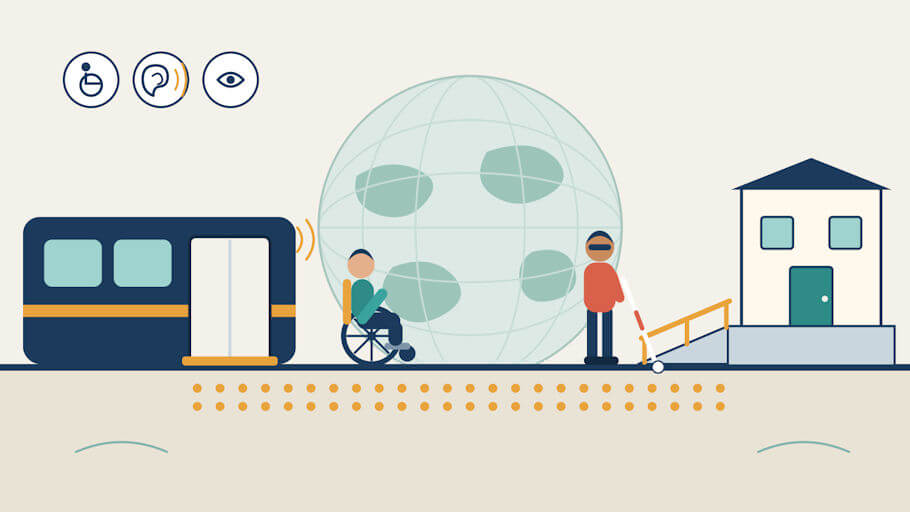
The 20 Most Accessible Countries, Ranked
1. Sweden
Why it ranks first
Sweden has been building toward access for longer than almost anyone, and the layering shows. Its disability policy tradition runs back to the 1960s normalization movement, which argued that disabled people should live ordinary lives in ordinary neighborhoods rather than in institutions - an idea that reshaped housing, schooling and transport across the Nordic region. Since 2015, an amendment to the Discrimination Act has made inadequate accessibility itself a form of unlawful discrimination, which converts access from a building code question into a civil rights question. Stockholm's metro has lifts at the great majority of stations, buses are low-floor and kneeling as standard, and the personal assistance scheme, though squeezed by budget disputes, remains among the most generous in the world for people with high support needs.
Where it falls short
The medieval core of Gamla Stan is cobbled and stepped and will never be fully accessible. Personal assistance eligibility has tightened significantly over the past decade, and disability organizations argue that hours have been cut in ways that reduce real freedom. Winter also matters more than visitors expect: snow clearance priorities determine whether a legally accessible route is physically usable in February.
2. Norway
Why it ranks second
Norway wrote universal design into its national planning law rather than leaving it to a separate disability statute, which is a structurally different and more durable choice. The Planning and Building Act and the Equality and Anti-Discrimination Act together make universell utforming a default expectation for new public buildings and outdoor areas. Oslo has an unusually high share of genuinely accessible hotel rooms compared with other European capitals, its airport express and metro are step-free, and even the fjord tourism industry has invested in accessible boats and viewing platforms. Norway also does something rare well: it funds assistive technology through the public system, so wheelchairs and communication devices are not a personal financial catastrophe.
Where it falls short
Terrain and cost. Much of the country's appeal is mountainous, and steep gradients defeat even good design. Norway is also expensive enough that accessible taxis and adapted accommodation carry a real premium, and older buildings in smaller towns lag far behind Oslo.
3. Denmark
Why it ranks third
Copenhagen is the strongest single argument for building new rather than retrofitting. The driverless metro was designed from the outset with level boarding, platform screen doors and lifts at every station, which means a wheelchair user can travel the network without pre-booking assistance - the practical test that separates good systems from great ones. Flat topography, wide cycle lanes that double as smooth wheeled routes, and a design culture that treats inclusive form as a point of national pride all reinforce each other. Denmark's Design for All tradition has produced public buildings where the accessible route and the main route are the same route.
Where it falls short
Denmark was slow to legislate a general prohibition on disability discrimination outside employment, only doing so in 2018, and enforcement remains lighter than in Sweden or Britain. The older S-train fleet and many historic buildings still require assistance or workarounds, and rural Jutland is a different country from Copenhagen in access terms.
4. Germany
Why it ranks fourth
Germany's advantage is density and engineering. The rail network reaches almost everywhere, and Deutsche Bahn reports that the large majority of passenger journeys now begin at step-free stations, with rolling programs of lift and platform-height works at major hubs. Newer intercity trains such as the ICE 3neo offer level entry at standard platform heights, removing the ramp-and-wait ritual. The Disability Equality Act of 2002 established federal obligations, and the Accessibility Strengthening Act, which took effect on 28 June 2025, extended binding accessibility requirements to a wide range of private-sector products and services, including e-commerce, banking apps and ticketing [Federal Ministry of Labour and Social Affairs, 2022].
Where it falls short
Hundreds of small rural stations remain stepped, and DB's assistance booking system has been criticized by disability groups for advance-notice requirements that undermine spontaneity. Restaurant and shop access in historic town centers is inconsistent, and the federal structure means standards vary noticeably between Länder.
5. Netherlands
Why it ranks fifth
The Netherlands benefits from geography that other countries would have to spend billions to imitate: it is flat, compact and already built around a mode of transport - the bicycle - whose infrastructure happens to suit handcycles, mobility scooters and wheelchairs beautifully. Dutch cities have continuous smooth-surfaced routes with gentle gradients and priority at junctions. Public transport is covered by a dedicated accessibility decree, station assistance is available at a large network of stations, and the Dutch approach to independent living support and adapted housing through municipal social support law is comparatively strong.
Where it falls short
The Netherlands ratified the UN Convention only in 2016, unusually late for a Western European state, and its implementation has been criticized as gradualist. Amsterdam's canal houses are famously vertical, with staircases that were built for barrels rather than people, so accessible accommodation in the historic center is scarce and expensive. Cobbled streets and bridge ramps also create friction that flat terrain alone does not solve.
6. Switzerland
Why it ranks sixth
Switzerland gave itself a deadline and largely met it. The Disability Equality Act of 2004 set a twenty-year transition period requiring public transport to become accessible by the end of 2023, which drove a nationwide program of platform raising, station rebuilds and rolling stock replacement. The result is a rail network where level boarding is common rather than exceptional, integrated with buses, funiculars and cable cars that carry wheelchair users to high alpine viewpoints. Swiss precision helps here in a literal sense: published access information tends to be accurate, which reduces the planning burden that quietly consumes so much disabled travelers' time.
Where it falls short
A meaningful minority of stations missed the 2023 deadline and remain in remediation. Costs are extremely high, adapted accommodation is limited outside major resorts, and Swiss anti-discrimination law is narrower than the British or American model, offering weaker remedies to individuals in the private services sector.
7. United States
Why it ranks seventh
The Americans with Disabilities Act of 1990 remains the most influential piece of disability legislation ever written, and its fingerprints are on building codes from Santiago to Seoul. Its practical legacy inside the United States is remarkable in specific ways: essentially the entire public bus fleet is wheelchair accessible, complementary paratransit is a legal entitlement in areas served by fixed-route transit, accessible parking and curb ramps are ubiquitous, and the ADA Standards for Accessible Design give precise, enforceable dimensions [U.S. Department of Justice, 2010]. Chain hotels typically offer roll-in showers, national parks have invested in accessible trails, and the private right of action means the law is genuinely litigated rather than politely ignored.
Where it falls short
The United States is a study in uneven implementation. Older rail systems are the weak point, with New York's subway still leaving the large majority of stations without step-free access despite a court-supervised settlement committing to near-universal access decades from now. Intercity rail is thin, land use is car-dependent in ways that strand non-drivers, sidewalks are missing entirely across large suburban areas, and health care costs mean that a wheelchair, a repair or a personal care attendant can be financially devastating. Air travel is a persistent grievance: wheelchairs are damaged or lost on flights with a frequency that airlines are now required to report, and the machinery for redress is slow.
8. Japan
Why it ranks eighth
Japan is the country most likely to surprise a first-time disabled visitor. It invented the technology that millions of blind people worldwide now rely on: tactile paving, developed by Seiichi Miyake and first installed in Okayama in 1967, spread from Japanese streets to the rest of the planet. The Barrier-Free Act of 2006, strengthened in 2018 and 2020, drove elevator installation across the rail network to the point where roughly 92 percent of stations handling 3,000 or more passengers a day are step-free [Ministry of Land, Infrastructure, Transport and Tourism, 2021]. Station staff are trained, reliable and will physically deploy ramps and radio ahead to your destination station. Universal design taxis are now common in major cities, and multi-purpose accessible toilets are widespread and immaculately maintained.
Where it falls short
Space is the enemy. Small restaurants, family-run inns and older commercial buildings frequently have a step at the door and no room to turn a wheelchair inside. Accessible hotel rooms are limited relative to demand despite rules requiring larger hotels to provide them. Cultural norms also tend toward assistance rather than independence, which some disabled travelers find gracious and others find constraining, and mental health and neurodivergence remain stigmatized subjects.
9. Singapore
Why it ranks ninth
Singapore demonstrates what a small, wealthy, centrally planned state can achieve in a single generation. Every MRT and LRT station is barrier-free, with lifts, wider fare gates, tactile guidance and accessible toilets, and newer lines are built with multiple lifts to remove the single point of failure that plagues older networks [Land Transport Authority, 2025]. Pedestrian overhead bridges are being systematically retrofitted with lifts, with dozens completed and a large further program running to 2030. The Code on Accessibility in the Built Environment is enforced at approval stage rather than argued about afterward, and the Enabling Masterplan 2030 sets national targets across employment, education and independent living.
Where it falls short
Singapore's disability rights framework is administrative rather than adversarial, so individuals have limited legal remedies when access fails. Wheelchair-accessible taxi supply is thin relative to the population, employment rates for disabled residents remain well below the national average, and the tropical heat and humidity impose a real physiological cost on many disabled people that no ramp can fix.
10. Australia
Why it ranks tenth
Australia pairs a strong legal spine with unusually good outdoor access. The Disability Discrimination Act 1992 is backed by the Disability Standards for Accessible Public Transport, which set binding compliance targets for vehicles, infrastructure and premises rather than leaving accessibility to goodwill [Australian Human Rights Commission, 2020]. The National Disability Insurance Scheme, whatever its administrative turbulence, funds equipment, therapies and support at a scale few countries attempt. Australia is also the world leader in beach access, with matting, floating chairs and accessible viewing platforms at hundreds of beaches, and the Companion Card scheme means a support person travels free to many venues.
Where it falls short
Distance defeats policy. Regional and remote access is dramatically worse than metropolitan access, and long-haul domestic flights reintroduce all the risks of aviation wheelchair handling. Older tram and rail stock in Melbourne and Sydney lags the standards, NDIS funding decisions are frequently contested, and heat waves and bushfire smoke create seasonal access barriers for people with respiratory and chronic conditions.
11. Canada
Why it ranks eleventh
Canada is mid-transformation. The Accessible Canada Act of 2019 sets an explicit national goal of a barrier-free Canada by 2040, requires federally regulated organizations to publish accessibility plans and progress reports, and creates an Accessibility Commissioner with enforcement powers [Employment and Social Development Canada, 2019]. Federally regulated transport is covered by dedicated regulations, and the One Person One Fare policy means a disabled passenger who requires an attendant does not pay twice on domestic flights - a concrete, unusual and genuinely valuable right. Ontario's earlier provincial legislation gave much of the country a decade's head start on service and design standards.
Where it falls short
Jurisdiction fragments everything. Municipal sidewalks, provincial building codes and federal transport rules produce a patchwork where a person's rights change when they cross a provincial line. Winter is a serious and underdiscussed barrier: unshoveled curb cuts turn accessible cities into impassable ones for months. Accessible housing supply is tight, and wait times for equipment funding vary sharply by province.
12. United Kingdom
Why it ranks twelfth
The Equality Act 2010 remains one of the most sophisticated disability rights instruments anywhere, largely because of its anticipatory duty to make reasonable adjustments. Every bus in Great Britain must meet accessibility regulations, which in practice means a low floor and a ramp, and this is one of the most complete national bus accessibility outcomes in the world. Britain also pioneered the Changing Places toilet - a larger facility with a hoist and adult-sized changing bench for people who cannot use standard accessible toilets - and made them mandatory in many new large public buildings from 2021. Blue Badge parking eligibility was extended in 2019 to include non-visible disabilities such as autism and some mental health conditions, a quiet but significant conceptual shift.
Where it falls short
The London Underground is the counterexample that dominates perceptions, with only around a third of stations step-free after decades of work and a target of half by 2030 [Transport for London, 2025]. National rail assistance still depends on booking systems that fail often enough to be newsworthy, listed-building protections frequently trump access in historic town centers, and social care funding for personal assistance has been under sustained pressure.
13. Austria
Why it ranks thirteenth
Vienna is the quiet overachiever of European accessibility. The entire U-Bahn network is step-free, trams have been progressively replaced with low-floor vehicles, and the city publishes detailed and reliable access information for cultural venues. The Federal Disability Equality Act of 2006 gave businesses a decade-long transition to remove barriers, after which discrimination claims became viable, and Austria has since implemented the European Accessibility Act requirements for digital and consumer services. Austria also does well on what might be called information access, with strong provision of easy-read materials and Austrian Sign Language interpretation in public services.
Where it falls short
Outside Vienna, provincial infrastructure is inconsistent, and alpine tourism regions vary enormously between resorts that have invested heavily and villages that have not. Austrian remedies for discrimination emphasize conciliation and damages rather than orders to fix the barrier, which means a business can in effect pay rather than change.
14. Finland
Why it ranks fourteenth
Finland's strength is systemic rather than showy. Its Non-Discrimination Act obliges authorities and service providers to make reasonable accommodations, the Act on the Provision of Digital Services made Finland an early and strict enforcer of public sector web accessibility, and personal assistance is a subjective right for those who qualify, meaning municipalities cannot simply refuse on budget grounds. Helsinki's metro stations all have lifts, the tram fleet is increasingly low-floor, and Finnish public buildings tend to be recent enough that universal design was assumed rather than retrofitted.
Where it falls short
Finland ratified the UN Convention only in 2016, and disability organizations argue that municipal variation in social services undercuts the theoretical rights. Extreme winter conditions, long distances between population centers and limited accessible taxi supply outside the capital region all constrain practical mobility.
15. Spain
Why it ranks fifteenth
Spain has built the strongest accessible tourism proposition in Europe. Dozens of beaches offer amphibious chairs, shaded rest areas and trained assisted-bathing staff, which for many wheelchair users is the difference between watching the sea and being in it. Barcelona's bus fleet is fully low-floor and ramp-equipped and the metro is step-free at the overwhelming majority of stations, while Madrid, Valencia and Seville have all invested heavily in tactile guidance and audio announcements. The ONCE Foundation, funded by the national lottery for the blind, has channeled enormous sums into accessibility projects, giving Spain an unusual institutional engine. Spain also implemented the European Accessibility Act through national law effective June 2025 [European Parliament and Council, 2019].
Where it falls short
Spain's universal accessibility deadline for existing buildings passed in 2017 and was widely missed, with limited enforcement consequences. Historic quarters in Toledo, Granada and much of Andalusia are steep and cobbled. Older housing stock frequently lacks lifts entirely, which affects residents far more than tourists, and regional autonomy produces significant variation in standards and funding.
16. France
Why it ranks sixteenth
France's 2005 accessibility law was genuinely ambitious, requiring public establishments to become accessible within a decade, and it reshaped museums, hospitals and new construction. Paris buses are effectively all accessible, and hosting the 2024 Paralympic Games drove significant investment in accessible taxis, hotel rooms and station upgrades. French cultural institutions are often excellent, with audio description, tactile tours and sign language programming that goes beyond compliance into genuine curatorial thought.
Where it falls short
The Paris Métro is the most conspicuous accessibility failure in any major Western capital: the network is more than a century old, deep, and largely unlifted, leaving only a small minority of stations usable by wheelchair users, with the automated Line 14 as the notable exception. The 2005 deadline was missed so comprehensively that the government created a program of extended compliance schedules, which disability organizations regard as a decade of legalized delay. Rural access, older regional trains and small hotel stock all lag.
17. New Zealand
Why it ranks seventeenth
New Zealand punches above its weight on outdoor and attitudinal access. The Department of Conservation has developed genuinely accessible walking tracks, several Great Walks have accessible sections, and adaptive adventure sport - from tandem skydiving to sailing - is unusually well developed. The Total Mobility scheme subsidizes taxi travel for people unable to use public transport, and the Enabling Good Lives approach has pushed disability support toward self-direction rather than service allocation. New Zealand also ratified the UN Convention early and maintains an active Disabled People's Organisations Coalition with real policy influence.
Where it falls short
Legislative reform has stalled. A proposed Accessibility for New Zealanders Bill, intended to create binding standards, did not survive the parliamentary cycle, leaving the country reliant on general human rights law without an accessibility standards regime. Public transport outside Auckland and Wellington is sparse, older housing stock is overwhelmingly stepped, and geographic isolation makes equipment repair slow and costly.
18. South Korea
Why it ranks eighteenth
Seoul's transformation is one of the fastest in the world, and it was won by disabled activists rather than granted by planners. Sustained protest campaigns from the early 2000s onward forced elevator installation across the subway network, which is now close to universal, and the city has moved its entire municipal bus fleet to low-floor vehicles [Seoul Metropolitan Government, 2024]. The Anti-Discrimination Against and Remedies for Persons with Disabilities Act of 2007 created a legal basis for complaints, and Korea ratified the UN Convention in 2008. Public buildings are new enough that accessible design is common, and technology adoption - accessible transit apps, real-time lift status - is strong.
Where it falls short
The gap between Seoul and everywhere else is severe. Intercity express buses remain largely inaccessible to wheelchair users, which is a major barrier in a country where coaches carry much of the intercity load. Older neighborhoods have narrow, stepped and heavily parked streets, disability employment rates trail badly, and social attitudes toward visible disability are improving but remain a live grievance among Korean disability organizations.
19. Israel
Why it ranks nineteenth
Israel's Equal Rights for Persons with Disabilities Law of 1998, together with detailed accessibility regulations phased in through the 2010s, produced one of the more prescriptive access regimes outside Europe and North America. Public buildings, restaurants, shops and service providers face specific and enforceable requirements covering ramps, lifts, tactile and Braille signage, accessible toilets and parking [Israel Ministry of Justice, 2013]. Tel Aviv is flat, modern and has accessible beach access points with matting and floating chairs, the light rail is step-free, and digital accessibility is governed by a national standard aligned with WCAG. Israel also has a strong assistive technology sector, which shortens the distance between innovation and availability.
Where it falls short
Jerusalem's Old City is stepped, stone and steep, and much historic and religious infrastructure is exempt or impractical to adapt. Security procedures add friction and unpredictability for travelers with equipment and support needs. Regional instability affects travel insurance, evacuation planning and route availability, which for many disabled travelers is a decisive practical consideration rather than an abstract one.
20. United Arab Emirates
Why it ranks twentieth
The UAE, and Dubai in particular, has spent a decade deliberately buying its way into accessibility, and the physical results are real. The My Community initiative launched in 2013 set a target of a fully accessible city, and the Dubai Universal Design Code applies inclusive design requirements to new construction [Dubai Municipality, 2017]. Dubai Metro is fully step-free with lifts and tactile guidance at every station, taxis with wheelchair access are dispatchable, and Dubai Municipality reports that a very large majority of public beaches and parks now include accessible facilities, with thousands of mapped accessible venues. Malls, hotels and airports - the core of the tourist experience - are new, spacious and generally excellent.
Where it falls short
Rights and remedies are the weak layer. Federal law recognizes the rights of People of Determination, but individual enforcement mechanisms are limited compared with the litigation-backed models of the United States, Britain or Australia, and disabled residents have far less leverage than disabled visitors. Employment participation remains low, provision for psychosocial and cognitive disability lags physical access considerably, extreme summer heat restricts outdoor mobility for months, and access outside Dubai and Abu Dhabi drops off sharply.
Notable Near Misses
Portugal has invested heavily in accessible tourism and Lisbon's newer infrastructure is good, but the city's famous hills and tram network work against it. Iceland offers strong newer infrastructure and excellent accessible geothermal bathing, but its small population limits specialized services. Belgium and Ireland both have solid legal frameworks undermined by older transport stock. Brazil has genuinely progressive legislation in the Brazilian Inclusion Law and impressive accessible beach programs in some cities, but enforcement and infrastructure are highly uneven. Mexico is often listed in popular rankings on the strength of low-cost personal assistance and warm social attitudes rather than infrastructure, which illustrates how differently these criteria can be weighted.
The Pattern Underneath the Ranking
Step back from the individual countries and a structure emerges. Accessibility outcomes are produced by the interaction of four clocks running at different speeds, and understanding this explains almost every anomaly in the list above.
Legislative time - years
Laws change fast. A parliament can pass a comprehensive accessibility act in a single session, which is why legal frameworks are the least reliable predictor of lived experience. The gap between statute and street is where most disappointment lives.
Vehicle time - one to three decades
Buses last roughly twelve to fifteen years, trains thirty to forty. This is why bus fleets go accessible long before rail networks do, and why a country that mandated low-floor buses in 2000 has a fully accessible bus system now while its trains are still half-legacy. Britain, Spain and South Korea all show this pattern clearly.
Building time - decades to centuries
Building stock turns over at perhaps one to two percent a year. A country that adopted universal design codes in 1995 has, three decades on, changed maybe a third to a half of its built environment. This is the single biggest reason Copenhagen outperforms Paris and Singapore outperforms Rome: it is not superior virtue, it is a younger building stock.
Cultural time - generations
Attitudes shift slowest and last longest. The Nordic normalization movement of the 1960s is still paying dividends in 2026, because it changed what people considered normal rather than what the code required. Conversely, physical investment without attitudinal change produces the UAE pattern: superb ramps, limited belonging.
The curb cut effect - the well-documented tendency for accommodations designed for disabled people to benefit everyone. Curb ramps, built for wheelchair users, are used far more often by parents with strollers, travelers with luggage and delivery workers with trolleys. Captions, built for Deaf viewers, are now used by a large share of all video audiences. The countries highest on this list are, almost without exception, the ones that stopped framing access as a cost imposed by a minority and started treating it as an upgrade for the whole population.
There is one more scale worth naming. Above national policy sits the international layer: the UN Convention on the Rights of Persons with Disabilities, ratified by more than 190 states, which reframed disability from a medical problem located in the individual to a social and environmental one located in the design of the world [United Nations, 2006]. Below national policy sits the daily layer: whether the lift is working today, whether the ramp is stored where the driver can reach it, whether the staff member has been trained this year. National rankings live between these two scales, and they are only as meaningful as the connection between them holds. A country earns its place at the top of this list not by having the best law or the best metro, but by having built a chain in which the treaty, the statute, the standard, the budget, the building and the bus driver are all pulling in the same direction on the same morning.
Frequently Asked Questions
What is the difference between the social model and the medical model of disability
The medical model locates disability inside the person and treats it as a condition to be cured or managed, while the social model locates disability in the barriers a society builds and treats those barriers as the thing to be fixed. Most modern accessibility law, including the UN Convention on the Rights of Persons with Disabilities, is built on the social model, which is why the legal question is usually whether an environment excludes rather than whether a person is impaired.
Which country is the most accessible for blind and low vision travelers specifically
Japan is generally considered the strongest, because tactile paving is near universal on streets and platforms, audio announcements are consistent on transport, and station staff routinely provide guided assistance without advance booking. Spain is a close second due to the exceptional infrastructure investment driven by the ONCE Foundation, which funds accessibility projects nationwide from lottery revenue.
Are there countries that are good for Deaf travelers but not for wheelchair users
Yes, and this is one of the clearest limits of any single accessibility ranking. Countries with strong sign language recognition and interpreter provision, such as New Zealand and Iceland, can be excellent for Deaf visitors while still having stepped older housing and limited step-free transport, whereas a country with flawless lifts may offer almost no captioning or interpretation.
How much does the cost of living affect real accessibility
Considerably, because many access solutions are purchased rather than provided. Accessible taxis, adapted accommodation and equipment hire all carry a premium often called the disability price tag, so a country with excellent infrastructure but very high costs, such as Norway or Switzerland, can be less practically accessible for a disabled person on a low income than a cheaper country with weaker infrastructure.
Do accessibility ratings for hotels mean the same thing everywhere
No, and this is a common source of trouble. The term accessible room is defined by national building codes that differ substantially in door width, turning circle, bed height and bathroom layout, so a room certified as accessible in one country may be unusable for the same traveler in another. Requesting specific measurements and photographs is far more reliable than trusting a booking site label.
What should I check before flying with a wheelchair
Confirm the aircraft cargo door dimensions, provide written battery specifications for a powered chair, attach clear handling instructions to the chair itself, and photograph it at the gate. Also check what legal protections apply on your route, since compensation rules for damaged mobility equipment differ sharply between jurisdictions and the airline's home country rules may not be the ones that govern your claim.
Which regions of the world are improving accessibility fastest
East Asia and the Gulf states are moving quickest in physical infrastructure, largely because they are building new rather than retrofitting and can apply universal design codes from the outset. Latin America has seen rapid legislative progress, particularly in Brazil and Colombia, though implementation and enforcement continue to lag well behind the statutes.
Is accessible tourism actually a large market
Yes, and it is consistently underestimated. Research in accessible tourism finds that disabled travelers rarely travel alone, typically bringing companions or family, and that they show unusually high loyalty to destinations and providers that get access right, which means the economic footprint is several times larger than the number of disabled travelers alone would suggest.
References:
Australian Human Rights Commission. (2020). Access under the Disability Standards for Accessible Public Transport. Australian Human Rights Commission.
Buhalis, D., and Darcy, S. (Eds.). (2011). Accessible tourism: Concepts and issues. Channel View Publications.
Darcy, S., and Dickson, T. J. (2009). A whole-of-life approach to tourism: The case for accessible tourism experiences. Journal of Hospitality and Tourism Management, 16(1), 32-44.
Dubai Municipality. (2017). Dubai universal design code. Government of Dubai.
Employment and Social Development Canada. (2019). Summary of the Accessible Canada Act. Government of Canada.
European Parliament and Council of the European Union. (2019). Directive (EU) 2019/882 on the accessibility requirements for products and services. Official Journal of the European Union.
Federal Ministry of Labour and Social Affairs. (2022). Barrierefreiheitsstaerkungsgesetz: Act on the strengthening of accessibility. Government of Germany.
Imrie, R. (2012). Universalism, universal design and equitable access to the built environment. Disability and Rehabilitation, 34(10), 873-882.
Israel Ministry of Justice. (2013). Equal rights for persons with disabilities (accessibility adjustments to service) regulations. State of Israel.
Land Transport Authority. (2025). An inclusive public transport system. Government of Singapore.
Mace, R. L. (1985). Universal design: Barrier free environments for everyone. Designers West, 33(1), 147-152.
Ministry of Land, Infrastructure, Transport and Tourism. (2021). Promoting the barrier-free design of railway facilities. Government of Japan.
Organisation for Economic Co-operation and Development. (2022). Disability, work and inclusion: Mainstreaming in all policies and practices. OECD Publishing.
Seoul Metropolitan Government. (2024). Mobility support for persons with mobility challenges. Seoul Metropolitan Government.
Transport for London. (2025). Step-free access programme update. Transport for London.
United Nations. (2006). Convention on the Rights of Persons with Disabilities. United Nations.
United Nations Department of Economic and Social Affairs. (2018). Disability and development report: Realizing the sustainable development goals by, for and with persons with disabilities. United Nations.
U.S. Department of Justice. (2010). 2010 ADA standards for accessible design. United States Department of Justice.
World Health Organization. (2022). Global report on health equity for persons with disabilities. World Health Organization.
World Health Organization and World Bank. (2011). World report on disability. World Health Organization.
Zero Project. (2022). Zero Project report 2022: Accessibility. Essl Foundation.
Insights, Analysis, and Developments
Editorial Note: The countries at the top of this list share no single policy, climate or constitution, but they do share a habit of mind: they stopped asking what accommodations disabled people need and started asking what a building, a bus route or a booking system should have looked like in the first place. That shift is why Copenhagen's metro requires no advance phone call, why Swedish law treats a step as a form of discrimination rather than an inconvenience, and why the same investment in Dubai produces flawless ramps but a thinner sense of belonging. Accessibility, in the end, is less a feature than a byproduct - it is what a society produces when it genuinely expects disabled people to show up, and its absence is always, on close inspection, a record of who was not expected.
 Author Credentials: Ian is the founder and Editor-in-Chief of Disabled World, a leading resource for news and information on disability issues. With a global perspective shaped by years of travel and lived experience, Ian is a committed proponent of the Social Model of Disability, a transformative framework developed by disabled activists in the 1970s that emphasizes dismantling societal barriers rather than focusing solely on individual impairments. His work reflects a deep commitment to disability rights, accessibility, and social inclusion. To learn more about Ian's background, expertise, and accomplishments, visit his full biography.