Accessible EV Charging Stations: Barriers, Rules and Design
Author: Ian C. Langtree - View Credentials
Published: 14 Nov 2026
Publication Type: Informative
Table of Contents:
Synopsis - Definition - Overview - FAQs - Insights, Updates - Related Content
Synopsis
This information looks at why public electric vehicle charging stations are often unusable for drivers with disabilities and what U.S. regulators and standards bodies are doing about it. It is based on the U.S. Access Board's technical assistance document on accessible EV charging stations, the Board's 2024 notice of proposed rulemaking published in the Federal Register, and the British accessible charging specification PAS 1899, so the dimensions and requirements quoted come from the agencies that wrote them. The main finding is that charging a car is a different physical task from parking one: the driver has to get out, reach the charger, carry a connector to an inlet that may be on the far side of the vehicle, and do it without an attendant. Curbs, bollards, short heavy cables and high touch screens each break that chain, and existing ADA standards were written before public chargers existed. This affects wheelchair and scooter users, people with limited grip or arm strength, drivers who are deaf or hard of hearing, and older motorists, and it is of practical use to anyone with a disability weighing up an electric car as well as to site owners planning new chargers.
At a Glance
- 1 - Charging inlets sit in different places on different EVs, so a driver may need a clear path around the whole vehicle.
- 2 - The Access Board advises that operable parts be no higher than 48 inches and need no more than 5 pounds of force to use.
- 3 - The 2024 proposal would require communication features, such as status cues that do not rely on color alone, on every charger and not only the accessible ones.
- 4 - Research for the UK Motability charity estimated that about 1.35 million disabled drivers and passengers there could depend on public charging by 2035, which led to the PAS 1899 standard.
Topic Definition
- Accessible EV Charging Station
An accessible EV charging station is a public or shared electric vehicle charging site designed so that drivers with disabilities can park, leave the vehicle, reach the charger, handle the connector, pay, and start a charging session without help. In practice that means a wider charging space with an access aisle, a charger set at ground level on a firm surface with clear space beside it, controls and connectors within reach of a seated person and usable with limited grip, cables that are long and light enough to reach any inlet position, and screens, signals and payment systems that work for people who are deaf, hard of hearing or have low vision. The term also covers the accessible route linking the charger to the building or facility it serves.
Overview
Public charging is the part of electric vehicle ownership that drivers with disabilities most often describe as the obstacle. The car itself may suit them well, since many EVs have smooth single-speed drivetrains that pair easily with adaptive driving controls. The trouble starts at the charger: a unit set on a raised curb behind two bollards, a liquid-cooled cable too heavy to lift from a wheelchair, and a touch screen mounted at standing eye level. This article sets out the common barriers, what U.S. law currently requires, what the U.S. Access Board has proposed, and how the issue fits into the wider picture of disability and electric vehicles.
Why Charging Is Not the Same as Parking
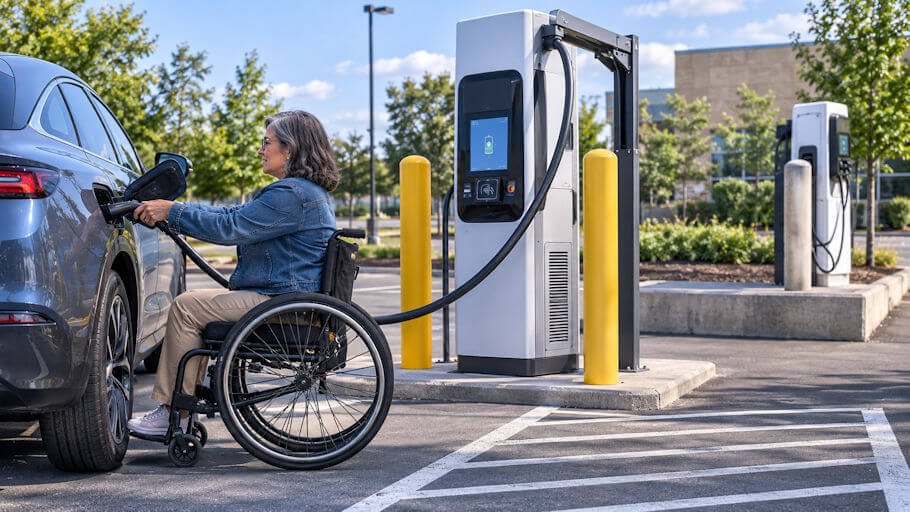
An accessible parking space only has to let a person get in and out of a vehicle. A charging space asks for more. The Access Board points out that a driver with a disability must exit the vehicle, travel to the charger, and carry the connector back to the charging inlet, which may be on the opposite side from the door they use. Because there is no standard inlet location, the driver needs room to move around the entire vehicle (U.S. Access Board, 2023).
There is a second difference. Gas stations sometimes have an attendant who can help, while EV charging stations are usually unattended, so the equipment has to work for a person on their own.
The Most Common Barriers
- Curbs and raised islands. Chargers installed on top of or behind a curb leave a wheelchair user unable to get close enough to reach the screen, card reader or connector.
- Bollards and wheel stops. Protective posts placed directly in front of a charger block the clear ground space a wheelchair needs.
- Heavy, short cables. Fast charger cables have become thicker and shorter to carry more power, which makes them hard to lift and carry for anyone with limited strength or who is pushing a wheelchair with both hands.
- Connectors that need grip. Many connectors require the user to grasp the handle and press a release button with the thumb at the same time.
- High screens and controls. Displays and payment readers are often above the reach of a seated person.
- Narrow spaces. Standard-width bays leave no room to open a door fully, deploy a ramp or pass between the vehicle and the charger.
- App-only payment and audio-only or color-only signals, which shut out some drivers who are deaf, hard of hearing or color blind.
- Weather and surfaces. Gravel, slopes, plowed snow and unlit sites all add difficulty, and black cables left in strong sun can burn people with reduced sensation.
What U.S. Law Requires Today
The ADA Standards do not mention EV chargers by name, but that does not exempt them. The Access Board states that entities covered by the Americans with Disabilities Act or the Architectural Barriers Act must still provide charging stations that are accessible to and usable by people with disabilities, applying existing rules for ground surfaces, clear floor space, reach ranges, operable parts and accessible routes (U.S. Access Board, 2023).
Two other laws apply in particular cases. Section 508 of the Rehabilitation Act covers the screens and payment systems on chargers that federal agencies buy or use. The Architectural Barriers Act applies to facilities built with certain federal funds, which the Access Board notes includes chargers funded through the National Electric Vehicle Infrastructure program.
The Access Board's Design Recommendations
In partnership with the Department of Transportation, the Access Board published a technical assistance document, last updated in July 2023, that turns those general rules into specific guidance. Its main recommendations for chargers that serve people who use mobility devices are:
- A vehicle charging space at least 11 feet wide and 20 feet long, with an adjoining access aisle at least 5 feet wide running the full length of the space.
- The charger installed at the same level as the charging space, not on or behind a curb. Where a curb cannot be avoided, operable parts should be no more than 10 inches from the face of the curb.
- Clear ground space of at least 30 inches by 48 inches at the charger, positioned for a side approach, with no bollards, wheel stops, grass or curbs inside it.
- All operable parts, including the connector handle and release button, card reader and emergency stop, no higher than 48 inches above the ground.
- Connectors and controls usable with one hand, with no tight grasping, pinching or twisting of the wrist and no more than 5 pounds of force.
- Cables on heavier fast chargers able to reach a vehicle parked at least 5 feet away, with cable management that keeps slack off the ground and out of the access aisle.
- At least 98 inches of vertical clearance on the route to an accessible charging space inside a parking garage, to suit wheelchair accessible vans.
- For pull-through layouts similar to a gas station, a charging lane at least 16 feet wide.
The document also recommends shelters, good lighting and bollards in place of wheel stops, and it advises against converting existing accessible parking spaces into charging spaces, since that can leave a site short of the accessible parking it is required to provide.
The Proposed Federal Rule
Recommendations are not enforceable, so on September 3, 2024, the Access Board published a notice of proposed rulemaking to add EV charging stations to the ADA and ABA Accessibility Guidelines. The comment period closed on November 4, 2024 (Architectural and Transportation Barriers Compliance Board, 2024). Key features of the proposal include:
- A minimum number of accessible charging spaces based on the size of the station, starting with one where a station has 1 to 25 charging spaces and two where it has 26 to 50, counted separately for each charger type.
- Accessible charging spaces at least 132 inches wide and 240 inches long, with a 5-foot access aisle and slopes no steeper than 1:48.
- International Symbol of Accessibility signage on accessible charging spaces.
- An accessible route from the charging spaces to the entrance of the facility they serve.
- Communication features on every charger, including volume control, status indicators that can be perceived by sight and by sound or touch, and information that does not depend on color.
The Board also asked for comment on an alternative "use last" approach, in which a larger number of accessible spaces would be provided but not reserved, with other drivers asked to use them only when no other charger is free.
Two points about timing matter. First, Access Board guidelines become binding on businesses and state and local governments only after the Department of Justice and the Department of Transportation adopt them in their own standards. Second, at the time of writing in November 2026 the proposal had not been published as a final rule. Until it is, the existing ADA and ABA requirements and the 2023 recommendations remain the working reference for designers.
Communication Access at the Charger
Physical reach is only half of the picture. A charger is also a payment terminal and an information display. The Access Board recommends that every charger, not only those in accessible spaces, have screens visible from a seated height of 40 inches, tactile controls, contactless payment that gives both visual and audible confirmation, and a help function that works by text as well as voice. Websites and mobile apps used to find chargers and start a session should meet recognized digital accessibility standards. The Board also suggests that charging networks publish specific accessibility details for each charger, such as which side the access aisle is on and whether the cable is long enough to reach any inlet position, instead of a single "accessible" label.
The United Kingdom's PAS 1899 Standard
The United Kingdom addressed the issue through a voluntary specification. PAS 1899:2022, published by the British Standards Institution in October 2022 and sponsored by the Motability charity and the government's Office for Zero Emission Vehicles, sets out requirements for accessible public chargepoints, covering the space around the charger, the height of screens and sockets, cable weight and handling, and the information given to users. The work followed research estimating that there could be 2.7 million disabled drivers or passengers in the UK by 2035, with about half of them partly or wholly reliant on public charging. Because the standard is voluntary, it does not bind chargepoint operators, and a later BSI review looked at how the specification was working in practice.
Other Disability Issues Raised by Electric Vehicles
Quiet Vehicles and Pedestrians With Vision Loss
Electric motors are close to silent at low speed, which removes the sound cue that blind and low vision pedestrians rely on at crossings and in parking lots. U.S. federal safety rules now require hybrid and electric vehicles to emit an alert sound at low speeds. The subject is covered in more depth in our article on EV noise and pedestrian safety.
Wheelchair Accessible Electric Vehicles
Most wheelchair accessible vans are built by lowering the floor of a standard minivan. In many EVs the battery pack sits under the floor, which makes that conversion harder and has limited the choice of accessible electric models. Purpose-built electric platforms with flat floors are beginning to reach the market, but drivers who need a ramp and a lowered floor still have far fewer electric options than other buyers.
Charging at Home
Home charging avoids many public charging barriers, since the cable is lighter and the equipment can be mounted at whatever height suits the user. It is not available to everyone. Renters and people in apartment buildings, a group that includes many disabled people, often cannot install a charger and depend on the public network. The Access Board notes that chargers at privately owned housing are not covered by the ADA, although multifamily housing may be subject to the Fair Housing Act.
Automatic and Wireless Charging
The most promising long-term fix removes the cable altogether. Automatic connection devices and wireless inductive charging would let a driver charge without leaving the vehicle. The Access Board encourages their use, particularly for fleets, while cautioning that drivers with disabilities should not be limited to slower chargers in the meantime.
Practical Tips for Drivers With Disabilities
- Before buying, note where the charging inlet is and try plugging in from your own wheelchair, scooter or standing position at a public fast charger, not only at the dealership.
- Use charging apps that show user photos of each site, which reveal curbs, bollards and bay widths that listings leave out.
- Where your vehicle and network support it, set up plug-and-charge so that a session starts and bills automatically without using the screen.
- Report blocked or broken accessible chargers to the operator using the number on the unit. Operators track these reports, and repeated ones prompt site changes.
- If a charger at a business or public facility cannot be used because of its design, raise it with the site owner as an ADA access issue.
More on this topic: Adaptive Driving Publications | Private Transport Publications | Accessibility Publications
Frequently Asked Questions
Can a driver without a disability placard use an accessible EV charging space?
It depends on the signs at the site and on state and local law. Some accessible charging spaces are reserved for placard or plate holders, while others are marked as accessible but open to any EV driver, so check the posted sign before plugging in.
Can a power wheelchair or mobility scooter be charged at an EV charging station?
No. Power wheelchairs and mobility scooters use their own low-voltage battery chargers that plug into an ordinary household outlet, and they are not compatible with the connectors or power levels of electric car charging stations.
Can hand controls be fitted to an electric vehicle?
In most cases, yes. Hand controls, left-foot accelerators, steering aids, and similar equipment can be installed in many electric models by a qualified mobility equipment dealer, although it is wise to confirm compatibility for the exact model before buying.
Are some charging connectors lighter and easier to handle than others?
Yes. Connector size and weight vary by type and by charging speed, and slower AC chargers generally have much lighter cables than high-power DC fast chargers, so trying each type before relying on it is worthwhile.
Can a tenant with a disability ask a landlord to allow a home EV charger?
A tenant can ask, and in the United States fair housing law may give people with disabilities a right to make reasonable modifications in some housing, usually at their own expense. The answer depends on the property and local rules, so local fair housing advice is recommended.
Who should I contact about an EV charger I cannot use because of my disability?
Start with the charging network using the help number on the unit, then the owner of the site. If the barrier is not fixed, a complaint about a business or state or local government facility can be filed with the U.S. Department of Justice under the ADA.
Does snow or ice affect access to EV chargers?
Yes. Snow piled in access aisles or around a charger can make it unreachable for people who use wheelchairs or walkers, so site owners are advised to keep charging spaces, aisles, and routes clear and not to use them for snow storage.
Can a passenger or companion plug in the vehicle for a disabled driver?
Yes, anyone can connect the vehicle, and many drivers rely on a companion. Accessibility rules are written so that a driver with a disability can charge independently, because help is not always available at unattended stations.
References
- U.S. Access Board. (2023, July 17). Design recommendations for accessible electric vehicle charging stations. https://www.access-board.gov/tad/ev/
- Architectural and Transportation Barriers Compliance Board. (2024, September 3). Americans with Disabilities Act and Architectural Barriers Act accessibility guidelines; EV charging stations: Notice of proposed rulemaking. Federal Register, Vol. 89, No. 170. https://www.federalregister.gov/documents/2024/09/03/2024-18820/americans-with-disabilities-act-and-architectural-barriers-act-accessibility-guidelines-ev-charging
- British Standards Institution. (2022). PAS 1899:2022 Electric vehicles - Accessible charging - Specification.
- British Standards Institution. Accessible electric vehicle chargepoints: A review of PAS 1899:2022 summary report. https://knowledge.bsigroup.com/articles/accessible-electric-vehicle-chargepoints-a-review-of-pas-1899-2022-summary-report
- Disabled World. The Sound of Silence: Inside EV Noise Pollution. https://www.disabled-world.com/disability/publications/journals/ev-noise.php
Insights, Analysis, and Developments
Editorial Note: Electric vehicle charging is a rare case where the accessibility problem was visible before most of the infrastructure was built, and it was largely built inaccessibly anyway. A great many public chargers went into the ground on raised islands and behind posts during the years when the only federal guidance was advisory, and each of those sites will be expensive to correct. The lesson is an old one in disability policy, which is that voluntary guidance tends to arrive on time and enforceable rules tend to arrive late. There is also a fairness question that will sharpen as more of the vehicle market turns electric. A driver who cannot use a public charger and cannot install one at a rented apartment has no practical way into electric motoring at all. Whether the next generation of chargers includes wider bays, lighter cables and automatic connection will show how much of this was learned.
 Author Credentials: Ian C. Langtree is a writer, editor, and the founder and Editor-in-Chief of Disabled World, which he established in 2004 as one of the longest-running independent resources for disability news and information. Over more than two decades, he has written and edited thousands of articles on disability rights, health, accessibility, and assistive technology. Drawing on a global perspective shaped by extensive travel and lived experience, Ian is a committed advocate of the Social Model of Disability, the framework developed by disabled activists in the 1970s that focuses on removing societal barriers rather than on individual impairments. His writing is grounded in that framework and in a lasting commitment to disability rights, accessibility, and social inclusion. To learn more about Ian's background, expertise, and accomplishments, visit his full biography.