The Sound of Silence: Inside EV Noise Pollution
Author: Ian C. Langtree - Writer/Editor for Disabled World (DW)
Published: 14 Jul 2026 - Updated: 7 Aug 2026
Publication Type: Paper, Essay
Table of Contents:
Synopsis - Definition - Overview - FAQs - Insights, Updates - Related Content
Synopsis
Electric cars were supposed to make our streets calmer, and in many ways they have - but their near-total silence created a problem nobody expected, forcing composers, engineers, and disability advocates into an unlikely alliance to decide what a quiet car should actually sound like. This paper unpacks the strange new science of manufactured vehicle sound: the laws that require it, the wildly different tunes that BMW, Nissan, Jaguar, Ford, and Porsche have chosen, and the sharp human tension at its heart, where the same synthetic hum that saves a blind pedestrian's life can overwhelm a listener who cannot bear the noise.
At a Glance
- 1 - A Toyota Prius in electric mode was detectable to listeners only about two seconds before arrival, roughly 58 feet of warning at 20 miles per hour.
- 2 - Jaguar scrapped its first I-PACE sound because pedestrians heard the sci-fi tone and instinctively looked up at the sky instead of at the road.
- 3 - In testing, a two-tone alert produced the highest stress and annoyance ratings while adding no extra safety over gentler options.
Topic Definition
- Electric Car (EV) Noise Pollution
Electric car noise pollution refers to the unwanted or intrusive sound associated with electric vehicles, a term that cuts two ways. It describes the safety hazard created by their near silence at low speed, which strips pedestrians of the audible cues they use to sense approaching traffic, and it also describes the artificial alerting sounds that regulators now require these vehicles to emit, which add new electronic tones to the environment that some listeners, particularly those with heightened sound sensitivity, experience as genuinely disruptive.
Overview
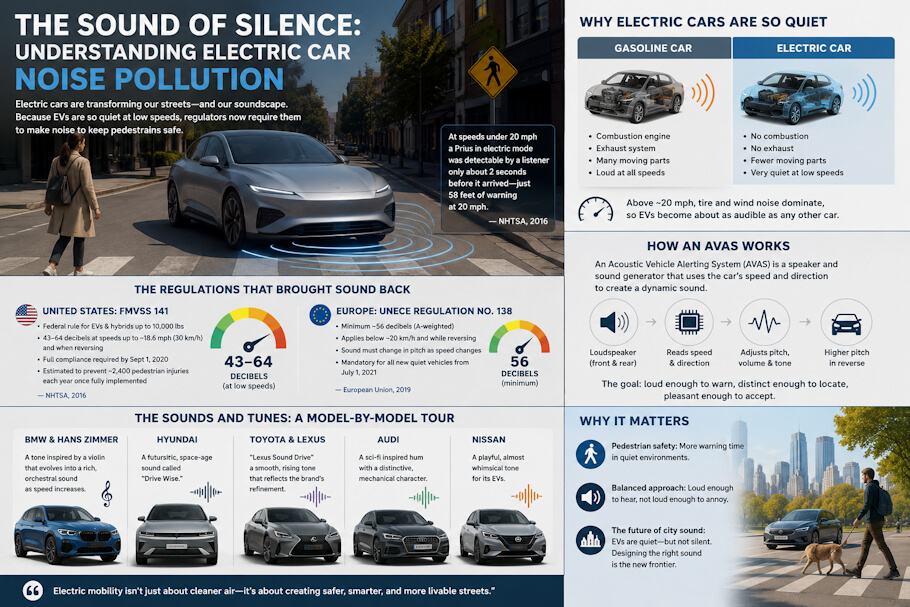
The Sound of Silence: Understanding Electric Car Noise Pollution
For more than a century, the approach of a car announced itself. The rumble of pistons, the hiss of an exhaust, and the low growl of an idling engine told pedestrians, cyclists, and drivers exactly where a vehicle was and how fast it was moving. Electric cars changed that overnight. An electric vehicle (EV) gliding along a residential street at low speed can be almost completely silent, and that silence has forced regulators, engineers, and disability advocates to ask a strange new question: how much noise should a quiet car be required to make? The answer has produced one of the most unusual design fields in modern transport, in which film composers, acoustic engineers, and safety researchers now argue over the pitch, tone, and character of sounds that did not exist a decade ago.
Why Electric Cars Are So Quiet
A conventional car is loud because combustion is loud. Thousands of controlled explosions every minute drive the engine, and the resulting mechanical and exhaust noise radiates in every direction. An electric motor has no combustion, few moving parts, and no exhaust, so at low speeds it produces only a faint electronic whir. Research supporting the United States sound rule found that a Toyota Prius operating in electric mode at speeds under 20 miles per hour was detectable by a listener only about two seconds before it arrived, which at 20 miles per hour translates to roughly 58 feet of warning distance [NHTSA, 2016]. Above roughly 20 miles per hour, tire noise and aerodynamic wind noise begin to dominate, and an EV becomes about as audible as any other car. The danger zone is therefore the low-speed environment - parking lots, driveways, crosswalks, and quiet neighborhood streets - which is exactly where pedestrians and vehicles mix most closely.
The Regulations That Brought Sound Back
Because the risk is real and measurable, lawmakers on both sides of the Atlantic decided that near-silent vehicles must be given an artificial voice. The technology that produces this voice is called an Acoustic Vehicle Alerting System, usually shortened to AVAS. Rather than leaving the choice to manufacturers, regulators set out minimum sound levels, frequency content, and the speeds at which the sound must play.
United States: FMVSS 141
In the United States the relevant rule is Federal Motor Vehicle Safety Standard No. 141, often called the Quiet Car standard. It grew out of the Pedestrian Safety Enhancement Act of 2010, which directed the National Highway Traffic Safety Administration to close the silent-car gap. Under the standard, hybrid and electric vehicles weighing up to 10,000 pounds must emit sound in a defined band of roughly 43 to 64 decibels when traveling at speeds up to about 18.6 miles per hour (30 kilometers per hour) and when reversing [NHTSA, 2016]. The agency reasoned that faster vehicles already make enough tire and wind noise to be heard. Full compliance was required for the covered fleet by September 1, 2020. NHTSA estimated that once every hybrid and electric vehicle on the road met the rule, it would prevent roughly 2,400 pedestrian injuries each year [NHTSA, 2016].
Europe: UNECE Regulation No. 138
Europe reached a similar conclusion through United Nations Economic Commission for Europe Regulation No. 138, adopted into European Union law. It requires an AVAS on new electric and hybrid types, with the mandate extending to all newly registered quiet vehicles from July 1, 2021. The European rule sets a minimum sound level of about 56 decibels (A-weighted), close to the hum of a household refrigerator, and caps the maximum so the sound does not become a nuisance. Crucially, the European system must operate at speeds below about 20 kilometers per hour and while reversing, and the emitted sound must change in pitch as the vehicle changes speed so that a listener can judge whether a car is accelerating or slowing [European Union, 2019]. This requirement that the sound track the vehicle's behavior, rather than simply play a fixed tone, is one reason EV sounds are so distinctive.
How an AVAS Actually Works
An AVAS is essentially a weatherproof loudspeaker, usually mounted low at the front of the car and sometimes at the rear, driven by a small sound generator wired into the vehicle's control system. The system reads the car's speed and direction and plays a synthesized sound whose pitch, volume, and texture shift accordingly. Accelerate, and the tone climbs; slow down, and it falls; shift into reverse, and many cars switch to a distinct pulsing or higher-pitched signal so the movement is unmistakable. The regulations require that this behavior mimic the intuitive cues people already associate with an approaching engine, which is why designers speak of pitch shift and frequency content rather than simply choosing a nice noise. The engineering brief is narrow and demanding: the sound has to be loud enough to warn, distinct enough to locate, gentle enough not to annoy, and pleasant enough that owners will not resent it.
The Sounds and Tunes: A Model-by-Model Tour
Within those legal boundaries, carmakers have taken strikingly different creative paths. Some hired film composers and music producers, others leaned on in-house acoustic teams, and the results range from orchestral swells to sci-fi hums. The examples below show how varied the field has become.
BMW and Hans Zimmer
BMW turned to Academy Award winning film composer Hans Zimmer, whose scores include several major Hollywood soundtracks, to create BMW IconicSounds Electric for models such as the i4 and iX [BMW Group, 2020]. The design begins with a tone that resembles a violin and then transforms into a higher, more complex structure as the car accelerates, with the harmony shifting in stages as speed increases. The same core sound that fills the cabin also forms the basis of the external pedestrian warning, so the character a driver hears inside is echoed, in a form tuned for safety, to people outside. BMW M performance models receive a more aggressive variant intended to convey power.
Nissan Canto
Nissan named the alerting sound in the Leaf Canto, from the Latin for I sing. Developed by sound designers and engineers in Japan and adapted at Nissan's European technical center, Canto rises and falls in tone and pitch depending on whether the car is accelerating, holding speed, decelerating, or reversing, so that its behavior carries information as well as warning [Nissan, 2021]. The intent was a sound that feels helpful and calm rather than alarming.
Jaguar I-PACE
The Jaguar I-PACE offers one of the most instructive case studies in AVAS design. Jaguar's engineers first experimented with futuristic, science-fiction style tones, but testing revealed an unexpected problem: pedestrians hearing the sound instinctively looked up at the sky rather than toward the road, because the noise did not read as a car [Jaguar Land Rover, 2018]. That approach was abandoned. Jaguar then worked with members of Guide Dogs for the Blind to develop a sound that is audible and locatable yet discreet, and the company reported tuning the system so that it can be heard clearly at the front of the vehicle without radiating excessive noise into the surrounding neighborhood.
Ford Mustang Mach-E
Ford collaborated with audio company Harman, and reporting on the project connected recording artist and producer T-Pain to the effort, to craft the exterior alert for the Mustang Mach-E. Owners have described the result in terms ranging from a modern hum to a spaceship-like tone, and the sound can be managed through the vehicle's driver assistance and EV sound menus, though the legally required pedestrian alert cannot simply be disabled at will.
Porsche Taycan and the European Producers
Porsche gives the Taycan an optional Electric Sport Sound that dramatizes the car's performance character, layered on top of a standard pedestrian protection system that meets the legal requirement and cannot be switched off. Other European brands took a similar tack: manufacturers including Volkswagen worked with well-known producers and sound designers to give models such as the ID.3 a signature acoustic identity, treating the mandated warning as a branding opportunity as much as a safety feature. The trend has drawn some criticism, discussed below, from those who worry that branding ambitions can pull designers away from the human-centered needs the sounds are meant to serve.
When Silence Is the Danger: EVs and Disability
The entire regulatory effort exists because silence is not neutral - it is dangerous for the people who rely most on hearing. Pedestrians who are blind or have low vision often cross streets and judge traffic gaps by ear, listening for the presence, direction, and speed of approaching cars. A near-silent vehicle removes that information. In a controlled study, researchers found that adding an artificially generated alert sound significantly improved the ability of blind pedestrians to detect a hybrid vehicle and to do so sooner, giving them more time to react [Kim et al., 2012]. Surveys of the blind and low-vision community have found that a large share of respondents report a collision or near-collision with a quiet vehicle, underscoring that the concern is lived experience and not merely theoretical.
Crash data reinforce the point. Analyses by the National Highway Traffic Safety Administration found that hybrid electric vehicles were meaningfully more likely than comparable gasoline vehicles to be involved in pedestrian crashes during exactly the low-speed situations where engine noise would normally provide warning. The largest differences appeared during low-speed maneuvers such as slowing, stopping, backing up, and turning, where a hybrid was roughly twice as likely to be involved in a pedestrian crash as an internal combustion vehicle [Wu, Austin, and Chen, 2011]. Independent insurance research pointed in the same direction, reporting higher rates of pedestrian injury claims for hybrids than for conventional cars [HLDI, 2011]. Guide dogs add another wrinkle: a trained dog listens for traffic as part of its work, and a silent car undermines the animal's cues as much as the handler's, which is why organizations for the blind pressed hard for minimum sound rules and were consulted directly in the design of systems such as Jaguar's.
When Sound Is the Danger: Sensory Overload and Noise Annoyance
Yet the same solution that protects one group of people can burden another, and this is where the debate becomes genuinely difficult. Artificial vehicle sounds are, by design, new noise added to the environment. For people with heightened sound sensitivity the effect can be overbearing on the senses. Decreased tolerance for sound is common among autistic people and among those who experience hyperacusis, a condition in which ordinary sounds are perceived as uncomfortably or painfully loud, or misophonia, in which specific sounds trigger strong distress. An electronic tone that repeats every time a car creeps through a parking lot, or a chorus of different manufacturers' AVAS signals layered together at a busy crossing, can be far more taxing for these listeners than a single familiar engine ever was.
There is early experimental support for treating annoyance as a real design variable rather than an afterthought. A study examining the effects of low-level EV noise, including several common AVAS sound types, on attention, physiological arousal measured through electrodermal activity, perceived workload, and annoyance found that responses differed sharply depending on the sound, with a two-tone AVAS producing the highest arousal, mental demand, and annoyance ratings among those tested [The Journal of the Acoustical Society of America, 2025]. In plain terms, some warning sounds are measurably more stressful than others while providing no extra safety, which suggests real room to choose gentler options. Acousticians also caution about low-frequency content: poorly designed sounds can add persistent low-frequency noise to otherwise quiet residential areas, the kind of drone that is hard to locate and slow to fade. Because road traffic already accounts for the great majority of urban noise pollution, critics argue that mandated EV sounds should be held to a careful standard so that the cure for silence does not quietly reintroduce the very noise electrification promised to remove.
Designing Sound for Everyone
The tension between these two groups - people who need the sound and people who are overwhelmed by it - is the central design problem of AVAS, and it explains why the rules are so specific. A good alerting sound has to satisfy several competing demands at once. It must be easy to detect against city background noise, easy to localize so a listener can tell where the car is, informative so its rising or falling pitch signals acceleration or braking, and restrained so it does not saturate a quiet street or distress sensitive listeners. Jaguar's decision to test with blind pedestrians and guide dog users, and to reject a sound that made people look at the sky, is a template for how this balance can be struck through real user testing rather than studio taste [Jaguar Land Rover, 2018]. Some researchers and advocates argue that manufacturers should resist the pull toward flashy, branded signatures and instead prioritize functional, human-centered clarity, particularly for blind and low-vision pedestrians who depend on the sound most. As the vehicle fleet electrifies and combustion noise fades from towns and cities, the acoustic character of the street will increasingly be a designed choice rather than an accident of engineering, and getting that choice right matters for safety, for comfort, and for the growing number of people whose daily mobility depends on it.
Conclusion
Electric car noise pollution is a paradox wrapped in a policy. The silence of electric propulsion is one of its quiet triumphs, promising cities freed from the relentless growl of combustion, and yet that same silence had to be partly undone to keep vulnerable pedestrians safe. The result is a new and still-maturing craft of automotive sound, governed by decibel limits and speed thresholds, populated by everything from Hans Zimmer's evolving harmonies to Nissan's singing Canto, and pulled between the blind pedestrian who cannot afford to miss an approaching car and the sound-sensitive listener for whom every artificial tone is a small assault. The models on the road today represent a first draft of how the electric street should sound, and the best of them show that safety and serenity need not be enemies. The task now is to refine these voices so they warn without wearing people down.
References:
- BMW Group. (2020). New soundscapes for pure electric driving pleasure: BMW IconicSounds Electric [Press release]. BMW Group PressClub.
- European Union. (2019). Regulation (EU) No. 540/2014 on the sound level of motor vehicles and UNECE Regulation No. 138 on Acoustic Vehicle Alerting Systems. Official Journal of the European Union.
- Highway Loss Data Institute. (2011). Effect of hybrid vehicles on pedestrian and bicyclist related injuries. HLDI Bulletin, 28(11).
- Jaguar Land Rover. (2018). Sound of Jaguar I-PACE protects road users [Press release]. JLR Media Newsroom.
- Kim, D. S., Emerson, R. W., Naghshineh, K., Auer, J., and Graves, K. (2012). Impact of adding artificially generated alert sound to hybrid electric vehicles on their detectability by pedestrians who are blind. Journal of Rehabilitation Research and Development, 49(3), 381 - 394.
- National Highway Traffic Safety Administration. (2016). Federal Motor Vehicle Safety Standard No. 141: Minimum sound requirements for hybrid and electric vehicles (Final rule). U.S. Department of Transportation.
- Nissan Motor Corporation. (2021). The Nissan LEAF Canto acoustic vehicle alerting system.
- The Journal of the Acoustical Society of America. (2025). Effects of low-level electric vehicle noise on attention, electrodermal activity, workload, and annoyance. The Journal of the Acoustical Society of America, 159(1), 285.
- Wu, J., Austin, R., and Chen, C.-L. (2011). Incidence rates of pedestrian and bicyclist crashes by hybrid electric passenger vehicles: An update (DOT HS 811 526). National Highway Traffic Safety Administration.
Frequently Asked Questions
Can drivers turn off an electric car's pedestrian warning sound?
No. In the United States and Europe the low-speed alert is required by law, so it cannot be permanently switched off. Some cars let owners pick between approved sound profiles or adjust an optional sport sound, but the mandated pedestrian warning stays active at low speed.
Do hybrid cars have to make the same sounds as fully electric cars?
Yes, when they can run silently. The rules apply to any vehicle that can move on electric power alone at low speed, so plug-in hybrids and conventional hybrids in electric mode must also carry an acoustic alerting system.
Do electric scooters, bikes, and motorcycles need AVAS?
Generally no. Current minimum-sound rules focus on cars, vans, and buses. Most electric bicycles, scooters, and many motorcycles fall outside the requirement, though some regulators are studying whether faster electric motorcycles should be included.
Can EV owners customize or download their own alert sound?
Only within limits. A few manufacturers offer a menu of approved external sounds or updatable cabin tones, but owners cannot legally load any sound they like for the pedestrian warning, because it must still meet the loudness, frequency, and pitch-shift standards set by regulators.
Do electric cars actually reduce a city's overall noise pollution?
On balance, yes. Because alert sounds only play at low speed and are capped in volume, EVs remain far quieter than combustion cars at cruising speeds, so wide adoption is expected to lower total traffic noise, provided the alerts avoid low-frequency drone.
Are electric vehicle warning sounds the same in every country?
No. The United States standard and the United Nations regulation used across Europe and many other regions share similar goals but differ in exact decibel levels, speed thresholds, and test methods, so the same model may be tuned differently depending on where it is sold.
Insights, Analysis, and Developments
Editorial Note: The electric street is still being tuned, and the sounds rolling out of showrooms today are only a first draft of a soundscape that every one of us will live inside for decades - which is precisely why the quiet debate over how loud a quiet car should be deserves far more attention than it gets.
 Author Credentials: Ian is the founder and Editor-in-Chief of Disabled World, a leading resource for news and information on disability issues. With a global perspective shaped by years of travel and lived experience, Ian is a committed proponent of the Social Model of Disability, a transformative framework developed by disabled activists in the 1970s that emphasizes dismantling societal barriers rather than focusing solely on individual impairments. His work reflects a deep commitment to disability rights, accessibility, and social inclusion. To learn more about Ian's background, expertise, and accomplishments, visit his full biography.