Teen Founder Builds Four Accessible Technology Platforms
Author: Shriyan Avadhanula
Published: 30 Sep 2026
Publication Type: Paper, Essay
Table of Contents:
Synopsis - Definition - Overview - FAQs - Insights, Updates - Related Content
Synopsis
This information comes from Shriyan Avadhanula, a 16-year-old student and technology builder in Virginia. In it he describes four projects he has built, each aimed at a different barrier to participation. Scholark is a free college-planning platform that has served more than 10,000 users. Capital Mastery offers 16 finance career pathways and more than 80 free credentials. DataShadow is a personal-data model, backed by a U.S. provisional patent filing, that is built around informed and reversible consent. OpenLens evaluates smart glasses through simulation, digital twins, and local-first testing. All four projects start from one question: who is being left out by the way a system is built right now? The piece is useful because it goes beyond general statements about inclusion. It names specific failure points, including missing captions, poor color contrast, inaccessible spreadsheets, timed tasks, and devices marketed as accessible that were never tested by disabled users. Students with disabilities, their families, older adults weighing assistive wearables, and anyone concerned about how health or accommodation data is handled will find practical points here. The author is also candid about the limits of his own work, and his projects have been covered by outlets including The Times of India and Government Technology.*
At a Glance
- 1 - Scholark is a free college-planning platform serving more than 10,000 users.
- 2 - Capital Mastery offers 16 finance career pathways, more than 80 free credentials, simulations, assessments, and professional-development resources.
- 3 - DataShadow began with my filing of a U.S. provisional patent and is being developed around personal control, transparency, and informed consent.
- 4 - OpenLens explores smart-glasses technology through simulation, evaluation, digital twins, and local-first development.
- 5 - I have completed more than 30 credentials and professional programs with organizations such as JPMorgan Chase, Goldman Sachs, Anthropic, IBM, OpenAI, Microsoft, Bank of America, Citi, and Mastercard.
- 6 - My projects and story have appeared in more than 20 national and international media articles.
Topic Definition
- Inclusive Technology Design
Inclusive technology design is the practice of building digital tools, platforms, and devices so that people with a wide range of abilities, incomes, ages, and circumstances can use them without extra barriers. It covers technical accessibility, such as screen reader and keyboard support, captions, alternative text, sufficient color contrast, plain language, and forms that prevent errors. It also covers broader access: affordability, device compatibility, low connectivity requirements, flexible pacing, and privacy protections that let people control how their personal information is used. The approach treats accessibility as an ongoing process rather than a one-time feature. Products are tested with the people they are meant to serve, especially disabled users, and improved based on what that testing shows, rather than being called accessible because of a design intention or a marketing claim
Overview
Four Platforms, One Principle: Building Technology Around Access, Independence, and Control
At 16, I have built four technology initiatives addressing distinct barriers to accessibility, including college guidance, financial education, data control, and the evaluation of emerging smart-glasses technology. Scholark, Capital Mastery, DataShadow, and OpenLens may appear different, but they adhere to a single philosophy: technology should increase the participation and empowerment of the many.
For disabled users especially, accessibility cannot be an afterthought; it has to define how technology is designed, tested, explained, and improved.
One Question Behind Four Different Projects
The four projects I am building address various areas of life but began with the same question:
Who is being excluded by the way the technology or system is currently built?
Sometimes exclusion is clear: a student cannot afford a college-planning service, a person is unable to pursue a profession because of costly or inflexible training, or someone's sensitive information is collected without being meaningfully understood or controlled.
Sometimes exclusion is hidden: a keyboard user is unable to navigate a page, a video lacks captions, an interface is unnecessarily complicated, colors do not have sufficient contrast, or a device is promoted as accessible but has not been tested by the community it hopes to serve.
Technology can exclude, but it also has the potential to open doors. That is why I increasingly see accessibility not as a feature, but as a responsibility.
Scholark: Making College Guidance Accessible to All
Scholark is a free, end-to-end college-planning platform that has served more than 10,000 users, bringing together academic planning, admissions preparation, GPA evaluation, standardized testing, essays, and college decision-making.
I built Scholark after realizing that the information students seek is often fragmented across dozens of websites, hidden behind paywalls, or unnecessarily confusing.
This can compound challenges for disabled students and family members who may need to navigate college applications while also considering additional factors such as accommodations, assistive technology, medical considerations, transportation, and campus accessibility.
College guidance should not require repeated searching or wading through disconnected content simply to understand what to do next. That is why I built Scholark.
My experience shows that while removing a paywall or restriction is valuable, information must also be organized and presented clearly, simply, and accessibly across devices and methods of interaction.
A resource is not truly accessible simply because it is free.
Capital Mastery: Turning Financial Education Into Action
Capital Mastery focuses on another type of access: the ability to transition from learning about a career to actually practicing it.
The platform contains 16 finance career pathways, more than 80 free credentials, simulations, assessments, technical exercises, Excel-based tasks, and professional-development resources. It is intended to provide a more structured and practical way of learning about the profession.
Traditional professional preparation often involves expensive programs, networking opportunities, selective admission, or a need to learn under strict conditions. These requirements can create difficulties for many students.
A digital platform can offer flexibility, but it has to be deliberately designed. Long pages, unclear explanations, inaccessible spreadsheets, time restrictions on tasks, and poor feedback can become barriers.
Capital Mastery is not only about the breadth of opportunities it provides. It is also about preparing someone to join a firm while helping that firm better onboard and train new employees.
DataShadow: Beginning With Ownership and Consent
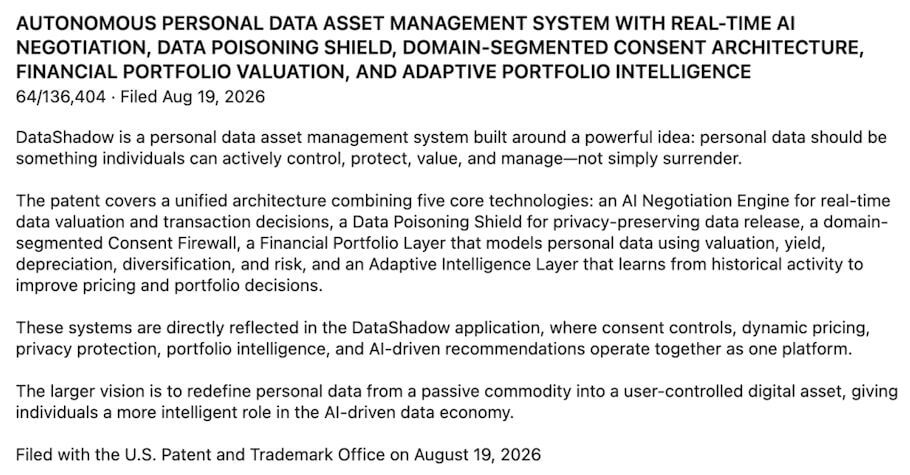
Before developing DataShadow as a platform, I filed a U.S. provisional patent with five claims covering its underlying approach.
DataShadow explores a personal-data model in which individuals can better understand, manage, and control how - and whether - their information is shared or used.
The principles of transparency, permission, security, and choice are critical for a personal-data system. However, these principles are especially important for data concerning disability, health, accommodations, location, communication, or assistive-technology use.
This information may be used to personalize services, but it may also expose someone to discrimination, unwanted disclosure, or decisions they cannot easily stop or understand.
A culture of consent cannot rely on a single checkbox or a privacy policy that few people read. Consent must be specific, informed, and reversible. People must be able to understand what information is held, why it is held, and what can happen if they withdraw their consent.
DataShadow is an evolving project, and complex questions concerning legality, technology, security, and accessibility still have to be addressed.
Filing a provisional patent was an early step. The platform will only add value if the protections it offers are easy to understand and use for the people whose information is involved.
OpenLens: Evaluating Smart Glasses Beyond the Marketing
OpenLens explores emerging smart-glasses technology through a lens simulator, device diagnostics, digital twins, and local-first experimentation.
Smart glasses have tremendous accessibility potential. Depending on the device and software, they could eventually offer visual interpretation, navigation assistance, reminders, hands-free communication, live transcription, object recognition, or access to information without requiring a person to hold a phone.
However, potential should not be mistaken for reality.
A device may offer impressive hardware but still be uncomfortable, unaffordable, difficult to control, dependent on constant internet connectivity, or unreliable in practice.
Battery life, weight, heat, privacy, latency, prescription-lens compatibility, audio quality, and the placement of physical controls can all affect how accessible a device is.
My work with OpenLens has also led to an invitation to one of the world's largest AI and augmented-reality smart-glasses conferences in Shenzhen, China, a major electronics-manufacturing center. Such an opportunity can offer a deeper look at how these devices are designed and built.
The most credible accessibility assessment will always involve disabled users with different needs, environments, and experiences.
Accessibility Must Be Earned
One of the most important lessons I have learned from building these projects is that accessibility cannot be achieved on paper or assumed. A platform or product must be tested, evaluated, and improved.
Calling something inclusive does not make it so. It has to be examined for screen-reader and keyboard compatibility, captioned videos, alternative text for images, sufficient contrast for text and controls, simple language, manageable cognitive load, and appropriate labels and error prevention for forms.
Accessibility also includes affordability, privacy, device compatibility, connection requirements, flexible pacing, and the ability to complete a task without unnecessary help.
I do not claim that every aspect of every project is accessible to every user. In fact, I believe accessibility is an ongoing process of testing, listening, identifying problems, and making improvements.
Disabled people should not only be able to provide feedback. They should help determine what is being built, how it is being built, and what is being measured for success.
What Building for Access Has Taught Me at 16
Although I am 16, my work has already required me to think critically about education, financial opportunity, data ownership, cybersecurity, accessibility, and the responsibilities that come with building technology for others.
While developing these projects, I have completed more than 30 credentials and professional programs with organizations such as JPMorgan Chase, Goldman Sachs, Anthropic, IBM, OpenAI, Microsoft, Bank of America, Citi, and Mastercard.
My learning has covered artificial intelligence, cybersecurity, financial analysis, risk, operations, product development, and responsible technology.
I have also gained practical experience with penetration testing, vulnerability management, information-security frameworks, business continuity, and cyber-risk assessment through IBM. Through professional mentorship in mergers and acquisitions, I have learned how firms evaluate businesses, financial performance, transactions, and opportunities.
That learning has been applied to actual work - not only through coursework, but through projects that are making an impact.
Scholark has served more than 10,000 users seeking free college-planning resources. Capital Mastery offers 16 finance career pathways, more than 80 free credentials, simulations, assessments, and employer-facing training materials. I filed a U.S. provisional patent before developing DataShadow around personal-data ownership and informed consent. OpenLens has grown from a technical project into an opportunity to engage with the international smart-glasses industry.
My work and story have also appeared in more than 20 national and international media articles. Coverage has included The Times of India, Government Technology, Times Now World, Eenadu, and publications in the United States, India, Africa, and Latin America.
Such recognition has allowed more people to discover the projects, but it has also reinforced an important lesson: recognition is not the same as impact.
A platform should ultimately be judged by whether it is useful, responsible, understandable, and worthy of the trust people place in it. Credentials and media appearances can show the seriousness with which I have approached this work, but neither can replace actual decisions, results, or community feedback.
These experiences have not made me omniscient. They have shown me how much thought goes into technology that can affect someone's education, financial future, privacy, independence, or ability to participate.
Credibility is not granted by credentials. It has to be earned through actual work, honesty, learning, and listening - especially to people whose experiences differ from my own.
Building Technology That Widens Participation
Scholark, Capital Mastery, DataShadow, and OpenLens operate in different domains:
- Scholark addresses accessibility in education.
- Capital Mastery addresses accessibility in professional preparation.
- DataShadow addresses visibility and control over personal information.
- OpenLens addresses how emerging hardware can be evaluated and improved.
Together, they represent the type of technology I want to continue building: technology that can reduce barriers to participation rather than increase them.
At 16, the most important lesson I have learned is that innovation cannot begin with what technology can do. It has to begin with who it can help, what barriers it can overcome, and how responsibly it can be built.
Technology should expand participation and empower the many - not the few.
That standard is much more difficult than simply building another platform. It is also exponentially more meaningful.
Explore the Platforms by Shriyan
- Scholark - Free college-planning platform
- Capital Mastery - Finance career pathways and free credentials
- DataShadow - Personal-data ownership and consent
- OpenLens - Smart-glasses simulation and evaluation

Shriyan Avadhanula is a 16-year-old student, founder, and technology builder based in Virginia. He created Scholark, Capital Mastery, DataShadow, and OpenLens, with work spanning education, finance, personal-data control, cybersecurity, artificial intelligence, and emerging smart-glasses technology.
Shriyan has completed more than 30 credentials and professional programs with organizations such as JPMorgan Chase, Goldman Sachs, Anthropic, IBM, OpenAI, Microsoft, Bank of America, Citi, and Mastercard. His projects and story have appeared in more than 20 national and international media articles.
Contact Shriyan: avadhanula.shriyan@gmail.com - LinkedIn
Frequently Asked Questions
NOTE: Researched FAQs by Disabled World (DW)
What accessibility standard should websites and learning platforms follow?
Most organizations follow the Web Content Accessibility Guidelines, known as WCAG, published by the World Wide Web Consortium. Version 2.2 at the AA level is the widely used benchmark and covers text alternatives, keyboard access, color contrast, captions, readable content, and predictable navigation.
How can disabled students request accommodations when applying to or attending college?
Students usually register with the college disability services office and provide documentation of their condition. Accommodations for standardized tests such as the SAT and ACT are requested separately through the testing organization, well before the test date.
Can smart glasses help people who are blind or have low vision?
Some smart glasses and paired apps can read text aloud, describe scenes, identify objects, and connect users to sighted assistants through video calls. Results vary widely by device, lighting, connectivity, and software, so hands-on trials before buying are strongly recommended.
What is a U.S. provisional patent application?
A provisional patent application sets an early filing date with the U.S. Patent and Trademark Office for up to 12 months. It is not examined and does not become a patent on its own. The inventor must file a full nonprovisional application within that year to pursue patent protection.
What is informed consent in the context of personal data?
Informed consent means a person clearly understands what data is collected, why it is collected, who can access it, and how long it is kept before agreeing. Meaningful consent should be specific to each use, freely given, and easy to withdraw later.
Is disability or health information protected under U.S. privacy law?
Protection depends on who holds the data. HIPAA covers health providers and insurers, and the ADA limits how employers handle medical information. Many apps and websites fall outside these laws, although some states, including California, Colorado, and Washington, have added rules for sensitive health data.
What does local-first mean for assistive technology?
Local-first software processes and stores data on the user's own device rather than relying on a remote server. For assistive tools this can mean faster response times, continued function without an internet connection, and less exposure of personal information to outside companies.
How can someone test whether a website works with a keyboard alone?
Put the mouse aside and use the Tab key to move forward, Shift plus Tab to move back, and Enter or Space to activate items. Every link, button, and form field should be reachable in a logical order with a clearly visible focus indicator, and no element should trap the cursor.
Insights, Analysis, and Developments
Editorial Note: It is rare to see a young founder put his own limits in writing, and that is the most useful part of this account. Credentials from major banks and technology firms, along with coverage in more than 20 media outlets, would be easy to lead with. Instead, the author keeps returning to one point: a platform earns trust through testing, listening, and correcting mistakes, not through press attention. This matters to disabled people because they are often invited to give feedback only after a product is already built. The author argues that they should help decide what gets built and how its success is measured. This applies directly to smart glasses and personal-data systems, where weight, battery life, latency, offline reliability, and the risk of exposing disability or health information can make the difference between a helpful tool and a new source of harm. Developers, educators, and policymakers can use the piece as a practical checklist. Readers who rely on assistive technology can use it as a reminder to ask who tested a product before they trust the label on the box.*
* Editorial additions by Ian C. Langtree.