Adult Changing Stations: Laws, Standards and Locations
Author: Ian C. Langtree - View Credentials
Published: 14 Nov 2026
Publication Type: Informative
Table of Contents:
Synopsis - Definition - Overview - FAQs - Insights, Updates - Related Content
Synopsis
This information explains what adult changing tables and universal changing stations are, why ordinary accessible restrooms do not meet the needs of people who require help with toileting, and which laws and building standards now address the gap. It draws on primary sources, including a 2026 U.S. Access Board rulemaking notice, the 2024 International Building Code, and government announcements from the United Kingdom, rather than on secondhand summaries. The central finding is that the federal ADA accessibility guidelines have never required an adult-size changing surface, so coverage in the United States depends on a mix of newer building codes, state statutes, and an airport requirement that begins in fiscal year 2030. That matters to wheelchair users, older adults, people with developmental disabilities, and the family members and paid caregivers who assist them, because without a suitable table the only option is often a restroom floor. The page is useful for families planning travel or a day out, for seniors and people with disabilities who need assisted care away from home, and for venue owners and advocates who want to know what a compliant installation involves .
At a Glance
- 1 - California passed AB 662, one of the earliest U.S. adult changing station laws, in 2015.
- 2 - The model standard calls for a changing surface at least 70 inches long and 30 inches wide that can support 400 pounds.
- 3 - England has required Changing Places toilets in many large new public buildings since 2021, supported by a 30 million pound fund for existing buildings.
- 4 - Under the 2024 International Building Code, the accessible route to a required station cannot pass through a security checkpoint and cannot be longer than 2,000 feet.
Topic Definition
- Adult Changing Station
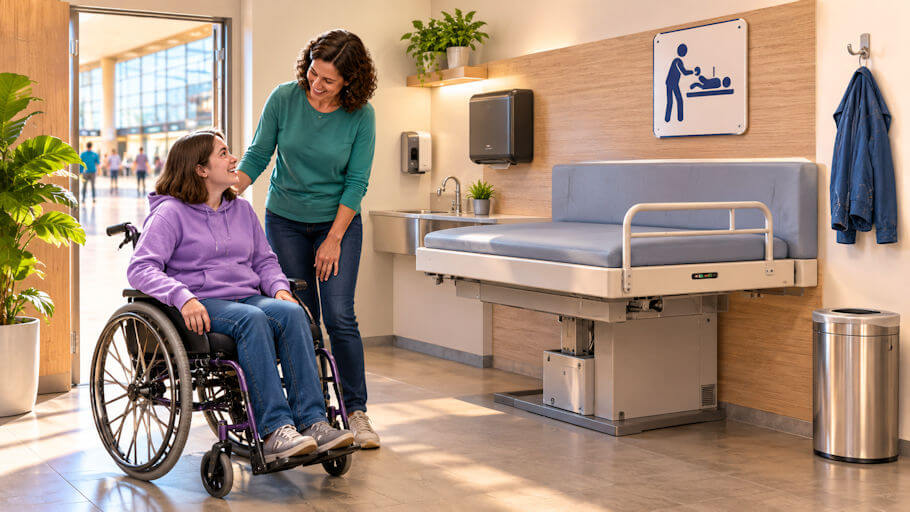
An adult changing station, also called a universal changing station or adult changing table, is a height-adjustable, adult-size table installed in a private restroom or dedicated room so that a person who cannot use a toilet independently can be changed and cared for lying down by a caregiver. It is built to hold the weight of a teenager or adult, lowers far enough for a transfer from a wheelchair, and rises to a working height that protects the caregiver's back. The room around it provides space for a wheelchair and helper, a sink, and waste disposal, and in some countries a ceiling hoist as well. The term covers the table, the room, and the growing body of building codes and laws that specify where such facilities must be provided.
Overview
An accessible restroom stall gives a wheelchair user room to turn, grab bars, and a toilet at a usable height. What it does not give is anywhere to lie down. For a teenager with cerebral palsy, an adult with a spinal cord injury, or an older person with advanced dementia who cannot transfer to a toilet, that missing surface decides whether a trip to the mall, the stadium, or the airport is possible at all. Adult changing tables, also called universal changing stations, fill that gap, and laws and building codes are slowly starting to require them.
What Is an Adult Changing Station?
The U.S. Access Board describes a universal changing table as a table on which a person with a disability receives help from a caregiver with toileting. That can mean changing incontinence garments or dressings, managing a colostomy bag or catheter, or other personal and medical care (U.S. Access Board, 2026). The tables are larger and stronger than baby changing stations, adjust in height, and are placed in a private room with enough space for a wheelchair and at least one helper.
People who use them include wheelchair users, older adults, and children, teens and adults with developmental disabilities. Many also rely on adult incontinence products, which cannot be changed safely while seated or standing.
Why Standard Accessible Restrooms Fall Short
The ADA and ABA Accessibility Guidelines were last revised in 2004. They set requirements for toilet rooms, compartments, lavatories and sinks, but they contain no specific requirements for adult changing tables (U.S. Access Board, 2026). A restroom can therefore meet every requirement of the Americans with Disabilities Act standards and still leave a family with no option except the floor.
The Access Board is direct about the consequences. Lying on a restroom floor raises obvious dignity and hygiene problems, and moving a person between a wheelchair and the floor is difficult and risks injury to both the person and the caregiver. A UK government statement lists what families do instead: limiting fluids to avoid needing a toilet, sitting in soiled clothing until they get home, lifting a relative manually, or simply cutting outings short (Ministry of Housing, Communities and Local Government, 2020).
The Technical Standard: ICC A117.1 Section 613
The main U.S. technical reference is Section 613 of ICC A117.1-2017 with Supplement 1, the accessibility standard published by the International Code Council. It was written by a working group of committee members, manufacturers, disability advocates and an Access Board representative that met every two weeks for about nine months and reviewed laws then moving through 12 U.S. states and one Canadian province (U.S. Access Board, 2026). Its main requirements for the table and room include:
- A changing surface at least 70 inches by 30 inches, made of durable, non-porous material.
- Height adjustment from 17 inches to 38 inches above the floor, so a person can transfer from a wheelchair at the low position and a caregiver can work without bending at the high position.
- A weight capacity of at least 400 pounds applied at any point on the surface.
- A side rail that can be raised and locked, and lowered out of the way for transfers.
- Clear floor space of at least 36 inches along one long side and one short end of the table.
- A soap dispenser, hand towel dispenser or dryer, coat hook, waste receptacle, and a sign at the entrance identifying the adult changing station.
Where a table is added to a multi-user restroom, privacy has to be provided by walls, curtains or partitions.
Where the 2024 International Building Code Requires Them
The 2024 International Building Code (IBC) is the first edition of the model code to require adult changing stations. Section 1110.4 applies to new construction in these settings:
- Assembly and mercantile buildings, such as theaters, arenas, museums, casinos and shopping malls, where six or more male and female water closets are required in total.
- College and university buildings where 12 or more water closets are provided on a floor.
- Schools with an assembly use, such as a gymnasium, that requires six or more water closets.
- Highway rest stops and service plazas.
The IBC is a model code. It only takes effect when a state or local government adopts it, and it applies to new buildings and some renovations, not to existing buildings as they stand. Adoption dates vary widely, so a venue built last year in one state may have no obligation that a similar venue in the next state does.
U.S. Federal Law: Airports From Fiscal Year 2030
The FAA Reauthorization Act of 2024 created the first federal requirement. Beginning in fiscal year 2030, medium and large hub airports that apply for airport development grants must give written assurance that they will install or maintain at least one private, single-user room with a universal changing station in each passenger terminal building (49 U.S.C. 47107(y)).
The Act also directs the Access Board to write design standards for the tables and for the privacy, accessibility and sanitation equipment of the rooms. The Board published an advance notice of proposed rulemaking on February 18, 2026, with comments due by April 20, 2026. It is weighing whether to adopt Section 613.4 of ICC A117.1 by reference or to write its own standard, whether table height should be continuously adjustable, and whether the door must lock from the inside. The Board has stated that this rulemaking is limited to the airport requirement and will not extend adult changing tables to other places (U.S. Access Board, 2026). For families who fly, this is likely to be the most visible change to accessible air travel facilities in years.
State Laws and State Building Codes
Because federal law is narrow, states have moved on their own. California's AB 662 requires adult changing stations in commercial places of public amusement such as large theaters, sports arenas and amusement parks. Arizona's statute, A.R.S. 41-1444, addresses changing stations suitable for adults in certain public buildings, and New Hampshire's RSA 155:80 covers universal changing stations. Other states that have enacted statutes or building code provisions include Alabama, Arkansas, Hawaii, Illinois, Maryland, Minnesota, Ohio, Rhode Island, Tennessee and Utah, and bills have been introduced elsewhere.
The details differ from state to state. Some laws cover only government buildings, some only large entertainment venues, and some apply only to new construction or renovations above a cost threshold. Anyone relying on a state rule should read the statute itself or contact the state building code office.
The Changing Places Model in the UK and Australia
The United Kingdom's Changing Places standard goes further than the U.S. model. A Changing Places toilet is a room of about 12 square meters with an adult-size changing bench, a hoist, a privacy curtain and space for caregivers. The ceiling hoist is the key difference, because it removes manual lifting altogether.
Building rules in England now require these rooms in new or substantially refurbished public buildings above set sizes, including assembly and entertainment venues with capacity for 350 or more people, shopping centers of 30,000 square meters or more, sport and leisure buildings over 5,000 square meters, and stadiums, theme parks and zoos with capacity above 2,000. The government estimated that more than 250,000 people in the UK need these facilities and that numbers had grown from 140 rooms in 2007 to more than 1,400 by 2020 (Ministry of Housing, Communities and Local Government, 2020). Australia's National Construction Code has required comparable accessible adult change facilities in certain large public buildings since 2019.
How to Find an Adult Changing Station
There is no single official U.S. directory yet, so finding a station takes some planning:
- Check advocacy maps. Volunteer campaigns in the United States maintain state-by-state maps of known universal changing tables, and the UK and Australian Changing Places programs run searchable national maps.
- Ask the venue directly. Airports, stadiums, theme parks, children's hospitals and large museums are the most likely locations. Guest services can confirm whether the table is powered, its weight limit, and whether a key or staff member is needed.
- Look at airport accessibility pages. Several large U.S. airports installed stations ahead of the 2030 requirement and list them by terminal.
- Check highway rest areas and service plazas, which a number of state transportation departments have upgraded.
- Ask about first aid rooms. Where no dedicated station exists, a venue's medical room sometimes has a height-adjustable treatment table and a door that closes.
These steps are worth adding to any accessible travel plan, alongside the usual checks on step-free access and parking.
Asking a Venue or Local Government to Install One
Most existing installations began with a request from a parent or caregiver. A request is easier to act on when it is specific: point to ICC A117.1 Section 613 as the design reference, identify an existing family or single-user restroom with enough floor area, and explain who in the community would use it. At the state level, the practical route is the building code board. Asking it to adopt the 2024 IBC provisions makes the requirement automatic for new large buildings and takes the burden off individual families.
Frequently Asked Questions
Can an older child or adult use a baby changing station?
No. Baby changing stations are built and tested for infants and toddlers, and each unit carries a manufacturer weight limit that an older child or adult will exceed, which creates a risk of collapse and injury.
Is a ceiling hoist required with an adult changing table in the United States?
The U.S. model standard concentrates on the table, the clear space around it, and the room fittings, and it does not generally require a ceiling hoist. A hoist is a standard feature of the Changing Places design used in the United Kingdom and Australia.
Can a business get tax relief for installing an adult changing station?
Possibly. Eligible small businesses in the United States may be able to claim the federal Disabled Access Credit for access-related spending, and businesses of any size may be able to use the barrier removal tax deduction, so it is worth asking a tax professional before starting work.
Who is responsible for cleaning an adult changing table?
The venue that provides the table is responsible for cleaning and maintaining it, in the same way as any other restroom fixture. Many caregivers also carry disinfectant wipes and a disposable or washable pad to cover the surface.
What should a caregiver bring when using a public adult changing station?
Useful items include a disposable or washable underpad, gloves, wipes, a change of clothing, sealable bags for soiled items, and any sling or transfer aid the person normally uses, because public rooms rarely supply them.
Are portable adult changing facilities available for outdoor events?
Yes. Mobile units built into trailers or vehicles, fitted with a changing bench and often a hoist, can be hired for festivals, fairs, and sporting events, and some event organizers now list them in their accessibility information.
Is there a standard sign or symbol for adult changing stations?
There is no single symbol used across the United States. Building codes call for a sign at the room entrance stating that an adult changing station is provided, while the United Kingdom and Australia use a registered Changing Places logo.
Do adult changing tables fold away when not in use?
Many do. Wall-mounted models fold up against the wall to keep the floor space clear for wheelchair turning, and freestanding or mobile models are also sold, with height adjustment that is usually powered by an electric motor.
References
- Architectural and Transportation Barriers Compliance Board. (2026, February 18). Accessibility standards for universal changing stations: Advance notice of proposed rulemaking. Federal Register, 91 FR 7412. https://www.federalregister.gov/documents/2026/02/18/2026-03199/accessibility-standards-for-universal-changing-stations
- FAA Reauthorization Act of 2024, H.R. 3935, 118th Congress. https://www.congress.gov/bill/118th-congress/house-bill/3935/text
- International Code Council. (2024). 2024 International Building Code, Chapter 11: Accessibility. https://codes.iccsafe.org/content/IBC2024P1/chapter-11-accessibility
- International Code Council. (2024). ICC A117.1-2017 with Supplement 1: Standard for Accessible and Usable Buildings and Facilities, Section 613.
- Ministry of Housing, Communities and Local Government. (2020, July 19). Changing Places toilets for severely disabled people to be compulsory in new public buildings. GOV.UK. https://www.gov.uk/government/news/changing-places-toilets-for-severely-disabled-people-to-be-compulsory-in-new-public-buildings
- California Legislature. (2015). Assembly Bill 662, 2015-2016 Regular Session.
- Arizona Revised Statutes, Section 41-1444.
- Disabled World. Accessibility: Disability Access Information. https://www.disabled-world.com/disability/accessibility/
More on this topic: Accessibility Publications | Caregivers Publications | Air Travel Publications
Insights, Analysis, and Developments
Editorial Note: The story of the adult changing table is a reminder that accessibility law tends to describe the person its drafters had in mind, and in 1990 that person could get from a wheelchair to a toilet. Everyone who could not was left out of the measurements, and for three decades families worked around the omission with picnic blankets on tiled floors and trips timed to the hour. What has changed is less the technology, since a height-adjustable table is not complicated, than who is in the room when codes are written, as parents and caregivers have spent years in code hearings and statehouses making the case. The progress so far is uneven. A new arena in one state must provide a station while an identical arena across the state line need not, and existing buildings are almost entirely untouched. The airport rule in 2030 will be the first time many travelers see one of these rooms, and it may do more than any statute to make them an expected part of a public building instead of a favor a venue chooses to grant.
 Author Credentials: Ian C. Langtree is a writer, editor, and the founder and Editor-in-Chief of Disabled World, which he established in 2004 as one of the longest-running independent resources for disability news and information. Over more than two decades, he has written and edited thousands of articles on disability rights, health, accessibility, and assistive technology. Drawing on a global perspective shaped by extensive travel and lived experience, Ian is a committed advocate of the Social Model of Disability, the framework developed by disabled activists in the 1970s that focuses on removing societal barriers rather than on individual impairments. His writing is grounded in that framework and in a lasting commitment to disability rights, accessibility, and social inclusion. To learn more about Ian's background, expertise, and accomplishments, visit his full biography.