Cognitive Debt: How AI and Thinking Affect Disability
Author: Ian C. Langtree - Writer/Editor for Disabled World (DW)
Published: 21 Mar 2026 - Updated: 24 Aug 2026
Publication Type: Scholarly Paper
Table of Contents:
Synopsis - Definition - Overview - FAQs - Insights, Updates - Related Content
Synopsis
This paper examines cognitive debt, the gradual erosion of mental capacity that occurs when thinking patterns either drain cognitive resources without benefit or let critical reasoning skills weaken through disuse, and it traces the term across two fields that rarely speak to one another: clinical neuroscience and artificial intelligence research. Key facts include the origin of the idea in a 2015 paper by Natalie Marchant and Robert Howard in the Journal of Alzheimer's Disease, brain imaging evidence from a 2020 study of 360 older adults linking repetitive negative thinking to amyloid and tau buildup, and a 2025 MIT Media Lab preprint that recorded up to 55 percent lower neural connectivity among people who wrote essays with ChatGPT compared with those who used no tools at all. This affects a broad audience - students, workers, aging adults facing rising dementia rates, and especially people with cognitive, learning, and neurodivergent disabilities for whom AI is often an essential accommodation rather than a shortcut. It matters because both the clinical and technology models rest on the same well supported neurological principle, that cognitive capacity is built or diminished by how the brain is used over time, and the paper is careful to apply that principle without stigmatizing disabled people who rely on assistive tools. The discussion is authoritative and useful because it draws directly on peer reviewed research, distinguishes clearly between settled findings and preliminary evidence, notes that the MIT study has not yet been peer reviewed, and connects the science to practical questions of cognitive accessibility, masking, autistic burnout, and inclusive design that seniors and disabled readers can act on.
At a Glance
- 1 - The term was first proposed in a 2015 clinical paper by Natalie Marchant and Robert Howard. They framed it as the opposite of cognitive reserve, the neurological buffer that delays dementia symptoms.
- 2 - In a 2020 study of 360 older adults, higher repetitive negative thinking predicted greater memory decline. Those participants also showed more amyloid and tau deposits, the biological hallmarks of Alzheimer's disease.
- 3 - A 2025 MIT Media Lab study used EEG to track 54 people writing essays with ChatGPT, a search engine, or no tools. ChatGPT users showed neural connectivity up to 55 percent lower than the no-tools group.
- 4 - For many neurodivergent people, masking neurotypical behavior carries a heavy cognitive cost that can lead to autistic burnout. This sustained self-monitoring can itself be understood as a hidden form of cognitive debt.
Topic Definition
- Cognitive Debt
Cognitive debt is the gradual erosion of mental capacity that results from patterns of thought or behavior that either deplete cognitive resources without productive return or allow critical thinking skills to weaken through disuse. In clinical neuroscience, the term refers to the cumulative neurological damage caused by repetitive negative thinking - persistent rumination and worry common across depression, anxiety, and chronic stress - which may reduce the brain's resilience to conditions like Alzheimer's disease. In the context of technology and artificial intelligence, cognitive debt describes the long-term cost to a person's independent thinking ability that comes from habitually offloading reasoning and problem-solving to AI tools instead of performing those tasks themselves. In both cases, the core principle is the same: cognitive capacity is not fixed but is built or diminished by how we use our minds over time, and shortcuts that save mental effort today may quietly compromise cognitive function in the future.
Overview
Cognitive Debt: What It Is, Why It Matters, and How It Relates to Disability
The phrase "cognitive debt" has surfaced in two very different fields over the past decade, yet the underlying concern is remarkably similar in both cases. Whether researchers are talking about the long-term brain health consequences of chronic negative thinking or the intellectual toll of outsourcing our reasoning to artificial intelligence, the core idea is the same: certain habits of mind - or the absence of them - can quietly erode our cognitive capacity over time. What makes the concept especially important right now is the speed at which AI tools are being adopted in workplaces, classrooms, and daily life, alongside an aging global population facing unprecedented rates of dementia.
This paper examines cognitive debt from both angles, explores where the two interpretations overlap, and considers what the concept means for people living with disabilities or cognitive differences.
Origins of the Term
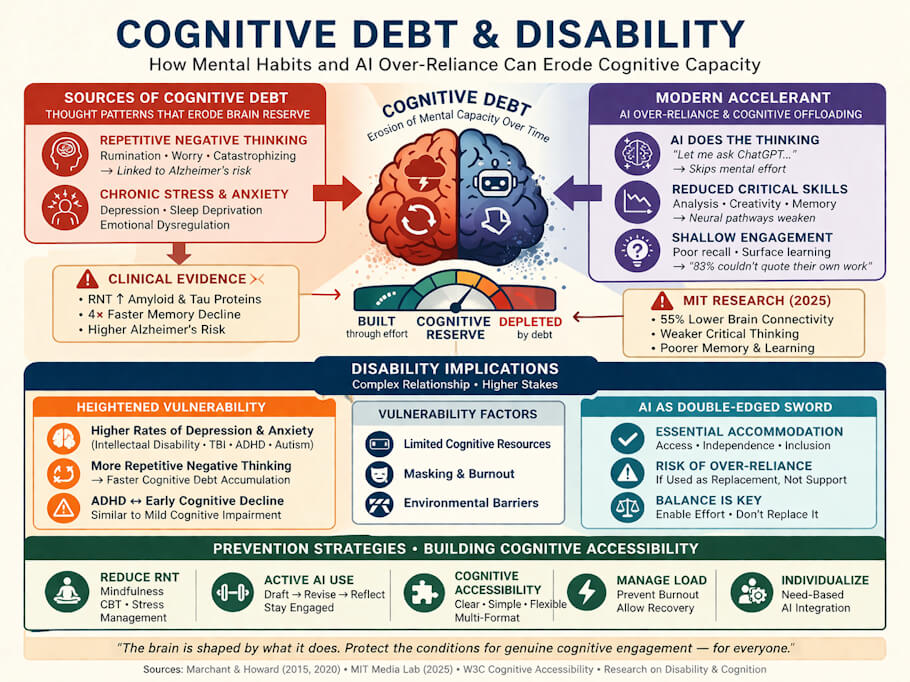
Cognitive debt did not begin as a technology buzzword. It was first proposed in a clinical context by Natalie Marchant and Robert Howard in a 2015 paper published in the Journal of Alzheimer's Disease. Marchant and Howard framed cognitive debt as the opposite of cognitive reserve - the well-established idea that education, intellectually stimulating work, and social engagement build a kind of neurological buffer that delays the onset of dementia symptoms. If cognitive reserve is the savings account, cognitive debt is the credit card bill. It represents the cumulative damage caused by psychological and behavioral patterns - depression, anxiety, chronic stress, sleep disorders, and neuroticism - that wear down the brain's resilience over time [Marchant and Howard, 2015].
The mechanism Marchant and Howard identified as the common thread running through all of these risk factors is repetitive negative thinking, or RNT. This is the clinical term for the kind of persistent rumination and worry that loops through the mind without resolution - rehashing past failures, anticipating future disasters, cycling through the same distressing scenarios again and again. RNT is not simply feeling sad or anxious. It is a measurable cognitive process that transcends the boundaries of any single diagnosis and appears across depression, generalized anxiety disorder, post-traumatic stress disorder, and insomnia alike [Ehring and Watkins, 2008].
Evidence from Brain Imaging Studies
The cognitive debt hypothesis gained significant empirical support in 2020, when Marchant and colleagues published the results of a study involving 360 older adults drawn from two cohort projects - PREVENT-AD in Canada and IMAP+ in France. Participants completed questionnaires measuring their levels of repetitive negative thinking, depression, and anxiety. A subset also underwent PET brain scans to measure deposits of amyloid beta and tau proteins, the biological hallmarks of Alzheimer's disease. The findings were striking. Individuals who scored higher on measures of RNT showed greater cognitive decline over a four-year period, with specific declines in memory - an early marker of Alzheimer's. They also had more amyloid and tau deposits in their brains. Notably, while depression and anxiety were associated with cognitive decline, they were not independently linked to amyloid or tau buildup in the same way that RNT was [Marchant et al., 2020].
This distinction matters because it suggests that the act of repetitive negative thinking itself - rather than the broader emotional state that accompanies it - may be the mechanism doing the most damage. As Marchant explained in a subsequent commentary, RNT could be the "active ingredient" within depression and anxiety that actually increases Alzheimer's risk [Marchant, 2020]. If that is the case, then interventions that specifically target repetitive thinking patterns, such as cognitive behavioral therapy and mindfulness-based approaches, could potentially reduce dementia risk even in people who continue to experience some level of depression or anxiety.
Cognitive Debt in the Age of AI
The second major use of "cognitive debt" emerged roughly a decade later, in an entirely different context. In 2025, researchers at the MIT Media Lab published a preprint titled "Your Brain on ChatGPT: Accumulation of Cognitive Debt when Using an AI Assistant for Essay Writing Task." Led by Nataliya Kosmyna, the study used electroencephalography to monitor the brain activity of 54 participants while they wrote essays under three conditions: using ChatGPT, using a search engine, or using no external tools at all. The results were dramatic. Participants who wrote without any tools showed the strongest and most broadly distributed neural connectivity, particularly in brain regions associated with critical thinking, creativity, and memory formation. Search engine users showed moderate engagement. ChatGPT users exhibited the weakest neural connectivity of the three groups - up to 55 percent lower than the no-tools group [Kosmyna et al., 2025].
Perhaps even more telling was what happened during the fourth session, when participants were switched. Those who had been writing with ChatGPT and were then asked to write without it struggled noticeably - their thinking had not been deeply engaged during the earlier sessions, so they had little to fall back on. Meanwhile, participants who had built up their own cognitive muscles by writing independently were able to transition smoothly to using ChatGPT as a complement rather than a replacement. The researchers also found that 83 percent of ChatGPT users could not accurately quote a single sentence from the essays they had just written, suggesting a profound absence of engagement with their own work [Kosmyna et al., 2025].
The MIT team used the term "cognitive debt" to describe how AI tools spare users mental effort in the short term but generate long-term costs including diminished critical thinking, reduced creativity, increased vulnerability to bias, and shallow information processing. The analogy to technical debt in software engineering is deliberate. Technical debt accumulates when developers take shortcuts that work in the moment but create maintenance problems later. Cognitive debt works the same way: each time a person lets an AI handle a thinking task they could have done themselves, they miss the neurological exercise that would have strengthened those capacities.
Where the Two Frameworks Converge
At first glance, the clinical model of cognitive debt and the technology model may seem to have little in common. One is about negative thought patterns eroding brain resilience. The other is about the atrophy of thinking skills through disuse. But both rest on the same neurological principle: cognitive capacity is not fixed. It is shaped by what we do with our minds over time. Just as physical muscles grow stronger with use and weaker with neglect, neural pathways are strengthened by effortful mental engagement and weakened by its absence.
In the clinical model, repetitive negative thinking consumes cognitive resources without producing adaptive outcomes - the mental equivalent of running a motor without ever engaging a gear. Over years and decades, this wasted effort depletes the brain's reserve capacity, leaving it more vulnerable to the effects of Alzheimer's pathology. In the technology model, the problem is not wasted effort but absent effort. When an AI system handles the reasoning, planning, synthesizing, and evaluating that a person's brain would otherwise perform, the brain simply does not get the workout it needs to maintain and develop those skills. The result in both cases is the same: a gradual erosion of cognitive function that may not be immediately apparent but compounds over time.
Cognitive Debt and Cognitive Disabilities
The relationship between cognitive debt and disability is complex and runs in multiple directions. For people with existing cognitive disabilities - whether resulting from intellectual disability, traumatic brain injury, neurodegenerative conditions like Alzheimer's, or developmental conditions affecting information processing - cognitive debt can be both a risk factor and a complicating element.
Consider the clinical model first. Individuals with cognitive disabilities are often more vulnerable to the conditions that generate cognitive debt. Depression, for instance, is significantly more common among people with intellectual disabilities, traumatic brain injuries, and neurological conditions than in the general population. Anxiety disorders and sleep disturbances are similarly elevated. If these conditions increase cognitive debt through repetitive negative thinking - and the research suggests they do - then people with existing cognitive vulnerabilities are at heightened risk of further decline. The concern is especially acute for older adults with ADHD, whose lifelong difficulties with executive function and emotional regulation already overlap with the cognitive profile associated with mild cognitive impairment. Researchers have noted that ADHD and mild cognitive impairment can look remarkably similar in older adults, creating diagnostic confusion that may delay appropriate intervention [Soff et al., 2021].
The technology model introduces a different set of concerns. For many people with cognitive and learning disabilities, AI tools are not a luxury - they are a necessity. A person with dyslexia may rely on AI to help organize and proofread written work. Someone with ADHD may use AI to break complex tasks into manageable steps. A person with a traumatic brain injury may depend on AI-powered reminders and planning tools to manage daily life. In these contexts, AI is not replacing effortful thinking so much as making effortful thinking possible in the first place. The question of cognitive debt becomes more nuanced when the alternative to AI assistance is not independent effort but rather exclusion from the task altogether.
The Disability Paradox of AI Offloading
This creates what might be called a disability paradox within the cognitive debt framework. The MIT study and similar research implicitly frame cognitive offloading as a choice - a shortcut taken by people who could do the work themselves but prefer to let the machine handle it. For many disabled individuals, however, offloading is not a shortcut. It is an accommodation. And drawing a sharp line between healthy effortful thinking and unhealthy reliance on tools ignores the reality that many people operate with cognitive budgets that are already stretched thin.
A writer and advocate who publishes under the name "Autside" made this point forcefully in a 2025 critique of the MIT study, noting that the research never asks why people offload cognitive work in the first place. The reasons can include executive functioning challenges, language processing differences, educational trauma, chronic fatigue, and the sheer cognitive load of navigating environments not designed for neurodivergent minds [Autside, 2025]. In these situations, cognitive offloading is not a failure of discipline. It is a rational adaptation to a mismatch between the person's cognitive profile and the demands placed on them.
This does not mean cognitive debt is irrelevant for disabled people. It means the concept needs to be applied with care. There is a meaningful difference between using AI to handle tasks that are genuinely inaccessible without support and using AI to avoid the kinds of cognitive effort that would build and maintain valuable skills. A person with dyslexia who uses voice-to-text software to draft ideas and then actively revises and refines the output is engaging in substantial cognitive work. A student who pastes a prompt into ChatGPT and submits whatever comes back without reading it closely is not - regardless of whether that student has a disability.
Cognitive Load, Masking, and the Hidden Costs
There is another dimension of cognitive debt that is specific to the disability experience and rarely discussed in the mainstream research. Many neurodivergent individuals - particularly autistic people and those with ADHD - engage in a process known as masking, in which they consciously suppress their natural behaviors and communication styles in order to fit into neurotypical environments. Masking is cognitively expensive. It requires constant self-monitoring, real-time behavioral adjustment, and sustained attention to social cues that neurotypical people process automatically. Over time, the cumulative cost of masking can lead to autistic burnout - a state of profound physical and emotional exhaustion that often includes significant cognitive regression [Raymaker et al., 2020].
This burnout could reasonably be understood as a form of cognitive debt. The person has been spending cognitive resources on performance rather than on genuine learning, problem-solving, and personal development. When those resources run out - and they eventually do - the person is left not only exhausted but also with a diminished capacity for the cognitive tasks they actually care about. In this sense, the societal expectation that neurodivergent people should conform to neurotypical norms is itself a generator of cognitive debt, one that the current research frameworks have largely failed to account for.
Cognitive Accessibility and the Prevention of Debt
The concept of cognitive accessibility offers a useful bridge between disability advocacy and the prevention of cognitive debt. Cognitive accessibility, as defined by the World Wide Web Consortium's Cognitive and Learning Disabilities Accessibility Task Force, refers to the design of information, environments, and tools so that they can be effectively used by people with a wide range of cognitive abilities. This includes simplifying language, reducing unnecessary complexity, providing clear navigation, offering multiple formats for information, and allowing users to control the pace at which they engage with content [W3C, 2021].
When environments are cognitively accessible, everyone - disabled or not - is freed from the unnecessary mental effort of decoding poor design, wrestling with confusing interfaces, or managing information overload. That freed-up cognitive capacity can then be directed toward the effortful, meaningful thinking that builds rather than depletes cognitive reserve. In other words, cognitive accessibility is not just about inclusion. It is about creating the conditions in which cognitive debt is less likely to accumulate for anyone.
Consider a practical example. A university student with a processing speed difference is given a timed exam with dense, jargon-heavy questions. Much of the student's cognitive effort goes toward managing anxiety about the time limit and parsing unnecessarily complicated language - neither of which has anything to do with the knowledge being tested. That wasted effort is a form of cognitive debt generated by poor design. If the same exam used clear language and provided extended time, the student could direct all of their cognitive resources toward demonstrating their actual understanding, and the experience would reinforce rather than deplete their knowledge.
Implications for Policy and Practice
If cognitive debt is a real and measurable phenomenon - and the evidence from both clinical and technology research suggests it is - then several practical implications follow for how we approach disability, education, and technology design.
First, mental health interventions for people with cognitive disabilities should pay specific attention to repetitive negative thinking as a modifiable risk factor. Cognitive behavioral therapy and mindfulness-based interventions have demonstrated effectiveness in reducing RNT, and there is growing evidence that these approaches can be adapted for people with intellectual disabilities and other cognitive differences [Marchant and Howard, 2015]. Reducing RNT in these populations could offer protective benefits against further cognitive decline.
Second, the integration of AI tools in educational and workplace settings should be guided by thoughtful policies that distinguish between assistive use and replacement use. For individuals who need AI as an accommodation, the goal should be to maximize the person's active engagement with the task while minimizing the barriers that would otherwise make the task impossible. This is not a binary choice between full independence and full automation. It is a spectrum, and the right balance will differ for every individual.
Third, designers and policymakers should recognize that cognitive debt is not purely an individual problem. It is shaped by environments, systems, and expectations. When workplaces demand more cognitive output than any person can sustainably produce, people will offload to survive - and some will accumulate cognitive debt as a result. When educational systems fail to accommodate cognitive differences, students will either mask their way through or disengage entirely, both of which carry cognitive costs. Addressing cognitive debt at a structural level means designing systems that support genuine cognitive engagement rather than merely demanding more output.
Looking Ahead
The concept of cognitive debt is still relatively young, and much remains to be understood. The clinical model proposed by Marchant and Howard has been supported by promising but preliminary evidence, and the researchers themselves note that the causal direction is not yet firmly established - it is possible that early Alzheimer's pathology contributes to increased repetitive negative thinking rather than the other way around [Marchant et al., 2020]. The MIT study, meanwhile, was a preprint with a small sample size that has not yet undergone peer review, and its authors have cautioned against overinterpreting their results [Kosmyna et al., 2025].
Still, the underlying principle is well supported by decades of neuroscience: the brain is shaped by what it does. Effortful cognitive engagement builds capacity. Chronic stress, rumination, and passive reliance on external systems can diminish it. For people with disabilities, these dynamics are amplified by environmental barriers, social expectations, and the daily costs of navigating a world not designed for cognitive difference. Any serious reckoning with cognitive debt must account for these realities - not to excuse disengagement, but to understand its causes and design better alternatives.
The conversation about cognitive debt is ultimately a conversation about what kind of thinking we want to protect and how we ensure that everyone - regardless of ability, diagnosis, or neurological profile - has the opportunity and the support to do it.
References
- Autside. (2025). The MIT AI brain study didn't measure what it thinks it measured. Autside Substack.
- Ehring, T., and Watkins, E. R. (2008). Repetitive negative thinking as a transdiagnostic process. International Journal of Cognitive Therapy, 1(3), 192-205.
- Kosmyna, N., Hauptmann, E., Yuan, Y. T., Situ, J., Liao, X. H., Beresnitzky, A. V., Braunstein, I., and Maes, P. (2025). Your brain on ChatGPT: Accumulation of cognitive debt when using an AI assistant for essay writing task. arXiv preprint arXiv:2506.08872.
- Marchant, N. L. (2020). Dementia: Negative thinking linked with more rapid cognitive decline, study indicates. The Conversation.
- Marchant, N. L., and Howard, R. J. (2015). Cognitive debt and Alzheimer's disease. Journal of Alzheimer's Disease, 44(3), 755-770.
- Marchant, N. L., Lovland, L. R., Jones, R., Pichet Binette, A., Gonneaud, J., Arenaza-Urquijo, E. M., Chetelat, G., and Villeneuve, S. (2020). Repetitive negative thinking is associated with amyloid, tau, and cognitive decline. Alzheimer's and Dementia, 16(7), 1054-1064.
- Raymaker, D. M., Teo, A. R., Steckler, N. A., Lentz, B., Scharer, M., Delos Santos, A., Kapp, S. K., Hunter, M., Joyce, A., and Nicolaidis, C. (2020). "Having all of your internal resources exhausted beyond measure and being left with no clean-up crew": Defining autistic burnout. Autism in Adulthood, 2(2), 132-143.
- Soff, C., Sotnikova, A., Christiansen, H., Becker, K., and Siniatchkin, M. (2021). Mild cognitive impairment or attention-deficit/hyperactivity disorder in older adults? Overlapping cognitive profiles in clinical practice. Frontiers in Aging Neuroscience, 13, 737357.
- W3C. (2021). Cognitive accessibility at W3C. Web Accessibility Initiative.
Frequently Asked Questions
Is cognitive debt the same as technical debt in software
No, but the name is borrowed deliberately, since technical debt describes shortcuts that work now but create problems later, and cognitive debt applies the same logic to the human mind and its thinking capacity.
Can cognitive debt be reversed once it has built up
Research is still young, but the underlying neuroscience suggests the brain remains shapeable, and approaches that reduce repetitive negative thinking or restore active mental engagement may help rebuild cognitive capacity over time.
Does using AI tools always cause cognitive debt
No, the concern centers on passive reliance, since actively revising, questioning, and building on AI output keeps the brain engaged, while pasting a prompt and submitting the result without thought does not.
How is cognitive debt different from cognitive reserve
Cognitive reserve is the protective buffer built by education, stimulating work, and social engagement, whereas cognitive debt is the cumulative wear that depletes that buffer and leaves the brain more vulnerable.
What everyday habits may contribute to cognitive debt
Chronic rumination, poor sleep, unmanaged stress, and consistently offloading reasoning tasks to external tools can all reduce the effortful mental engagement that keeps neural pathways strong.
Are children and students at risk of cognitive debt from AI
The concept raises particular questions for developing minds, since habitually letting AI perform reasoning during formative learning years may limit the practice that builds critical thinking and memory skills.
Can measuring cognitive debt be done reliably yet
There is no single validated test, and current evidence comes from proxy measures such as brain imaging, EEG activity, and questionnaires on repetitive negative thinking rather than a direct cognitive debt score.
How can workplaces reduce cognitive debt for staff
Employers can design roles with sustainable cognitive demands, provide cognitively accessible tools and information, and frame AI as a support for active thinking rather than a full replacement for it.
Insights, Analysis, and Developments
Editorial Note: What makes cognitive debt worth watching is not a single alarming statistic but the way it reframes a familiar idea, that shortcuts saving mental effort today can quietly compound into real costs tomorrow, in the same way technical debt accumulates in software when developers defer maintenance. The concept carries particular weight for people with disabilities, where the line between healthy independent effort and harmful over-reliance is far blurrier than headline coverage of the AI research suggests - a person with dyslexia who drafts with voice-to-text and then revises closely is doing substantial cognitive work, while a student who submits unread AI output is not, regardless of diagnosis. The evidence also points toward prevention that is squarely within reach: reducing repetitive negative thinking through cognitive behavioral therapy and mindfulness, using AI actively rather than passively, and designing cognitively accessible environments so that no one wastes mental effort decoding poor design instead of engaging with the task itself. For seniors, neurodivergent individuals, and anyone navigating systems that demand more cognitive output than they can sustainably give, the practical takeaway is that cognitive debt is shaped as much by environments, expectations, and structural barriers as by individual choices, which means the responsibility for protecting genuine thinking is collective rather than personal.
 Author Credentials: Ian is the founder and Editor-in-Chief of Disabled World, a leading resource for news and information on disability issues. With a global perspective shaped by years of travel and lived experience, Ian is a committed proponent of the Social Model of Disability, a transformative framework developed by disabled activists in the 1970s that emphasizes dismantling societal barriers rather than focusing solely on individual impairments. His work reflects a deep commitment to disability rights, accessibility, and social inclusion. To learn more about Ian's background, expertise, and accomplishments, visit his full biography.