Grocery Store Markup and Shelf Space Pricing Scams
Author: Ian C. Langtree - View Credentials
Published: 7 Mar 2026 - Updated: 20 Aug 2026
Publication Type: Research Paper
Table of Contents:
Synopsis - Definition - Overview - FAQs - Insights, Updates - Related Content
Synopsis
Most people assume the price on a grocery store shelf simply reflects what a product costs to make, ship, and sell - but the reality is far more calculated and far less transparent. Behind every strategically positioned cereal box and every prime end-of-aisle display lies a pay-to-play system of slotting fees, manufacturer kickbacks, and deliberate product placement that quietly inflates the cost of feeding a household. For millions of seniors on fixed incomes, families stretching limited budgets, and people with disabilities navigating stores with fewer choices, these hidden pricing mechanics are not an abstract business curiosity - they are a daily financial burden that shapes what ends up on the dinner table and what gets left behind on the shelf.
At a Glance
- 1 - Bottled water is often sold at markups exceeding 4,000 percent over its production cost.
- 2 - The total United States market for slotting fees has been estimated at roughly 9 billion dollars and continues to grow.
- 3 - Urban shoppers at small neighborhood stores can pay between 3 and 37 percent more than suburban shoppers buying identical items.
- 4 - The University of Massachusetts Amherst found average packaged food sizes fell by nearly 15 percent between 2012 and 2019, and endcap displays can cost manufacturers 350 to 500 dollars per store.
Topic Definition
- Store Shelf Space Pricing
Store shelf space pricing refers to the commercial practice in which grocery and retail chains charge manufacturers and suppliers fees - commonly known as slotting fees or listing fees - in exchange for placing their products on store shelves. These fees vary based on factors such as shelf location, product category, store chain size, and regional market demand, and they can range from a few hundred dollars per item per store to hundreds of thousands of dollars for premium placement in high-traffic retail environments. Because shelf space in any retail setting is a finite and highly competitive resource, the fees essentially function as a rental system in which manufacturers bid for visibility, with the most desirable positions - such as eye-level shelves and end-of-aisle displays - commanding the highest prices. The cost of these arrangements is typically passed through to consumers in the form of higher retail prices, making shelf space pricing a largely invisible but significant factor in what shoppers ultimately pay at checkout.
Overview
High Grocery Store Markup, Pricing Margins, and Shelf Space Scams
Walk into any grocery or produce store and you will encounter a pricing landscape far more engineered than most people realize. Behind the neat rows of cereal boxes, the colorful displays of bottled drinks, and the carefully arranged shelves of frozen meals lies a complex web of markups, slotting fees, and strategic product placement designed to maximize every square inch of retail space for profit. While all shoppers are affected by these practices, the consequences fall hardest on those who can least afford them - seniors on fixed incomes, people living with disabilities, and low-income households who may have limited options for where and how they shop.
How Grocery Store Markups Actually Work
The term "markup" in the grocery world refers to the percentage added to a product's wholesale cost before it reaches the shelf. This added margin pays for everything from rent and utilities to employee wages, refrigeration, and yes, the retailer's profit. In most conventional grocery chains, the average markup sits around 15 percent or less, though it varies wildly by product category (ECS Payments, 2024). Non-alcoholic packaged drinks like juices and iced teas carry markups as high as 72 percent, according to data published by the National Association of Convenience Stores. Bottled water - which costs manufacturers just pennies to produce - is often sold at markups exceeding 4,000 percent. On the other end, staples like bread might carry markups as low as 5 to 8 percent.
What makes grocery pricing so counterintuitive is that despite these sometimes enormous markups on individual items, the overall profit margin for grocery retailers remains remarkably thin. Industry data consistently shows that conventional grocery chains typically retain only about 1 to 3 percent of total revenue as actual profit after all operating costs are paid (Toast, 2025). In 2023, the grocery store profit margin fell to approximately 1.6 percent, marking its third straight year of decline (Griffith, as cited in River News Online, 2024). Natural, organic, and gourmet retailers tend to operate at somewhat higher margins in the 5 to 10 percent range, largely because their customers are willing to pay premium prices for specialty products.
The Hidden World of Slotting Fees
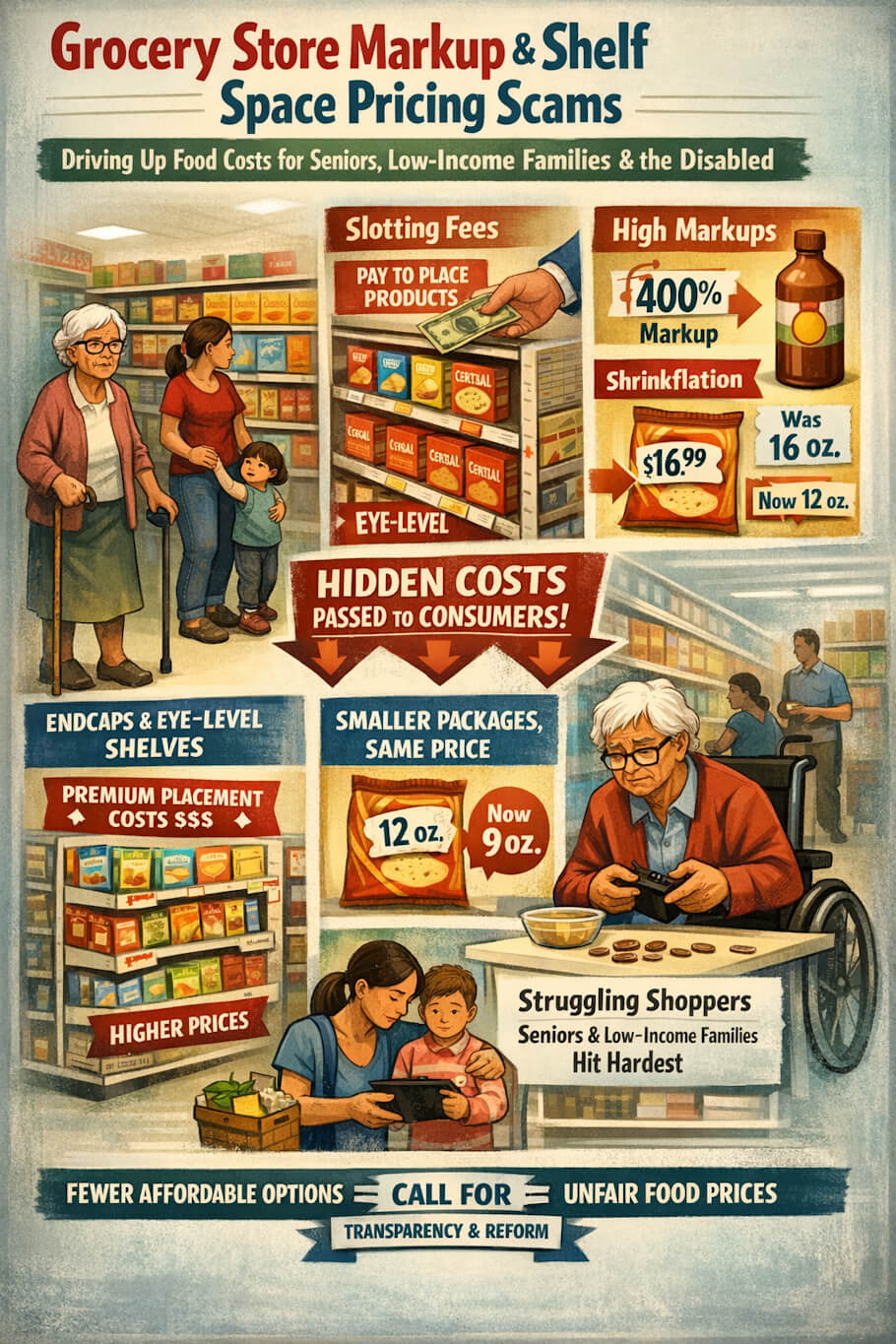
One of the least understood aspects of grocery pricing is the slotting fee - a payment that food manufacturers make to retailers simply for the privilege of having their product placed on store shelves. These fees, which emerged in the 1980s and have since become an entrenched part of the industry, can range from a few hundred dollars per product per store to hundreds of thousands of dollars for placement in a high-demand market or major retail chain (Federal Trade Commission, 2003). The total market for slotting fees in the United States has been estimated at roughly 9 billion dollars and continues to grow (University of Connecticut Food Marketing Policy Center, as cited in Observa, 2023).
A Federal Trade Commission study confirmed that slotting fees are "widespread" in the supermarket industry, and that many grocery retailers actually earn more revenue from the fees they charge manufacturers for shelf access than they do from selling products to customers. Freezer section placement alone in smaller chains can run up to 9,000 dollars per product, while the cost in larger chains can skyrocket far beyond that (Frozen and Refrigerated Foods, as cited in Observa, 2023). In addition to initial slotting fees, retailers commonly charge separate "pay-to-stay" fees for continued shelf presence, promotional fees for end-of-aisle displays, and stocking fees that cover warehouse and inventory management costs.
Who Really Pays for Shelf Space
The crucial question, of course, is who absorbs the cost of these fees. Manufacturers do not simply accept a thinner margin. They build slotting costs into their wholesale pricing, which means the fees are effectively passed along to the consumer through higher retail prices. When a cereal company pays tens of thousands of dollars to secure prime eye-level shelf placement at a national chain, that cost does not come out of the company's goodwill budget. It gets folded into the per-unit price of every box on the shelf.
This system creates a self-reinforcing dynamic that favors large, well-funded manufacturers over smaller producers. Established brands with deep marketing budgets can afford to pay top dollar for the best shelf positions - typically at eye level, sometimes referred to in the trade as the "strike zone" - while smaller or local brands are squeezed into bottom-shelf or peripheral placements where customers are far less likely to notice them (Pantry AI, 2024). The practical result for shoppers is a retail environment that systematically promotes higher-priced, heavily marketed products while making it harder to find potentially more affordable alternatives.
Shrinkflation - The Quiet Price Increase
Alongside traditional markups and shelf fees, consumers face another pricing pressure that is even harder to detect. Shrinkflation - the practice of reducing the size or quantity of a product while keeping the price the same or nearly the same - has become an increasingly common cost management strategy among food manufacturers. A 2024 analysis by LendingTree found that roughly one-third of common grocery items had been affected by shrinkflation, with household paper products showing the highest rates of downsizing at around 60 percent of tracked products (CBS News, 2024).
The U.S. Government Accountability Office confirmed that while shrinkflation's overall contribution to national inflation figures was small - less than one-tenth of a percentage point of the 34.5 percent increase in consumer prices from 2019 to 2024 - the per-unit price increases on individual downsized products were far more significant (GAO, 2025). Coffee saw average per-unit price increases of up to 32 percent due to downsizing. Research from the University of Massachusetts Amherst found that between 2012 and 2019, the average size of packaged food decreased by nearly 15 percent (Rojas, as cited in WBUR, 2026). Consumers typically do not notice subtle packaging changes, and in the United States, companies are not legally required to advertise that a product has been downsized, making it particularly difficult for budget-conscious shoppers to track.
How These Pricing Practices Affect Seniors
Older adults living on fixed incomes are among the most vulnerable to the cumulative effect of grocery markups, slotting-driven pricing, and shrinkflation. Many seniors rely on Social Security benefits, modest pensions, or limited retirement savings that do not adjust fast enough to keep pace with food price increases. The AARP reported that nearly 11.8 million Americans aged 50 and older faced food insecurity and the threat of hunger in 2022, representing a 25 percent increase from the previous year (AARP, 2022). The U.S. Department of Agriculture has documented that food prices in the United States rose by 25 percent between 2019 and 2023.
For a senior navigating the grocery store on a fixed monthly budget, the difference between a product at eye level - likely carrying a premium driven partly by slotting fees - and a cheaper alternative tucked away on a lower shelf can be both meaningful and invisible. Physical limitations such as reduced mobility, poor eyesight, or difficulty bending to reach bottom shelves mean that many older shoppers default to grabbing whatever is most easily accessible, which is almost always the higher-priced option. A survey by the Senior Citizens League found that 25 percent of senior respondents had skipped meals because of rising food costs (MetroHealth, 2022). When every dollar counts, the hidden architecture of grocery store pricing can force impossible choices between eating adequately and paying for medications or other essentials.
The Impact on People Living with Disabilities
People with disabilities face a unique and often compounding set of obstacles when it comes to grocery pricing. Research from Feeding America has shown that older adults with disabilities are twice as likely to be food insecure as their non-disabled peers (National Council on Aging, 2024). The reasons extend well beyond product prices themselves. Many individuals with physical or cognitive disabilities rely on caregivers, delivery services, or limited public transportation to access grocery stores, which can restrict the number and type of stores available to them.
When a person's mobility limits them to shopping at the nearest store rather than traveling to a less expensive one across town, they effectively become a captive consumer. If that nearest store happens to be a small neighborhood market or convenience store - common in many urban areas - they are likely paying significantly more for the same products. Studies cited by the Food Empowerment Project have found that urban residents who purchase groceries at small neighborhood stores pay between 3 and 37 percent more than suburban shoppers buying identical items at full-size supermarkets (Food Empowerment Project, 2025). For someone who cannot drive and depends on a nearby store, the shelf space dynamics of a large retailer are replaced by an even more constrained environment where healthy options are scarce and prices are inflated.
Low-Income Households and the Grocery Pricing Trap
For households with limited financial resources, grocery store pricing margins create what might fairly be called a structural disadvantage. While wealthier families spend more on food in absolute terms, lower-income households dedicate a disproportionately larger share of their total income to groceries. This means that every markup, every slotting-fee-driven price premium, and every shrinkflation-reduced package has a proportionally greater impact on a family operating near the poverty line.
The problem is worsened by geography. The USDA has identified that approximately 17.4 percent of the U.S. population - about 53.6 million people - live in low-income census tracts where they are more than half a mile from the nearest supermarket in urban areas or more than 10 miles in rural areas (USDA Economic Research Service, 2024). These areas, commonly referred to as food deserts or low-access communities, tend to be served primarily by convenience stores and small markets that stock fewer healthy items at higher prices. Research has shown that wealthy districts have roughly three times as many supermarkets as poor ones (Food Empowerment Project, 2025). When a low-income family's nearest shopping option is a small store with limited selection, they have no practical way to comparison-shop or seek out the lower-priced alternatives that full-size supermarkets may bury on a bottom shelf.
The Psychology Behind Store Layout and Product Placement
Grocery store layouts are not designed by accident. Retailers invest heavily in research on consumer behavior to arrange products in ways that encourage higher spending. The most profitable items are placed at eye level, where shoppers are most likely to reach for them without deliberation. Staples like milk and bread are often positioned at the back of the store, requiring shoppers to walk past aisle after aisle of impulse items. End-of-aisle displays - known in the industry as "endcaps" - command premium placement fees from manufacturers, sometimes ranging from 350 to 500 dollars per display per store (Trax Retail, 2025).
For seniors, people with disabilities, or anyone who finds lengthy shopping trips physically taxing, these layout strategies are more than an inconvenience. A shopper using a wheelchair or walker may find it impractical to navigate deep into the store for a basic staple, or to scan multiple shelf levels for the cheapest option. A shopper with cognitive challenges may struggle to compare unit prices across different package sizes, especially when shrinkflation has made those comparisons even more confusing. The entire store environment is calibrated for a shopper who has the time, energy, physical ability, and financial flexibility to hunt for value, and those who do not fit that profile end up paying more almost by default.
The Unit Price Problem
One of the most practical tools available to consumers who want to see through pricing complexity is the unit price - the cost per ounce, per count, or per other standard measure. Comparing unit prices across brands and sizes can reveal which products are genuinely better values, and it is particularly useful for spotting the effects of shrinkflation. The Food Marketing Institute has reported that 78 percent of consumers use unit prices when they are displayed (NPR, 2024).
The problem is that unit pricing regulations vary widely across the United States. Only some states require retailers to display unit prices, and even where laws exist, enforcement can be inconsistent. In 2024, the New Jersey Attorney General underscored the importance of accurate unit price labeling in helping shoppers make informed decisions (NPR, 2024). For consumers without access to clearly labeled unit prices - or without the visual acuity to read them on small shelf tags - the opacity of grocery pricing remains a significant barrier to smart shopping. Seniors with age-related vision loss, people with intellectual disabilities, and anyone unfamiliar with the concept of unit pricing are at a particular disadvantage.
What Can Be Done
Addressing the disparate impact of grocery pricing on vulnerable populations requires action at multiple levels. At the policy level, expanding and strengthening unit pricing requirements across all states would give every shopper a clearer picture of what they are actually paying. France has already moved in this direction by requiring retailers to disclose product downsizing through in-store labels, and Australia is considering similar measures (GAO, 2025). Federal proposals such as the Shrinkflation Prevention Act, introduced in the U.S. Congress, aim to increase transparency around product downsizing.
At the community level, programs such as SNAP (the Supplemental Nutrition Assistance Program), the Senior Farmers Market Nutrition Program, and initiatives like Meals on Wheels remain essential for bridging the gap between food costs and what vulnerable populations can actually afford. The expansion of mobile food pantries, community gardens with accessible raised beds, and partnerships between food banks and local organizations all represent practical efforts to bring affordable nutrition within reach of those who need it most.
For individual consumers, awareness is perhaps the most accessible form of protection. Understanding that eye-level placement often means higher prices, that the largest package is not always the best deal per unit, and that familiar packaging may be hiding reduced quantities can all contribute to more informed grocery shopping. Checking unit prices when they are available, buying store-brand alternatives when possible, and exploring local farmers markets for seasonal produce are small but meaningful strategies.
Conclusion
The modern grocery store is a far more complex commercial environment than it appears at first glance. Markups, slotting fees, pay-to-stay arrangements, shrinkflation, and strategic product placement all contribute to a pricing landscape that rewards manufacturers with the deepest pockets and penalizes shoppers with the fewest options. While these practices affect everyone, their impact is not distributed equally. Seniors, people with disabilities, and low-income households bear a disproportionate share of the burden - not because they shop recklessly, but because the system is not designed with their circumstances in mind. Greater transparency, stronger consumer protections, and continued investment in community food access programs are essential steps toward a grocery marketplace that treats all shoppers fairly.
References
- AARP. (2022). Food insecurity among older adults aged 50 and older. AARP Public Policy Institute.
- CBS News. (2024, October 16). Shrinkflation has affected one-third of grocery items, analysis finds. CBS News.
- Disabled World. (2025). Shrinkflation Decoded: Hidden Cost Increases in Everyday Products. Disabled-World.
- ECS Payments. (2024). 2024 sales strategy: Markups and margins. ECS Payments.
- Federal Trade Commission. (2003). Slotting allowances in the retail grocery industry. FTC Staff Report.
- Food Empowerment Project. (2025). Food deserts. Food Empowerment Project.
- Griffith, G. (2024). Food costs up but grocery profit margins down. River News Online.
- MetroHealth Inc. (2022). Seniors and the rising cost of food. MetroHealth Inc.
- National Council on Aging. (2024). Get the facts on food insecurity and older adults. NCOA.
- NPR. (2024, July 9). How to fight shrinkflation? Pay attention to grocery store unit prices. NPR Planet Money.
- Observa. (2023). Know your slotting fees. Observa.
- Pantry AI. (2024). Slotting fees in retail: Are they worth the investment? Pantry AI.
- Rojas, C. (2026). Shrinkflation and product downsizing trends. International Journal of Industrial Organization.
- Toast. (2025). How much do grocery stores make? Average grocery store revenue data 2025. Toast.
- Trax Retail. (2025). Retail shelf strategy: A guide to shelf space cost. Trax Retail.
- U.S. Department of Agriculture, Economic Research Service. (2024). Food Access Research Atlas. USDA ERS.
- U.S. Government Accountability Office. (2025). Consumer prices: Trends and policy options related to shrinking product sizes (GAO-25-107451). U.S. GAO.
Frequently Asked Questions
Are slotting fees legal in the United States
Yes, slotting fees are a legal and common commercial practice, and regulators such as the Federal Trade Commission have studied them without banning them, though debate continues about their effect on smaller producers.
Do all grocery stores charge slotting fees
No, many small independent grocers, farmers markets, and some discount chains operate with limited or no slotting fees, which is one reason their product selection and pricing can differ from large national chains.
How can shoppers spot shrinkflation on their own
Shoppers can watch for familiar packages that feel lighter or list a smaller net weight than before, and comparing the unit price over time is the most reliable way to catch quiet downsizing.
Does buying store-brand products help lower grocery costs
Often yes, because store brands usually skip the slotting fees and marketing costs tied to national brands, allowing retailers to price them lower while offering comparable quality.
Why are staples like milk placed at the back of the store
Retailers position high-demand staples at the rear so shoppers must walk past many other products, increasing the chance of unplanned impulse purchases along the way.
Is online grocery shopping cheaper than shopping in person
It depends, since online platforms can make unit price comparison easier and reduce impulse buying, but delivery fees, service charges, and tips can offset those savings.
What is the difference between a slotting fee and a pay-to-stay fee
A slotting fee is the upfront charge to place a new product on the shelf, while a pay-to-stay fee is an ongoing charge a manufacturer pays to keep that product on the shelf over time.
Can government food assistance programs offset high grocery prices
Programs like SNAP, the Senior Farmers Market Nutrition Program, and Meals on Wheels can ease the burden, though benefit amounts do not always keep pace with rising food costs.
Insights, Analysis, and Developments
Editorial Note: Understanding how grocery pricing really works is not about demonizing retailers operating on razor-thin margins or manufacturers competing for limited shelf space - it is about recognizing that the system as currently designed imposes its heaviest costs on those who have the fewest resources and the least flexibility to shop around. When slotting fees worth thousands of dollars get baked into the price of a box of cereal, and when shrinkflation quietly trims the contents of a package without any notice on the label, the people who feel it most acutely are not the ones with the luxury of comparison shopping across multiple stores. Transparency in pricing, stronger unit-price labeling laws, and continued investment in food access programs are not radical proposals - they are common-sense steps toward ensuring that the cost of eating does not fall disproportionately on the people who can least afford it.
 Author Credentials: Ian C. Langtree is a writer, editor, and the founder and Editor-in-Chief of Disabled World, which he established in 2004 as one of the longest-running independent resources for disability news and information. Over more than two decades, he has written and edited thousands of articles on disability rights, health, accessibility, and assistive technology. Drawing on a global perspective shaped by extensive travel and lived experience, Ian is a committed advocate of the Social Model of Disability, the framework developed by disabled activists in the 1970s that focuses on removing societal barriers rather than on individual impairments. His writing is grounded in that framework and in a lasting commitment to disability rights, accessibility, and social inclusion. To learn more about Ian's background, expertise, and accomplishments, visit his full biography.