Purple Washing: Disability and Performative Allyship
Author: Ian C. Langtree - Writer/Editor for Disabled World (DW)
Published: 4 May 2026 - Updated: 18 Aug 2026
Publication Type: Scholarly Paper
Table of Contents:
Synopsis - Definition - Overview - FAQs - Insights, Updates - Related Content
Synopsis
Across boardrooms and ad campaigns, purple has become shorthand for disability inclusion - a color worn on lapel pins, splashed across awareness day graphics, and used to signal corporate goodwill. Behind the polished imagery sits a growing critique from disabled communities: that much of what passes for advocacy is carefully managed branding without substantive change. This paper examines purple washing, the practice of using disability symbolism to gain reputational or commercial benefit while leaving inaccessible policies, products, and workplaces untouched, and considers what genuine inclusion looks like in contrast.
At a Glance
- 1 - The color is fine, what sits behind it is what matters.
- 2 - Comedian and activist Stella Young coined the term inspiration porn for media that frames disabled people as inspiring simply for living their lives.
- 3 - Sia's 2021 film Music became a reference point after casting a non-autistic performer as an autistic lead and depicting restraint techniques criticized by advocates.
- 4 - The disability rights principle Nothing about us without us, linked to James Charlton, is offered as the clearest test of whether inclusion is genuine.
Topic Definition
- Purple Washing
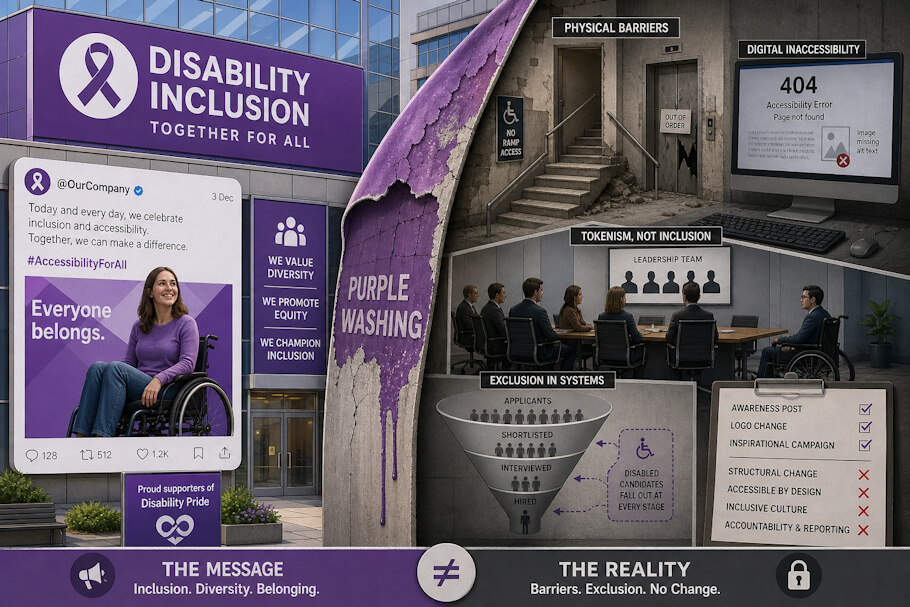
Purple washing is the practice of borrowing disability related symbolism, language, or imagery to project an inclusive public image while doing little to dismantle the accessibility barriers, hiring inequities, and structural disadvantages that disabled people actually experience. It belongs to a wider family of allyship critiques that includes greenwashing, pinkwashing, and rainbow washing, each of which pairs a color with messaging that runs well ahead of practice. The term is most often aimed at corporations, governments, and institutions whose outward disability branding - the purple ribbon, the awareness day graphic, the single accessible feature - conceals policies, products, and workplaces that remain difficult or impossible for many disabled people to use. At its sharpest, purple washing trades on the credibility of disabled communities to gain reputational or commercial advantage without ceding real influence, resources, or accountability to them, which is why advocates increasingly ask not whether a gesture looks sincere, but whether anything beneath it has actually changed.
Overview
When a Purple Ribbon Replaces Real Accessibility Change
Purple has become a common visual cue for disability inclusion. It appears on awareness ribbons, on lanyards used to signal hidden disabilities, on social media graphics for the International Day of Persons with Disabilities, and in marketing campaigns that promise belonging. The color carries genuine meaning for many disabled communities. As that visibility has grown, however, so has a phenomenon that disability advocates increasingly call purple washing - the practice of borrowing disability symbolism, vocabulary, or imagery to gain reputational or commercial advantage without making the structural changes that disabled people have long requested. This paper examines what purple washing is, how it operates across sectors, why it has become widespread, and how to distinguish it from substantive inclusion (Pulrang, 2021; Ellis and Goggin, 2015).
Where the Term Comes From
The label purple washing belongs to a wider family of critiques that pair a color with the suffix "washing" to describe surface level allyship. The earliest and best known relative is greenwashing, a term popularized in the 1980s to describe corporate environmental claims that did not match operations. Pinkwashing followed, first in the breast cancer awareness context and later in critiques of LGBTQ+ branding. Rainbow washing now describes Pride month marketing without year round inclusion. Purple washing applies the same logic to disability (Haller, 2010).
Purple itself has multiple associations with disability. The disability pride flag uses a series of stripes that include lavender tones, and purple is widely adopted by disability charities, awareness campaigns, and advocacy organizations. The "Purple Pound" - a phrase coined in the United Kingdom to describe the collective spending power of households containing a disabled person - has been cited at roughly 274 billion pounds annually, a figure that has helped move disability from the margins of marketing strategy to its center (Purple Tuesday, 2020). When a corporation paints a logo purple for a day, it is borrowing from this established visual shorthand.
Common Forms of Purple Washing
Awareness Day Performance
The most visible form of purple washing tends to cluster around set dates: the International Day of Persons with Disabilities on 3 December, Global Accessibility Awareness Day in May, Disability Pride Month in July, and various national observances. A company may post a single graphic, change a profile photo, or release a statement, then return to inaccessible products, websites that fail basic Web Content Accessibility Guidelines, and physical premises without step-free entry. Disabled audiences have grown adept at spotting this pattern, sometimes called "ribbon allyship" (Pulrang, 2021).
Inspiration Porn and Charity Imagery
The late comedian and activist Stella Young coined the term "inspiration porn" to describe media that presents disabled people as inherently inspiring purely for living their lives, and that is consumed primarily by non disabled audiences for emotional uplift (Young, 2014). When organizations recycle this imagery in their marketing - the smiling child with a prosthetic, the wheelchair athlete framed as overcoming - they often do so without consulting disabled communities and without altering their underlying practice. The visual signals concern, but the relationship to disabled people remains charitable rather than equitable.
Tokenistic Hiring and Casting
A second pattern involves hiring or casting a single disabled person, often in a public facing role, while leaving recruitment pipelines, retention policies, and promotion practices unchanged. Sia's 2021 film Music, which cast a non autistic performer in a lead autistic role and depicted prone restraint techniques widely criticized by autistic advocates, became a reference point in debates about who is allowed to tell disability stories (Andrews et al., 2019). The pattern extends well beyond film. Industry surveys conducted by disability employment networks regularly find that visible disability representation in advertising outpaces actual representation in workforces.
Surface Level Accessibility Claims
Technology firms, hotels, retailers, and transport providers increasingly market themselves as accessible. Some claims are well founded. Others rest on a single accessible feature - a screen reader compatible page, one adapted hotel room, an automatic door - while the broader product remains difficult or impossible for many disabled users to navigate. Annual audits of the most visited websites have repeatedly found accessibility errors on the overwhelming majority of home pages, despite public commitments to inclusion (WebAIM, 2025).
Political and Institutional Washing
Governments and public institutions can also engage in purple washing. A ministry may announce a disability strategy, fund a single high visibility program, and reference the United Nations Convention on the Rights of Persons with Disabilities, while leaving benefits assessments, social care funding, or institutional living arrangements broadly unreformed. Disabled People's Organizations have cautioned that ratification of the Convention, without domestic implementation, can itself become a form of purple washing (United Nations, 2006; Shakespeare, 2014).
The Purple Pound and Commercial Incentives
Purple washing is not random. It responds to a clear commercial calculation. Disabled people and their families represent a substantial share of consumer spending, and surveys consistently show that disabled customers and their networks will switch providers when accessibility is poor or representation is absent. The Purple Pound figure, the World Health Organization estimate that roughly 1.3 billion people experience significant disability worldwide, and the aging of populations across high income economies all point in the same direction (World Health Organization, 2022). Brands that ignore disabled customers risk losing them. Brands that signal inclusion without delivering it can capture short term goodwill at low cost.
This commercial pressure is reinforced by reputational pressure. Investor frameworks increasingly include diversity, equity, and inclusion metrics. Procurement standards, particularly in the public sector, may require evidence of accessibility commitments. The combination creates an incentive to perform inclusion publicly even where internal capacity is limited. Purple washing is, in this sense, a rational if cynical response to misaligned incentives (Heiss, 2011).
Recognizing Purple Washing in Practice
Several markers help distinguish performance from substance. Among the more useful are:
- Awareness days messaging from organizations whose physical or digital products fail basic accessibility standards on other days of the year.
- Public commitments without published targets, timelines, or progress reports.
- Disability imagery in advertising without disabled people in senior roles, on advisory boards, or in product design teams.
- Accessibility framed as a feature for a separate user group rather than as a baseline for all users.
- Charity partnerships used to deflect from criticism of core operations or working conditions.
- The absence of disabled employees, contributors, or consultants from any visible part of the campaign.
None of these markers is conclusive in isolation. Together, they describe a recognizable pattern that disabled audiences and disability journalists have documented for years (Haller, 2010; Ellis and Goggin, 2015).
The Harms of Purple Washing
Purple washing is sometimes treated as harmless marketing. It is not. The first and most direct harm is that it absorbs attention, funding, and political will that might otherwise support substantive change. When a campaign performs inclusion convincingly, audiences and policymakers can come to believe that the underlying problem is being addressed. Second, it crowds out disabled led organizations, which often operate on smaller budgets and cannot match the visibility of corporate or government messaging. Third, it tends to reproduce ableist narratives - the inspirational individual, the deserving recipient, the grateful beneficiary - rather than the political and structural framing that disability rights movements have spent decades building (Charlton, 1998; Mitchell and Snyder, 2015).
There is also a slower harm. Disabled communities, like other groups subject to repeated performative gestures, become understandably sceptical of claims about inclusion. That scepticism is reasonable, but it complicates the work of organizations attempting to act in good faith. Trust, once eroded, is expensive to rebuild.
Purple Washing and Adjacent Critiques
Purple washing overlaps with several adjacent concepts without being interchangeable with any of them. Ableism describes the broader system of beliefs, practices, and policies that disadvantage disabled people; purple washing is one of its surface expressions, not its source. Performative allyship is a wider phenomenon that applies across marginalized communities, while purple washing is its disability specific instance. Inspiration porn, as defined by Young (2014), is a particular media trope that purple washing campaigns frequently rely upon, but the two are not the same: a campaign can avoid inspirational framing and still purple wash, and a piece of inspiration porn can circulate without any corporate sponsor behind it.
The distinctions matter because remedies differ. Reducing inspiration porn requires editorial and curatorial change in media organizations. Tackling othering and ableism requires legislative, educational, and cultural work across generations. Reducing purple washing specifically requires accountability mechanisms, inclusive procurement standards, and a willingness among disabled communities and their allies to publicly evaluate the gap between claim and reality (Goodley, 2014).
What Genuine Disability Inclusion Looks Like
The disability rights principle "Nothing about us without us," widely associated with the work of James Charlton and adopted by Disabled Peoples' International, offers the clearest test (Charlton, 1998). Genuine inclusion involves disabled people in setting priorities, designing solutions, and evaluating outcomes. Several practical markers tend to follow:
- Disabled people in governance and senior leadership, not only in front of cameras.
- Co-design processes that begin before specifications are drafted, rather than user testing added at the end.
- Accessibility treated as a baseline standard across all products, services, and communications, with measurable conformance to recognized guidelines.
- Procurement, recruitment, and retention practices audited and revised with input from disabled employees and consultants.
- Transparent reporting on workforce representation, pay, and accommodation rates, comparable to the reporting now common for gender.
- Funding relationships with disabled led organizations that are sustained rather than transactional.
The Social Model of Disability, developed primarily by British disabled scholars and activists in the 1970s and formalized in the work of Mike Oliver, frames disability as the product of social, environmental, and attitudinal barriers rather than individual deficit (Oliver, 1990). Organizations that take the model seriously tend to examine their own contribution to those barriers first, before turning to imagery and messaging.
Conclusion
Purple washing is best understood as the gap between disability messaging and disability practice. It is encouraged by real economic and reputational incentives, and it survives because the gap is often invisible to non disabled audiences. Closing the gap requires moving disability from the communications team to the boardroom, from the awareness day to the procurement contract, and from the campaign image to the hiring decision. The color is fine. What sits behind it is what matters.
Frequently Asked Questions
Where does the phrase Purple Pound come from?
The Purple Pound is a term coined in the United Kingdom to describe the collective spending power of households that include a disabled person, and it has helped push disability from the edges of marketing strategy toward its center.
Is purple washing a recent idea?
The specific label is relatively new, but it follows a long line of color based washing critiques stretching back to greenwashing in the 1980s, so the underlying concern about surface level allyship has been discussed for decades.
Why do companies engage in purple washing at all?
It responds to real economic and reputational pressure, since disabled customers represent a large share of spending and investor and procurement frameworks increasingly reward visible inclusion, making cheap public gestures tempting when internal capacity is limited.
Does raising awareness ever help disabled people?
Awareness can be valuable when it is paired with structural change, but on its own it risks becoming performative, which is why advocates treat awareness as a starting point rather than the goal itself.
How is purple washing different from performative allyship?
Performative allyship is a broad pattern that appears across many marginalized communities, while purple washing is its disability specific instance, focused on the gap between disability messaging and disability practice.
What harm does purple washing actually cause?
It diverts attention, funding, and political will away from real change, crowds out disabled led organizations with smaller budgets, and erodes community trust that later becomes expensive to rebuild.
What is the Social Model of Disability mentioned in this context?
The Social Model, developed by British disabled scholars and activists and formalized by Mike Oliver, frames disability as the result of social, environmental, and attitudinal barriers rather than individual impairment, encouraging organizations to examine their own role in creating those barriers.
Can an organization recover after being accused of purple washing?
Yes, though recovery depends on credible action such as publishing measurable accessibility and workforce data, involving disabled people in decisions, and reporting progress openly rather than issuing more statements.
References:
Andrews, E. E., Forber-Pratt, A. J., Mona, L. R., Lund, E. M., Pilarski, C. R., and Balter, R. (2019). #SaytheWord: A disability culture commentary on the erasure of "disability." Rehabilitation Psychology, 64(2), 111-118.
Ellis, K., and Goggin, G. (2015). Disability and the media. Palgrave Macmillan.
Goodley, D. (2014). Dis/ability studies: Theorising disablism and ableism. Routledge.
Haller, B. A. (2010). Representing disability in an ableist world: Essays on mass media. Advocado Press.
Heiss, S. N. (2011). Locating the bodies of women and disability in definitions of beauty: An analysis of Dove's Campaign for Real Beauty. Disability Studies Quarterly, 31(1).
Langtree, I. C. (2025). Disability Rights: Nothing About Us, Without Us Examined. Disabled World.
Mitchell, D. T., and Snyder, S. L. (2015). The biopolitics of disability: Neoliberalism, ablenationalism, and peripheral embodiment. University of Michigan Press.
Oliver, M. (1990). The politics of disablement. Macmillan.
Pulrang, A. (2021). What disability community language tells us about ourselves. Forbes.
Purple Tuesday. (2020). The Purple Pound: Understanding the spending power of disabled consumers. Purple.
Shakespeare, T. (2014). Disability rights and wrongs revisited (2nd ed.). Routledge.
United Nations. (2006). Convention on the Rights of Persons with Disabilities. United Nations.
WebAIM. (2025). The WebAIM Million: An accessibility analysis of the top 1,000,000 home pages. WebAIM.
World Health Organization. (2022). Global report on health equity for persons with disabilities. World Health Organization.
Young, S. (2014). I'm not your inspiration, thank you very much. TED Talk.
Insights, Analysis, and Developments
Editorial Note: Purple washing thrives where awareness is mistaken for action and where representation is treated as a destination rather than a starting point. Disabled communities have repeatedly named the difference between being depicted and being included, and the harder work belongs less to marketing departments than to the policymakers, designers, and employers willing to share decision making with the people most affected. The next time a purple ribbon appears on a corporate feed, the more useful question may not be whether the gesture is sincere, but whether anything beneath it has actually changed.
 Author Credentials: Ian is the founder and Editor-in-Chief of Disabled World, a leading resource for news and information on disability issues. With a global perspective shaped by years of travel and lived experience, Ian is a committed proponent of the Social Model of Disability, a transformative framework developed by disabled activists in the 1970s that emphasizes dismantling societal barriers rather than focusing solely on individual impairments. His work reflects a deep commitment to disability rights, accessibility, and social inclusion. To learn more about Ian's background, expertise, and accomplishments, visit his full biography.