Polygenic Scores: Genetic Risk in Aging and Disability
Author: Ian C. Langtree - Writer/Editor for Disabled World (DW)
Published: 23 Feb 2026 - Updated: 31 Aug 2026
Publication Type: Informative
Table of Contents:
Synopsis - Definition - Overview - FAQs - Insights, Updates - Related Content
Synopsis
The human genome holds clues not just about who we are, but about what health challenges may lie ahead - and modern science is finally learning how to read them. Polygenic scores represent one of the most significant advances in genetic risk prediction, aggregating the tiny effects of thousands of DNA variants into a single meaningful number. For the millions of older adults navigating chronic disease and disability, these scores offer something genuinely new: a way to glimpse genetic vulnerability before symptoms ever appear, potentially opening the door to earlier prevention and more personalized care. This paper examines how polygenic scores work, what they can and cannot tell us, and why they hold particular relevance for seniors and people living with disabilities.
At a Glance
- 1 - A single saliva sample is enough to calculate polygenic scores. Because your DNA never changes, one test can score risk for many conditions across your lifetime.
- 2 - Longevity genes may counter Alzheimer's risk. A score of 330 variants linked to up to four years of added survival and partly offset the harmful APOE-e4 allele.
- 3 - Physical activity matters most for those with high genetic risk. Among older adults predisposed to cognitive decline, staying active was tied to significantly slower loss.
- 4 - Score accuracy drops for non-European ancestry. Most genetic studies used European populations, so results are less reliable for African, Hispanic, Asian, and Indigenous groups, risking wider health inequities.
Topic Definition
- Polygenic Score
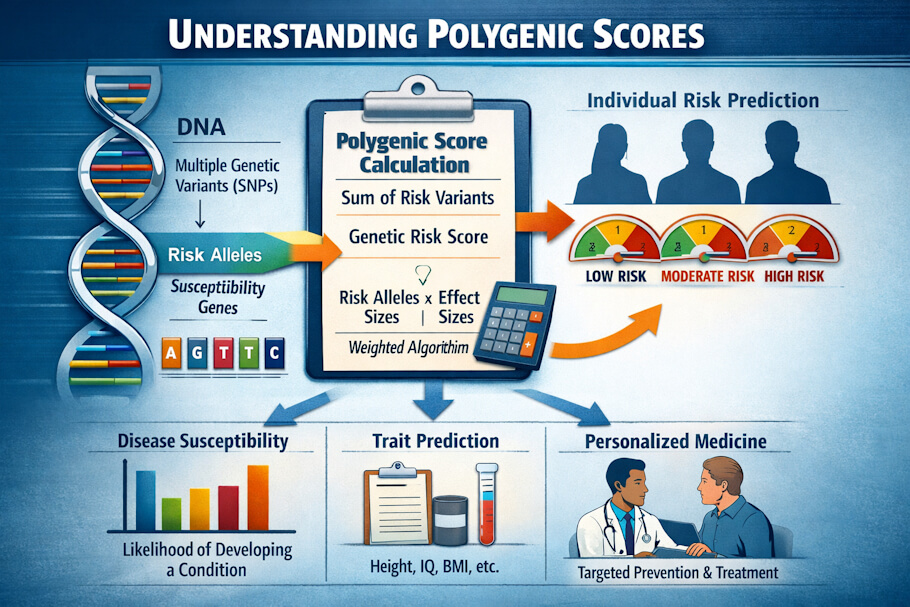
A polygenic score is a single numerical value that estimates a person's genetic predisposition toward a particular disease or trait by adding together the small, weighted effects of many genetic variants scattered across their genome. Unlike genetic tests for conditions caused by a single gene, polygenic scores capture the combined influence of hundreds or even thousands of DNA differences - each individually minor - that together contribute meaningfully to a person's overall risk. These scores are derived from large-scale genetic studies that compare the DNA of affected and unaffected individuals, and they place a person on a spectrum of relative genetic risk rather than providing a definitive diagnosis or guarantee of any outcome.
Overview
Polygenic Scores: What They Mean for Seniors and People Living With Disabilities
For most of human history, we understood disease risk in fairly simple terms. You either carried a gene for a particular illness, or you did not. But modern genetics has revealed a much more nuanced picture - one in which thousands of tiny genetic variations, each contributing a small sliver of risk, combine to shape your likelihood of developing conditions like heart disease, diabetes, Alzheimer's disease, and many others. Polygenic scores attempt to capture this complexity in a single number, offering a window into individual genetic risk that was unimaginable just a couple of decades ago. For seniors and people living with disabilities, these scores could eventually reshape how we approach prevention, diagnosis, and care - though significant challenges remain before that promise is fully realized.
What Exactly Is a Polygenic Score?
A polygenic score - sometimes called a polygenic risk score (PRS) or genetic risk score - is a numerical summary of a person's genetic predisposition for a particular trait or disease. Unlike conditions caused by a single gene mutation, such as Huntington's disease or cystic fibrosis, most common diseases and traits are influenced by many genes acting together. Each individual genetic variant may contribute only a tiny amount of risk on its own, but collectively, they add up to a meaningful picture (National Human Genome Research Institute [NHGRI], 2023).
To create a polygenic score, researchers draw on data from genome-wide association studies (GWAS). These are large-scale investigations that compare the DNA of people who have a disease with those who do not, identifying which genetic variants - typically called single nucleotide polymorphisms, or SNPs - appear more frequently in affected individuals. Each identified variant is assigned a statistical "weight" reflecting how strongly it correlates with the disease. A person's polygenic score is then calculated by adding up the weighted effects of all the relevant variants they carry (Lewis and Vassos, 2020).
The result is a single number that places a person along a bell curve of genetic risk. Most individuals fall somewhere in the middle, meaning they have an average level of genetic predisposition. People at the high end of the distribution carry more risk-associated variants, while those at the low end carry fewer. Importantly, a polygenic score captures relative risk - it tells you how your genetic makeup compares to others, not whether you will definitely develop a disease (NHGRI, 2023).
How Polygenic Scores Are Built
The foundation of any polygenic score is the GWAS that supplies the raw data. In a typical study, researchers scan millions of genetic markers across the genomes of hundreds of thousands or even millions of participants. For each marker, they test whether there is a statistical association between carrying a particular variant and having a given condition or trait. The variants that show a meaningful association, along with their estimated effect sizes, form the building blocks of the score (Dudbridge, 2013).
There are several methods for constructing polygenic scores, but they generally follow a similar logic. The simplest approach, known as "pruning and thresholding," selects a subset of independent genetic markers that reach a particular level of statistical significance. More advanced techniques, such as Bayesian methods and penalized regression, incorporate additional information about the genetic architecture of traits - for instance, accounting for patterns of linkage disequilibrium, which refers to the tendency for nearby genetic variants to be inherited together (Ge et al., 2019). These newer methods tend to produce more accurate scores because they handle statistical noise more effectively.
One of the most appealing features of polygenic scoring is that a person's DNA only needs to be tested once. Since your genetic code remains the same throughout your life, a single DNA sample - collected through something as simple as a saliva test - can be used to calculate polygenic scores for many different conditions (Khera et al., 2018).
Why Polygenic Scores Matter for Seniors
Aging is a complex biological process, and many of the diseases that disproportionately affect older adults - heart disease, type 2 diabetes, Alzheimer's disease, osteoporosis, atrial fibrillation, and certain cancers - have strong polygenic components. This means that polygenic scores could be particularly relevant for senior populations as tools for early risk identification and targeted prevention.
Consider coronary artery disease, the leading cause of death worldwide. A landmark 2018 study led by researchers at the Broad Institute demonstrated that polygenic scores could identify individuals whose genetic risk of coronary artery disease was equivalent to carrying a single high-risk mutation - even though no single variant in their genome would have been flagged on its own (Khera et al., 2018). For an older adult, this kind of information could prompt earlier or more aggressive use of preventive medications like statins, lifestyle changes, or enhanced screening.
Research has also shown that higher polygenic risk for coronary heart disease is associated with greater coronary artery calcium buildup in adults aged 75 and older, independently of traditional risk factors like smoking and high blood pressure. In the Atherosclerosis Risk in Communities (ARIC) study, individuals in the top 20 percent of polygenic risk had more than four times the odds of having severe coronary calcification compared to those in the bottom 20 percent (Razavi et al., 2024). This finding suggests that genetic risk continues to influence cardiovascular outcomes well into old age.
Perhaps nowhere is the potential for polygenic scores more compelling than in Alzheimer's disease, the most common form of dementia among older adults. Research has consistently shown that polygenic scores can help identify individuals at higher risk of cognitive decline years before symptoms appear. In one notable study from the Alzheimer's Disease Neuroimaging Initiative, individuals with higher polygenic risk scores showed faster cognitive decline over a five-year period, regardless of whether they carried the well-known APOE-e4 risk allele (Gao et al., 2022). This is significant because roughly 60 percent of the general population carries two copies of the APOE-e3 allele and would not traditionally be considered high-risk - yet polygenic scoring could still flag some of these individuals for earlier intervention.
Polygenic Scores and the Aging Brain
Cognitive decline is one of the most feared consequences of aging, and understanding who is most vulnerable is a major focus of current research. The Health and Retirement Study, a large nationally representative study of Americans aged 50 and older, has been instrumental in exploring how polygenic scores relate to cognitive function over time. Researchers using this dataset found that a polygenic score for general cognition predicted the rate at which both White and Black participants experienced cognitive decline over eight years, even after adjusting for lifestyle factors and APOE status (Li et al., 2023).
What makes this finding especially interesting is the interaction between genetics and lifestyle. Among participants with high genetic risk for cognitive decline, physical activity appeared to be especially protective - it was associated with significantly slower decline compared to those who were less active. In other words, knowing your polygenic risk might help you understand just how important certain lifestyle choices are for your specific situation. This kind of personalized guidance is a key goal of precision medicine.
Polygenic scores for longevity have also emerged as a fascinating area of research. A study published in The Journals of Gerontology constructed a longevity-related polygenic score using data from cognitively healthy centenarians and found that it predicted longer survival across a broad age continuum. The score, which included 330 genetic variants, was associated with up to a four-year difference in survival based on common genetic factors alone. It even appeared to partially offset the harmful effects of the APOE-e4 allele, which is linked to higher Alzheimer's risk (Tesi et al., 2021).
Connections Between Polygenic Scores and Disability
Disability in later life - defined broadly as difficulty performing everyday activities like bathing, dressing, walking, or managing household tasks - affects at least 20 percent of Americans aged 65 and older. It represents one of the most significant predictors of both quality of life and long-term care costs. While environmental and social factors play enormous roles, researchers have increasingly recognized that genetics contributes to disability risk as well.
A groundbreaking genome-wide association study of more than 24,000 participants specifically examined the genetic architecture of disability in older adults. Researchers identified promising genetic associations at 19 different locations in the genome and found that polygenic risk scores - which aggregated the effects of many small genetic contributions - showed highly significant associations with disability status. The study also revealed that the genetic pathways involved in disability overlapped substantially with those involved in age-related conditions, particularly through mechanisms related to oxidative stress, inflammatory response, and musculoskeletal system development (Ukraintseva et al., 2019).
This research points to an important concept: many of the disabilities that affect older adults are not caused by a single disease or event, but rather by the gradual accumulation of damage across multiple body systems. Polygenic scores can help capture this cumulative genetic vulnerability. For example, a person with a high polygenic risk for osteoporosis, combined with elevated genetic risk for poor muscle development, may be more susceptible to falls and fractures - a leading cause of disability among seniors.
Conditions that commonly lead to disability in older adults - including cardiovascular disease, diabetes, arthritis, dementia, and stroke - are all polygenic in nature. Polygenic scores for each of these conditions can theoretically help identify which older adults are at greatest combined risk for functional decline. The American Heart Association has emphasized that cardiovascular disease remains the leading contributor to years lost due to disability or premature death among adults, and that polygenic risk scores may help improve the prediction of who will develop these conditions (O'Sullivan et al., 2022).
Polygenic Scores and Specific Disabling Conditions
Several specific conditions illustrate how polygenic scores might reshape our understanding of disability risk among older adults:
- Alzheimer's disease affects more than six million Americans over 65 and is the most common cause of dementia-related disability. Polygenic risk scores have been shown to predict not just disease diagnosis but also the pace of cognitive decline, brain structural changes, and even amyloid accumulation in the brain before any symptoms appear (Escott-Price and Schmidt, 2023).
- Type 2 diabetes is a major contributor to disability through complications such as neuropathy, vision loss, kidney failure, and cardiovascular damage. A Finnish study found that individuals with high polygenic risk developed diabetes four to nine years earlier than those with average risk, and that polygenic information added meaningful predictive value beyond standard clinical risk assessment (Mars et al., 2020).
- Multiple sclerosis, while it can begin earlier in life, frequently causes progressive disability that worsens with age. Recent research has shown that polygenic risk scores are associated with the rate of disability progression in MS patients, particularly among those diagnosed before age 50 (Ferretti et al., 2025).
- Coronary heart disease and atrial fibrillation, both major causes of disability and death in older adults, have well-validated polygenic scores that can identify high-risk individuals who might benefit from earlier or more intensive medical management (O'Sullivan et al., 2022).
The Promise of Personalized Prevention
One of the most exciting potential applications of polygenic scores is in personalized prevention - the idea that knowing your genetic risk profile could allow you to take targeted steps to reduce your chances of developing disease and disability. This is especially relevant for seniors, who often face multiple overlapping health risks and who stand to benefit the most from even modest delays in disease onset.
For instance, if a 55-year-old learns that they carry a high polygenic risk for both type 2 diabetes and cardiovascular disease, their physician might recommend more aggressive dietary modifications, earlier initiation of preventive medications, and more frequent screening - years before symptoms would typically appear. The same logic applies to Alzheimer's disease: identifying people with high polygenic risk during midlife could open the door to emerging preventive therapies and lifestyle interventions at a stage when they may be most effective.
Clinical trials are already beginning to incorporate polygenic scores for participant selection. By enrolling individuals who are genetically predisposed to certain conditions, researchers can more efficiently test whether new treatments work, which could accelerate the development of therapies that specifically benefit high-risk older adults (Lewis and Vassos, 2020).
Important Limitations and Ethical Concerns
Despite their promise, polygenic scores come with significant limitations that are important to understand - especially for seniors and people with disabilities who might be affected by clinical decisions based on these scores.
First, polygenic scores measure relative risk, not absolute certainty. A person with a high polygenic risk score for heart disease may never develop the condition, while someone with a low score might still have a heart attack due to environmental factors, lifestyle choices, or random chance. The scores explain only a portion of the overall risk for any given disease, and that portion varies widely depending on the condition.
Second, and critically, the vast majority of genetic studies used to develop polygenic scores have been conducted in populations of European ancestry. Research published in Nature has shown that the accuracy of polygenic scores decreases continuously as an individual's genetic ancestry diverges from the population used to develop the score (Ding et al., 2023). This means that polygenic scores currently perform far better for people of European descent than for people of African, Hispanic, Asian, or Indigenous ancestry. The American Society of Human Genetics has cautioned that clinical use of polygenic scores without addressing this disparity could actually worsen existing health inequities rather than reduce them (ASHG Professional Practice and Social Implications Committee, 2023).
Third, for age-related diseases, the performance of polygenic scores can be influenced by the ages of the participants in the original studies. As researchers have noted, for conditions like Alzheimer's disease, the relevance of specific genetic variants may shift depending on the age at which a person is tested or the age composition of the study population. This makes it important to interpret scores carefully when applying them to very old populations, where survivorship itself may reflect an underlying genetic resilience (Escott-Price and Schmidt, 2023).
There are also broader ethical concerns. Some scholars worry about the potential for genetic discrimination - the possibility that insurance companies, employers, or other institutions could use polygenic information to disadvantage individuals, including people with disabilities. While legal protections exist in many countries, they were not designed with polygenic scores in mind, and the regulatory landscape has not kept pace with the rapidly advancing science (Murray et al., 2021).
The Road Ahead
Polygenic scores represent a genuine shift in how we think about genetic risk, and their relevance to aging and disability is substantial. As the technology improves - with larger, more diverse studies, better statistical methods, and more sophisticated integration of genetic and environmental information - these scores are likely to become increasingly useful tools for predicting and preventing age-related diseases and disability.
Several major international initiatives, including the National Institutes of Health-funded PRIMED Consortium, are working specifically to improve the accuracy and equity of polygenic scores across diverse populations (NHGRI, 2023). These efforts aim to ensure that the benefits of polygenic risk prediction reach all communities, not just those that have been historically overrepresented in genetic research.
For seniors and people living with disabilities, the ultimate value of polygenic scores will depend on how thoughtfully they are integrated into clinical practice. They are not crystal balls - they cannot tell you with certainty what will happen. But they can provide a meaningful piece of the puzzle, adding genetic context to the clinical and environmental factors that physicians already consider when making care decisions. Used wisely, polygenic scores have the potential to help older adults live healthier, more independent lives for longer - which is, after all, what most of us hope for as we age.
Frequently Asked Questions
Are polygenic scores available to consumers today
Some direct-to-consumer genetic companies offer polygenic risk reports, but availability and quality vary widely, and many experts recommend discussing any results with a qualified clinician or genetic counselor before acting on them.
Do polygenic scores change as you age
Your underlying DNA and therefore the raw score stay the same throughout life, though how researchers interpret the score for a given condition can shift as scientific understanding and reference data improve.
How is a polygenic score different from a genetic test for a single condition
A single-gene test looks for one specific mutation that strongly causes a disease, while a polygenic score sums the tiny effects of many variants to estimate combined risk for common, multifactorial conditions.
Can lifestyle changes lower the risk shown by a polygenic score
A polygenic score reflects genetic predisposition rather than destiny, and evidence suggests that healthy habits such as regular exercise, good diet, and preventive care can meaningfully reduce actual disease risk even for people with high scores.
Are polygenic scores used in clinical care right now
Use is still emerging and mostly found in research and some specialist settings, with clinicians cautious because the scores explain only part of overall risk and perform unevenly across ancestry groups.
Can insurers or employers access my polygenic score
Legal protections against genetic discrimination exist in many countries but were not written with polygenic scores in mind, so people should understand local laws and privacy terms before sharing genetic information.
What does it mean to be in the top percentile of a polygenic score
Falling in a high percentile means you carry more risk-associated variants than most people for that condition, which raises your relative likelihood but does not guarantee you will ever develop the disease.
Why do polygenic scores work less well for some populations
Most of the genetic studies behind these scores were done in people of European ancestry, so predictions become less accurate the more a person's genetic background differs from that reference group.
References:
American Society of Human Genetics (ASHG) Professional Practice and Social Implications Committee. (2023). Addressing the challenges of polygenic scores in human genetic research. The American Journal of Human Genetics, 110(2), 223-232.
Ding, Y., Hou, K., Xu, Z., Pimber, A., Burch, K., Mester, R., and Pasaniuc, B. (2023). Polygenic scoring accuracy varies across the genetic ancestry continuum. Nature, 618(7966), 774-781.
Dudbridge, F. (2013). Power and predictive accuracy of polygenic risk scores. PLoS Genetics, 9(3), e1003348.
Escott-Price, V., and Schmidt, K. M. (2023). Pitfalls of predicting age-related traits by polygenic risk scores. Annals of Human Genetics, 87(5), 203-213.
Ferretti, A., Ferretti, M. T., Cavallari, M., and D'Alfonso, S. (2025). Contribution of polygenic scores to progression independent of relapse activity in multiple sclerosis. Brain Sciences, 15(6), 596.
Gao, Q., Daunt, P., Gibson, A. M., and Bandopadhyay, R. (2022). Utility of polygenic risk scoring to predict cognitive impairment as measured by Preclinical Alzheimer Cognitive Composite score. Journal of Aging Research and Lifestyle, 11, 1-8.
Ge, T., Chen, C. Y., Ni, Y., Feng, Y. A., and Smoller, J. W. (2019). Polygenic prediction via Bayesian regression and continuous shrinkage priors. Nature Communications, 10(1), 1776.
Khera, A. V., Chaffin, M., Aragam, K. G., Haas, M. E., Roselli, C., Choi, S. H., and Kathiresan, S. (2018). Genome-wide polygenic scores for common diseases identify individuals with risk equivalent to monogenic mutations. Nature Genetics, 50(9), 1219-1224.
Lewis, C. M., and Vassos, E. (2020). Polygenic risk scores: From research tools to clinical instruments. Genome Medicine, 12(1), 44.
Li, C., Zhang, R., Miao, H., and Liu, T. (2023). A longitudinal study of polygenic score and cognitive function decline considering baseline cognitive function, lifestyle behaviors, and diabetes among middle-aged and older US adults. BMC Geriatrics, 23(1), 734.
Mars, N., Koskela, J. T., Ripatti, P., Kiiskinen, T., Havulinna, A. S., Lindbohm, J. V., and Ripatti, S. (2020). Polygenic and clinical risk scores and their impact on age at onset and prediction of cardiometabolic diseases and common cancers. Nature Medicine, 26(4), 549-557.
Murray, M. F., Giovanni, M. A., Klinger, E., and George, E. (2021). Ethical, legal, and social implications of genetic risk prediction for multifactorial disease. Journal of Community Genetics, 12(4), 495-511.
National Human Genome Research Institute (NHGRI). (2023). Polygenic risk scores. National Institutes of Health.
O'Sullivan, J. W., Raghavan, S., Marquez-Luna, C., Luzum, J. A., and Natarajan, P. (2022). Polygenic risk scores for cardiovascular disease: A scientific statement from the American Heart Association. Circulation, 146(8), e93-e118.
Razavi, A. C., Hazzard, B., Engel, D., Mathews, L., and Blaha, M. J. (2024). Polygenic risk scores and extreme coronary artery calcium phenotypes in adults 75 years and older: The ARIC study. Circulation: Genomic and Precision Medicine, 17(6), e004751.
Tesi, N., van der Lee, S. J., Hulsman, M., Jansen, I. E., Stringa, N., van Schoor, N. M., and Holstege, H. (2021). Polygenic risk score of longevity predicts longer survival across an age continuum. The Journals of Gerontology: Series A, 76(5), 750-759.
Ukraintseva, S., Arbeev, K., Duan, M., Akushevich, I., Kulminski, A., Stallard, E., and Yashin, A. (2019). Polygenic risk score for disability and insights into disability-related molecular mechanisms. GeroScience, 42(1), 231-244.
Insights, Analysis, and Developments
Editorial Note: Polygenic scores are not fortune tellers, and they are certainly not the whole story when it comes to health and aging. Environmental influences, lifestyle choices, access to healthcare, and plain chance will always play enormous roles in shaping who develops disease and disability and who does not. But the ability to quantify even a portion of genetic risk across complex, multifactorial conditions represents a remarkable scientific achievement - one that stands to benefit older adults and people with disabilities most of all, provided the science advances equitably and is applied with both clinical wisdom and ethical care.
 Author Credentials: Ian is the founder and Editor-in-Chief of Disabled World, a leading resource for news and information on disability issues. With a global perspective shaped by years of travel and lived experience, Ian is a committed proponent of the Social Model of Disability, a transformative framework developed by disabled activists in the 1970s that emphasizes dismantling societal barriers rather than focusing solely on individual impairments. His work reflects a deep commitment to disability rights, accessibility, and social inclusion. To learn more about Ian's background, expertise, and accomplishments, visit his full biography.