Physicalism Explained: Mind, Matter, and Disability
Author: Ian C. Langtree - View Credentials
Published: 6 Jul 2026 - Updated: 9 Aug 2026
Publication Type: Scholarly Paper
Table of Contents:
Synopsis - Definition - Overview - FAQs - Insights, Updates - Related Content
Synopsis
Is your mind nothing more than your brain at work? Physicalism, the reigning view in modern philosophy, answers yes - and the consequences reach far beyond the seminar room. This paper unpacks the theory in plain language, from the old quarrel between monists and dualists to the technical idea of supervenience, then walks through the three great accounts of how minds fit into a physical world: identity theory, functionalism, and behaviorism. Along the way it asks a question philosophers have only recently taken seriously: what does a physicalist worldview mean for how we understand disability, assistive technology, and neurological difference.
At a Glance
- 1 - The term "physicalism" was coined in the early 1930s by Otto Neurath and Rudolf Carnap of the Vienna Circle. It replaced the older word "materialism" because modern physics had moved beyond solid matter to fields, forces, and energy.
- 2 - Hilary Putnam's octopus argument changed the field in the 1960s. Because creatures with radically different nervous systems can all feel pain, he concluded that one mental state can be physically realized in many different ways, an idea that now underpins the neurodiversity movement.
- 3 - Philosophers Andy Clark and David Chalmers argue that tools like notebooks and devices can literally form part of a person's mind. On this "extended mind" view, taking away someone's assistive technology is closer to interfering with their cognition than confiscating their property.
- Physicalism
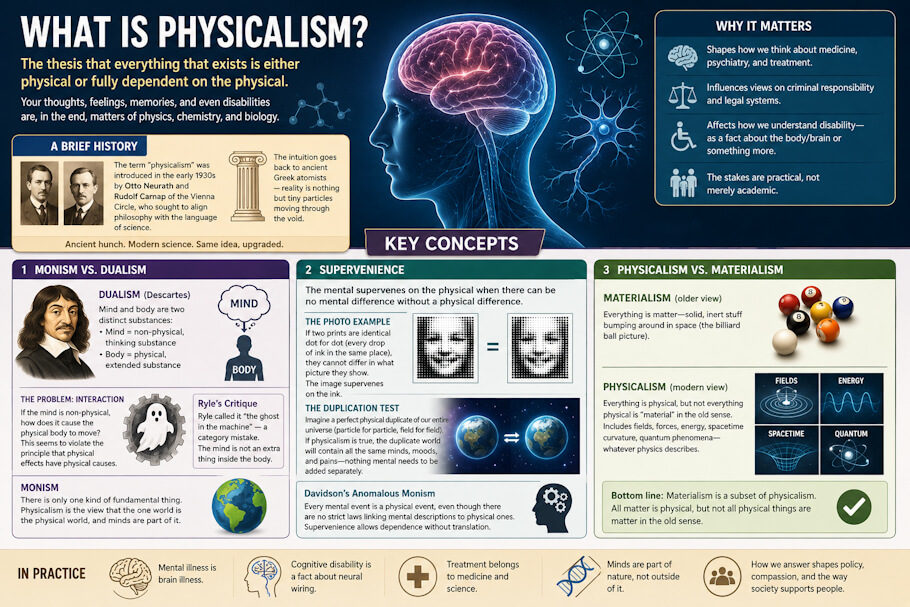
Physicalism is the philosophical thesis that everything that exists is physical or is wholly dependent on the physical, so that once all the physical facts about the universe are settled, every other fact - including every fact about thoughts, feelings, and consciousness - is settled too. Rooted in ancient atomism but named by the Vienna Circle in the 1930s, it is a form of monism: it recognizes one fundamental kind of reality rather than the two kinds proposed by mind-body dualists. In the philosophy of mind, physicalism holds that mental states are brain states, functional states of physical systems, or otherwise nothing over and above the workings of the body, a claim usually expressed through the idea that the mental supervenes on the physical, meaning there can be no mental difference without a physical difference.
Topic Definition
Overview
What Is Physicalism?
Ask a philosopher what the universe is ultimately made of, and one answer has dominated the conversation for the better part of a century: physical stuff, and nothing else. That, in a nutshell, is physicalism. It is the thesis that everything that exists - every object, every property, every event, and, most controversially, every thought and feeling - is either physical or fully dependent on the physical (Stoljar, 2010). If physicalism is true, then your joy at a friend's good news, your memory of a childhood home, and your experience of chronic back pain are all, in the end, matters of physics, chemistry, and biology.
The word itself is younger than the idea. The term "physicalism" was introduced in the early 1930s by Otto Neurath and Rudolf Carnap, two members of the Vienna Circle, a group of philosophers and scientists who wanted philosophy to speak the language of science (Stoljar, 2010). The underlying intuition, however, stretches back to the ancient Greek atomists, who proposed that reality consists of nothing but tiny particles moving through the void. Modern physicalism is that ancient hunch upgraded with quantum fields, neurons, and brain scanners.
Why does this matter to anyone outside a philosophy seminar? Because physicalism quietly shapes how societies think about medicine, psychiatry, criminal responsibility, and - as this paper will explore in detail - disability. If minds are brains, then mental illness is brain illness, cognitive disability is a fact about neural wiring, and treatment belongs to medicine. If minds are something more, or if disability is something other than a bodily fact, the picture changes. The stakes are practical, not merely academic.
Key Concepts
Monism vs. Dualism
The oldest question in the philosophy of mind is a counting question: how many fundamental kinds of thing are there? Monism answers "one." Dualism answers "two."
Dualism received its most famous defense from Rene Descartes in the seventeenth century. Descartes argued that the mind is a non-physical thinking substance, entirely distinct from the mechanical body it inhabits (Descartes, 1641/1996). On this view, a human being is a partnership between two different kinds of entity: an extended, spatial body and an unextended, immaterial mind. The intuitive appeal is obvious. Thoughts do not seem to weigh anything or occupy space, and it is hard to imagine how a lump of grey tissue could taste coffee or feel embarrassment.
Yet dualism faces a notorious problem: interaction. If the mind is not physical, how does it make the body move? When you decide to raise your arm, something non-physical must somehow push around physical particles in your brain, which appears to violate the principle that physical effects have physical causes. Gilbert Ryle mocked the Cartesian picture as the myth of "the ghost in the machine," arguing that it rests on a category mistake - like a visitor who tours the colleges, libraries, and laboratories of Oxford and then asks, "But where is the university?" (Ryle, 1949). The university is not an extra building; it is the organized whole. Ryle suggested the mind is not an extra thing hidden behind behavior either.
Monism avoids the interaction problem by insisting on a single fundamental kind. There are different monisms - idealism says everything is mental, and neutral monism says everything is some third neutral stuff - but physicalism is by far the most influential version today. The physicalist monist says: there is one world, the physical world, and minds are part of it, not visitors to it.
Supervenience
Modern physicalists rarely claim that every mental term can be translated into the language of physics. Instead, they typically state their thesis using a technical relation called supervenience. The mental supervenes on the physical when there can be no mental difference without a physical difference (Kim, 1993). Put positively: once all the physical facts are fixed, all the mental facts come along for free.
A homely example helps. Consider two printed copies of the same photograph. If the two prints are identical dot for dot - every drop of ink in exactly the same place - they cannot differ in what picture they show. The image supervenes on the ink. You could not change the smile in the photo without changing at least one dot. Physicalists claim the mind stands to the brain and body roughly as the image stands to the ink: fix the physical arrangement, and the mental life is thereby fixed.
A vivid way philosophers dramatize this is the duplication test. Imagine a being who creates a perfect physical duplicate of our entire universe, particle for particle, field for field. If physicalism is true, that duplicate world automatically contains all the same minds, moods, and pains as ours - nothing mental needs to be added separately (Kim, 1993; Stoljar, 2010). Donald Davidson used supervenience to defend a position he called anomalous monism, which holds that every mental event is a physical event even though there are no strict laws linking mental descriptions to physical ones (Davidson, 1970). Supervenience thus lets physicalists claim dependence without demanding translation.
Physicalism vs. Materialism
The words "physicalism" and "materialism" are often used interchangeably, and for everyday purposes the difference is small. Historically, though, they are not quite the same doctrine. Materialism is the older term, and it carried a specific picture of reality: everything is matter, understood as solid, inert stuff bumping around in space. That picture suited seventeenth century mechanics reasonably well.
Physics itself then outgrew it. Fields, forces, energy, spacetime curvature, and quantum phenomena are physical but not "material" in the old billiard-ball sense. Light, for instance, is a physical phenomenon with no rest mass at all. The term "physicalism" was adopted partly to signal deference to physics as it actually develops, rather than to any fixed image of matter (Stoljar, 2010). A physicalist says: whatever completed physics ends up positing, that is what reality is made of.
This flexibility comes at a price, known as Hempel's dilemma. If physicalism is defined by current physics, it is almost certainly false, because current physics is incomplete and will be revised. If it is defined by some future, finished physics, the thesis becomes vague, since nobody knows what that future science will say (Stoljar, 2010). Most physicalists live with the dilemma, treating their view as a working commitment that reality contains nothing spooky - no souls, no irreducibly mental ingredients - rather than as a bet on any particular textbook.
Prominent Theories in the Philosophy of Mind
Saying that the mind is physical is only the opening move. The harder task is explaining how mental states relate to physical states. Three theories have shaped the modern debate.
Type Identity Theory
The boldest proposal is type identity theory, developed in the 1950s by U. T. Place and J. J. C. Smart. It claims that types of mental states simply are types of brain states, in the same way that lightning simply is an electrical discharge and water simply is H2O (Place, 1956; Smart, 1959). The standard illustration is that pain is identical to a particular kind of neural activity, often given in the philosophical shorthand "C-fiber firing." On this view, neuroscience does not merely correlate experiences with brain events; it discovers what those experiences really are, just as chemistry discovered what water really is.
The theory's great virtue is simplicity. There is no interaction problem, because there are not two things to interact. Your decision causes your arm to rise because your decision is a brain event with ordinary physical effects.
Its great weakness was exposed by Hilary Putnam in an argument known as multiple realizability. If pain is strictly identical to one type of human brain state, then any creature lacking that exact neural structure cannot feel pain. But an octopus, whose nervous system is organized very differently from ours, clearly seems capable of pain (Putnam, 1967). The same worry applies within our own species: two human brains, or one brain before and after injury and recovery, may realize the same mental state through different neural configurations. If one mental type can be "realized" by many different physical types, the neat one-to-one identity collapses.
Functionalism
Functionalism, which Putnam himself pioneered, turns the objection into a theory. It proposes that mental states are defined not by what they are made of but by what they do - by their causal role in mediating between inputs, outputs, and other mental states (Putnam, 1967). Pain, on this account, is whatever internal state is typically caused by tissue damage, tends to produce avoidance and distress, and interacts with beliefs and desires in characteristic ways. Whether that role is played by human neurons, octopus neurons, or conceivably silicon circuits is beside the point.
The classic analogy is software and hardware. A chess program is not identical to any one arrangement of transistors; the same program can run on a laptop, a phone, or a mainframe. What makes it that program is its functional organization. Functionalists say minds are like that: the brain is the hardware, and the mind is the pattern of causal organization the hardware implements. This idea underwrites much of modern cognitive science and artificial intelligence research, and it explains why the same psychological condition, such as depression, might be treated at multiple levels - chemically, behaviorally, or cognitively - since they are different handles on one functional system.
Functionalism is usually a physicalist position in practice, since the realizers we know of are physical. Critics, however, worry that a purely functional description leaves out the felt quality of experience - what philosophers call qualia. A system could seemingly play the "pain role" perfectly while feeling nothing at all, a worry made vivid by thought experiments about zombies and inverted color experiences (Chalmers, 1996).
Behaviorism
Before either identity theory or functionalism, behaviorism dominated the field. Psychological behaviorism, launched by John B. Watson and developed by B. F. Skinner, was a methodological stance: psychology should study observable behavior and the stimuli that shape it, not private inner episodes that no experimenter can measure (Watson, 1913; Skinner, 1953). Philosophical or "logical" behaviorism went further, claiming that mental terms just mean patterns of behavior and behavioral dispositions. To say someone believes it will rain is to say they are disposed to carry an umbrella, close the windows, and assent to the sentence "It will rain" (Ryle, 1949). On this analysis there is no hidden inner belief for a dualist to point to - the mind is visible in what people do and are prepared to do.
Behaviorism collapsed under two pressures. First, mental states resist definition in purely behavioral terms, because what a belief produces depends on other mental states. A person who believes it will rain but wants to get soaked will leave the umbrella at home, so no fixed behavioral translation works. Second, behaviorism seems to deny the obvious: there is something going on inside. A perfect actor can display pain behavior without pain, and a stoic can be in agony while displaying nothing. Thomas Nagel later sharpened the deeper point: an organism has a mind if there is "something it is like" to be that organism, and that subjective character is exactly what behavioral descriptions omit (Nagel, 1974). Behaviorism's legacy survives, however, in the insight that mind and behavior are intimately linked, and in behavioral therapies still used today.
Physicalism and Disability
At first glance, a metaphysical thesis about mind and matter might seem remote from the lived realities of disability. In fact, the connection runs deep, because how a society conceptualizes bodies and minds shapes how it conceptualizes bodies and minds that differ.
The Medical Model and the Physicalist Picture
The traditional "medical model" treats disability as a physical fact about an individual: a missing limb, a lesion, an atypical chromosome, a difference in neural development. It fits naturally with a physicalist worldview, since it locates disability in the body and hands responsibility for it to medicine (Shakespeare, 2014). The model has delivered real goods - prosthetics, medications, and surgeries that many disabled people value. Physicalism also does important destigmatizing work here. If all mental states supervene on physical states, then depression, schizophrenia, and intellectual disability are no less "real" or "physical" than diabetes, undercutting the old prejudice that psychiatric conditions are character flaws or failures of will. There can be no mental disorder without some physical difference, which is precisely what supervenience asserts (Kim, 1993).
The Social Model and Its Challenge
Disability scholars and activists, however, have long argued that the medical model tells only half the story. The "social model," developed forcefully by Michael Oliver, distinguishes impairment - the bodily or cognitive difference itself - from disability, understood as the disadvantage imposed by a society built for typical bodies (Oliver, 1990). A wheelchair user is impaired by a spinal injury but disabled by staircases. Importantly, this is not a rejection of physicalism. Ramps, staircases, hiring practices, and social attitudes are themselves physical and physically realized phenomena. What the social model rejects is the assumption that the physical facts that matter are located only inside the disabled person's body. The World Health Organization now embraces a hybrid "biopsychosocial" framework that treats disability as an interaction between bodily features and environmental context (World Health Organization, 2001). Philosopher Elizabeth Barnes pushes further, arguing that many disabilities are best understood as "mere difference" - ways of having a minority body - rather than as defects, even though they are, of course, physical conditions (Barnes, 2016).
Multiple Realizability, Assistive Technology, and Neurodiversity
The theories surveyed above each cast their own light on disability. Multiple realizability, the idea that drove functionalism, has a quietly liberating implication: there is no single "correct" physical way to realize a mind. If cognition is a matter of functional organization, then autistic cognition, dyslexic reading strategies, or cognition after a stroke are not failed versions of one true neural template but alternative realizations - a philosophical backbone for the neurodiversity movement's claim that neurological variation is variation, not deviance (Barnes, 2016; Putnam, 1967).
Functionalism also illuminates assistive technology. If what makes something a memory store or a communication channel is the role it plays, then a cochlear implant, a speech-generating device, or a smartphone notebook can be a working part of a person's cognitive system, not a mere accessory. Andy Clark and David Chalmers made exactly this argument with their "extended mind" thesis, using the example of a man with memory loss who navigates by a notebook that functions for him as biological memory functions for others (Clark and Chalmers, 1998). On this view, removing a disabled person's assistive device is less like taking their luggage and more like interfering with their mind.
Behaviorism's relationship with disability is more cautionary. Behaviorist principles produced widely used interventions, including applied behavior analysis for autistic children, but the movement's founding refusal to consult inner experience has drawn sharp criticism from disabled self-advocates, who argue that training outward behavior while ignoring inner distress repeats behaviorism's central philosophical mistake (Shakespeare, 2014). The lesson from Nagel applies with practical force: what it is like to be the person concerned is data, and any theory or therapy that discards it is incomplete (Nagel, 1974).
Standing Challenges to Physicalism
Physicalism remains the majority view among professional philosophers of mind, but it is not unchallenged. The most famous objection is Frank Jackson's knowledge argument. Imagine Mary, a brilliant scientist who knows every physical fact about color vision but has lived her whole life in a black and white room. When she finally sees a red tomato, she seems to learn something new - what red looks like (Jackson, 1982). If she already knew all the physical facts, that new knowledge suggests there are facts beyond the physical ones. Nagel's bat makes a related point: we could know everything about bat sonar physiology and still not know what echolocation feels like from the inside (Nagel, 1974). Physicalists have developed sophisticated replies - perhaps Mary gains a new ability or a new way of grasping an old fact rather than a new fact - and the debate continues (Stoljar, 2010). Whatever its outcome, the argument is a useful reminder, echoed in disability studies, that third-person descriptions of a body never automatically capture the first-person experience of living in it.
Why Physicalism Matters
Physicalism began as a manifesto for scientific philosophy and became the default metaphysics of the modern research university. Its key concepts - monism against dualism, supervenience, and the shift from old-fashioned matter to whatever physics discovers - give it precision, while identity theory, functionalism, and behaviorism represent three generations of attempts to say exactly how minds fit into a physical world. Its encounter with disability shows that the doctrine is anything but bloodless. Whether disability is framed as bodily defect, social barrier, or valued difference depends in part on which physicalist story one tells, and the strongest positions in both fields converge on the same conclusion: the physical facts matter enormously, and the perspective of the person living them matters just as much.
Frequently Asked Questions
What is the hard problem of consciousness?
Coined by philosopher David Chalmers, the hard problem asks why physical processes in the brain are accompanied by subjective experience at all. Explaining functions like memory or attention is considered "easy" in principle, but explaining why there is something it feels like to see red or taste coffee resists standard scientific explanation, making it the central modern challenge to physicalism.
What is eliminative materialism?
Eliminative materialism is a radical form of physicalism defended by Paul and Patricia Churchland. It claims that everyday mental concepts such as "belief" and "desire" belong to a flawed folk theory of the mind, and that a mature neuroscience may eliminate these categories entirely, replacing them with more accurate descriptions of brain processes rather than reducing them.
Does physicalism rule out free will?
Not necessarily. Most physicalist philosophers are compatibilists, holding that free will is compatible with our choices being physical brain processes governed by natural laws. On this view, acting freely means acting from your own reasons and character without coercion, not acting outside the causal order of nature.
What is property dualism?
Property dualism is a middle position holding that there is only one kind of substance, the physical, but that some physical things, like brains, have two kinds of properties: physical properties and irreducible mental properties. It accepts monism about substance while denying that consciousness can be fully explained in physical terms.
Is physicalism the same as naturalism?
They overlap but differ in scope. Naturalism is the broader claim that reality is exhausted by the natural world knowable through science, with no supernatural entities. Physicalism makes the stronger, more specific claim that everything natural is ultimately physical, so a philosopher could be a naturalist while doubting that biology or mathematics reduces to physics.
References:
Barnes, E. (2016). The minority body: A theory of disability. Oxford University Press.
Chalmers, D. J. (1996). The conscious mind: In search of a fundamental theory. Oxford University Press.
Clark, A., and Chalmers, D. (1998). The extended mind. Analysis, 58(1), 7-19.
Davidson, D. (1970). Mental events. In L. Foster and J. W. Swanson (Eds.), Experience and theory (pp. 79-101). University of Massachusetts Press.
Descartes, R. (1996). Meditations on first philosophy (J. Cottingham, Trans.). Cambridge University Press. (Original work published 1641)
Jackson, F. (1982). Epiphenomenal qualia. The Philosophical Quarterly, 32(127), 127-136.
Kim, J. (1993). Supervenience and mind: Selected philosophical essays. Cambridge University Press.
Nagel, T. (1974). What is it like to be a bat? The Philosophical Review, 83(4), 435-450.
Oliver, M. (1990). The politics of disablement. Macmillan.
Place, U. T. (1956). Is consciousness a brain process? British Journal of Psychology, 47(1), 44-50.
Putnam, H. (1967). Psychological predicates. In W. H. Capitan and D. D. Merrill (Eds.), Art, mind, and religion (pp. 37-48). University of Pittsburgh Press.
Ryle, G. (1949). The concept of mind. Hutchinson.
Shakespeare, T. (2014). Disability rights and wrongs revisited (2nd ed.). Routledge.
Skinner, B. F. (1953). Science and human behavior. Macmillan.
Smart, J. J. C. (1959). Sensations and brain processes. The Philosophical Review, 68(2), 141-156.
Stoljar, D. (2010). Physicalism. Routledge.
Watson, J. B. (1913). Psychology as the behaviorist views it. Psychological Review, 20(2), 158-177.
World Health Organization. (2001). International classification of functioning, disability and health. World Health Organization.
Insights, Analysis, and Developments
Editorial Note: Physicalism endures because it keeps a promise no rival has matched: a single, unified picture of reality in which minds are not mysterious exceptions but natural phenomena open to investigation. Yet as the debates over Mary's black and white room and the social model of disability both show, describing a body from the outside is never quite the same as living in it from the inside. The next chapter of this hundred-year-old conversation will likely be written where philosophy of mind, neuroscience, and disability studies meet - and it promises to be the most interesting chapter yet.
 Author Credentials: Ian C. Langtree is a writer, editor, and the founder and Editor-in-Chief of Disabled World, which he established in 2004 as one of the longest-running independent resources for disability news and information. Over more than two decades, he has written and edited thousands of articles on disability rights, health, accessibility, and assistive technology. Drawing on a global perspective shaped by extensive travel and lived experience, Ian is a committed advocate of the Social Model of Disability, the framework developed by disabled activists in the 1970s that focuses on removing societal barriers rather than on individual impairments. His writing is grounded in that framework and in a lasting commitment to disability rights, accessibility, and social inclusion. To learn more about Ian's background, expertise, and accomplishments, visit his full biography.