Phosphenes: Why You See Light That Is Not Really There
Author: Ian C. Langtree - View Credentials
Published: 21 Feb 2026 - Updated: 31 Aug 2026
Publication Type: Informative
Table of Contents:
Synopsis - Definition - Overview - FAQs - Insights, Updates - Related Content
Synopsis
You have almost certainly seen them - those strange bursts of light and swirling patterns that appear when you press on your closed eyes or lie in a dark room drifting toward sleep. These phantom lights, called phosphenes, are far more than a visual oddity; they sit at the crossroads of neuroscience, aging, disability research, and some of the most promising technologies for restoring sight to people who have lost it. This paper explores what phosphenes are, how they differ from commonly confused phenomena like eye floaters and migraine auras, and why understanding them matters not only for curious minds but for seniors navigating age-related vision changes and for individuals living with visual and neurological disabilities.
At a Glance
- 1 - Isaac Newton once pressed a blunt needle called a bodkin against the side of his own eye. He did this to observe the light effects it produced.
- 2 - Transcranial magnetic stimulation over the occipital cortex can trigger brief phosphene flashes. This has helped researchers map how the visual cortex works.
- 3 - Some scientists suggest phosphene patterns may have shaped prehistoric cave art. The geometric shapes seen appear across many early cultures worldwide.
- 4 - Blind participants fitted with cortical electrode arrays have perceived shapes, letters, and simple patterns made entirely of electrically induced phosphenes. Devices like the Argus II create similar effects by stimulating remaining retinal cells.
Topic Definition
- Phosphenes
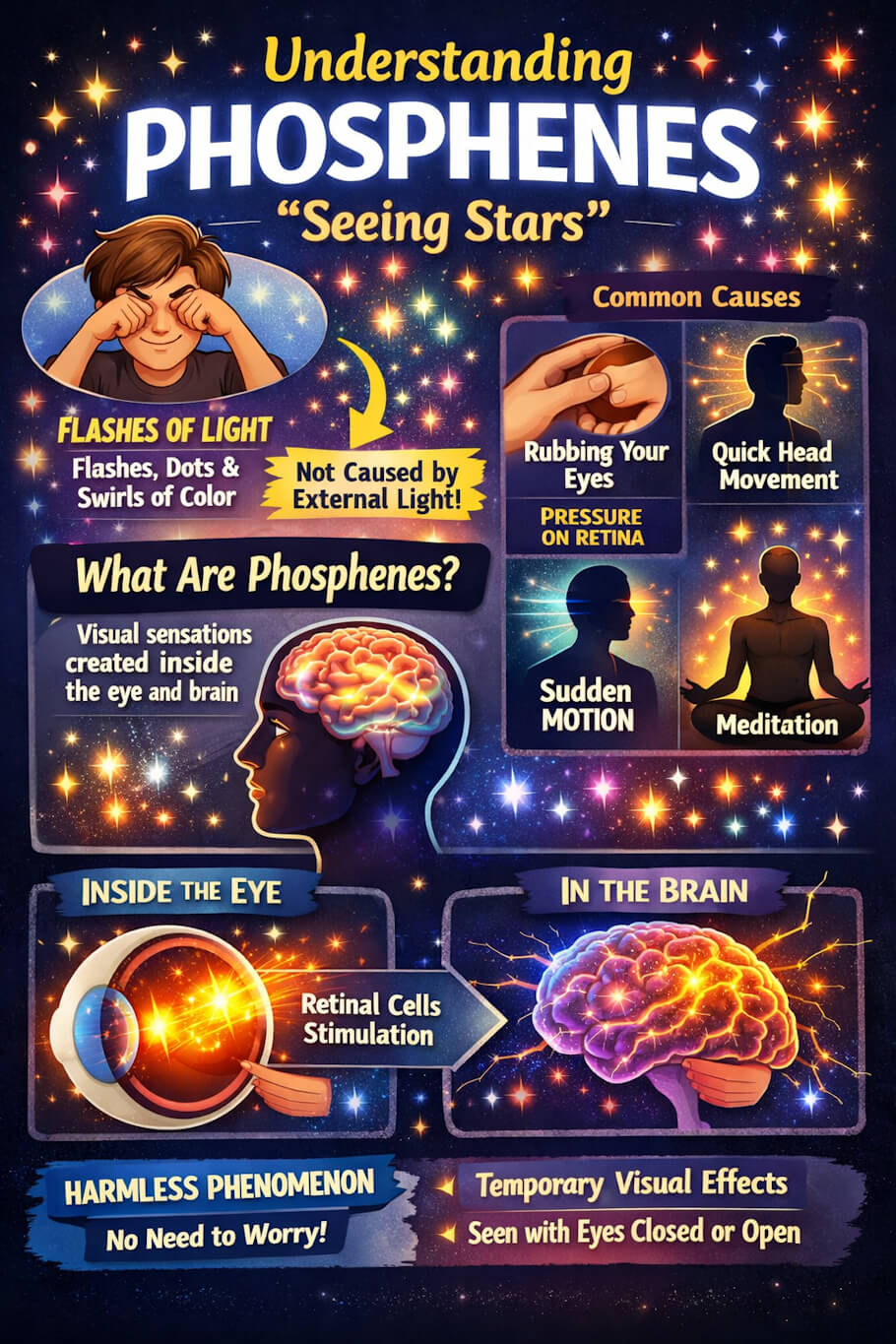
Phosphenes are visual sensations of light - such as flashes, geometric patterns, colors, or glowing spots - that occur without any external light actually entering the eye. They are produced when neurons along the visual pathway, from the retina to the visual cortex of the brain, are stimulated by non-photic means such as mechanical pressure, electrical current, magnetic fields, or spontaneous neural activity. Nearly everyone experiences phosphenes at some point, most commonly when rubbing closed eyes or transitioning into sleep in a dark room, and they are generally considered a normal part of how the visual system functions rather than a sign of disease.
Overview
Phosphenes Explained: The Science Behind Seeing Light in the Dark
Most people have experienced it at some point - you rub your closed eyes after a long day, and suddenly a swirl of colors, lights, and shifting geometric patterns appears in your visual field. These phantom lights are called phosphenes, and they are among the most common yet least understood visual phenomena in everyday life. The word itself comes from the Greek roots phos (light) and phainein (to show), which is fitting because phosphenes are quite literally a display of light that has no external source. They are generated entirely within the visual system itself (Gruesser and Hagner, 1990).
Unlike the images we see when we look at the world around us, phosphenes are not caused by photons entering the eye and stimulating the retina in the usual way. Instead, they result from direct stimulation of neurons somewhere along the visual pathway - from the retina all the way to the visual cortex at the back of the brain. This stimulation can be mechanical, electrical, or even magnetic. The result is the perception of light, shapes, or patterns that exist nowhere outside the observer's own nervous system.
How Do Phosphenes Occur?
There are several well-documented ways that phosphenes can be triggered, and understanding these mechanisms helps clarify what phosphenes are and, just as importantly, what they are not.
Mechanical Phosphenes
The most familiar type of phosphene is the mechanical phosphene, which occurs when physical pressure is applied to the eye. Gently pressing on a closed eyelid stimulates the retinal cells through deformation, and those cells respond as though they have received light. This is why rubbing tired eyes can produce fleeting bursts of color and pattern. The phenomenon was noted as far back as the ancient Greeks, and Isaac Newton famously experimented with it by pressing a bodkin - a blunt needle - against the side of his own eye to observe the resulting visual effects (Oster, 1970).
Electrical Phosphenes
Passing a weak electrical current near the eyes or across the scalp can also produce phosphenes. Researchers have used transcranial electrical stimulation to induce phosphenes since the early days of neuroscience. When a mild current is applied to the visual cortex, subjects report seeing flashes or moving spots of light. This type of phosphene has become an important research tool, particularly in efforts to develop visual prosthetics for people who have lost their sight (Beauchamp et al., 2020).
Magnetic Phosphenes
Transcranial magnetic stimulation, or TMS, uses a rapidly changing magnetic field to induce small electrical currents in targeted regions of the brain. When TMS is applied over the occipital cortex - the brain's visual processing center - many people experience brief phosphene-like flashes. These magnetically induced phosphenes have helped researchers map visual cortex function and understand how different brain regions contribute to conscious visual experience (Kammer et al., 2005).
Spontaneous Phosphenes
Sometimes phosphenes appear without any obvious external cause. Many people report seeing faint swirling patterns, pinpoints of light, or shifting geometric shapes when they close their eyes in a dark room, particularly as they are falling asleep. These are sometimes called hypnagogic phosphenes and are thought to arise from the spontaneous firing of retinal cells or neurons in the visual cortex during the transition between wakefulness and sleep. While occasionally startling, they are considered normal and benign in the vast majority of cases (Ohayon et al., 1996).
Phosphenes vs. Eye Floaters: Key Differences
One of the most common points of confusion is the difference between phosphenes and eye floaters. While both involve seeing things that are not part of the external visual scene, they arise from entirely different causes and have distinct characteristics.
Eye floaters are small, shadowy shapes - often described as dots, threads, cobwebs, or squiggly lines - that drift across the field of vision. They are most noticeable when looking at a plain, bright background such as a blue sky or a white wall. Floaters are caused by tiny clumps or strands of collagen fibers within the vitreous humor, the gel-like substance that fills the interior of the eye. As light enters the eye, these clumps cast shadows on the retina, and we perceive those shadows as floaters. They are a physical phenomenon occurring inside the eyeball itself (Webb et al., 2012).
Phosphenes, by contrast, do not involve shadows or physical debris in the eye. They are generated by neural activity within the retina or the brain's visual processing areas. Where floaters tend to drift lazily and follow the movement of the eyes, phosphenes often appear as flashes, geometric patterns, or bursts of color and are usually triggered by a specific stimulus such as pressure, electrical activity, or the transition to sleep. Floaters are almost always harmless, though a sudden increase in floaters - especially if accompanied by flashes of light - can signal a retinal tear or detachment and should prompt immediate medical attention (American Academy of Ophthalmology, 2023).
In simple terms, floaters are about the physical structure of the eye, while phosphenes are about the electrical and neural activity of the visual system. They share the quality of being internally generated visual experiences, but the mechanisms behind them are fundamentally different.
Phosphenes vs. Migraine Auras: Understanding the Distinction
Another phenomenon that is frequently confused with phosphenes is the migraine aura. People who experience migraines with aura often see flickering lights, zigzag lines, shimmering arcs, or expanding blind spots in their visual field, typically lasting between 5 and 60 minutes. These visual disturbances can look superficially similar to phosphenes, but the underlying mechanism is quite different.
Migraine auras are believed to result from a wave of neuronal excitation followed by depression - known as cortical spreading depression - that moves slowly across the visual cortex. This wave of altered brain activity produces the characteristic expanding, often scintillating visual patterns that migraine sufferers know well (Charles and Baca, 2013). The experience tends to build gradually, move across the visual field in a predictable pattern, and resolve over a period of minutes. It is often followed by a headache, though not always.
Phosphenes, on the other hand, are typically brief, lasting only seconds or a few moments, and they do not progress across the visual field in the same organized, wave-like manner. Phosphenes can be triggered on demand - by rubbing the eyes, for instance - whereas migraine auras generally arrive uninvited and follow their own timeline. Additionally, migraine auras are considered a clinical feature of migraine disorder and may be accompanied by other neurological symptoms such as tingling, speech difficulty, or temporary partial vision loss. Phosphenes, in most contexts, are a normal physiological response to stimulation and are not a symptom of disease (Borsook et al., 2012).
That said, it is worth noting that some overlap exists. Certain individuals with migraine may experience phosphene-like flashes as part of their prodromal or aura phase, and distinguishing between a true phosphene and the early visual symptoms of a migraine can sometimes require careful clinical evaluation.
Phosphenes in Everyday Life
For the general population, phosphenes are a benign curiosity. Nearly everyone has seen them at some point, whether from rubbing their eyes, sneezing forcefully, standing up too quickly, or simply lying in a dark room before falling asleep. Athletes sometimes report seeing flashes of light after a blow to the head - these are phosphenes caused by mechanical impact to the visual system and, while they may be alarming, they serve as a useful reminder that the brain's visual machinery can be activated by forces other than light.
Some people report phosphenes during meditation or extended periods of sensory deprivation. In these contexts, the visual cortex, deprived of its usual input, begins to generate its own activity, producing faint patterns and lights. This has led to fascinating cultural and spiritual interpretations of phosphenes throughout human history. Some researchers have even proposed that the geometric patterns seen during phosphene experiences may have influenced prehistoric cave art and early symbolic imagery across cultures (Lewis-Williams and Dowson, 1988).
Phosphenes and Aging
As people age, the visual system undergoes a number of changes, and phosphenes can become more noticeable or occur more frequently in seniors. The vitreous humor gradually liquefies and shrinks over time, a process known as vitreous degeneration. As the vitreous pulls away from the retina - a common condition called posterior vitreous detachment - it can tug on the retinal surface and mechanically stimulate photoreceptor cells, producing brief flashes of light that are essentially phosphenes (Hollands et al., 2009). These flashes are especially common in people over the age of 60 and are usually harmless, though they can sometimes indicate a retinal tear that requires treatment.
Older adults may also experience phosphenes related to changes in blood flow and blood pressure, particularly orthostatic hypotension, a condition in which blood pressure drops suddenly when standing up from a seated or lying position. The brief reduction in blood flow to the visual cortex can trigger phosphene-like flashes or a temporary graying or whitening of vision. Because orthostatic hypotension is more prevalent among seniors, especially those taking medications for hypertension or heart conditions, phosphene experiences in this population can be more frequent and more concerning (Freeman et al., 2011).
For seniors, the key clinical question is whether phosphenes are benign or whether they signal an underlying problem. Flashes of light that are new, persistent, or accompanied by a sudden increase in floaters, a curtain-like shadow in the peripheral vision, or any loss of visual acuity should be evaluated promptly by an ophthalmologist. In many cases, the cause is harmless posterior vitreous detachment, but ruling out retinal detachment or other serious conditions is essential.
Phosphenes and Disability
Perhaps the most remarkable and hopeful area of phosphene research involves their potential role in assisting people with visual disabilities. For individuals who are blind or have severe vision loss, phosphenes represent a possible pathway to restoring some degree of visual experience through technology.
Visual Prosthetics and Cortical Implants
The concept is elegant in principle, though enormously challenging in practice. If electrical stimulation of the visual cortex produces phosphenes - discrete points of perceived light - then an array of electrodes implanted in or on the surface of the visual cortex could theoretically produce a pattern of phosphenes that corresponds to the visual scene captured by an external camera. This is the foundational idea behind cortical visual prosthetics, sometimes called bionic eyes or brain-computer visual interfaces (Beauchamp et al., 2020).
Researchers at institutions including Baylor College of Medicine and the Netherlands Institute for Neuroscience have made significant progress in this field. In experiments, blind participants fitted with cortical electrode arrays have been able to perceive shapes, letters, and simple visual patterns generated entirely through electrically induced phosphenes. While the resolution of these systems remains limited compared to natural vision, the results demonstrate that phosphenes can serve as building blocks for a functional, albeit rudimentary, form of artificial sight (Fernandez et al., 2021).
Retinal Prosthetics
In addition to cortical implants, retinal prosthetic devices such as the Argus II system have used electrical stimulation of the remaining retinal cells to produce phosphenes in individuals with conditions like retinitis pigmentosa. These devices bypass the damaged photoreceptor cells and directly stimulate the retinal ganglion cells, which transmit signals to the brain. Patients using these devices have reported being able to detect movement, identify doorways, and navigate environments more independently - all through patterns of phosphenes generated by the implant (Luo and da Cruz, 2016).
Phosphenes and Other Disabilities
Beyond blindness and low vision, phosphenes are relevant to a broader range of disabilities. People with traumatic brain injuries may experience phosphenes as a result of damage to or disruption of the visual pathways. Individuals with epilepsy, particularly those with seizure activity originating in the occipital lobe, may see phosphene-like flashes as part of their seizure aura (Panayiotopoulos, 1999). Understanding phosphenes in these populations helps clinicians distinguish between benign visual phenomena and symptoms that may require intervention.
For individuals with multiple sclerosis, optic neuritis - inflammation of the optic nerve - can sometimes produce phosphenes, particularly phosphenes triggered by eye movement, a phenomenon known as movement phosphenes or phosphenes of optic neuritis. These are thought to result from the demyelinated optic nerve fibers becoming mechanically sensitive, so that the normal stretching of the nerve during eye movement generates abnormal electrical signals perceived as brief flashes (Davis et al., 2010).
In rehabilitation settings, phosphene research informs our understanding of neuroplasticity and the brain's capacity to adapt to altered sensory input. For people adjusting to vision loss later in life, knowing that the visual cortex retains its capacity to generate phosphenes offers both a scientific basis for hope and a practical foundation for developing assistive technologies.
When Should Phosphenes Be a Concern?
In most situations, phosphenes are nothing to worry about. The brief lights seen when rubbing closed eyes, the faint patterns that appear in darkness before sleep, or the occasional flash when sneezing or coughing are all part of normal visual physiology. However, there are circumstances in which phosphenes warrant medical attention.
If phosphenes occur frequently without any obvious trigger, if they are accompanied by other visual symptoms such as a sudden shower of floaters or a shadow creeping across the visual field, or if they are associated with headaches, neurological symptoms, or changes in vision, a visit to an eye care professional or neurologist is appropriate. In older adults particularly, new-onset flashes of light should be evaluated to rule out retinal detachment, which is a medical emergency requiring prompt surgical intervention (American Academy of Ophthalmology, 2023).
Persistent or unusually vivid phosphenes can also be a side effect of certain medications, or they can occur in the context of conditions affecting the optic nerve or visual cortex. In all cases, the clinical significance of phosphenes depends on their context - who is experiencing them, how often, under what circumstances, and whether they are accompanied by other symptoms.
The Future of Phosphene Research
Phosphene research sits at a fascinating intersection of neuroscience, ophthalmology, biomedical engineering, and disability science. As our tools for mapping and stimulating the brain become more precise, our understanding of phosphenes continues to deepen. The development of high-density electrode arrays, advances in brain-computer interface technology, and improved understanding of visual cortex organization are all contributing to a future in which phosphenes may play a central role in restoring vision to those who have lost it.
At the same time, basic research into why and how spontaneous phosphenes occur continues to shed light on the fundamental workings of the visual system. Every phosphene, however fleeting, is a window into the brain's remarkable capacity to create visual experience from within - a reminder that seeing is not simply a matter of light entering the eye, but of a brain actively constructing the world we perceive.
Frequently Asked Questions
Are phosphenes the same as seeing stars after standing up too fast
Yes, the brief flashes many people notice when they stand up quickly are phosphenes. They are often linked to a short drop in blood flow to the visual cortex.
Can staring at a bright screen cause phosphenes
Screen light itself does not create true phosphenes because that is normal light entering the eye. Eye strain and rubbing tired eyes afterward, however, can trigger them.
Do children see phosphenes too
Yes, phosphenes are a normal feature of the human visual system at every age. Children commonly notice them when they rub their eyes or lie in a dark room.
Are phosphenes a sign that I need glasses
No, phosphenes are unrelated to refractive errors like nearsightedness or farsightedness. Needing glasses affects how clearly you focus, not whether you see internal flashes.
Can stress or anxiety trigger phosphenes
Stress does not directly produce phosphenes, but related habits such as forceful eye rubbing or poor sleep can make them more noticeable. Fatigue in particular tends to increase awareness of them.
How long do phosphenes usually last
Most phosphenes last only a few seconds or moments before fading. Flashes that persist or keep returning without a clear trigger should be checked by an eye professional.
Can dehydration cause phosphenes
Dehydration can lower blood pressure and reduce blood flow to the brain, which may bring on phosphene-like flashes. Rehydrating and standing up slowly usually helps reduce them.
Is there any way to stop seeing phosphenes
Since most phosphenes are harmless and brief, no treatment is needed for the everyday type. Avoiding hard eye rubbing and having sudden or frequent flashes evaluated are the main sensible steps.
References:
American Academy of Ophthalmology. (2023). Flashes of light. American Academy of Ophthalmology Eye Health Information.
Beauchamp, M. S., Oswalt, D., Sun, P., Foster, B. L., Magnotti, J. F., Niketeghad, S., Pouratian, N., Bosking, W. H., and Yoshor, D. (2020). Dynamic stimulation of visual cortex produces form vision in sighted and blind humans. Cell, 181(4), 774-783.
Borsook, D., Maleki, N., Becerra, L., and McEwen, B. (2012). Understanding migraine through the lens of maladaptive stress responses: A model disease of allostatic load. Neuron, 73(2), 219-234.
Charles, A., and Baca, S. M. (2013). Cortical spreading depression and migraine. Nature Reviews Neurology, 9(11), 637-644.
Davis, F. A., Bergen, D., Schauf, C., McDonald, I., and Deutsch, W. (2010). Movement phosphenes in optic neuritis: A new clinical sign. Neurology, 26(11), 1100-1104.
Fernandez, E., Alfaro, A., Soto-Sanchez, C., Gonzalez-Lopez, P., Lozano, A. M., Pena, S., Grima, M. D., Rodil, A., Gomez, B., Chen, X., Vidal-Sanz, M., Castaldi, E., Keliris, G. A., Normann, R. A., and Bernabeu, A. (2021). Visual percepts evoked with an intracortical 96-channel microelectrode array inserted in human occipital cortex. Journal of Clinical Investigation, 131(23), e151331.
Freeman, R., Wieling, W., Axelrod, F. B., Benditt, D. G., Benarroch, E., Biaggioni, I., Cheshire, W. P., Chelimsky, T., Cortelli, P., Gibbons, C. H., Goldstein, D. S., Hainsworth, R., Hilz, M. J., Jacob, G., Kaufmann, H., Jordan, J., Lipsitz, L. A., Levine, B. D., Low, P. A., and Raj, S. R. (2011). Consensus statement on the definition of orthostatic hypotension, neurally mediated syncope and the postural tachycardia syndrome. Clinical Autonomic Research, 21(2), 69-72.
Gruesser, O. J., and Hagner, M. (1990). On the history of deformation phosphenes and the idea of internal light generated in the eye for the purpose of vision. Documenta Ophthalmologica, 74(1-2), 57-85.
Hollands, H., Johnson, D., Brox, A. C., Almeida, D., Simel, D. L., and Sharma, S. (2009). Acute-onset floaters and flashes: Is this patient at risk for retinal detachment? JAMA, 302(20), 2243-2249.
Kammer, T., Puls, K., Erb, M., and Grodd, W. (2005). Transcranial magnetic stimulation in the visual system. II. Characterization of induced phosphenes and scotomas. Experimental Brain Research, 160(1), 129-140.
Lewis-Williams, J. D., and Dowson, T. A. (1988). The signs of all times: Entoptic phenomena in Upper Palaeolithic art. Current Anthropology, 29(2), 201-245.
Luo, Y. H. L., and da Cruz, L. (2016). The Argus II retinal prosthesis system. Progress in Retinal and Eye Research, 50, 89-107.
Ohayon, M. M., Priest, R. G., Caulet, M., and Guilleminault, C. (1996). Hypnagogic and hypnopompic hallucinations: Pathological phenomena? British Journal of Psychiatry, 169(4), 459-467.
Oster, G. (1970). Phosphenes. Scientific American, 222(2), 82-87.
Panayiotopoulos, C. P. (1999). Elementary visual hallucinations, blindness, and headache in idiopathic occipital epilepsy: Differentiation from migraine. Journal of Neurology, Neurosurgery and Psychiatry, 66(4), 536-540.
Webb, B. F., Webb, J. R., Schroeder, M. C., and North, C. S. (2012). Prevalence of vitreous floaters in a community sample of smartphone users. International Journal of Ophthalmology, 6(3), 402-405.
Insights, Analysis, and Developments
Editorial Note: Phosphenes remind us that vision is not a passive process of recording light but an active construction carried out by the brain, and understanding that construction opens doors that extend far beyond academic curiosity. From helping clinicians distinguish harmless flashes from urgent warning signs in aging eyes, to powering cortical implants that may one day give blind individuals a functional form of sight, the humble phosphene carries outsized significance for human health, science, and hope. As research into visual prosthetics and brain-computer interfaces accelerates, the study of phosphenes is poised to move from the margins of vision science to the very center of how we think about perception, disability, and the remarkable adaptability of the human brain.
 Author Credentials: Ian C. Langtree is a writer, editor, and the founder and Editor-in-Chief of Disabled World, which he established in 2004 as one of the longest-running independent resources for disability news and information. Over more than two decades, he has written and edited thousands of articles on disability rights, health, accessibility, and assistive technology. Drawing on a global perspective shaped by extensive travel and lived experience, Ian is a committed advocate of the Social Model of Disability, the framework developed by disabled activists in the 1970s that focuses on removing societal barriers rather than on individual impairments. His writing is grounded in that framework and in a lasting commitment to disability rights, accessibility, and social inclusion. To learn more about Ian's background, expertise, and accomplishments, visit his full biography.