Savant vs Savant Syndrome: Meaning, Causes and Examples
Author: Ian C. Langtree - View Credentials
Published: 25 Oct 2026
Publication Type: Informative
Table of Contents:
Synopsis - Definition - Overview - FAQs - Insights, Updates - Related Content
Synopsis
The word savant once described the learned scholars who followed Napoleon into Egypt, yet today it most often brings to mind a blind pianist replaying a concerto after a single hearing or an artist sketching a whole city from memory. This paper untangles two terms that are constantly confused, explaining that a savant is a person while savant syndrome is the rare condition in which remarkable ability sits beside a developmental disability, brain injury, or brain disease. Drawing on more than a century of clinical observation and modern neuroscience, it examines how often the condition occurs, the three paths by which it can emerge, the leading theories of how the savant brain works, and the real people whose lives have shaped public understanding.
At a Glance
- 1 - Kim Peek, who inspired the film Rain Man, was born without a corpus callosum. Despite the film's portrayal, Peek himself was not autistic.
- 2 - Brief, mild brain stimulation helped 40 percent of volunteers solve the notoriously hard nine-dot puzzle. None of the unstimulated control group managed it.
- 3 - Some people with frontotemporal dementia develop new artistic talent as the disease advances. Their art can flourish even as language and social skills decline.
- 4 - Savant syndrome is reported in males roughly four to six times as often as in females. Some researchers link this to prenatal hormonal effects on left hemisphere development.
Topic Definition
- Savant and Savant Syndrome
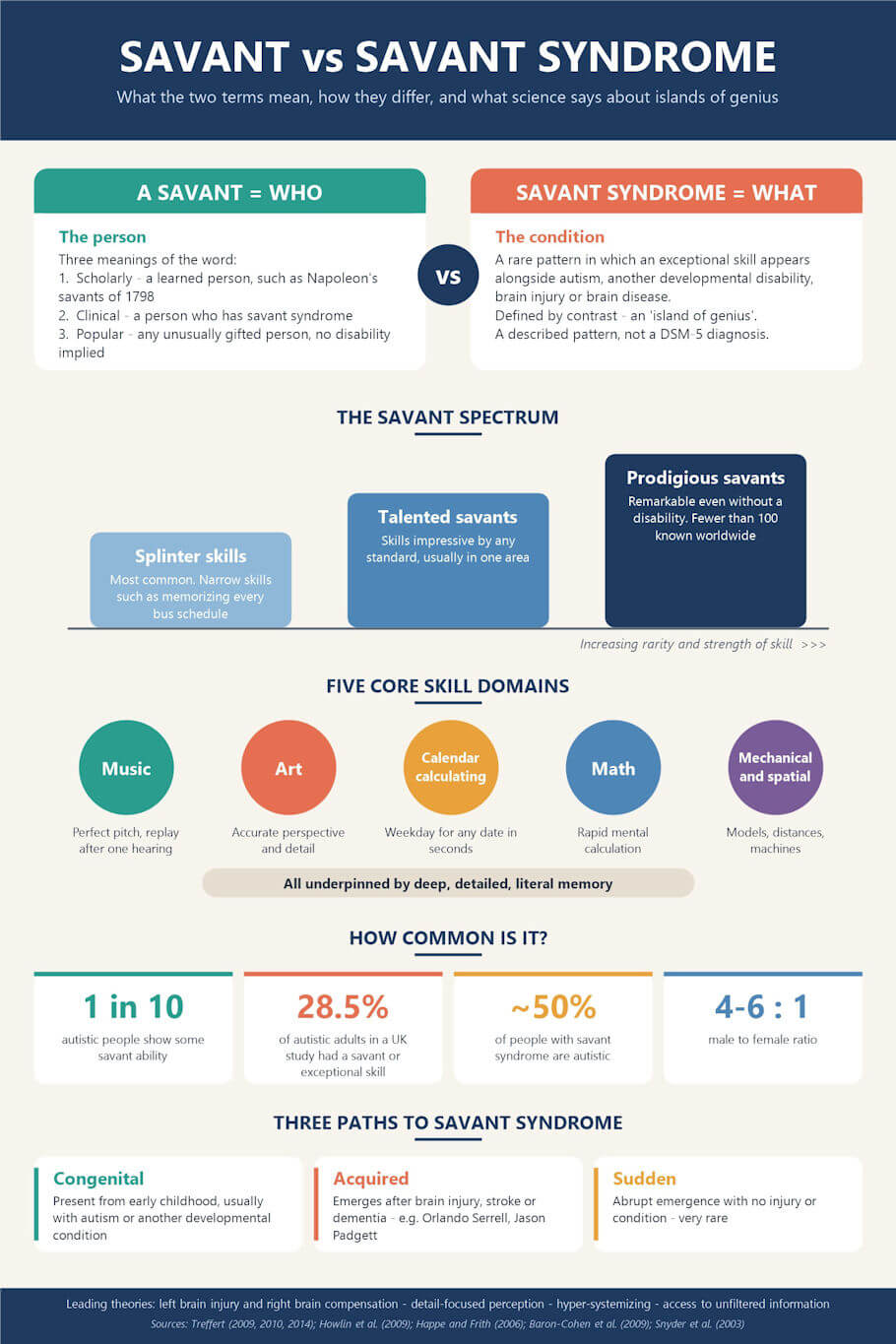
A savant is a person who shows an exceptional ability, and while the word once described any learned scholar, in medicine it now refers to someone who has savant syndrome. Savant syndrome is the rare condition behind that label, in which a person with autism, another developmental disability, a brain injury, or a brain disease displays a striking skill, most often in music, art, calendar calculating, mathematics, or mechanical and spatial tasks, that stands in sharp contrast to their overall level of functioning. Put simply, the savant is the individual and savant syndrome is the pattern that individual lives with, and the skill can range from a narrow splinter ability to prodigious talent that would be remarkable in anyone.
Overview
Two Words, One Puzzle
When Napoleon Bonaparte invaded Egypt in 1798, he brought more than 150 scholars with him - mathematicians, engineers, botanists, and artists who measured temples, catalogued plants, and helped produce the multivolume Description de l'Egypte. History remembers them simply as the savants. Nobody in that group would have been described as having a syndrome. They were savants in the oldest sense of the word: learned people.
Fast forward to a modern search bar, and "savant" now pulls up something quite different - a blind pianist who can replay a concerto after one hearing, or an artist who draws an entire city skyline from memory after a short helicopter flight. The same word now points to a person, a set of skills, and a recognized medical pattern. Sorting out which is which is the purpose of this paper.
The word itself comes from the French verb savoir, "to know." Its clinical career began in 1887, when the London physician John Langdon Down described patients who combined serious intellectual disability with remarkable abilities, and he named them "idiot savants" (Down, 1887). At the time, "idiot" was a formal classification for people with very low measured intelligence, not the insult it later became (Treffert, 2009). The phrase stuck for nearly a century before researchers replaced it with the more accurate and respectful term savant syndrome.
Famous Savants: Notable People With Savant Syndrome: A list of famous savants, from Kim Peek to Stephen Wiltshire, with the musical, artistic, memory and acquired skills that define Savant Syndrome.
What Is a Savant?
Savant (noun): a person with exceptional knowledge or ability. In clinical and research writing, it refers specifically to a person who has savant syndrome.
"Savant" is a label for a person. Today it is used in three overlapping ways, and much of the public confusion comes from people sliding between them without noticing:
- The scholarly sense - a learned person or distinguished scientist, as with Napoleon's expedition. This usage is now old-fashioned but still appears in academic and literary writing.
- The clinical sense - a person with savant syndrome, meaning someone whose striking ability exists alongside a developmental disability, brain injury, or neurological disease.
- The popular sense - a loose compliment for anyone unusually gifted, as when a sports commentator calls a quarterback a "football savant." No disability is implied.
Only the second meaning carries medical weight. When researchers write about savants, they mean people who fit the clinical picture, and the difference matters because the popular sense can blur a real condition into a figure of speech.
What Is Savant Syndrome?
Savant syndrome: a rare condition in which a person with a significant developmental disability, brain injury, or brain disease shows one or more abilities that stand out sharply, both against the person's own overall functioning and, in some cases, against the general population.
Psychiatrist Darold Treffert, who studied savants for more than five decades and became the leading authority on the subject, described these abilities as "islands of genius" (Treffert, 2010). The image is useful. An island is defined as much by the water around it as by the land itself. In savant syndrome, the striking skill is meaningful precisely because of the contrast with the surrounding challenges, which may include limited language, difficulty with daily living tasks, or significant social differences.
A syndrome is a cluster of features that tend to occur together. It is not a single disease with a single cause. Savant syndrome is not listed as a diagnosis in the Diagnostic and Statistical Manual of Mental Disorders, the standard reference used by clinicians in the United States (American Psychiatric Association, 2013). Instead, it describes a pattern that can appear within autism, intellectual disability, or acquired brain conditions. Think of it less like a diagnosis and more like a description of how a particular mind is organized.
The Core Difference Between Savant and Savant Syndrome
The simplest way to hold the distinction is grammatical. A savant is who; savant syndrome is what. One names the person, the other names the condition that person has. The relationship resembles the one between a "climber" and "mountaineering" - one is an individual, the other is the domain that defines the individual's role.
Several practical differences follow from that starting point:
- Scope - "Savant" can be used in everyday conversation without any medical meaning. "Savant syndrome" is always a clinical and research term.
- Requirement of contrast - Savant syndrome requires that the ability coexist with a disability or neurological condition. A gifted violinist with no disability may be called a musical savant in casual speech, but that person does not have savant syndrome.
- Level of analysis - "Savant" focuses on an individual and what that individual can do. "Savant syndrome" refers to a pattern seen across many individuals, which allows researchers to ask questions about causes, frequency, and brain mechanisms.
- Grading - Researchers grade savant syndrome by the strength of the skill, which leads to the categories described below. The word "savant" alone carries no such scale.
Splinter Skills, Talented Savants and Prodigious Savants
Treffert proposed a three-level spectrum that helps clarify what is, and what is not, extraordinary (Treffert, 2009):
- Splinter skills - the most common level. These are narrow abilities, such as memorizing every bus schedule in a city or knowing obscure sports statistics, that stand out against the person's overall functioning.
- Talented savants - people whose skills are impressive by any standard, not just in contrast to their disability. Their abilities are well developed and usually concentrated in one area.
- Prodigious savants - an extremely rare group whose abilities would be remarkable even in a person without any disability. Treffert estimated that there were fewer than 100 known prodigious savants living worldwide at the time of his 2009 review.
This spectrum works like the zoom function on a digital map. Splinter skills are the street view, ordinary in the wider landscape but notable on that particular block. Prodigious savants are the mountains visible from orbit.
Where Savant Abilities Tend to Appear
One of the most striking things about savant syndrome is how narrow its range of abilities is. Across hundreds of reported cases, the same few domains appear again and again (Treffert, 2009):
- Music - most often piano, frequently paired with perfect pitch and the ability to replay a piece after hearing it once.
- Art - typically drawing, painting, or sculpture, often with exceptional accuracy in perspective and detail.
- Calendar calculating - naming the day of the week for a date far in the past or future, usually within seconds.
- Mathematics - rapid mental calculation or, more rarely, an intuitive grasp of prime numbers.
- Mechanical and spatial skills - building complex models, estimating distances precisely, or assembling and repairing machines without instruction.
Less commonly, savants show unusual language ability. One well-documented example, a man known in the research literature as Christopher, had significant difficulties with everyday tasks yet could read, write, and translate in more than a dozen languages (Smith and Tsimpli, 1995).
Running underneath almost every one of these domains is a deep, highly detailed memory. Treffert noted that this memory tends to be narrow and very literal - closer to an extremely high-resolution recording than to the flexible, meaning-based memory most people use.
How Common Is Savant Syndrome?
The figures most often cited come from long-term clinical work and population studies:
- About 1 in 10 autistic people show some savant ability, according to Treffert's widely cited estimate (Treffert, 2009).
- A British study of autistic adults found that 28.5 percent had either a savant skill reported by parents or an exceptional cognitive skill measured by testing, which suggests that the true rate depends heavily on how a "skill" is defined (Howlin et al., 2009).
- Roughly half of all people with savant syndrome are autistic. The other half have other developmental disabilities, intellectual disability, or brain injury or disease (Treffert, 2009).
- Savant syndrome is reported far more often in males than females, with ratios of around four to six males for every female (Treffert, 2009).
A useful term here is base rate, meaning how common something is within a defined group. The base rate of savant skills within autism is notable, but the base rate of autism within savant syndrome is just as telling. The two conditions overlap heavily without being the same thing.
Born With It or Acquired Later: Three Paths to Savant Syndrome
Congenital Savant Syndrome
Most savants show their abilities in early childhood, usually alongside autism or another developmental condition that is present from birth. Parents often notice the skill well before a formal diagnosis is made, such as a toddler who picks out melodies on a piano or a young child who draws in accurate perspective.
Acquired Savant Syndrome
In rarer cases, savant abilities emerge after a brain injury, stroke, or the onset of brain disease in someone who previously showed no special talent. Orlando Serrell was struck on the head by a baseball at age 10 and afterward found he could calculate calendar dates and recall the weather for nearly every day since the accident (Treffert, 2010). Jason Padgett, after a violent assault in 2002 left him with a concussion, began seeing geometric patterns in the world around him and taught himself to draw intricate mathematical fractals. Brain imaging studies later linked his experience to unusual activity in regions involved in visual and mathematical processing (Brogaard et al., 2013).
A striking variation appears in some people with frontotemporal dementia, a disease that damages the front and side regions of the brain. Neurologist Bruce Miller and colleagues described patients who developed new artistic abilities as the disease progressed, even as their language and social skills declined (Miller et al., 1998).
Sudden Savant Syndrome
Treffert also described a small number of cases where people with no injury, illness, or developmental condition abruptly developed savant-like ability, often in music or art (Treffert, 2010). These cases are few and less well studied, but they raise a provocative question: could such capacity be latent in many brains, waiting for the right conditions?
Inside the Savant Brain: The Leading Explanations
No single theory accounts for every case, and researchers increasingly view the explanations below as overlapping layers of one larger picture rather than competing answers.
Left Brain Injury, Right Brain Compensation
Many savant skills - visual art, music, spatial reasoning - draw heavily on processes associated with the right hemisphere of the brain, while language relies more on the left. Treffert proposed that injury or atypical development in the left hemisphere may lead the right hemisphere to take on a larger role, a process known as compensation. This idea also fits with the male predominance of savant syndrome, since some researchers have proposed that prenatal hormonal differences can affect how the left hemisphere develops (Treffert, 2009).
Detail-Focused Thinking
The weak central coherence theory, developed by Uta Frith and Francesca Happe, suggests that many autistic people naturally process details before the overall picture, rather than automatically pulling details into a general meaning (Happe and Frith, 2006). In a related idea, the enhanced perceptual functioning model holds that autistic perception can be unusually sharp and less filtered by expectation (Mottron et al., 2006). Both ideas help explain why a savant artist might reproduce every window in a building that most people would summarize as "a tall glass tower."
Hyper-Systemizing
Simon Baron-Cohen and colleagues proposed that savant talent grows from a combination of heightened attention to detail, sensory sensitivity, and systemizing - a strong drive to find the rules that govern a system, whether that system is a calendar, a piece of music, or a train timetable (Baron-Cohen et al., 2009).
Access to Unfiltered Information
Physicist and neuroscientist Allan Snyder argued that all brains collect detailed, raw information, but most quickly convert it into concepts and discard the rest. Savants, in this view, have unusual access to that lower-level information. To test the idea, Snyder's team used transcranial magnetic stimulation, a noninvasive method that briefly alters activity in a targeted brain region, to temporarily dampen the left front temporal area in volunteers. Some participants showed modest, short-lived improvements in drawing and proofreading tasks (Snyder et al., 2003). In a later study using mild electrical stimulation, 40 percent of participants solved a classic and very difficult puzzle called the nine-dot problem, compared with none in the control group (Chi and Snyder, 2012). These results are intriguing, but they involve small samples and do not mean that savant ability can be switched on at will.
A thought experiment: Look at this paragraph and try not to read it. You can't. Your brain converts shapes into letters, letters into words, and words into meaning before you can stop it. Now imagine a mind that keeps the shapes as shapes, every serif and spacing gap preserved. That mind might struggle to summarize the paragraph, but it might also be able to draw it perfectly from memory. That trade-off sits at the heart of several theories of savant syndrome.
Reading Savant Syndrome Across Time
Savant syndrome makes more sense when it is viewed across several timescales at once, because the pattern looks different depending on how far you zoom out.
- Milliseconds - At the level of perception, the key event may be what the brain does or does not filter in the first fraction of a second. Detail that most brains discard may remain available to a savant.
- Years - Across a lifetime, skills tend to deepen through intense, repetitive practice. Many savants rehearse their skill for hours a day, and in some people, such as Leslie Lemke, ability that began as precise imitation later expanded into improvisation (Treffert, 2014).
- Centuries - Across history, the concept itself has shifted, from Down's "idiot savant" to a recognized syndrome and finally to a lens that informs how scientists think about memory, creativity, and the hidden capacities of all brains.
These layers fit together. A perceptual difference that lasts milliseconds, practiced for decades, becomes the kind of life story that eventually reshapes a scientific field. That alignment between small and large scales is what researchers mean when they describe a model as coherent.
Well-Known Examples
Kim Peek
Kim Peek (1951 to 2009) was the real-life inspiration for the character Raymond Babbitt in the 1988 film Rain Man. Peek was born without a corpus callosum, the thick band of fibers that normally connects the brain's two hemispheres, and he had other structural brain differences. He could read two pages at once, one with each eye, and he retained an enormous store of facts covering history, geography, music, and thousands of books (Treffert and Christensen, 2005). Although the film portrayed its character as autistic, Peek himself was not autistic, a detail often lost in the popular retelling.
Leslie Lemke
Leslie Lemke was born prematurely in 1952 and lost his sight as an infant. He also had cerebral palsy and significant developmental disabilities. At age 14, after hearing Tchaikovsky's Piano Concerto No. 1 on television, he sat at the piano and played it back without having had formal lessons (Treffert, 2010).
Stephen Wiltshire
Stephen Wiltshire, a British artist who is autistic, can draw detailed panoramas of entire cities, including Rome, Tokyo, and New York, after a brief helicopter ride over them. He was appointed a Member of the Order of the British Empire (MBE) in 2006 for services to art.
Daniel Tammet
Daniel Tammet, who was diagnosed with Asperger syndrome and also experiences synesthesia (a blending of the senses in which numbers, for example, may appear as colors or shapes), recited the mathematical constant pi to 22,514 decimal places from memory in 2004, a European record at the time. He has also written several books describing his inner experience.
Common Misconceptions
- "Most autistic people are savants." They are not. Most autistic people do not have savant syndrome, and the stereotype can create unfair expectations for autistic children and adults.
- "Savants are just human recording devices." Treffert's later work emphasized that many savants move from copying to genuine creativity over time, composing original music or developing distinctive artistic styles (Treffert, 2014).
- "Savant ability always comes with intellectual disability." Measured intelligence in savants ranges widely. Some have intellectual disability, while others score in the average or above-average range in areas outside their special skill.
- "The talent is a gift that offsets the disability." The relationship is more complex. A savant skill can bring purpose, connection, and even a career, but it does not cancel the support needs that come with the underlying condition.
A Note on Language
The phrase "idiot savant" is now considered outdated and offensive, and it is no longer used in medical or research writing. "Savant syndrome" and "person with savant syndrome" are the standard terms. Some autistic people prefer identity-first language, such as "autistic savant," while others prefer person-first phrasing. When writing about a specific person, it is best to follow that person's own preference.
Why the Distinction Matters
Keeping "savant" and "savant syndrome" separate is not mere wordplay. When the popular sense swallows the clinical one, the real condition becomes a cliche, and the people living with it can be reduced to party tricks. When the clinical sense is kept clear, savant syndrome becomes what Treffert believed it was - a window into how memory, perception, and talent are built in every human brain, and a reminder that disability and ability can sit side by side in the same person.
Frequently Asked Questions
Is savant syndrome inherited or passed down in families?
There is no known savant gene, and most savants do not have relatives with similar skills. Researchers think genetics may play an indirect role through the conditions linked to savant syndrome, such as autism, which has a strong hereditary component, but the skill itself does not appear to be directly inherited.
Can savant skills be taught to people who do not have them?
Ordinary practice can build impressive memory and calculation abilities, as memory champions show, but these are learned strategies rather than savant skills. Savant abilities tend to appear without formal instruction and operate with unusual speed and precision, so they cannot simply be taught in the usual sense.
Do savant abilities ever fade or disappear?
Most savant skills remain stable or grow stronger with regular use throughout life. A few cases describe a skill becoming less striking over time, sometimes as language or social abilities develop, which suggests that the brain may shift its resources as other abilities emerge.
Is a person with a very high IQ considered a savant?
Not in the clinical sense. A high IQ reflects strong general reasoning across many areas, while a savant shows an exceptional skill in one narrow area that contrasts with the rest of their abilities. A gifted person may be called a savant in casual speech, but they do not have savant syndrome unless a disability or neurological condition is also present.
Is savant memory the same as a photographic memory?
They are related but not identical. Savant memory is usually deep and highly detailed within a narrow subject, such as music, dates, or visual scenes. True photographic memory, known as eidetic memory, is very rare in adults and has proven difficult to verify in controlled research.
Can people with savant syndrome live and work independently?
It depends on the person and the underlying condition rather than on the skill. Some savants need lifelong daily support, while others live on their own and turn their ability into a career in art, music, or technical work. Support needs should be assessed individually, without assuming the skill reduces them.
Should parents encourage a child's savant skill or try to redirect it?
Many clinicians recommend nurturing the skill rather than suppressing it. A special ability can serve as a bridge to communication, social connection, and independence, and focused interest is often a strong motivator for learning other skills when teachers and therapists build on it.
How are savant skills identified or assessed?
There is no single test for savant syndrome. Clinicians and researchers usually combine a developmental or neurological assessment with standardized cognitive testing, parent or caregiver reports, and direct demonstration of the skill to judge how unusual it is compared with the person's other abilities and with the general population.
References:
American Psychiatric Association. (2013). Diagnostic and statistical manual of mental disorders (5th ed.). American Psychiatric Publishing.
Baron-Cohen, S., Ashwin, E., Ashwin, C., Tavassoli, T., and Chakrabarti, B. (2009). Talent in autism: Hyper-systemizing, hyper-attention to detail and sensory hypersensitivity. Philosophical Transactions of the Royal Society B: Biological Sciences, 364(1522), 1377-1383.
Brogaard, B., Vanni, S., and Silvanto, J. (2013). Seeing mathematics: Perceptual experience and brain activity in acquired synesthesia. Neurocase, 19(6), 566-575.
Chi, R. P., and Snyder, A. W. (2012). Brain stimulation enables the solution of an inherently difficult problem. Neuroscience Letters, 515(2), 121-124.
Down, J. L. (1887). On some of the mental affections of childhood and youth. J. and A. Churchill.
Happe, F., and Frith, U. (2006). The weak coherence account: Detail-focused cognitive style in autism spectrum disorders. Journal of Autism and Developmental Disorders, 36(1), 5-25.
Howlin, P., Goode, S., Hutton, J., and Rutter, M. (2009). Savant skills in autism: Psychometric approaches and parental reports. Philosophical Transactions of the Royal Society B: Biological Sciences, 364(1522), 1359-1367.
Miller, B. L., Cummings, J., Mishkin, F., Boone, K., Prince, F., Ponton, M., and Cotman, C. (1998). Emergence of artistic talent in frontotemporal dementia. Neurology, 51(4), 978-982.
Mottron, L., Dawson, M., Soulieres, I., Hubert, B., and Burack, J. (2006). Enhanced perceptual functioning in autism: An update, and eight principles of autistic perception. Journal of Autism and Developmental Disorders, 36(1), 27-43.
Smith, N., and Tsimpli, I.-M. (1995). The mind of a savant: Language learning and modularity. Blackwell.
Snyder, A. W., Mulcahy, E., Taylor, J. L., Mitchell, D. J., Sachdev, P., and Gandevia, S. C. (2003). Savant-like skills exposed in normal people by suppressing the left fronto-temporal lobe. Journal of Integrative Neuroscience, 2(2), 149-158.
Treffert, D. A. (2009). The savant syndrome: An extraordinary condition. A synopsis: Past, present, future. Philosophical Transactions of the Royal Society B: Biological Sciences, 364(1522), 1351-1357.
Treffert, D. A. (2010). Islands of genius: The bountiful mind of the autistic, acquired, and sudden savant. Jessica Kingsley Publishers.
Treffert, D. A. (2014). Savant syndrome: Realities, myths and misconceptions. Journal of Autism and Developmental Disorders, 44(3), 564-571.
Treffert, D. A., and Christensen, D. D. (2005). Inside the mind of a savant. Scientific American, 293(6), 108-113.
Insights, Analysis, and Developments
Editorial Note: Savant syndrome endures as one of the most revealing puzzles in brain science because it refuses to fit the tidy idea that intelligence is a single, measurable quantity. A person who cannot manage a bus fare may name the weekday of any date in history, and a man who struggled with ordinary routines could recall the contents of thousands of books. Keeping the person and the condition clearly separated, savant on one side and savant syndrome on the other, protects real people from becoming curiosities while keeping the science honest, and the lesson that runs through every documented case is that ability and disability are not opposites on a single scale but separate threads that can be woven into the same remarkable life.
 Author Credentials: Ian C. Langtree is a writer, editor, and the founder and Editor-in-Chief of Disabled World, which he established in 2004 as one of the longest-running independent resources for disability news and information. Over more than two decades, he has written and edited thousands of articles on disability rights, health, accessibility, and assistive technology. Drawing on a global perspective shaped by extensive travel and lived experience, Ian is a committed advocate of the Social Model of Disability, the framework developed by disabled activists in the 1970s that focuses on removing societal barriers rather than on individual impairments. His writing is grounded in that framework and in a lasting commitment to disability rights, accessibility, and social inclusion. To learn more about Ian's background, expertise, and accomplishments, visit his full biography.