Kim Peek: Savant Memory, Disability and Measuring Ability
Author: Lexx Che - View Credentials
Published: 30 Oct 2026
Publication Type: Awareness, Appreciation
Table of Contents:
Synopsis - Definition - Overview - FAQs - Insights, Updates - Related Content
Synopsis
This report looks at the life of Kim Peek, the American memory savant whose 1984 meeting with screenwriter Barry Morrow helped shape the 1988 film Rain Man, and uses his case to challenge the habit of judging people on a single scale of intelligence. Drawing on the account by psychiatrist Darold Treffert and Daniel Christensen, it sets Peek's remarkable recall of history, geography, sport and music beside his difficulty with coordination, abstract reasoning and tasks as basic as buttoning his clothes, and explains why neither side of that picture cancels out the other. The piece is careful with evidence, separating family recollections from clinical findings and noting that brain imaging showing an absent corpus callosum does not by itself explain his memory. It is useful reading for people with disabilities, their families and caregivers, seniors who rely on daily help, and the professionals who assess support needs, because it shows how one impressive skill or one visible limitation can wrongly decide a person's access to services, assistance or opportunity.*
At a Glance
- 1 - Later observations recorded growth in Peek's humor, sociability and piano playing well into adulthood.
- 2 - His father, Fran Peek, helped with dressing and personal care while also limiting how often they accepted public appearances.
- 3 - Doctors reportedly advised institutional placement for Peek as a young child, a prognosis his early reading went on to contradict.
- 4 - Widely repeated figures for how many books Peek memorized have never been independently verified. They are better treated as estimates than as measurements.
Topic Definition
- Savant Syndrome
Savant syndrome is a rare condition in which a person with a developmental disability, brain injury or other neurological difference shows an exceptional skill that stands in sharp contrast to their overall level of everyday functioning. The abilities tend to cluster in a few areas, including memory, calendar calculation, music, art, mathematics and spatial or mechanical skills, and they are usually paired with an unusual capacity for recalling detail. Roughly half of people with savant syndrome are autistic, while the rest have other developmental or acquired conditions, so the two terms are not interchangeable. Psychiatrist Darold Treffert, who studied the condition for decades, described a range running from isolated splinter skills to prodigious savants such as Kim Peek, whose abilities would be remarkable even in a person with no disability at all.
Famous Savants: Notable People With Savant Syndrome: A list of famous savants, from Kim Peek to Stephen Wiltshire, with the musical, artistic, memory and acquired skills that define Savant Syndrome.
Overview
Kim Peek: When Memory Is Not Intelligence
"You don't have to be handicapped to be different. Everybody is different."
- Kim Peek.
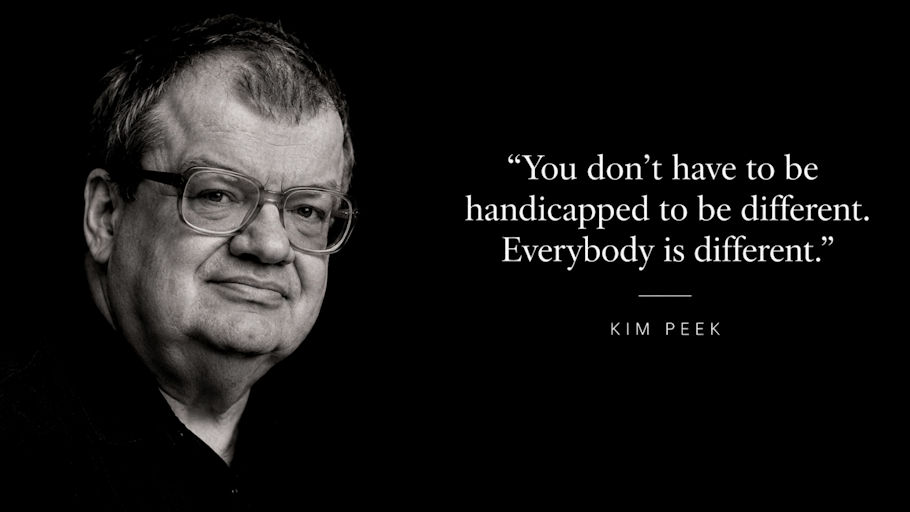
The sentence becomes harder to interpret when placed beside the arrangements of Peek's life. Someone else helped him manage ordinary activities. People who needed no such assistance asked him questions they could not answer themselves. Dependence and expertise occupied the same person, sometimes within the same encounter.
Calling this a contradiction already assumes too much. It assumes that human abilities should rise together, that remembering more should produce greater independence, or that needing help should indicate limited knowledge. Peek exposes the weakness of those assumptions. His life requires several questions where public discussion usually asks one: how intelligent was he?
Before Rain Man
Kim Peek was born in 1951. Family accounts describe early medical advice that anticipated profound incapacity and recommended institutional placement. They also describe reading beginning unusually early, although accounts differ about its precise onset. His brother later recalled that he taught himself to read at approximately three. These are retrospective family observations, not a continuous developmental assessment. They nevertheless establish a childhood poorly represented by the original prognosis.
The error was consequential. A prediction about limited development could determine whether a child received books, attention, education, or opportunities to demonstrate anything unexpected. Once someone is classified as incapable of learning, environments can become organized around that classification.
There is a temptation to reverse the verdict completely: the doctors saw disability, while the family discovered genius. That version preserves the same crude scale. It merely moves Peek to its opposite end.
His subsequent abilities did not make his developmental difficulties imaginary. Nor did those difficulties describe everything happening in his mind. Understanding his childhood requires holding both facts without forcing either to become the explanation for the other.
Memory Without a General Scale
Memory contributes to intelligence. It does not provide a complete measurement of it.
Retaining information, retrieving it when prompted, understanding its implications, and using it under unfamiliar conditions are distinguishable operations. In ordinary conversation they often arrive together, making their separation difficult to notice. Someone supplies an accurate historical detail, and the listener assumes comparable competence in interpreting historical causes.
That inference may be unwarranted.
The title therefore identifies a measurement error. It does not suggest that Peek possessed no intelligence or that everything he said was mechanical repetition. Such claims would require evidence that spectacular demonstrations of recall cannot supply.
Comprehension also needs a specified object. Understanding a musical passage, an instruction, a joke, and another person's intentions makes different demands. A difficulty with abstraction cannot automatically settle all four questions.
Functional independence introduces another problem. Knowing what an activity involves does not ensure that a person can coordinate the movements or organize the sequence required to perform it. Conversely, completing familiar routines offers limited evidence about reasoning in unfamiliar situations.
Peek makes these distinctions unusually visible. They remain relevant wherever an institution turns one observed performance into a general verdict about a person.
A Mind Built Differently
Brain imaging documented the absence of Peek's corpus callosum, a major bundle of fibers connecting the cerebral hemispheres, alongside other structural differences. Darold Treffert's scientific review discusses these findings within the broader literature on savant syndrome. That literature also distinguishes savant abilities from autism: the two are not interchangeable categories.
An anatomical finding can be precise while its explanatory meaning remains uncertain. Identifying an absent structure does not establish the mechanism producing exceptional recall. It leaves questions about development, alternative connections, and the organization of particular tasks.
Researchers who studied Peek explicitly acknowledged the gap between describing his brain and explaining his abilities. Their observations did not establish that the absence of the corpus callosum produced his memory.
Popular explanations often close that gap prematurely. A visible difference becomes a mechanism; the mechanism becomes an origin story; the origin story is repeated as settled science.
Anti-Coaching has no authority to complete this neurological explanation. Its concern here is narrower: how abilities and limitations were distributed, what activities that distribution permitted, and which forms of assistance made participation possible. Explaining how a life functioned is a different undertaking from explaining how its nervous system developed.
What He Could Do
Reports of Peek's public appearances document extensive recall across history, geography, literature, sport, and music. Questions could lead rapidly to related dates, locations, names, or events. An account of a teachers' gathering in 1991 records him answering geographical questions and moving between associated historical details.
These performances involved more than possessing information somewhere in memory. A question had to provide access to the relevant material. The speed and specificity of retrieval were central to what audiences witnessed.
Calendar answers and geographical directions also show why the subject matter matters. A remembered date, a route, and a musical composition have different internal structures. Describing all three as "facts" can conceal the variety of operations involved.
The familiar totals of books memorized or percentages retained add apparent precision without necessarily supplying comparable measurement. Widely repeated estimates should not be mistaken for an independently audited inventory.
A more useful question concerns availability: what could he retrieve, through which prompt, and for what purpose? A collection of information becomes usable through those relationships. Its size alone tells us little about how the person will respond when an unfamiliar problem requires choosing between competing interpretations.
What He Could Not Do Alone
Treffert and Daniel Christensen described substantial difficulties with coordination, everyday activities, and abstraction. Their account specifically noted that Peek could not button his clothes. These limitations coexisted with the abilities attracting scientific and public attention.
Buttoning a shirt is easily dismissed as a minor task because many adults perform it without conscious analysis. For someone unable to complete it, the task introduces another person into the organization of the morning. Its social importance bears little relationship to its intellectual prestige.
This is where descriptions based on impressive demonstrations become inadequate. An audience sees an answer. Daily life requires getting dressed, arriving somewhere, managing transitions, and returning home.
We should not turn each reported difficulty into a retrospective diagnosis of a particular executive function. The available biographies cannot support that precision. They do support the broader conclusion that knowledge and independent execution were markedly separated.
Calling such activities "simple" records the observer's experience. It explains nothing about their difficulty for Peek. Repetition, encouragement, and the possession of relevant information do not guarantee that the necessary motor or organizational capacity will follow.
Fran Peek and Distributed Function
Fran Peek supplied sustained practical assistance and accompaniment. Accounts describe him helping with dressing and personal care, while library visits and public engagements placed his son in contact with information and other people.
"Devoted father" names a relationship but leaves much of its work unspecified. The functional questions are more exacting: who organized the day, managed an engagement, recognized a difficulty, or made continued participation possible?
Viewed this way, their shared activities depended on a distribution of work. Kim supplied the recall. Fran supplied assistance that allowed Kim to be present and participate. Neither contribution can be inferred from the other.
There is also an evidential boundary. A successful appearance cannot demonstrate that Kim could independently arrange the conditions surrounding it. Equally, Fran's involvement does not make Kim's answers borrowed achievements.
This arrangement carries a practical vulnerability: when essential support rests heavily with one person, continuity depends on that person's availability. Describing the relationship only through affection obscures this dependency.
Distributed function is useful here because it identifies where work occurred. It should never turn Fran into an interchangeable device or Kim into the passive recipient of care. Both were people within an arrangement that required continuing labor.
The Man Behind Rain Man
Screenwriter Barry Morrow met Peek in 1984. Their encounter helped inspire the character played by Dustin Hoffman in the 1988 film Rain Man.
The resulting Raymond Babbitt was a fictional construction. His diagnosis, behavior, and narrative circumstances cannot be transferred to Peek as biographical evidence. Contemporary reporting explicitly distinguished Peek from the autistic character.
Cinema supplied a powerful route to public recognition. It also supplied expectations through which the recognized person would subsequently be interpreted. Audiences could arrive already believing they knew what his abilities meant.
A recollection reported from Peek's funeral illustrates a different problem of interpretation. Fran told mourners that, after the premiere, Morrow asked Kim why he had not watched the screen. According to his father, Kim answered: "I watched it with my heart." This is a family recollection reported at the funeral, not a contemporaneous transcript of the premiere.
The remark cannot establish a clinical conclusion about emotional understanding. It does, however, resist the assumption that every meaningful statement by Peek must be interpreted as information retrieval. Making it proof of profound emotional insight would be another overreach. The responsible account preserves the remark and the limits of its provenance together.
When Public Life Changed the System
After the film, requests for appearances expanded. Early reporting describes Fran regulating their frequency and Kim expressing enjoyment of performing. Public participation had become an activity requiring its own boundaries.
Later observations described developments in sociability, humor, and musical performance. Treffert and Christensen documented emerging piano skills and increasingly inventive connections between remembered material. Their account complicates any picture of an adult whose capacities had become permanently fixed.
Several explanations remain possible. More frequent interaction may have supported practice. Familiar formats may have reduced uncertainty. Abilities previously difficult to observe may have become more visible. These possibilities should not be collapsed into a single causal claim.
The evidence does not permit a neat calculation of how much change resulted from exposure, learning, maturation, or changing observation. It certainly does not establish that affection or celebrity removed his disabilities.
For practical purposes, the important consequence is that an assessment has a date. A description that was adequate at one stage may become incomplete later. Support must allow for development without making its continuation conditional on improvement.
Someone should not have to acquire new skills to justify assistance. Equally, receiving assistance should not consign that person to an expectation of permanent sameness.
Anti-Coaching: Capacity Is Not a Single Number
Within Anti-Coaching, the appropriate unit of inquiry is the function under specified conditions.
A qualitative map of Peek would place exceptional retention and rapid recall beside limited everyday independence and motor coordination. It would record extensive domain knowledge, difficulties with abstraction, and social participation that changed over time. Judgment and interpretation would require examination task by task.
This is an analytical map, not a clinical rating instrument.
Its purpose is to prevent one observation from silently answering unrelated questions. Can the person recall the instruction? Understand its purpose? Initiate the activity? Complete the movements? Recognize when circumstances have changed? These questions may produce different answers.
An overall IQ result cannot by itself provide that operational description. This does not require dismissing intelligence testing. It requires keeping the scope of any aggregate score separate from the decisions being made with it. A score alone cannot specify the assistance someone needs tomorrow morning.
The same discipline applies to praise. Exceptional memory does not justify assuming reliable judgment everywhere. Such inflation can expose a person to demands for which the demonstrated ability offers little preparation.
Here the methodological limit is essential. Anti-Coaching can examine the fit between a task, a person, and available support. It cannot explain the biological origin of Peek's abilities, replace individual assessment, or derive an entire person from a functional diagram.
When Dependence and Ability Coexist
Dependence becomes misleading when used as a complete identity. It describes a relationship around a requirement: someone needs another person's assistance to do something. The requirement must remain visible.
Ability needs the same precision. Knowing far more than a supporter in one domain does not eliminate the need for that supporter elsewhere. Accepting help does not transfer ownership of the knowledge to the person providing it.
Institutional decisions often lose these distinctions. A person may be denied access because assistance is required, or denied assistance because a striking ability has been demonstrated. Both decisions make one function stand in for the whole.
There is a further limit to this analysis. A functional map cannot determine someone's human worth. It should improve the decisions surrounding a life, without making that life accountable for an impressive balance of strengths over limitations.
Peek's memory did not repay the cost of his support. No repayment was required. His need for support did not reduce the reality of what he knew.
We misjudge a person when we overlook an ability. We also misjudge a person when we insist that every ability and dependency must resolve into one position on a single scale.
More frameworks for performance and decision-making when information is incomplete but responsibility for the result remains can be found in my Responsibility Series - Operating in the Dark.
Frequently Asked Questions
NOTE: Researched FAQs by Disabled World (DW)
When did Kim Peek die?
Kim Peek died of a heart attack on December 19, 2009, in Salt Lake City, Utah, at the age of 58.
How common is savant syndrome?
Savant syndrome is rare. Darold Treffert estimated that as many as 1 in 10 autistic people show some savant skills, while prodigious savants with abilities on the level of Kim Peek are thought to number fewer than 100 known cases worldwide.
What is agenesis of the corpus callosum?
It is a condition present at birth in which the band of nerve fibers linking the two halves of the brain is partly or completely missing. Effects range from very mild to significant developmental, motor and learning challenges, and it is usually confirmed through brain imaging.
Can a person develop savant skills later in life?
Yes, in rare cases known as acquired savant syndrome, a person develops new artistic, musical or mathematical abilities after a brain injury, stroke or dementia. These cases suggest that some abilities may surface when brain function changes.
Was a genetic cause ever suggested for Kim Peek's condition?
In later years, some researchers suggested Peek may have had FG syndrome, a rare X-linked genetic disorder that can involve developmental delay and differences in the corpus callosum. It was never confirmed as the explanation for his memory.
What is the difference between IQ and adaptive functioning?
IQ tests measure reasoning, verbal and problem solving skills under test conditions, while adaptive functioning describes how well a person handles everyday tasks such as self care, communication and getting around the community. Diagnoses of intellectual disability in the United States consider both.
How can families plan support when one caregiver provides most of the help?
Families can share tasks among several trusted people, write down daily routines and preferences, and connect with local disability services or respite care programs before an emergency arises. Planning ahead reduces the risk of a sudden gap in care if the main caregiver becomes ill or unavailable.
Who was Darold Treffert?
Darold Treffert was a Wisconsin psychiatrist who spent more than 50 years studying savant syndrome and wrote books including Extraordinary People and Islands of Genius. He served as a consultant on the film Rain Man and died in 2020.
References:
Treffert, D. A., and Christensen, D. D. (2005). Inside the Mind of a Savant. Scientific American, 293(6), 108-113.
Treffert, D. A. (2009). The savant syndrome: an extraordinary condition. A synopsis: past, present, future. Philosophical Transactions of the Royal Society B: Biological Sciences, 364(1522), 1351-1357.
Peek, F. (1996). The Real Rain Man: Kim Peek. Salt Lake City: Harkness Publishing Consultants.
Weber, B. (2009, December 26). Kim Peek, Inspiration for Rain Man, Dies at 58. The New York Times.
Anti-Coaching: Beyond the Limit
Read More From the Series:
- Marla Runyan: Elite Racing With Stargardt Vision Loss: Marla Runyan, Paralympic champion and two-time Olympian with Stargardt disease, raced at elite speed with central vision loss and incomplete visual information.
- John Nash: Schizophrenia, Genius and Verifying Reality: Essay on John Nash's schizophrenia, Nobel-winning game theory and return to Princeton, examining why intelligence alone cannot verify a person's grip on reality.
- Claude Monet: When Perception Becomes Unreliable: How cataracts diagnosed in 1912 changed Claude Monet's color perception, what his 1923 eye surgery fixed, and what his late paintings can and cannot reveal.
- Alex Zanardi: Rebuilding Control After Double Amputation: Alex Zanardi's racing career after a double leg amputation shows how hand controls, prosthetics and handcycle design rebuilt his driving and Paralympic success.
- Lesya Ukrainka: Chronic Illness, Writing and The Forest Song: How Lesya Ukrainka wrote The Forest Song while living with tuberculosis and variable capacity, and how her 1911 drama became the animated film Mavka during war.
- Vincent van Gogh: What Reproduction Cannot Preserve: An artist's essay on why Vincent van Gogh's original paintings and drawings reveal brushstroke, texture, and scale that digital reproductions cannot preserve.
- Beethoven's Hearing Loss and the Architecture of Feedback: Beethoven's progressive hearing loss stripped away the feedback his composing and performing relied on, while notation, memory, and sketches kept his work going.
- Stephen Hawking Was Not a Motivation Story: Stephen Hawking viewed through decision architecture, showing how assistive technology and support systems extend human agency when motivation meets hard limits.
Insights, Analysis, and Developments
Editorial Note: Kim Peek died in 2009, yet the questions his life raises are still very much alive in disability services today. The deeper lesson is not simply that memory and intelligence are different things, which most researchers would accept, but that institutions keep acting as if they were the same - granting or withholding help based on one visible skill or one visible limitation. Looking at function task by task, under real conditions, and remembering that any assessment is a snapshot taken on a particular date, gives families, support workers and policy makers a fairer way to plan care. It also protects a principle that is easy to lose: a person should not have to earn support by improving, and needing help should never be used to discount what that person knows.*
 Author Credentials: Lexx Che is a Systems Builder, Narrative Architect, author, independent journalist, and researcher with nearly 20 years of professional experience. His work spans more than 1,000 projects across strategy, design, technology, digital ecosystems, organizational transformation, identity, and decision architecture. In medicine and healthcare, he and his teams bring 15 years of experience creating visual identity systems, developing and repositioning brands, building corporate websites, and delivering digital transformations and complex digital ecosystems for private clinics and large healthcare networks. Explore Lexx Che's complete biography for comprehensive insights into his background, expertise, and accomplishments.
* Editorial additions by Ian C. Langtree.