Orgone Chambers Explained: Reich, the FDA and the Evidence
Author: Ian C. Langtree - View Credentials
Published: 21 Nov 2026
Publication Type: Informative
Table of Contents:
Synopsis - Definition - Overview - FAQs - Insights, Updates - Related Content
Synopsis
This paper explains what an orgone chamber, or orgone energy accumulator, is and traces it from Wilhelm Reich's work in the 1940s through the federal injunction, contempt trial and imprisonment that followed. Drawing on the federal appeals court record, archival biographies, medical journal reviews and FDA consumer guidance, it separates what supporters claim from what has actually been tested, and it explains why the 1954 court order never decided whether orgone energy exists. It also looks specifically for evidence on autism, ADHD and disability and reports plainly that none was found, offering families, caregivers, seniors and people with disabilities a clear way to judge orgone products and similar health claims before spending money or delaying proven care.
At a Glance
- 1 - Einstein examined a small accumulator in 1941, but his tests did not produce the results Reich expected.
- 2 - Reich's papers were sealed for 50 years under his will and opened to scholars in November 2007, decades after his death.
- 3 - Supporters' own reviews describe human healing reports as anecdotal, with controlled studies limited to mice.
- 4 - In 1956 a federal appeals court ruled that a court order must be obeyed while it stands, even by someone who believes it was obtained unfairly.
Topic Definition
- Orgone Chamber
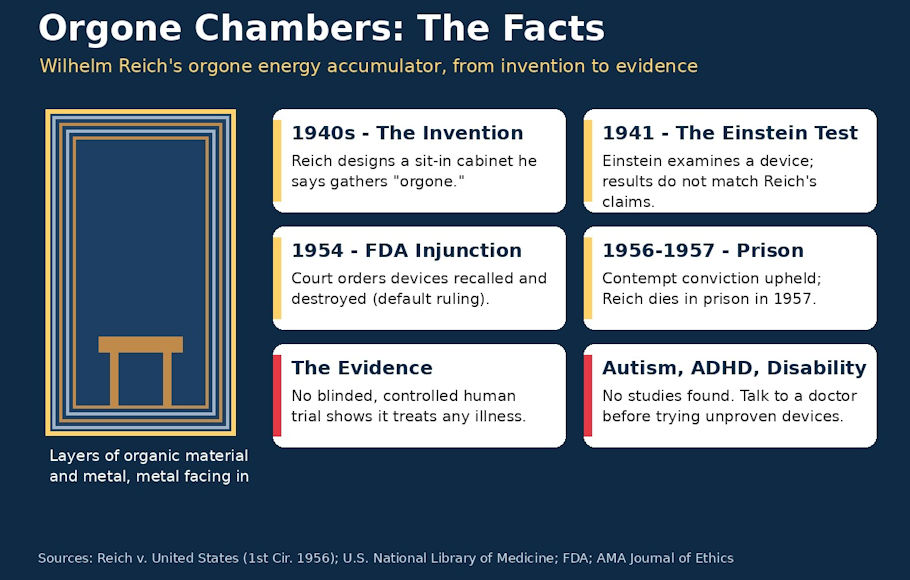
An orgone chamber, also called an orgone energy accumulator or orgone box, is an enclosure designed by Wilhelm Reich in the 1940s, built from alternating layers of organic materials and metal with metal facing inward, and large enough in its best-known form for a person to sit inside. Reich held that it gathered orgone, a universal life energy he believed he had found, and that sitting in it could improve health. Orgone has never been confirmed by mainstream science, no rigorous independent trial has shown the accumulator treats any illness or disability, and in 1954 a U.S. federal court ordered the devices recalled and destroyed after the FDA alleged they were misbranded.
Overview
Picture a wooden cabinet a little larger than a phone booth. Its walls feel ordinary from the outside, but inside they are lined with sheet metal, and the layers in between alternate organic and metallic materials. A person opens the door, sits on a stool, and waits. According to the man who designed it, that person is soaking up a universal life energy. According to the U.S. Food and Drug Administration and two federal courts, the box was being sold with claims it could not support. This is the orgone chamber, and its story runs from Freud's Vienna to a federal prison in Pennsylvania, and on into health claims that still circulate online.
What an Orgone Chamber Is
An orgone chamber is more formally called an orgone energy accumulator, often shortened to ORAC by its supporters and to "orgone box" by everyone else. It was designed by the Austrian-born physician and psychoanalyst Wilhelm Reich in the 1940s, after he settled in the United States.
Orgone is the name Reich gave to a life energy he believed fills the atmosphere and all living things. Mainstream physics and biology have never confirmed that such an energy exists.
How It Is Built
Supporters describe the accumulator as a box made from alternating layers of organic insulating materials and metal, with metal facing the inside. In orgone theory, the organic layers attract and hold the energy while the metal draws it in and passes it inward, so the energy collects in the enclosed space. Human-sized versions are built as cabinets a person can sit in, and smaller versions have been used for animals, plants and laboratory tests [Mazzocchi and Maglione, 2010].
It helps to separate two layers of the claim. The first is physical: the box contains more of something than the room around it. The second is medical: sitting in it improves health. A device can fail the second test even if something odd is happening in the first, and almost all of the controversy has played out between those two layers.
The Man Behind the Box
Wilhelm Reich was born on March 24, 1897, in Dobrzanica, Galicia, then part of the Austro-Hungarian Empire. He joined the Vienna Psychoanalytic Society in 1920, graduated from the University of Vienna medical school in 1922, and worked in Sigmund Freud's Psychoanalytic Polyclinic. In the early 1930s he wrote widely on character analysis, and his book The Mass Psychology of Fascism (1933) was banned by the Nazis. He was expelled from the Communist Party in 1933 and from the international psychoanalytic association in 1934, moved through Scandinavia, and reached the United States in 1939 [Boston Psychoanalytic Society and Institute, n.d.].
That background matters. Reich was not an outsider to medicine. His early work on character structure still has a place in the history of psychotherapy, which is one reason his later claims drew so much attention. The orgone theory grew out of the same line of thinking: Reich came to believe that blocked emotional and sexual energy was not just a metaphor but a physical force that could be measured, collected and used.
The Einstein Episode
In January 1941, Reich persuaded Albert Einstein to look at a small accumulator. Reich's central physical claim was that the air above or inside the device ran slightly warmer than the surrounding room, with no ordinary heat source to explain it. Einstein examined the apparatus, but the experiments he reproduced did not produce the results Reich expected, and the brief collaboration ended there [García Valdés et al., 2008].
A small temperature difference is a good example of why careful controls matter. Think of a thermometer placed near a sunny window or above a radiator. It will read differently from one in the middle of the room, and nothing mysterious is involved. Any claim that a box warms itself has to rule out drafts, air layers at different heights and differences in how materials absorb and release heat before it can point to a new form of energy.
The FDA and the Courts
Reich and his associates built and distributed accumulators from Orgonon, his property near Rangeley, Maine. After critical press coverage, the FDA opened an investigation in 1947 [Boston Psychoanalytic Society and Institute, n.d.].
The 1954 Injunction
On February 10, 1954, the United States filed a complaint in federal court in Maine under the Federal Food, Drug, and Cosmetic Act against the Wilhelm Reich Foundation, Wilhelm Reich and Ilse Ollendorff. The government alleged that the orgone energy accumulators were adulterated and misbranded. Reich refused to appear, writing that his position did not permit him to enter the case. On March 19, 1954, the court entered an injunction by default. It ordered accumulators owned or controlled by the defendants to be recalled to Rangeley and destroyed or dismantled under FDA supervision, and it ordered the destruction of labels, order forms and listed descriptive literature about the devices [Reich v. United States, 1956].
A default judgment is a ruling entered when a party does not respond to a lawsuit. In the Reich case, it means the court never held a trial on whether orgone energy exists. The injunction rested on the government's complaint, which Reich chose not to contest.
This point is often lost in retellings from both sides. Supporters sometimes describe the case as the government ruling against a scientific discovery, while critics sometimes describe it as the courts proving the device useless. The appeals record supports neither version. What the courts decided was narrower: the injunction was valid, and it had to be obeyed.
Contempt and Prison
The defendants did not comply. In July 1955, federal prosecutors charged the foundation, Reich and a physician associate, Michael Silvert, with criminal contempt, saying Silvert had aided and abetted the violation. A jury trial began on May 3, 1956, and all three were found guilty. The foundation was fined and the two men received prison terms. On December 11, 1956, the U.S. Court of Appeals for the First Circuit upheld the convictions, ruling that a court order must be obeyed while it stands, even by someone who believes it was obtained unfairly. The Supreme Court declined to hear the case on February 25, 1957 [Reich v. United States, 1956].
Reich was sentenced to two years in prison, and several tons of his publications were burned under FDA authority. He died of heart failure in the federal penitentiary at Lewisburg, Pennsylvania, on November 3, 1957 [Boston Psychoanalytic Society and Institute, n.d.]. The burning of books, by a U.S. agency, is the part of the story that troubles many historians regardless of what they think of orgone, and it is a large part of why Reich's name survives well beyond the device itself.
The Sealed Archives
Reich's will directed that his papers be stored for 50 years. They were held for decades at Harvard's Countway Library of Medicine and have been open to scholars since November 2007. Under a September 2021 agreement, physical control of the archive returned to the Wilhelm Reich Museum in Rangeley [Wilhelm Reich Infant Trust, n.d.].
What the Research Shows
More than 80 years after the first accumulators were built, the published evidence remains thin. A November 2026 search of PubMed, the U.S. National Library of Medicine's index of biomedical research, returned only 23 records for the word orgone. Many date from the 1940s to the 1970s, and several appeared in journals Reich himself published, such as the International Journal of Sex-Economy and Orgone Research [National Library of Medicine, 2026].
Studies by Supporters
Most modern experiments come from researchers sympathetic to orgone theory and appear in specialty journals outside the medical mainstream. Two examples show the pattern:
- A 2010 study placed 20 healthy people in an accumulator for 45 minutes each and reported an average rise in body temperature of 0.242 degrees Celsius. The abstract describes before-and-after measurements but does not describe a control group or blinding [Mazzocchi and Maglione, 2010].
- A 2009 review by a supporter acknowledged that reports of healing in humans were anecdotal and that the only controlled studies involved mice with mammary tumors - four studies in total, three reporting longer survival [Blasband, 2009].
Neither example is a randomized, blinded human trial, and neither has led any health regulator to recognize the accumulator as a treatment.
Blinding means the people being tested, and ideally the researchers measuring them, do not know who received the real treatment. Without it, expectation alone can change how people feel and what observers record - the well-known placebo effect.
A Simple Thought Experiment
Imagine two cabinets that look and feel identical from the inside. One has metal in its walls and the other does not. Volunteers sit in one or the other without knowing which, and a nurse who also does not know records their temperature, heart rate and how they feel. If the metal-lined cabinet consistently produces a difference that the plain one does not, across many people and in different laboratories, that would be a finding worth taking seriously. That kind of test is cheap, safe and simple, which makes its absence from the major medical literature telling in itself.
Autism, ADHD and Disability
No authoritative research links orgone chambers to autism, ADHD or any disability. A PubMed search combining orgone with autism, ADHD, attention deficit or disability retrieved no results at all [National Library of Medicine, 2026]. No government health agency, university program or major professional body recommends the accumulator for these conditions, and this paper found no clinical trial that has tested it for them.
That absence is still useful information for families, because orgone devices are sold online alongside many other products promising calm, focus or better sleep. Complementary and alternative approaches are common in autism care: one review in the AMA Journal of Ethics reports that 50 to 75 percent of children with autism use some form of complementary and alternative medicine, and it sets out warning signs of unsupported treatments [Singer and Ravi, 2015]. Readers can learn more about complementary and alternative medicine in autism care and about ADHD and ADD on Disabled World.
Questions to Ask Before Buying
The red flags described by the FDA and by autism researchers fit orgone marketing closely, so a short checklist helps:
- Does the product claim to help a long list of unrelated conditions?
- Is the evidence mainly testimonials, reviews or personal stories?
- Does the seller say the treatment has been suppressed by doctors, regulators or "the establishment"?
- Have the claims been tested in blinded, controlled human studies published in reputable peer-reviewed journals?
- Would buying it delay or replace care that has a proven record?
The FDA's tip-offs for health fraud include one-product-cures-all claims, personal testimonials, quick fixes, "miracle cure" language and stories of a hidden cure being kept from the public, and the agency advises checking with a doctor or other health care professional before buying an unproven product [U.S. Food and Drug Administration, 2021].
For people with disabilities, seniors and caregivers, the main risk of an orgone box is rarely the box itself, which is essentially an enclosed cabinet. The real costs are money, time and, most importantly, any delay in getting care that works. Anyone with limited mobility, breathing problems, heat sensitivity or claustrophobia should also think twice about sitting in a closed cabinet, and anyone considering a device like this for themselves or a child should talk with a doctor first. Disabled World's alternative medicine section covers other approaches and what is known about them.
The Bigger Picture
The orgone chamber sits at a crossroads of science, law and belief. At the smallest scale, it is a cabinet with metal walls and a claim about temperature. At the level of institutions, it became a test of how far a regulator may go in stopping health claims, and of whether a court order must be obeyed by someone convinced it is wrong. At the widest scale, it is a case study in how ideas outlive the evidence for them. Reich's box shares that pattern with other putative energy therapies such as Reiki, in which a proposed energy has not been measured by standard instruments.
Over time the story has kept shifting. The 1940s produced the invention and the Einstein episode, the 1950s the injunction, the trial and the book burning, 2007 the opening of the archives, and the decades since a small stream of studies by supporters. What has not changed is the core gap: there is still no rigorous, independent evidence that orgone exists or that sitting in an accumulator treats any condition. Understanding that gap, rather than either romanticizing Reich or dismissing his story, is the most useful thing a reader can take away.
Frequently Asked Questions
Is it safe to sit in an orgone box?
An orgone box is an enclosed cabinet with no power source, so the main physical concerns are heat, poor ventilation and feeling confined. People with breathing problems, heat sensitivity, limited mobility or claustrophobia should be cautious, and anyone with a health condition should talk to a doctor before using one.
Are orgone chambers legal to buy?
The 1954 injunction applied to Wilhelm Reich, his foundation and his associates. Products sold for health purposes are still subject to FDA rules on medical claims, so sellers cannot lawfully market them as treatments for diseases without supporting evidence.
Is orgonite the same as an orgone chamber?
No. Orgonite is the name sellers give to small objects, typically resin mixed with metal pieces, marketed with claims that they balance energy. It was not part of Reich's original work and has no scientific evidence behind it.
Does health insurance cover orgone therapy devices?
Orgone accumulators are not recognized medical treatments, so public and private health insurance plans generally do not cover them. Families should be wary of any seller who suggests otherwise.
How is Reichian body psychotherapy different from orgone devices?
Some forms of body-oriented psychotherapy trace their roots to Reich's earlier work on character and muscle tension. These talk and body-awareness therapies are separate from the orgone accumulator, and their evidence should be judged on its own terms.
Can an orgone device help with sleep or anxiety?
No controlled human studies show that orgone devices improve sleep or anxiety. Any short-term relief people report may come from rest, quiet or expectation, and approaches such as sleep hygiene, therapy and medical care have far stronger evidence.
How can I report false health claims about a device?
In the United States, problems with health products can be reported to the FDA through its MedWatch program, and misleading advertising can be reported to the Federal Trade Commission. In Canada, consumers can report to Health Canada.
Can you visit Reich's former home and laboratory?
Yes. Orgonon, Reich's former property near Rangeley, Maine, operates as the Wilhelm Reich Museum, which displays his laboratory, equipment and papers. Hours vary by season, so it is best to check with the museum before visiting.
References
- Blasband, R. A. (2009). The orgone energy accumulator in the treatment of cancer in mice. Subtle Energies and Energy Medicine, 20(2).
- Boston Psychoanalytic Society and Institute. (n.d.). Reich, Wilhelm (1897-1957) [Archival collection description].
- García Valdés, M., González Serra, D., and González Arias, A. (2008). Einstein and the psychic energy. Revista Cubana de Física, 25(1), 53 - 58.
- Mazzocchi, A., and Maglione, R. (2010). A preliminary study of the Reich orgone accumulator effects on human physiology. Subtle Energies and Energy Medicine, 21(2).
- National Library of Medicine. (2026). PubMed search results for orgone, and for orgone combined with autism, ADHD, attention deficit or disability.
- Reich v. United States, 239 F.2d 134 (1st Cir. 1956).
- Singer, A., and Ravi, R. (2015). Complementary and alternative treatments for autism part 2: Identifying and avoiding non-evidence-based treatments. AMA Journal of Ethics, 17(4), 375 - 380.
- U.S. Food and Drug Administration. (2021). 6 tip-offs to rip-offs: Don't fall for health fraud scams.
- Wilhelm Reich Infant Trust. (n.d.). Wilhelm Reich archives.
More on this topic: Alternative Medicine, Autism, ADHD and ADD
Insights, Analysis, and Developments
Editorial Note: The orgone chamber endures less because of what it does than because of the story around it: a once-respected psychoanalyst, a cabinet lined with metal, a court order he refused to answer, a prison sentence and a pile of burned books. That story deserves to be remembered accurately, including the uncomfortable fact that a U.S. agency destroyed publications, but sympathy for Reich is not evidence for orgone. For autistic people, people with ADHD, people with disabilities and the families who support them, the practical lesson is simple - when a device promises broad benefits, rests on testimonials and has never faced a blinded human trial, the safest course is to put the money and hope toward care that has been tested, and to bring any interest in alternatives to a trusted health professional.
 Author Credentials: Ian C. Langtree is a writer, editor, and the founder and Editor-in-Chief of Disabled World, which he established in 2004 as one of the longest-running independent resources for disability news and information. Over more than two decades, he has written and edited thousands of articles on disability rights, health, accessibility, and assistive technology. Drawing on a global perspective shaped by extensive travel and lived experience, Ian is a committed advocate of the Social Model of Disability, the framework developed by disabled activists in the 1970s that focuses on removing societal barriers rather than on individual impairments. His writing is grounded in that framework and in a lasting commitment to disability rights, accessibility, and social inclusion. To learn more about Ian's background, expertise, and accomplishments, visit his full biography.