Shamonda Virus: First Human Infection and What It Means
Author: Ian C. Langtree - View Credentials
Published: 22 Oct 2026
Publication Type: Informative
Table of Contents:
Synopsis - Definition - Overview - FAQs - Insights, Updates - Related Content
Synopsis
French health authorities have confirmed the first documented human infection with Shamonda virus, a midge-borne livestock pathogen that had circulated in Africa and Asia for six decades without ever being found in a person. The patient, severely immunocompromised and under treatment at the Hospices Civils de Lyon, died in early October 2026 after developing brain complications that investigators believe were very likely caused by the virus. The case follows the virus's sudden arrival in European cattle herds that summer and its spread to more than a dozen countries. This paper explains what Shamonda virus is, how it moves between insects and animals, what the French report does and does not tell us, and why officials currently see no health risk to the general population.
At a Glance
- 1 - Shamonda virus was first described during arbovirus surveillance in Ibadan, Nigeria, between 1964 and 1969. The same surveys also named three other new Simbu-group viruses: Sango, Sabo and Shuni.
- 2 - Two genetically distinct European lineages, SHAV-EU1 and SHAV-EU2, are now circulating. The first is found mainly in Switzerland, France, southern Germany and Austria, the second in Belgium, the Netherlands, northern Germany and northwestern France.
- 3 - In southern Japan, a cluster of calves born with congenital malformations between late 2015 and spring 2016 was traced to Shamonda virus infection in the womb. Researchers concluded that the virus should be considered teratogenic in ruminants, meaning it can cause birth defects.
- 4 - Shuni virus, a close Simbu-group relative discovered in the same Nigerian surveys, has been detected in people with neurologic illness in South Africa. That precedent suggests the wider virus family has some ability to reach the human nervous system, even though such infections appear to be rare.
Topic Definition
- Shamonda Infection
Shamonda infection is an illness caused by Shamonda virus, an insect-borne RNA virus of the Simbu serogroup in the genus Orthobunyavirus, which is spread mainly to cattle and other ruminants by the bites of tiny Culicoides midges. In adult cattle it usually causes a short bout of fever, diarrhea, lethargy and falling milk production, but infection during pregnancy can lead to abortion or birth defects in calves. First identified in Nigeria in the 1960s and later reported in Africa and Japan, the virus reached Europe in 2026, where it was linked that October to the first documented human infection - a fatal case with brain complications in a severely immunocompromised patient in France - although health authorities have identified no risk to the general population.
Overview
When a Cattle Virus Crosses a Line
For nearly sixty years, Shamonda virus lived quietly in the margins of veterinary science. It turned up in cattle blood samples in Nigeria, in insect traps in Japan, and in the occasional malformed calf, but it never appeared in a human being. That changed in October 2026, when French health authorities announced that the virus had been found in a hospitalized patient in Lyon - the first documented human infection anywhere in the world (Ministère de l'Agriculture, 2026a).
This paper explains what Shamonda virus is, how it reached Europe, what the French report actually says, and how to think clearly about the risk. Along the way, it introduces a handful of useful concepts - arbovirus, serogroup, reassortment, spillover - that help make sense of this story and the next one like it.
What Is Shamonda Virus?
Shamonda virus (often abbreviated SHAV) is an RNA virus in the genus Orthobunyavirus, family Peribunyaviridae. Within that genus it belongs to the Simbu serogroup, a cluster of more than 25 related viruses that mainly infect ruminants such as cattle, sheep and goats (Hirashima et al., 2017). Its better-known relatives include Akabane virus and Schmallenberg virus, and current taxonomy places Shamonda within the species Orthobunyavirus schmallenbergense (Kelleci et al., 2026).
Arbovirus - short for "arthropod-borne virus." Any virus that is passed between vertebrate hosts by blood-feeding insects or ticks. Dengue, West Nile, bluetongue and Shamonda are all arboviruses.
Serogroup - a group of viruses that are recognized by overlapping antibodies. Members of one serogroup are close enough that a blood test for one may react to another, which is why confirming a specific virus usually requires genetic testing.
A Three-Part Genome
Orthobunyaviruses carry their genetic code in three separate RNA segments, named by size: L (large), M (medium) and S (small). The L segment encodes the enzyme that copies the viral genome, the M segment encodes the surface proteins that let the virus attach to cells, and the S segment encodes the protein that packages the RNA (Elliott, 2014).
That segmented design matters. When two related viruses infect the same cell, they can swap whole segments, a process called reassortment. Think of it like two decks of cards being shuffled together and redealt - the new hand may carry a surface protein from one parent and a copying enzyme from the other. Reassortment is one way new viral lineages appear seemingly out of nowhere, and it is one of the possibilities scientists are examining for the European strain of Shamonda.
A Brief History: From Ibadan to the Alps
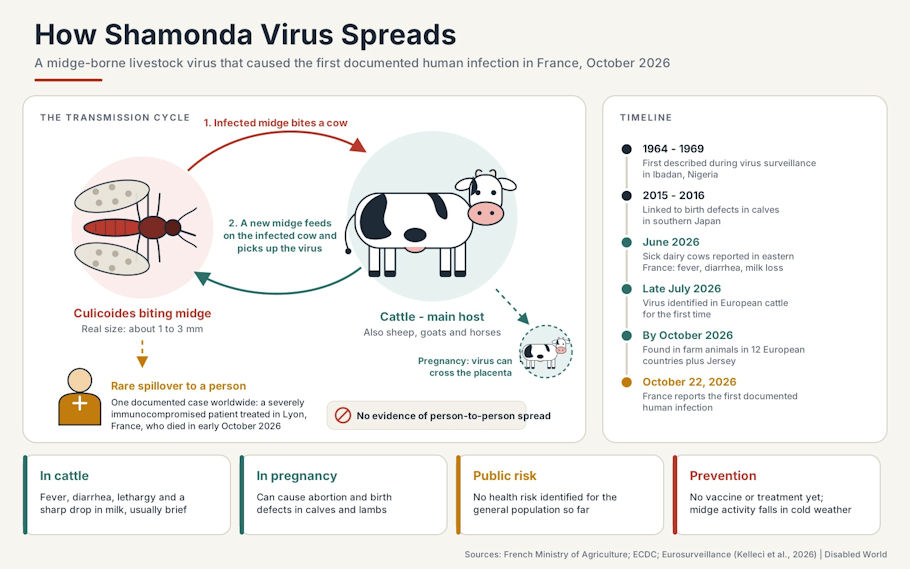
Shamonda virus was first described during arbovirus surveillance in Ibadan, Nigeria, between 1964 and 1969 (Causey et al., 1972). Over the following decades it was reported sporadically in cattle in West, East and southern Africa and in Japan (Ministère de l'Agriculture, 2026b). For most of that time, it was regarded as a minor livestock pathogen.
Japan provided the clearest warning that the virus could do real damage. Investigators in Kagoshima Prefecture linked Shamonda virus to a cluster of calves born with congenital malformations between late 2015 and spring 2016, concluding that the virus should be considered teratogenic - capable of causing birth defects - in ruminants (Hirashima et al., 2017).
Timescale check: the virus's documented history spans roughly six decades, its seasonal transmission cycle spans months, and a single infection in a cow typically runs its course in days. Keeping those three clocks separate helps explain why a virus can be "old" and "new" at the same time.
The 2026 European Emergence
In June 2026, veterinarians in the eastern French departments of Doubs and Ain began reporting clusters of dairy cows with sudden fever, diarrhea, lethargy and steep drops in milk yield. By July, similar herds were turning up in Savoie and Haute-Savoie. Routine tests for Schmallenberg virus came back negative, so a team from the National Veterinary School of Toulouse (ENVT) and INRAE used unbiased Nanopore metagenomic sequencing on plasma from sick cows. They recovered complete genomes of a Simbu-group virus they provisionally named European Shamonda virus (Kelleci et al., 2026).
Metagenomic sequencing - instead of testing for one suspected germ, the laboratory sequences all the genetic material in a sample and then sorts out what is there. It is the diagnostic equivalent of photographing an entire crowd rather than searching for one face.
At almost the same moment, Switzerland's Institute of Virology and Immunology detected the virus in cattle on 31 July 2026, and Germany's Friedrich-Loeffler-Institut reported it in herds in southern Germany (Institute of Virology and Immunology, 2026; Friedrich-Loeffler-Institut, 2026). Genetic analysis showed that the L and M segments of the European virus most closely matched a historical Nigerian strain isolated from cattle in 1965, while the S segment followed a different pattern, which may reflect a high mutation rate or reassortment (Kelleci et al., 2026).
The spread since then has been rapid. Spanish agricultural authorities noted that France had confirmed the virus in 37 departments by early September (Ministerio de Agricultura, Pesca y Alimentación, 2026). By late October, the European Centre for Disease Prevention and Control listed detections in farm animals in Austria, Belgium, France, Germany, Ireland, Italy, Liechtenstein, Luxembourg, the Netherlands, Portugal, Spain and Switzerland, as well as Jersey (European Centre for Disease Prevention and Control [ECDC], 2026).
There is a striking historical echo. In 2011, Schmallenberg virus - another Simbu-group virus that had never been seen in Europe - appeared in German cattle and swept across the continent (Hoffmann et al., 2012). German researchers described the 2026 event as an exotic orthobunyavirus being introduced into Central Europe once again (Friedrich-Loeffler-Institut, 2026). How the virus traveled from Africa or Asia to the Alps remains unknown.
What Shamonda Does to Livestock
In adult cattle, Simbu-group infections usually cause a short burst of virus in the blood and mild to moderate illness (Friedrich-Loeffler-Institut, 2026). Swiss authorities reported that affected farms generally saw illness lasting around two to three weeks at the herd level (Institute of Virology and Immunology, 2026). Cattle are the main hosts, though sporadic infections of sheep, goats and horses were also identified in France during the summer (Ministère de l'Agriculture, 2026a).
The bigger concern for farmers is pregnancy. If a cow with no prior immunity is infected roughly between days 75 and 175 of gestation, Simbu-group viruses can cross the placenta and harm the developing calf (Austrian Agency for Health and Food Safety [AGES], 2026). The Swiss institute has already detected the virus in aborted bovine fetuses (Institute of Virology and Immunology, 2026). The upcoming calving season will reveal how serious those effects are. There is currently no vaccine and no antiviral treatment for animals (Ministère de l'Agriculture, 2026b).
The French Report: The First Documented Human Infection
On 22 October 2026, France's ministries responsible for health and agriculture issued a joint statement. A patient with severe immune suppression, being treated at the Hospices Civils de Lyon for a serious illness, had been found to be infected with Shamonda virus. The patient died in early October (Ministère de l'Agriculture, 2026a).
What Investigators Know So Far
- The infection is the first documented and reported detection of Shamonda virus in a human being anywhere in the world.
- Preliminary findings suggest the brain complications the patient developed before death were very likely linked to the virus.
- The working hypothesis is that the patient was bitten by an infected Culicoides midge in eastern France, a region where the virus circulated in animals during spring and summer 2026.
- French authorities notified the World Health Organization and the ECDC, and clinical, laboratory and epidemiological investigations are continuing under a One Health approach that combines human, animal and environmental expertise.
- Based on current knowledge, no health risk to the general population has been identified.
(Ministère de l'Agriculture, 2026a)
What Remains Unknown
The ECDC has been careful to note that investigations are still working out whether the virus caused or merely contributed to the patient's death, and exactly how the infection was acquired. The specific midge species involved in transmission is also not yet known (ECDC, 2026). In other words, the case establishes that the virus can infect a human; it does not yet establish how often that happens or under what conditions.
One Health - an approach that treats human health, animal health and the shared environment as one connected system. Zoonotic events like this one are its textbook use case, because no single agency sees the whole picture.
Why the Immune System Matters Here
Before this case, experts considered Simbu-group viruses unlikely to cause human disease. Germany's Friedrich-Loeffler-Institut stated that these viruses are not generally regarded as zoonotic and, based on available knowledge, pose no significant infection risk to people (Friedrich-Loeffler-Institut, 2026). The Lyon case does not overturn that judgment so much as sharpen it.
A healthy immune system clears many viruses before they gain a foothold, especially viruses that are poorly adapted to human cells. When immunity is severely suppressed - for example by intensive cancer treatment, organ transplant medications or certain blood disorders - a virus that would normally fail can sometimes replicate long enough to reach vulnerable tissues such as the brain. French officials noted that the Lyon case shares features with other orthobunyavirus infections, such as Oropouche virus, in which neurological complications have been described, particularly in immunocompromised patients (Ministère de l'Agriculture, 2026b).
Oropouche is a useful comparison. It is also an orthobunyavirus, it is also spread mainly by biting midges, and it can cause neuroinvasive disease such as meningitis and encephalitis (Centers for Disease Control and Prevention [CDC], n.d.). Closer still, Shuni virus - a Simbu-group relative first isolated in the same Nigerian surveys as Shamonda - has been found in people with neurologic illness in South Africa (Motlou and Venter, 2021). The pattern across these viruses suggests that the wider family has some capacity to reach the human nervous system, even though such events appear rare.
Spillover - the moment a pathogen jumps from its usual host species into a new one. Most spillovers are dead ends: the virus infects one individual and goes no further. What turns a spillover into an outbreak is sustained onward transmission, and there is no evidence of that here.
How the Virus Moves: The Midge, the Cow and the Season
Shamonda virus spreads between animals through the bites of Culicoides midges, the same group of insects that carries bluetongue virus and epizootic hemorrhagic disease virus (Ministère de l'Agriculture, 2026b). A midge picks up the virus while feeding on an infected cow, the virus multiplies inside the insect, and the midge passes it on at its next blood meal. Apart from transmission from mother to fetus during pregnancy, there is no evidence of meaningful direct spread from animal to animal (Ministère de l'Agriculture, 2026b).
This makes Shamonda a seasonal story. In Europe, biting midges are generally most active from spring to autumn, with patterns that vary by species, location and weather. As temperatures fall, midge activity declines (ECDC, 2026). The insect, in effect, acts as a clock for the whole system: when the midges go quiet, so does transmission. The same logic governs other vector-borne illnesses, from bluetongue in sheep to Lyme disease in people, and it is one reason scientists watch how a changing climate shifts the range and active season of insect vectors.
Assessing the Risk: Reading the Signal Without Panic
A first human case naturally raises alarm, so it is worth slowing down and looking at the numbers. Shamonda virus has circulated in Africa and Asia for decades without a single documented human case (Ministère de l'Agriculture, 2026a). In Europe, it has now infected animals across a dozen countries during a full transmission season, and one human infection has been detected - in a person whose immune defenses were severely compromised.
Consider a thought experiment. Imagine millions of midge bites delivered to farm workers, hikers and rural residents across eastern France this summer, some of them from infected insects. If the virus readily caused illness in healthy people, doctors would likely have seen clusters of unexplained fever or encephalitis by now. Instead, the one detected case occurred in exactly the kind of patient whose body offered the least resistance. That pattern is consistent with the authorities' assessment of no identified risk to the general population.
Two cautions keep this reasoning honest. First, a "first documented" infection is not necessarily the first infection that ever occurred - mild human cases elsewhere could simply have gone untested, because few laboratories would ever think to look for a cattle virus in a person. Second, viruses evolve, and the European lineage is genetically distinct from the strains seen before. Both points argue for continued surveillance rather than either alarm or dismissal. The ECDC has said it is working with the relevant EU Reference Laboratory to strengthen testing capacity and help member states identify any other potential cases (ECDC, 2026).
Looking Ahead: The Questions Science Must Answer
The Lyon case opens several lines of inquiry that will unfold over months and years rather than days:
- Which Culicoides species carry the European strain, and do any of them readily bite humans?
- Have farm workers, veterinarians or rural residents in affected areas been silently infected? Antibody surveys of these groups could answer that.
- Did the European strain arise through reassortment, and does its distinct S segment change how it behaves in different hosts?
- How many calves and lambs will be born with defects from infections during the 2026 season?
- Will a livestock vaccine be developed, as eventually happened for Schmallenberg virus?
For now, Shamonda virus is primarily an animal health problem with one important human footnote. It is not regulated as a notifiable disease under EU animal health law or by the World Organisation for Animal Health, and no culling is required when herds are infected (Ministère de l'Agriculture, 2026b). Whether that framework changes will depend on what the ongoing investigations find.
Frequently Asked Questions
Can Shamonda virus spread from one person to another?
There is no evidence of person to person transmission. Like related Simbu-group viruses, Shamonda is spread by the bites of infected Culicoides midges, and the single human case is believed to have been acquired from an insect bite rather than from another person.
Are biting midges the same as mosquitoes?
No. Culicoides midges are a separate family of tiny flies, usually only one to three millimeters long, which is why they are sometimes called no-see-ums. They can slip through ordinary window screens and often bite around dawn and dusk.
Is milk or meat from infected cattle safe to eat?
Yes. French agricultural authorities have stated that the virus has no public health impact on the consumption of milk or meat, and normal food safety practices such as pasteurization and thorough cooking remain the standard.
Can doctors test people for Shamonda virus?
Not through routine hospital tests. Detection relies on specialized molecular testing at reference laboratories, and European health agencies are working with these laboratories to strengthen testing capacity in case further human cases need to be identified.
Does insect repellent protect against biting midges?
Repellents containing ingredients such as DEET, picaridin or IR3535 can reduce bites, especially when combined with long sleeves, light colored clothing and fine mesh screens. Avoiding livestock areas at dawn and dusk during the warm season also lowers exposure.
Could Shamonda virus return to Europe next summer?
It is possible. Schmallenberg virus, a close relative, persisted in Europe after its arrival in 2011 and caused further waves in later years, so scientists will be watching closely when midge activity resumes in spring.
Is it safe to travel to France and other affected countries?
Health authorities have not identified any risk to the general population, and the main driver of transmission, midge activity, declines as autumn temperatures fall. Travelers with severely weakened immune systems may wish to discuss insect bite precautions with their doctor before visiting rural livestock areas in warm months.
What should farm workers and veterinarians do to reduce exposure?
People who work closely with cattle can use protective clothing and insect repellent during the midge season, and farms can reduce breeding sites such as standing water and liquid manure. Anyone who is immunocompromised and develops unexplained fever or neurological symptoms after livestock contact should tell their doctor about that exposure.
References:
Austrian Agency for Health and Food Safety. (2026). Shamonda virus. AGES.
Causey, O. R., Kemp, G. E., Causey, C. E., and Lee, V. H. (1972). Isolations of Simbu-group viruses in Ibadan, Nigeria 1964-69, including the new types Sango, Shamonda, Sabo and Shuni. Annals of Tropical Medicine and Parasitology, 66(3), 357-362.
Centers for Disease Control and Prevention. (n.d.). Clinical overview of Oropouche virus disease. U.S. Department of Health and Human Services.
Elliott, R. M. (2014). Orthobunyaviruses: Recent genetic and structural insights. Nature Reviews Microbiology, 12(10), 673-685.
European Centre for Disease Prevention and Control. (2026, October 22). Severely ill patient in France becomes first ever human infected with Shamonda virus. ECDC.
Friedrich-Loeffler-Institut. (2026). FLI detects a new orthobunyavirus of the Simbu serogroup (Shamonda-like) in cattle in Germany. FLI.
Hirashima, Y., Kitahara, S., Kato, T., Shirafuji, H., Tanaka, S., and Yanase, T. (2017). Congenital malformations of calves infected with Shamonda virus, Southern Japan. Emerging Infectious Diseases, 23(6), 993-996.
Hoffmann, B., Scheuch, M., Höper, D., Jungblut, R., Holsteg, M., Schirrmeier, H., Eschbaumer, M., Goller, K. V., Wernike, K., Fischer, M., Breithaupt, A., Mettenleiter, T. C., and Beer, M. (2012). Novel orthobunyavirus in cattle, Europe, 2011. Emerging Infectious Diseases, 18(3), 469-472.
Institute of Virology and Immunology. (2026). New orthobunyavirus of the Simbu serogroup detected in cattle. IVI.
Kelleci, M., Fusade-Boyer, M., Chrétien, D., Durand, E., Mircovich, M., Sécula, A., Linard, B., Herman, N., Schelcher, F., Croville, G., Zientara, S., Bessière, P., and Guérin, J.-L. (2026). Detection of a novel Shamonda Orthobunyavirus in dairy cattle, France, June 2026. Eurosurveillance, 31(33), 2600689.
Ministère de l'Agriculture, de l'Agro-alimentaire et de la Souveraineté alimentaire. (2026a, October 22). Virus Shamonda : une première détection chez l'être humain [Press release].
Ministère de l'Agriculture, de l'Agro-alimentaire et de la Souveraineté alimentaire. (2026b). Cas d'infections de vaches laitières par un orthobunyavirus.
Ministerio de Agricultura, Pesca y Alimentación. (2026). Virus Shamonda. Government of Spain.
Motlou, T. P., and Venter, M. (2021). Shuni virus in cases of neurologic disease in humans, South Africa. Emerging Infectious Diseases, 27(2), 565-569.
More on this topic: Neurological Disorders | Medical Research News | Warnings and Advisories
Insights, Analysis, and Developments
Editorial Note: The Lyon case is a reminder that the line between animal and human disease is drawn by biology, not by habit, and that it can shift quietly while no one is looking. For the vast majority of people, Shamonda virus remains a livestock problem with no identified risk, and the seasonal decline of biting midges offers a natural pause. For people living with weakened immune systems, however, the case underlines why unusual infections deserve attention and why disability and chronic illness communities have a direct stake in how well veterinary and human health surveillance talk to each other. The most useful response is neither alarm nor dismissal, but patient investigation - identifying the midge species involved, testing those most exposed, and watching what next summer brings.
 Author Credentials: Ian C. Langtree is a writer, editor, and the founder and Editor-in-Chief of Disabled World, which he established in 2004 as one of the longest-running independent resources for disability news and information. Over more than two decades, he has written and edited thousands of articles on disability rights, health, accessibility, and assistive technology. Drawing on a global perspective shaped by extensive travel and lived experience, Ian is a committed advocate of the Social Model of Disability, the framework developed by disabled activists in the 1970s that focuses on removing societal barriers rather than on individual impairments. His writing is grounded in that framework and in a lasting commitment to disability rights, accessibility, and social inclusion. To learn more about Ian's background, expertise, and accomplishments, visit his full biography.