Weaponized Language: How Words Harm Vulnerable Groups
Author: Ian C. Langtree - Writer/Editor for Disabled World (DW)
Published: 21 Feb 2026 - Updated: 31 Aug 2026
Publication Type: Informative
Table of Contents:
Synopsis - Definition - Overview - FAQs - Insights, Updates - Related Content
Synopsis
Language shapes reality in ways most people never stop to consider - until the words are aimed at them. This paper pulls back the curtain on weaponized language, a pervasive yet often invisible force that degrades, silences, and marginalizes people across every walk of life, with a particular focus on older adults and individuals with disabilities who bear some of its heaviest costs in healthcare settings, government systems, and daily interactions that most of us take for granted.
At a Glance
- 1 - Elderspeak imitates baby talk toward older adults. A 2003 nursing home study linked it to increased resistance to care.
- 2 - Reclamation lets affected communities reclaim former slurs as terms of pride. The academic field of crip theory is one prominent example.
- 3 - Yale research found older adults with negative age beliefs lived 7.5 years less on average. Language a society uses can literally shorten lives.
- 4 - Inspiration porn, a term coined by activist Stella Young, treats disabled people as motivational props. It reduces complex individuals to objects for the nondisabled majority.
Topic Definition
- Weaponized Language
Weaponized language is the deliberate or culturally systematic use of words, phrases, labels, rhetorical framing, and communication patterns to demean, control, silence, or marginalize individuals or groups. It operates across a spectrum - from overt slurs and verbal abuse to subtler mechanisms like patronizing speech, bureaucratic jargon designed to confuse, dog-whistle politics, gaslighting, and deficit-based labeling - all of which function to reinforce power imbalances and strip targeted people of agency, dignity, and social standing. Unlike casual rudeness or ignorance, weaponized language serves a structural purpose: it shapes how societies perceive and treat entire populations, influences health outcomes and self-perception, and creates real barriers to participation, resources, and justice, particularly for vulnerable groups such as older adults and people with disabilities.
Overview
Weaponized and Weaponizing Language: How Words Are Used to Control, Marginalize, and Harm
A Scholarly Exploration of Linguistic Aggression Across Populations
Language as a Double-Edged Sword
Language is one of the most powerful tools human beings possess. It connects us, educates us, builds communities, and shapes how we see ourselves and each other. But the same language that can uplift a person can also be turned against them. When words are deliberately chosen to demean, control, silence, or exclude, language becomes something far more dangerous than a simple communication tool - it becomes a weapon.
The concept of "weaponized language" has gained growing attention from linguists, psychologists, disability scholars, and gerontologists alike. It describes the intentional or systematic use of words, phrases, labels, and rhetorical strategies to cause harm - whether to an individual, a demographic, or an entire community. While most people recognize outright slurs or hate speech as harmful, weaponized language often operates in far more subtle ways. It can hide inside euphemisms, clinical terminology, political slogans, or even well-meaning advice. And its targets are often those who are least positioned to push back: older adults, people with disabilities, and others who already navigate marginalized identities in daily life.
This paper examines how language is weaponized, who it targets, and why it matters. It pays particular attention to seniors and individuals with disabilities - populations whose experiences with harmful language are both widespread and frequently overlooked.
What Is Weaponized Language?
At its core, weaponized language refers to the deliberate or culturally embedded use of words and communication patterns to harm, manipulate, or exert power over others. Linguist Robin Lakoff argued decades ago that language is never neutral - it always carries social weight, and the people who control how language is used often control the conversation itself (Lakoff, 1975). Weaponized language takes this principle to an extreme. Rather than simply reflecting existing power dynamics, it actively reinforces and deepens them.
The term covers a wide range of communication behaviors, from overt acts like verbal abuse and slurs to more insidious forms such as gaslighting, strategic labeling, and coded speech. What distinguishes weaponized language from ordinary rudeness or carelessness is intent or systemic function - or, frequently, both. The speaker may intend to cause harm, or the language may serve a broader cultural function of keeping certain groups in subordinate positions, regardless of any single speaker's awareness.
Teun van Dijk, a leading scholar in critical discourse analysis, demonstrated how elite discourse - the language used by politicians, media figures, and institutional authorities - systematically frames minority and marginalized groups in ways that justify discrimination and unequal treatment (van Dijk, 1993). This kind of language does not need to include slurs to be weaponized. It can operate through emphasis, omission, framing, and repetition.
How Language Gets Weaponized: Key Mechanisms
Labeling and Categorization
One of the most common ways language is weaponized is through labeling. When a person or group is reduced to a single word or category - "invalid," "cripple," "senile," "illegal" - the full complexity of their humanity is erased. Labels create mental shortcuts in the minds of listeners, and those shortcuts often carry deeply negative associations. Scholars have shown that the language used to label groups directly influences public attitudes and policy decisions toward those groups (Fiske, 1993).
Consider the difference between describing someone as "a disabled person" versus "a person with a disability." While some individuals and advocacy communities prefer identity-first language (embracing "disabled person" as a statement of pride), others advocate for person-first language to emphasize their humanity before their condition. The point is not that one phrasing is universally correct, but that the choice of language has real consequences for how people are perceived and treated - and that powerful institutions often make that choice without consulting the people it affects.
Euphemism and Sanitization
Weaponized language does not always sound harsh. Sometimes it sounds polite, clinical, or even compassionate. Euphemisms like "special needs," "differently abled," or "golden years" may seem kind on the surface, but scholars have argued that they can actually obscure the real challenges people face, making it harder to advocate for concrete support and resources (Linton, 1998). When language softens a reality to the point of distortion, it can serve the interests of those who would rather not confront that reality at all.
For example, describing systemic underfunding of disability services as a matter of "limited resources" or "budgetary constraints" shifts attention away from the policy decisions that created the problem. The language frames the issue as an unfortunate circumstance rather than a deliberate choice - and in doing so, protects the decision-makers from accountability.
Gaslighting and Dismissal
Gaslighting is a form of psychological manipulation in which a person is made to doubt their own perceptions, memories, or sanity. While the term originated in a 1944 film, it has become widely recognized in psychology as a form of emotional abuse. Weaponized language is central to gaslighting: phrases like "you are overreacting," "that never happened," or "you are too sensitive" are tools of control, designed to undermine a person's confidence in their own experience (Sweet, 2019).
Gaslighting is especially prevalent in institutional settings where power imbalances are stark - nursing homes, hospitals, workplaces, and social service agencies. When a senior reports feeling disrespected and is told they are "confused" or "difficult," or when a person with a disability raises concerns and is told they are "not being realistic," the language functions as a weapon, silencing legitimate grievances under the guise of concern or expertise.
Coded Language and Dog Whistles
Not all weaponized language is obvious. "Dog whistles" are terms or phrases that carry a hidden meaning for a particular audience while appearing innocent or neutral to others. Political communication researchers have documented how coded language allows speakers to appeal to prejudice without making explicitly prejudiced statements (Haney-Lopez, 2014). This makes the language difficult to challenge because its surface meaning provides plausible deniability.
In discussions about aging populations, phrases like "burden on the system" or "draining resources" function as dog whistles that frame older adults as economic liabilities rather than valued members of society. Similarly, debates about disability accommodations sometimes deploy language about "fairness" or "special treatment" in ways that implicitly suggest people with disabilities are asking for undeserved advantages rather than basic equity.
Weaponized Language and the General Population
No one is entirely immune to weaponized language. In everyday life, people encounter it in workplaces, schools, social media platforms, political campaigns, and personal relationships. Workplace bullying, for instance, often relies heavily on verbal strategies - public humiliation, condescending remarks, deliberate exclusion from conversations, and the strategic use of sarcasm or "jokes" that carry an edge of cruelty (Lutgen-Sandvik, 2006).
Social media has amplified the reach and impact of weaponized language exponentially. Platforms designed for quick, emotionally charged communication create environments where pile-ons, trolling, doxxing, and targeted harassment campaigns can unfold at remarkable speed. Research has connected online exposure to hostile and dehumanizing language with measurable increases in anxiety, depression, and social withdrawal among targets (Tynes et al., 2008).
Political rhetoric offers another fertile ground. Throughout history, leaders have used language to dehumanize opponents, scapegoat minority groups, and manufacture consent for harmful policies. The linguist George Lakoff has written extensively about how political framing - the strategic choice of metaphors and narratives - shapes public opinion in ways that often go unnoticed by the people being influenced (Lakoff, 2004). When a government describes immigrants as an "invasion" or welfare recipients as "freeloaders," the language primes audiences to support punitive measures they might otherwise question.
Weaponized Language and Seniors
Ageist Language: More Than Just Words
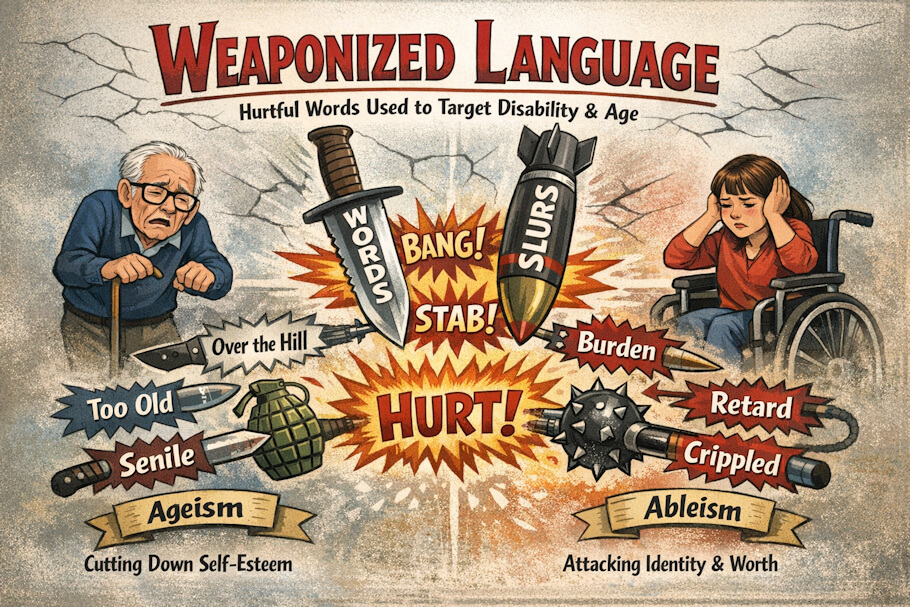
Older adults face a distinct and pervasive form of weaponized language rooted in ageism - the systematic stereotyping of and discrimination against people based on their age. Ageist language is so deeply embedded in everyday speech that many people use it without realizing the harm it causes. Phrases like "over the hill," "having a senior moment," "out of touch," and "past their prime" may seem lighthearted, but they collectively reinforce a cultural narrative that equates aging with decline, irrelevance, and incompetence.
Research by Becca Levy at Yale University has demonstrated that negative age stereotypes - many of which are communicated through language - have measurable effects on the physical and cognitive health of older adults. In one landmark study, Levy found that older adults who had internalized negative beliefs about aging lived an average of 7.5 years less than those with more positive self-perceptions of aging (Levy et al., 2002). In other words, the language a society uses to talk about aging can literally shorten lives.
Elderspeak: When "Kindness" Becomes Control
One of the most studied forms of weaponized language targeting seniors is "elderspeak" - a simplified, high-pitched, patronizing way of speaking to older adults that resembles baby talk. Elderspeak typically involves exaggerated intonation, simplified vocabulary, the use of collective pronouns like "we" when only the older person is being addressed ("Are we ready for our bath?"), and terms of endearment like "sweetie" or "dear" from strangers or caregivers.
While speakers may believe they are being warm or helpful, research consistently shows that elderspeak communicates low expectations and disrespect. A study by Williams, Kemper, and Hummert (2003) found that elderspeak in nursing homes was associated with increased resistance to care among residents, including both verbal and physical resistance. The residents were not being "difficult" - they were responding rationally to language that treated them as incompetent.
Elderspeak is especially harmful because it is often deployed by the very people seniors depend on - caregivers, medical professionals, and family members. When the language of care itself becomes a weapon, the person on the receiving end has few avenues to object without being further dismissed.
Institutional and Medical Language
In healthcare and institutional settings, the language used to describe older patients frequently reduces them to their diagnoses or deficits. Terms like "bed blocker" (used in some hospital systems to describe patients who occupy beds longer than expected), "non-compliant" (used when a patient does not follow medical advice), and "failure to thrive" strip away personhood and cast the patient as a problem to be managed rather than a person to be supported.
Palmore (2015) documented how institutional language around aging consistently frames older adults through a lens of decline and dependency, reinforcing both internal and external ageism. This framing has practical consequences: it affects how resources are allocated, how seriously complaints are taken, and how much autonomy older adults are permitted to exercise in their own care decisions.
Weaponized Language and Disability
A Long History of Harmful Labels
People with disabilities have endured centuries of dehumanizing language, much of it originating in medical and legal systems. Words that were once considered clinical terminology - "moron," "idiot," "imbecile," "cripple," "retarded" - entered everyday speech as insults, carrying with them deeply embedded assumptions about the inferiority and worthlessness of people with disabilities. While many of these terms have been formally retired from clinical use, their echoes persist in casual conversation, schoolyard taunts, and internet culture.
The social model of disability, articulated by scholars like Mike Oliver, draws a critical distinction between impairment (a physical or mental condition) and disability (the social barriers and attitudes that limit participation). Language plays a central role in this distinction. When we say someone is "confined to a wheelchair" rather than "uses a wheelchair," the language frames the assistive device as a prison rather than a tool of freedom and mobility. When we describe a building without a ramp as having "no disabled access" rather than being "inaccessible by design," the language shifts blame from the built environment to the person (Oliver, 1990).
Inspiration Rhetoric and Pity Framing
Not all weaponized language about disability sounds negative. Some of the most damaging language comes wrapped in admiration. The late disability activist Stella Young coined the term "inspiration porn" to describe the practice of treating people with disabilities as inherently inspirational simply for living their lives. Phrases like "you are so brave," "I could never do what you do," and "what is your excuse?" (often used as captions on images of people with disabilities exercising or working) reduce complex human beings to motivational props for the nondisabled majority (Young, 2014).
This kind of language may feel flattering, but it functions as a form of objectification. It tells people with disabilities that their primary social value lies in making others feel grateful or motivated - not in their own talents, opinions, or contributions. It also sets up a narrative in which people with disabilities are expected to be perpetually cheerful and uncomplaining, and those who express frustration, anger, or grief about their experiences are seen as failing an unspoken social contract.
Ableist Language in Everyday Speech
Ableist language is so deeply woven into English that many people use it constantly without any awareness. Common expressions like "that is crazy," "are you blind?", "falling on deaf ears," "lame excuse," and "turn a blind eye" all borrow from disability to signify something negative - irrationality, ignorance, weakness, or willful disregard. While most speakers intend no harm, the cumulative effect is a linguistic environment in which disability is constantly associated with deficiency and failure.
Scholars in disability studies have argued that this pervasive ableist language contributes to what Garland-Thomson (2002) calls the cultural "normate" - an unmarked, assumed standard of bodily and mental functioning against which all deviations are measured and found lacking. The language does not just describe a worldview; it actively creates and sustains one.
Institutional Gatekeeping Through Language
Perhaps the most materially consequential form of weaponized language against people with disabilities occurs in institutional settings - government agencies, insurance companies, schools, and workplaces. The language of eligibility criteria, diagnostic requirements, and accommodation requests is often so complex, contradictory, and narrowly defined that it functions as a barrier in its own right.
Consider the language many disability applicants encounter: they must prove they are "unable to engage in substantial gainful activity" or demonstrate "marked limitations in functioning." These phrases carry enormous legal weight but are interpreted by bureaucrats and adjudicators in ways that often seem designed to deny rather than grant support. Disability rights scholars have documented how the language of these systems forces applicants into demeaning performances of helplessness - they must emphasize everything they cannot do, often at the expense of their dignity, in order to access basic services (Schweik, 2009).
In educational settings, the language of Individualized Education Programs (IEPs) and accommodation letters can also function as a double-edged sword. While these documents are meant to ensure access, the deficit-focused language they require - cataloging what a student "cannot" do or where they "fall below" expected levels - can follow individuals through their academic careers, shaping how teachers perceive and interact with them long before any personal relationship is formed.
The Intersection: Seniors with Disabilities
For older adults who also have disabilities, the effects of weaponized language compound. They face both ageist and ableist language simultaneously, often in the same sentence. A phrase like "what do you expect at your age?" dismisses both the experience of disability and the dignity of aging in a single stroke. Research on intersectionality, drawing from the foundational work of Kimberle Crenshaw (1989), reminds us that people who occupy multiple marginalized identities do not simply experience the sum of each form of discrimination - they experience qualitatively different forms of marginalization that are more than the parts.
For a 75-year-old woman who uses a wheelchair, for example, the dismissive language she encounters from a healthcare provider may carry assumptions about her gender, her age, and her disability all at once. The provider may speak slowly, use elderspeak, direct questions to a companion rather than to her, and assume cognitive decline without evidence - all through the vehicle of language. Each of these linguistic choices individually might seem minor, but together they construct a communicative environment in which she is rendered invisible in her own care.
Why Weaponized Language Matters: Real-World Consequences
It is tempting to dismiss concerns about language as oversensitivity or political correctness. But the evidence is clear that weaponized language produces real, measurable harm across multiple dimensions of life.
- Health outcomes: As Levy's research demonstrated, internalized negative stereotypes about aging - communicated largely through language - are associated with worse cardiovascular health, memory performance, and longevity (Levy, 2009). Similarly, research on minority stress shows that chronic exposure to stigmatizing language contributes to elevated cortisol levels, anxiety, and depression in targeted populations (Meyer, 2003).
- Social isolation: When people are consistently spoken about or spoken to in demeaning ways, they often withdraw from social participation. Older adults who experience elderspeak in care settings have been shown to become less communicative over time, creating a cycle in which the language that disempowers them also isolates them (Williams et al., 2003).
- Policy and resource allocation: The way a society talks about a group influences how it legislates for that group. Language that frames older adults or people with disabilities as "burdens" or "drains" creates a political climate in which cuts to services and supports become easier to justify (Palmore, 2015).
- Self-perception and identity: Perhaps the most insidious effect of weaponized language is its ability to reshape how targeted individuals see themselves. When a person hears often enough that they are "less than," "broken," or "past their usefulness," those messages can become internalized, leading to diminished self-worth, reduced self-advocacy, and acceptance of conditions that should never be considered acceptable (Levy et al., 2002).
Resisting and Reclaiming: Moving Toward Language Justice
Recognizing weaponized language is the first step toward disarming it. Across communities - disability rights movements, aging advocacy organizations, anti-bullying campaigns, and media literacy programs - there is growing momentum toward what some scholars and activists call "language justice": the principle that all people deserve to be spoken about and spoken to with dignity, accuracy, and respect.
Awareness and Education
One of the most effective strategies is simply making people aware of how deeply language shapes perception. Media literacy programs that teach young people to identify framing, coded language, and manipulative rhetoric can build long-term resilience against weaponized communication (Kellner and Share, 2007). Similarly, training for healthcare workers, educators, and social service providers on respectful communication with seniors and people with disabilities has been shown to improve both the quality of care and the satisfaction of those receiving it.
Centering Affected Voices
Language decisions should, wherever possible, be guided by the people most affected. The disability rights slogan "Nothing About Us Without Us" captures this principle precisely. When organizations, media outlets, and policymakers consult with seniors and people with disabilities about how they wish to be described and addressed, the resulting language tends to be both more respectful and more accurate (Charlton, 1998).
Reclamation
Some communities have chosen to reclaim words that were once used against them, turning former slurs into terms of solidarity, identity, and pride. The word "crip," for example, has been reclaimed by some disability activists and scholars - most notably in the academic field of "crip theory" - as a way of asserting agency over language that was once used to diminish them (McRuer, 2006). Reclamation is not without controversy, and it is always the prerogative of the affected community rather than outsiders. But it represents one powerful way of neutralizing a linguistic weapon.
Policy and Institutional Change
Language change at the individual level matters, but systemic change requires institutional commitment. Updating the language used in laws, medical records, government forms, and media guidelines can shift cultural norms over time. The replacement of "mental retardation" with "intellectual disability" in U.S. federal law through Rosa's Law in 2010 is one example of how legislative language reform can both reflect and accelerate broader cultural change.
Conclusion
Words are not just sounds or symbols on a page. They carry weight. They carry history. They carry the power to include or exclude, to dignify or diminish, to heal or to wound. Weaponized language - whether it takes the form of a slur, a patronizing tone, a bureaucratic euphemism, or a political dog whistle - is a real and measurable force in people's lives. It shapes health outcomes, social participation, self-perception, and public policy.
For seniors, people with disabilities, and especially those who live at the intersection of multiple marginalized identities, the stakes of language are not abstract. They are felt in doctor's offices, in care facilities, in classrooms, in government agencies, and at kitchen tables. Recognizing weaponized language for what it is - and choosing to do better - is not a matter of politeness. It is a matter of justice.
Frequently Asked Questions
Is weaponized language always intentional
No, weaponized language can be intentional or culturally embedded, meaning a speaker may use harmful framing without conscious awareness while still reinforcing broader patterns that keep certain groups subordinate.
What is the difference between person-first and identity-first language
Person-first language places the individual before the condition, such as a person with a disability, while identity-first language leads with the trait, such as a disabled person, and the preferred form varies between individuals and communities.
How can I avoid using ableist language in everyday speech
Notice common phrases that borrow from disability to signal something negative and replace them with plain, accurate alternatives, since expressions like that is crazy or falling on deaf ears reinforce harmful associations.
What is language justice
Language justice is the principle that all people deserve to be spoken to and spoken about with dignity, accuracy, and respect, and it is advanced through awareness, education, and centering the voices of affected communities.
Are children and younger adults affected by weaponized language too
Yes, no group is fully immune, and younger people encounter it through workplace bullying, schoolyard taunts, political rhetoric, and online harassment that research links to anxiety, depression, and social withdrawal.
What role does social media play in spreading weaponized language
Social media amplifies reach and speed, creating environments where pile-ons, trolling, doxxing, and targeted harassment unfold rapidly and expose targets to hostile, dehumanizing language with measurable mental health effects.
How does weaponized language affect access to services
Complex eligibility criteria and diagnostic wording can act as barriers in themselves, often forcing applicants to emphasize everything they cannot do in demeaning performances of helplessness to qualify for support.
Can changing laws and official wording reduce harm
Yes, reforming the language in laws, medical records, and government forms can shift cultural norms over time, as shown when Rosas Law replaced mental retardation with intellectual disability in United States federal law in 2010.
References:
Charlton, J. I. (1998). Nothing about us without us: Disability oppression and empowerment. University of California Press.
Crenshaw, K. (1989). Demarginalizing the intersection of race and sex: A Black feminist critique of antidiscrimination doctrine, feminist theory and antiracist politics. University of Chicago Legal Forum, 1989(1), 139-167.
Fiske, S. T. (1993). Controlling other people: The impact of power on stereotyping. American Psychologist, 48(6), 621-628.
Garland-Thomson, R. (2002). Integrating disability, transforming feminist theory. NWSA Journal, 14(3), 1-32.
Haney-Lopez, I. (2014). Dog whistle politics: How coded racial appeals have reinvented racism and wrecked the middle class. Oxford University Press.
Kellner, D., and Share, J. (2007). Critical media literacy, democracy, and the reconstruction of education. In D. Macedo and S. R. Steinberg (Eds.), Media literacy: A reader (pp. 3-23). Peter Lang.
Lakoff, G. (2004). Don't think of an elephant! Know your values and frame the debate. Chelsea Green Publishing.
Lakoff, R. (1975). Language and woman's place. Harper and Row.
Levy, B. R. (2009). Stereotype embodiment: A psychosocial approach to aging. Current Directions in Psychological Science, 18(6), 332-336.
Levy, B. R., Slade, M. D., Kunkel, S. R., and Kasl, S. V. (2002). Longevity increased by positive self-perceptions of aging. Journal of Personality and Social Psychology, 83(2), 261-270.
Linton, S. (1998). Claiming disability: Knowledge and identity. New York University Press.
Lutgen-Sandvik, P. (2006). Take this job and...: Quitting and other forms of resistance to workplace bullying. Communication Monographs, 73(4), 406-433.
McRuer, R. (2006). Crip theory: Cultural signs of queerness and disability. New York University Press.
Meyer, I. H. (2003). Prejudice, social stress, and mental health in lesbian, gay, and bisexual populations: Conceptual issues and research evidence. Psychological Bulletin, 129(5), 674-697.
Oliver, M. (1990). The politics of disablement. Macmillan.
Palmore, E. B. (2015). Ageism: Negative and positive (2nd ed.). Springer Publishing.
Schweik, S. M. (2009). The ugly laws: Disability in public. New York University Press.
Sweet, P. L. (2019). The sociology of gaslighting. American Sociological Review, 84(5), 851-875.
Tynes, B. M., Reynolds, L., and Greenfield, P. M. (2008). Online racial discrimination and psychological adjustment among adolescents. Journal of Adolescent Health, 34(6), 565-569.
van Dijk, T. A. (1993). Elite discourse and racism. Sage Publications.
Williams, K. N., Kemper, S., and Hummert, M. L. (2003). Improving nursing home communication: An intervention to reduce elderspeak. The Gerontologist, 43(2), 242-247.
Young, S. (2014). I am not your inspiration, thank you very much [Video]. TED Conferences. TEDxSydney.
Insights, Analysis, and Developments
Editorial Note: If this paper makes one thing clear, it is that the harm caused by weaponized language is neither hypothetical nor trivial - it is documented, measurable, and deeply consequential for the people who live with it every day, particularly seniors and those with disabilities who deserve not just better words but the systemic respect and dignity that better words both reflect and help create.
 Author Credentials: Ian is the founder and Editor-in-Chief of Disabled World, a leading resource for news and information on disability issues. With a global perspective shaped by years of travel and lived experience, Ian is a committed proponent of the Social Model of Disability, a transformative framework developed by disabled activists in the 1970s that emphasizes dismantling societal barriers rather than focusing solely on individual impairments. His work reflects a deep commitment to disability rights, accessibility, and social inclusion. To learn more about Ian's background, expertise, and accomplishments, visit his full biography.