TAKTIKA: When a Brand Becomes Culture
Author: Lexx Che - View Credentials
Published: 19 Nov 2026
Publication Type: Submitted Article
Table of Contents:
Synopsis - Definition - Overview - FAQs - Insights, Updates - Related Content
Synopsis
This report is a first-person account and in-depth interview with the Ukrainian creative director behind TAKTIKA, an independent apparel brand launched in the first weeks of Russia's full-scale invasion in 2022 and built without a warehouse through a network of about ten specialist Ukrainian contractors offering more than one hundred designs. It traces how two of the brand's symbols - the SMERT VOROGAM falcon, drawn from the Kyivan princely trident tradition, and the single word НЕНАВИСТЬ (HATE) - moved from T-shirts into thousands of embroidered patches, tens of thousands of stickers and hundreds of permanent tattoos worn by soldiers. The author explains why he sees hate as a consequence of invasion rather than an ideology, why he uses runic and northern imagery while rejecting Nazi symbolism, and how his media reach has helped fundraisers for wounded service members, including a soldier who lost both lower legs. The account matters to readers interested in disability because it comes from inside a war that is producing large numbers of veterans with amputations and lasting injuries, and it connects directly to the author's Anti-Coaching approach to working within real physical, financial and social limits.*
Topic Definition
- Wartime Visual Culture
Wartime visual culture is the body of images, symbols, clothing, insignia and other visual objects that a society creates, shares and adopts during an armed conflict to express identity, resistance, grief and solidarity. It includes official military insignia as well as informal items such as morale patches, stickers, flags, street art, posters and tattoos, many of which spread far beyond their original makers through soldiers, volunteers and civilians. Over time these objects often gain personal and collective meaning through the experiences attached to them, turning mass-produced designs into memorials, historical records and markers of belonging that can last long after the fighting ends.
Overview
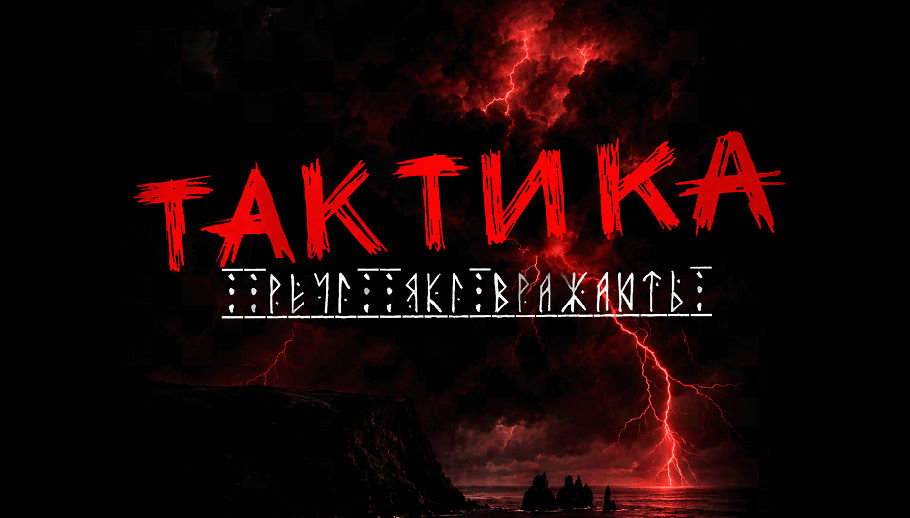
TAKTIKA: Ukrainian Wartime Apparel and Symbols of Resistance
When Russia launched its full-scale invasion of Ukraine on February 24, 2022, the familiar world collapsed into a reality governed by violence, uncertainty and permanent pressure. In March, TAKTIKA emerged as my response to that rupture. Its positioning, narrative and symbolic architecture took approximately two minutes to formulate. I deliberately rejected the familiar American tactical aesthetic of skulls, soldiers and militarized graphics, turning instead to a much older visual vocabulary: northern symbolism, runic structures, medieval heraldry, Roman references and historical forms that had survived centuries of political and cultural transformation.
TAKTIKA was conceived as an author-driven cultural system operating through physical objects. Clothing became its primary medium, although the underlying architecture extended into graphic design, symbols, narratives and collective identification. The first logo was drawn in roughly a minute on paper stickers. Its structure was deliberately adaptable: a dagger, wolf paw or sunflower could be integrated depending on the collection. Deep Digital Co - Worldwide subsequently refined the visual system while preserving the original drawing's raw character. The objective was to establish a recognizable identity capable of carrying different meanings without losing its structural integrity.
The production model was developed under equally unconventional conditions. I entered the apparel industry with almost no manufacturing experience and spent approximately two months assembling a network of ten independent Ukrainian contractors, including some of the country's strongest specialists. TAKTIKA operated without a warehouse, offered more than one hundred designs and distributed its products directly through its own online channels. Natural materials, direct-to-garment printing and precision embroidery pushed manufacturing costs to approximately two and a half times the conventional level. Durability was essential because these objects were entering environments where ordinary commercial assumptions about clothing, ownership and consumption no longer applied.
The first five or six months were an exercise in operational survival. Drone attacks, missile strikes, interrupted sleep and constant uncertainty existed alongside design, manufacturing, packaging, quality control and daily production decisions. Four or five hours of sleep became routine. The project developed within the same conditions it was attempting to interpret, and those conditions shaped its visual language, material choices and relationship with its audience.
Its cultural circulation began before the commercial identity was fully established. Stickers featuring the falcon-trident associated with the Kyivan princely tradition spread among military units. Another image depicted a defeated two-headed imperial chimera beneath a fallen crown. The composition attracted the attention of regional military leadership, and I subsequently produced a large plywood version for the regional governor's reception room. These were early indications that the graphics were being received as independent statements, capable of functioning outside advertising, retail and conventional brand communication.
Within six months, TAKTIKA had developed a presence across military, artistic and civilian environments. Its pieces appeared on People's Artist of Ukraine Artem Pivovarov, internationally recognized mask artist Bob Basset, members of former world boxing champion Alex Gvozdyk's team, artist Hamlet Zinkivskyi, musician and serviceman Prozorowww, historian and sociologist Oleksii Kovzhun, and Pulitzer Prize-winning journalist Vasilisa Stepanenko. Prozorowww, formerly the frontman of the Ukrainian band TOL, had also won Ukraine's Global Battle of the Bands final and placed fourth at the international final in London. Some photographic projects involved military mask artist Plastmask, whose work has also appeared in connection with Muse.
More consequential than public visibility was the way TAKTIKA entered personal histories. Its clothing, patches, stickers and flags traveled through frontline positions and military communities. Soldiers exchanged patches, preserved damaged insignia and attached individual experiences to objects that had originally been designed as elements of a visual system. Stories emerged of patches surviving fire and battlefield impacts. Some people who carried these symbols are no longer alive; their brothers-in-arms continue to preserve the objects as material records of memory, belonging and loss.
TAKTIKA gradually entered a cultural field in which the original author was no longer the sole source of meaning. Its symbols appeared on bodies, military equipment, personal possessions and commemorative objects. Their significance accumulated through use, circulation and lived experience. What began as an independent design project had become part of the visual culture of Ukrainian resistance.
Case Study: ТАКТИКА - Legendary Ukrainian Brand
SMERT VOROGAM: The Symbol Before the Brand
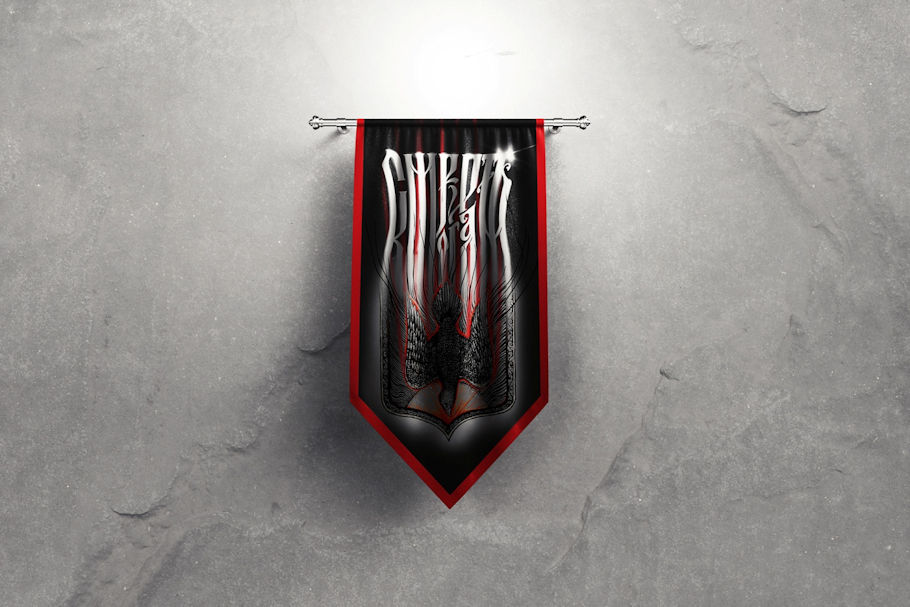
The first major TAKTIKA symbol existed before the brand itself had acquired a complete public identity. During the opening weeks of the invasion, I developed an image based on the sacred falcon associated with the Kyivan princes of the Rurik dynasty, drawing on the Rarog tradition and the visual structure of the Ukrainian Tryzub. The composition connected historical sovereignty with the immediate reality of resistance, using a recognizable national form as the foundation for a more aggressive symbolic narrative.
I extended the image through Egyptian mythology, placing the defeated Set beneath the attacking falcon. Set's associations with disorder, desert and foreign lands provided a symbolic parallel to the mythological struggle involving Horus and the restoration of legitimate rule. The composition was a deliberate artistic synthesis of different traditions, rather than a historical claim that they shared a common origin. In Ukraine in 2022, its contemporary political meaning was immediately recognizable.
A designer from Deep Digital Co painted the words SMERT VOROGAM - "Death to the Enemies" - in acrylic on canvas. We digitized and reconstructed the lettering, integrating its expressive physical texture with the falcon composition. The resulting image retained the force of an improvised wartime declaration while acquiring the technical precision required for reproduction across different materials and formats.
TAKTIKA did not yet have an Instagram account when I first placed the Falcon on T-shirts and published them through my MZNTRP artist profile. Requests arrived that same day. My longtime friend and client, People's Artist of Ukraine Artem Pivovarov, was subsequently photographed wearing the design, and further thematic shoots were produced with the Deep Digital Co team. Within the first month, orders had already crossed the Atlantic to the United States.
The symbol soon moved beyond clothing. Thousands of embroidered patches and tens of thousands of stickers circulated through military and civilian networks, often reaching people who had no direct relationship with the brand. SMERT VOROGAM acquired the character of a wartime folk incantation: a compact expression of anger, resistance and collective determination. Its force came from the historical moment and from the experiences of those who adopted it.
One battlefield account described a bullet passing close enough to damage a Falcon patch while the soldier wearing it survived. The story became part of the symbol's accumulated history. Such objects carry no supernatural protection, but their physical presence at moments of extreme danger can give them a significance that no designer could manufacture in advance.
The transformation revealed a fundamental distinction between commercial identity and cultural ownership. A company can control a logo, its reproduction and its commercial use. It cannot fully determine what that image will mean to someone who has carried it through a battle, exchanged it with a fellow soldier or preserved it after a death. The Falcon had entered a collective narrative, and every new experience attached to it expanded the meaning of the original design.
Case Study: SMERTVOROGAM - Cultural Narrative Streetwear Design
НЕНАВИСТЬ (HATE): The Emotion That Became a Symbol
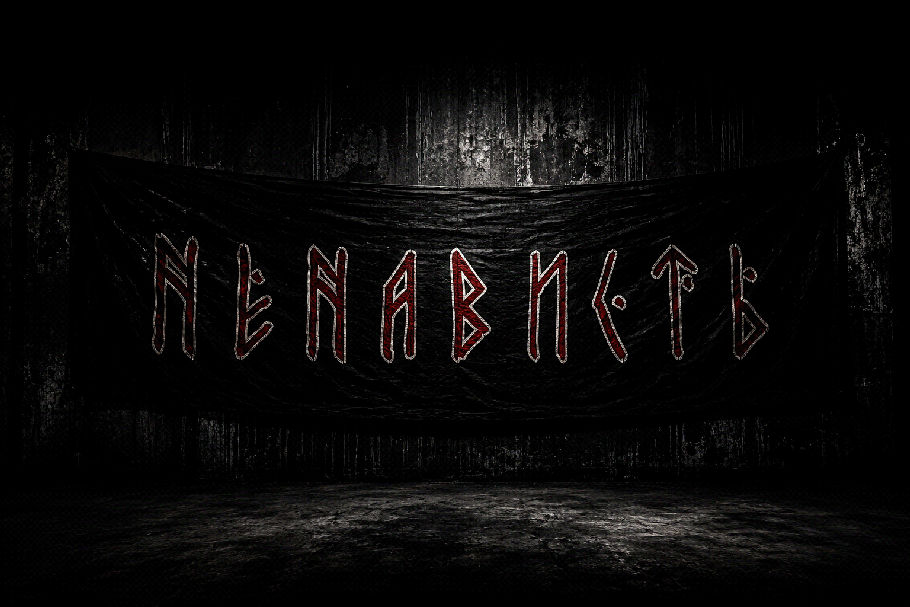
The second major symbolic project within TAKTIKA emerged from a different psychological source. Where the Falcon drew on historical imagery, mythology and the language of resistance, НЕНАВИСТЬ - HATE - began with an emotion that had become inseparable from the experience of millions of Ukrainians. It was a direct response to invasion, destruction, loss and the continuous pressure of living inside a war whose consequences could not be separated from everyday life.
I experienced the creation of this image as something physically violent, almost like pulling a thorn bush through my solar plexus. The first version was heavily illustrated, filled with aggressive strokes, fragmented graphics and visual tension. It attempted to contain the entire emotional experience within one composition. I eventually stripped away almost everything, leaving a single Ukrainian word.
НЕНАВИСТЬ.
The lettering was developed from a rune-inspired typeface connected to TAKTIKA's northern visual collections, then substantially transformed into an independent authorial design. Its severe geometry, condensed structure and recognizable rhythm turned the word into a visual object. The graphic no longer required an accompanying illustration. Its meaning was already carried by the language, the historical circumstances and the people encountering it.
Within two months, НЕНАВИСТЬ appeared on T-shirts, hoodies, caps, patches and stickers. Copies and imitations followed almost immediately, demonstrating how quickly a recognizable visual statement could spread beyond its original distribution system. Yet commercial replication was only one part of the process. The more significant development occurred when the design began moving between social groups and acquiring meanings that extended beyond the original collection.
Artist Hamlet Zinkivskyi, historians, cultural figures, soldiers and civilians wore the design. Hundreds of military personnel adopted it as a permanent tattoo, placing the word on their chests, backs and necks. Its migration from fabric to skin marked a decisive change in the relationship between the creator, the object and the audience. Clothing can be removed, replaced or discarded. A tattoo represents a much more enduring personal commitment to a symbol and the experience it contains.
This movement across media is central to understanding TAKTIKA as a cultural phenomenon. The same graphic could exist as a commercial product, a battlefield patch, a sticker, a personal declaration or a permanent inscription on the body. Each context changed its function while preserving its recognizable form. The design became part of a shared visual vocabulary through which people expressed experiences that conventional public language often struggled to contain.
My broader work with Anti-Coaching, pressure management, narrative systems and attention engineering begins with this relationship between lived reality and symbolic structure. Under extreme pressure, emotions influence perception, decisions and collective behavior. They can overwhelm individuals and institutions, but they can also be articulated, given form and incorporated into systems of communication and action. НЕНАВИСТЬ was one attempt to make an overwhelming collective emotion visible without pretending that the circumstances producing it could be resolved through a slogan.
By this stage, TAKTIKA's cultural significance could no longer be measured through products, sales or audience figures alone. Its symbols had entered personal memory, military experience, artistic practice and the physical bodies of people who had chosen to carry them. Their meanings continued to develop independently of the original design process.
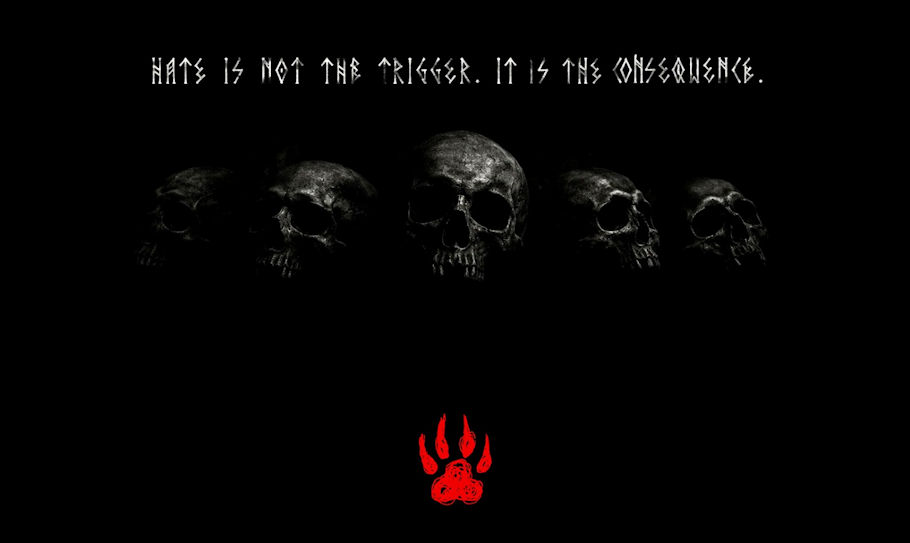
Hate is not the trigger. It is the consequence.
Case Study: НЕНАВИСТЬ - Apparel, Symbols, and Visual Pressure
Disabled World Interview With Lexx Che: Questions and Answers
Disabled World: I love the image of your sudden insight and passion, of two minutes wherein you defined TAKTIKA's positioning, narrative, and semantic framework, and in one minute you drew the first logo on paper stickers. I believe this, but there is also so much missing from the scene. Can you share with us some of how and why you were able to have this flash of passion and insight? What are a few things from your earlier work, in your personal life, and in your time and place that influenced and allowed for the moment as you describe it?
Lexx Che: What may look like a sudden flash of inspiration from a place of safety feels very different when you are inside the event itself. In my case, there was no romantic moment of creative enlightenment. I was in an extremely aggressive emotional state, close to breaking down after another wave of Shahed drone attacks. What happened during those two minutes was a direct discharge of accumulated energy into a visual and narrative structure. The ideas emerged as I worked, while drawing variations of the main symbol: a dagger, a wolf's paw and a sunflower. Each variation became part of a flexible identity system, allowing different collections to carry their own signs while remaining connected to the same visual architecture.
Twenty years of working with brands, complex projects, strategic systems and decision-making under pressure certainly played a role. When you have spent two decades building structures, you develop the ability to recognize relationships and assemble them quickly, even when the circumstances are far from ideal. But the emotional source of TAKTIKA was inseparable from the reality surrounding me. Ukraine was facing an invasion on a scale for which the country had not been adequately prepared. There was no established strategy capable of answering every dimension of that aggression. The immediate problem was how to act when the available information was incomplete, the environment was changing constantly and waiting for certainty was itself becoming dangerous.
That is also where the name TAKTIKA acquired its meaning. I later formalized this principle in my Anti-Coaching methodology, developed through the experience of war and twenty years of professional work. Action generates information. That information reveals possibilities, constraints and consequences, which in turn become the basis for the next decisions. An architecture of decision-making develops through interaction with reality. You cannot always construct a complete strategy in advance when the system around you is collapsing. Sometimes the first meaningful action is what makes the next decision possible.
In retrospect, the name became almost prophetic. Ukraine's military response demonstrated how tactical actions, integrated into broader strategic thinking, could challenge an adversary with vastly greater conventional resources. The destruction or disabling of much of Russia's Black Sea Fleet, strikes against the Crimean Bridge and attacks on strategically important energy infrastructure demonstrated the power of unconventional approaches, adaptation and systemic thinking under extreme asymmetry. These operations were not isolated improvisations. Their cumulative effects changed the operational environment and expanded the possibilities for subsequent action.
That is the connection between the moment TAKTIKA was created and the ideas I developed afterward. I was not sitting in a studio waiting for inspiration. I was responding to an environment that had become intolerable, using the professional instruments available to me. The symbols emerged through action, and the narrative developed alongside them. What appeared to take two minutes was supported by twenty years of experience and triggered by a reality in which there was no time to wait for ideal conditions.
DW: Tell us more about why you feel so strongly about the power of visual language?
Lexx: Visual language and linguistic systems have always carried equal weight in my work. I started drawing at the age of three, producing hundreds of images, and eventually began painting characters directly onto the walls of my room. Graffiti followed, along with long periods when I barely drew at all. I also wrote music, something I intend to return to. Last year, however, I was drawing almost every day, sometimes for two hours, sometimes for eight. My current artistic language is primarily graphic, somewhere between Albrecht Dürer's intricate structures and H. R. Giger's biomechanical imagination. Some works contain deliberately encoded elements that connect individual compositions into larger systems. TAKTIKA operates through a similar principle, although it has several independent visual languages, including collections built around occult and esoteric symbolism.
My relationship with symbols began long before my professional career. Since the age of twelve, I have studied heraldry, Hermetic traditions, occult iconography, Masonic symbolism and runic systems. I became particularly interested in sacred geometry, ornamental structures and the geographical migration of visual forms: how patterns, symbols and their interpretations traveled, transformed and reappeared across cultures, from Tibet and China to Indonesia and Europe. A symbol can survive for centuries while its meaning changes completely. It can move between religions, political structures, artistic traditions and everyday objects, accumulating new associations without necessarily losing its recognizable geometry. This historical mobility is one of the reasons I find visual systems so powerful. Their structure can persist far beyond the cultural conditions that originally produced them.
Some Artworks: TopDarkArt
For approximately twenty years, creative direction has been one of my principal professional disciplines. My teams and I have received hundreds of awards and recognitions from different countries, institutions and juries across visual communication, identity design, branding, unconventional digital systems, illustration and animated productions. Behind that experience are millions of images I have studied, from art and graphic design catalogs, of which I own dozens, to Pinterest, one of my favorite visual platforms, and thousands of professional portfolios. More recently, I built Deep Digital Worldwide, an international creative hub under my own brand, bringing together designers, studios and companies from different countries. In its first three months, the hub generated approximately four million views and hundreds of thousands of appreciations on Behance. It is another extension of my interest in how individual visual languages can coexist and interact within a larger architecture.
But there is an equally extensive linguistic and intellectual structure behind all of this. I have read more than 3,000 books across dozens of disciplines, from the folklore and mythologies of different civilizations to psychiatry, philosophy, psychology, sociology, history and social engineering, alongside an incalculable volume of articles, research papers and other materials. Reading has accompanied drawing since my earliest childhood. I wrote fairy tales as a child, then poetry, essays and short stories as a teenager and young adult. At school, I occasionally conducted literature classes and prepared research for the Junior Academy of Sciences of Ukraine. Later, I developed my own Russian-language media ecosystem consisting of three websites and two digital services, which at its peak attracted approximately one million visits per month.
During the war, I concentrated much of that accumulated experience into an interconnected body of more than fifty books, combining my professional frameworks with extensive additional research. Twenty-nine titles are already available on Amazon, with the thirtieth approaching publication. This year I also began publishing analytical and cultural journalism internationally. Over the past two months, more than sixty of my articles have appeared in media outlets across different countries, covering technology, philosophy, cultural history, psychology, decision-making, disability, social structures and other subjects. My author profile was verified on Muck Rack within approximately two weeks, and more than ten articles have already appeared in its database. Across these different disciplines, I try to maintain a recognizable analytical approach: examining familiar subjects through their underlying structures, contradictions, historical connections and less obvious consequences.
For me, visual and linguistic systems constantly interact. A drawing can compress an enormous amount of cultural information into a single recognizable form, while language can expose relationships, contradictions and layers of meaning that remain invisible in the image itself. They also operate at different speeds and through different mechanisms of perception. A visual symbol may establish recognition almost immediately, yet its full meaning can require years of cultural knowledge and interpretation. Language can construct an elaborate conceptual architecture, but it can also become a symbol in its own right, as happened with the word НЕНАВИСТЬ in TAKTIKA. The most interesting work often occurs where these systems intersect, influence one another and generate meanings that neither could produce independently.
This relationship extends deep into human cultural history. Visual representation, ornamentation and symbolic imagery existed long before the development of writing systems. The history of spoken language is considerably older and much harder to reconstruct, but the surviving material record allows us to trace how humans used images to preserve, organize and transmit meaning across generations. I explore these relationships in my books Identity Systems: Society, Culture, and Social Structures and Illustration and Advertising, examining how symbols participate in the construction of collective identities, social hierarchies, cultural memory and systems of influence.
That is why I take visual language seriously. Its power becomes especially visible when an image leaves the environment in which it was created and begins operating independently through other people's experiences. A graphic designed on a computer can eventually become a military patch, a political statement, a personal ritual or a tattoo carried for life. At that point, its meaning is shaped by an entire network of people, circumstances and interpretations. TAKTIKA gave me an unusually direct opportunity to observe this process in real time, under conditions where symbols were acquiring significance through the experiences of war.
DW: It's fascinating when people are drawn toward something entirely out of their wheelhouse. What compelled you to incorporate your visuals with apparel? Does your passion in art and design also naturally include an interest in the clothes people wear? Clearly we are talking about something unlike the red carpet fashion industry, and yet the visual language of clothing - from soldiers to religious leaders to hippies - is powerful. Have you always had an interest?
Lexx: I could quite reasonably be called a fashion obsessive. When I started working at seventeen, I began buying clothes in enormous quantities, often dozens of pieces at a time. Fashion was always another expression of personal visual identity for me. Without exaggeration, I was something of a trendsetter among my friends and acquaintances. I experimented with brands, silhouettes, combinations and styles long before I became professionally involved in apparel. Today, my son and I have approximately a thousand pieces of clothing between us, including my personal collection of nearly one hundred caps and bucket hats.
My wardrobe has never belonged to a single aesthetic or price category. Diesel, Levi's, AllSaints, PLEASURES, Adidas Originals, G-Star RAW, OBEY and various international niche brands associated with tattoo culture and alternative fashion coexist in it. I appreciate individuality, construction, materials and quality, regardless of whether a piece comes from a globally established company or a small independent label. Recently, I have stopped purchasing clothes and have begun selling part of my collection through Ukrainian resale platforms. But my interest in fashion goes back decades, and the idea of creating my own clothing brand first appeared when I was still a teenager.
At one point, I became a co-owner of Trendon, one of Ukraine's early multi-brand fashion marketplaces dedicated to Ukrainian designers. The business combined an online platform with two physical stores. My team developed its digital infrastructure, and I served as Head of Digital, responsible for the architecture and development of the e-commerce ecosystem. Trendon brought together dozens of Ukrainian fashion labels and hundreds of products, combining marketplace functionality, direct retail, brand presentation and a carefully structured shopping experience. Its second major digital iteration received an Awwwards Honorable Mention, CSS Design Awards Special Kudos and Gold at Golden Site 2016 in the e-commerce category.
Years later, Trendon was included in the international e-commerce research platform Website Motive, appearing in curated selections of menswear and urban fashion websites alongside brands and retailers such as Zegna, Burberry, ASOS, Selfridges, Diesel, Patagonia, Harrods, Alexander McQueen, OBEY, VANS and G-Star RAW. For a Ukrainian platform built around local designers, that was a meaningful international context. Unfortunately, the domestic market was not sufficiently developed to sustain our particular business model at that time. We eventually closed the operating business because of its lack of profitability, although the legal entity still exists. That experience deserves a separate conversation because it illustrates the gap that can emerge between the quality of a product, its technical infrastructure and the economic readiness of its market.
My professional responsibilities subsequently left almost no room for developing an independent clothing label. For nine years, I managed teams of forty to fifty people working in physical offices, overseeing creative production, marketing, digital products and complex projects. Approximately a year before the COVID-19 pandemic, I completed a digital transformation of my operating model, moving to a distributed structure built primarily around senior specialists. When companies around the world were forced to adopt remote work, my teams were already operating that way. But the volume of management, production and strategic responsibilities remained substantial. I had wanted to create an author-driven clothing brand for years. I simply had no time to build one properly.
The beginning of the full-scale invasion radically changed the situation. Ukraine's digital market contracted dramatically, and many of the projects and commercial structures that had occupied my time were disrupted. Suddenly, I had the capacity to pursue an idea that had existed for much of my adult life. TAKTIKA's identity, positioning and initial narrative came together almost immediately, as I described earlier. Manufacturing was an entirely different problem. I knew almost nothing about garment production and had no established relationships in that industry.
Over approximately two months, I worked through the major Ukrainian manufacturing contractors at an extraordinary pace. Some failed to meet deadlines, others ignored technical specifications, and many could not deliver the quality I expected. Eventually, I assembled a distributed production network of approximately ten highly specialized subcontractors. Each was responsible for a specific discipline, from garment manufacturing and custom patterns to printing, precision embroidery, labels and packaging. Instead of attempting to build an expensive centralized factory, I constructed a production architecture around independent specialists whose expertise could be coordinated within one quality system.
The resulting products were designed to meet the standards I associated with established international apparel brands such as Levi's and The North Face. We use high-quality natural materials, premium DTF printing, exceptionally precise embroidery and proprietary garment patterns. Manufacturing costs are considerably higher than those of conventional local merchandise. A TAKTIKA T-shirt typically costs around $50-60, while hoodies are priced at approximately $100-120. Only a handful of Ukrainian brands operate at a comparable quality level, and those generally serve different audience segments. From the beginning, I wanted TAKTIKA to be judged as a serious apparel product, independently of the emotional or political significance of its graphics.
The product architecture itself remains deliberately compact. The core capsule consists of coordinated sets, hoodies, sweatshirts, shorts, T-shirts, caps, balaclavas and several types of embroidered patches. Yet within this relatively small range, customers can choose from more than one hundred designs and illustrations, almost all created by me. A few collections involved collaborations with two other designers. We maintain availability across the full size range, and the visual collections remain part of the catalog rather than disappearing according to the seasonal logic of conventional fashion. Stickers occupy a separate position: they cannot be purchased individually and are included as gifts with orders, with the designs changing periodically.
I placed particular emphasis on sticker culture during the first months of the invasion, distributing our imagery into military environments where the stickers began circulating independently of clothing. They appeared on personal belongings, equipment and surfaces, becoming accessible carriers of the same symbolic language. Their low material value and high symbolic mobility made them especially effective. People could exchange them, preserve them or distribute them further without any involvement from the brand. This circulation became one of the mechanisms through which TAKTIKA entered the cultural environment surrounding Ukrainian resistance.
Another particularly interesting development came through our work with former world boxing champion Alex Gvozdyk. Members of his team and management had already become regular TAKTIKA customers. These were people accustomed to wearing brands such as Stone Island, so their continued interest in our products was a meaningful indication of how they perceived the quality. When Alex was preparing to return to professional boxing, his team approached us to develop a collection and a new visual identity.
TAKTIKA developed the narrative, while Deep Digital Co created a branding system that departed substantially from the usual conventions of personal sports identities. The project required a different manufacturing approach because Gvozdyk's team needed products outside the existing TAKTIKA capsule. I therefore created VECTOR UNIT, a separate production direction and subcontracting structure capable of developing independent apparel collections for other brands and clients.
Alex's training base was in Los Angeles, which introduced additional requirements. We developed more relaxed garment patterns, selected different fabrics appropriate to the local climate and adjusted the collection to the team's practical needs. Over approximately two months, several specialist teams operating under my direction produced and shipped around one thousand units to Los Angeles. The project combined narrative strategy, brand identity, apparel design, manufacturing, quality control and international logistics within one coordinated production system.
VECTOR UNIT has since become a broader production capability. Its architecture allows it to develop almost anything within apparel and related merchandise, from corporate collections and specialized promotional products to independent fashion brands with extensive product ranges. The infrastructure exists, the manufacturing expertise has been tested, and the Gvozdyk project demonstrated its ability to execute an international assignment at a substantial scale. What I have not yet determined is how to position and develop VECTOR UNIT internationally alongside my other major professional and creative directions.
So my relationship with clothing has always been personal, visual and professional. I have been interested in fashion since adolescence, participated in the development and ownership of a fashion retail business, and spent decades studying how identity is constructed through visual systems. TAKTIKA brought those experiences together under exceptional historical circumstances. Clothing is one of the few visual media that people voluntarily carry into virtually every part of their lives. It communicates taste, affiliation, social position, cultural references and personal history, often before a single word is spoken. In the case of TAKTIKA, that relationship became particularly intense because the garments and symbols accompanied people into situations where identity, solidarity and memory acquired an entirely different weight.
Case Study: The Nail Team - Rebranding and Identity Systems
DW: You mention that rejecting American tactical imagery and favoring runic, medieval, and Roman references was deliberate. Were you ever concerned about how some northern and runic forms have been misused by other movements elsewhere?
Lexx: No, the possibility of misinterpretation has never been a reason for me to abandon an entire historical or artistic tradition. When people misunderstand a particular subject, that is usually a reason to examine its history more carefully. I have studied heraldry, runic traditions, Hermetic symbolism, occult iconography and the geographical transmission of symbols since I was twelve. I am well aware that some of these forms were appropriated by nationalist, far-right and extremist movements, including the Nazis. But their appropriation does not grant those movements ownership over centuries of cultural history. A symbol's origin, historical transformations, specific composition and context of use all matter.
At the beginning of the full-scale invasion, Ukraine experienced a renewed interest in its own history, cultural origins and traditional symbolism. The history of Kyivan Rus is particularly interesting in this context because its early ruling dynasty had Scandinavian connections, and the society itself developed through interactions among Slavic, Norse, Byzantine and other cultural traditions. The degree and nature of Scandinavian influence remain subjects of historical discussion, but that cultural intersection is well established. Ukraine's historical visual heritage is therefore considerably more complex than any single national or ethnic tradition. For me, northern and Slavic references provided an opportunity to explore this layered inheritance through a contemporary graphic language.
In early 2022, much of the emerging Ukrainian wartime graphic culture seemed to concentrate around two recognizable directions. One reproduced the American tactical aesthetic of skulls, skeletons and soldiers in combat equipment. The other turned to familiar Ukrainian Cossack imagery. Both had an understandable place in the visual environment of the war, but I wanted to work with older historical material. I began combining northern geometric structures, runic references, medieval heraldry, Slavic motifs and selected Roman elements into a much broader visual system. TAKTIKA eventually developed several related but distinct symbolic languages across its collections. At that time, I saw very few Ukrainian apparel brands attempting to build a similarly extensive system from these sources.
I was among the designers developing and popularizing this direction during the opening period of the invasion. Over time, northern symbolism became increasingly visible across Ukrainian military and civilian visual culture. Soldiers adopted rune-inspired tattoos, other brands began using related aesthetics, and images of Vikings, northern deities and historical warriors appeared in enormous quantities. Some of this work was carefully researched; much of it was simply visual imitation, with little understanding of the historical sources. The distinction matters to me because a recognizable style can be reproduced almost indefinitely, while a coherent visual language requires structure, cultural knowledge and internal relationships between its elements.
Regarding the extremist associations, my position is straightforward. My attitude toward Nazism and neo-Nazism is unequivocally negative. Nazi Germany appropriated, reinterpreted and redesigned historical symbols for its own political mythology, and some of those configurations remain unmistakably associated with Nazi ideology. We do not use Nazi insignia or other explicitly extremist designs. At the same time, historical runic alphabets, northern ornaments and pre-Christian imagery cannot reasonably be classified as extremist in their entirety because some organizations adopted selected elements. Their meaning depends on the specific form, combination, political context and intended message. Ignoring that distinction would effectively surrender a substantial part of European cultural heritage to the movements that misused it.
I examine this problem extensively in my forthcoming book Architecture of the Third Reich. One chapter focuses specifically on historical symbols appropriated by organizations with extremist or otherwise deeply compromised reputations. The subject requires separating original cultural functions from later ideological reinterpretations. It also requires recognizing that certain symbols have acquired such powerful associations through their use by the Nazis that they cannot be treated as visually neutral today. Historical knowledge does not eliminate contemporary responsibility, but contemporary political associations should not erase the entire history of a symbol.
I encountered the practical consequences of this problem during the first months of the invasion. Facebook deleted my personal account, which was more than ten years old, together with an artist community I had built that included over 7,000 followers from around the world. The apparent trigger was an illustration containing the Azov emblem, which occupied approximately five percent of the entire composition. At the time, Meta's moderation system treated the regiment under its dangerous-organizations policy. My experience was particularly frustrating because a relatively small element of a larger artistic composition could determine the fate of years of accumulated work and an international creative community.
The broader controversy eventually reached Ukrainian government institutions. In January 2023, following discussions involving Ukrainian authorities, Meta removed the Azov Regiment from its dangerous-organizations designation and changed its treatment of related content. This did not erase the controversies surrounding the unit's historical symbolism or the backgrounds of some of its early members, but it demonstrated how platform classifications can change as institutional assessments and political circumstances evolve. My deleted artistic community, however, had already been lost. Since then, I have used Facebook very little. I also find that its contemporary environment has deteriorated considerably, with an overwhelming volume of aggressive, irrelevant and attention-seeking content.
There is another dimension that is frequently overlooked in these discussions. Northern symbolism exists in living cultural and spiritual practices completely unrelated to neo-Nazism. In countries such as Iceland, Norway, Denmark and Sweden, people continue to engage with historical customs, regional traditions, pre-Christian mythology and modern forms of Norse-inspired spirituality. Contemporary interpretations vary considerably, and historical reconstruction should be distinguished from modern invention. Nevertheless, the existence of these communities demonstrates that the entire tradition cannot be reduced to its appropriation by twentieth-century political movements.
The same is visible in contemporary digital culture. Instagram, TikTok and Etsy contain large communities producing rune-based artwork, protective talismans, bindrunes, divination materials and other objects associated with modern esoteric practices. Some draw on documented historical forms, while others are contemporary symbolic inventions. These communities may have little in common with each other, but their existence illustrates the range of meanings that the same visual vocabulary can acquire. A rune may function as a historical letter, an ornament, a spiritual reference, a commercial design element or, in a particular ideological configuration, an extremist emblem. Treating every appearance as equivalent would make serious cultural analysis impossible.
For TAKTIKA, the historical references were part of a deliberate authorial system developed in response to the Ukrainian experience of war. I was interested in sovereignty, resistance, historical continuity, collective identity and the capacity of symbols to carry meaning across generations. The final designs were shaped by contemporary circumstances, but their visual foundations were often much older. I consider it essential to understand how symbols have been used, including their darkest historical appropriations. That knowledge allows me to make more precise decisions about what to use, what to transform and what to reject.
A symbol has a history before someone appropriates it, and that history does not disappear afterward.
DW: With НЕНАВИСТЬ (HATE), you describe pulling a feeling out of yourself and stripping the design down to a single word. Some people might see a garment that says "HATE" as glorifying the emotion. How do you respond to that, and what do you mean by "Hate is not the trigger. It is the consequence"?
Lexx: Hatred is a terrible emotion, and I do not believe it should be cultivated. It can consume a person, distort judgment and eventually become destructive to the very individual experiencing it. But there is a fundamental difference between cultivating hatred as an ideology and experiencing it as a psychological response to sustained violence. Human emotions do not emerge independently of circumstances. Fear, grief, anger and hatred can be consequences of events that a person neither initiated nor had any opportunity to prevent.
Ukraine is an independent sovereign state that owes Russia neither its territory nor its political independence. Our country has been subjected to a massive, unprovoked invasion, despite international agreements in which Russia itself undertook to respect Ukraine's sovereignty and existing borders. The 1994 Budapest Memorandum is a particularly revealing example. Ukraine relinquished the nuclear weapons stationed on its territory, while Russia, the United States and the United Kingdom provided security assurances, including commitments to respect Ukraine's independence and refrain from the threat or use of force against it. Russia subsequently violated those commitments. The country that had formally recognized Ukraine's territorial integrity became the aggressor attempting to destroy it.
For me, these are immediate physical circumstances. I live in a particularly dangerous area near the Black Sea, where Russian drones and missiles have repeatedly attacked civilian infrastructure and residential neighborhoods. Shahed drones approach from the sea, aircraft launch missiles, explosions shake buildings, and people die. I can be killed on any ordinary day, at any hour, without having done anything to provoke the attack. The same is true for millions of my compatriots. In cities closer to the frontline, the conditions are even more devastating. Entire neighborhoods have been destroyed, communities displaced, families separated and countless individual lives irreversibly changed.
Mariupol alone demonstrates the scale of what remains impossible to fully comprehend or document. A city of more than 400,000 people was devastated by siege, bombardment and prolonged deprivation. Satellite investigations subsequently revealed thousands of new graves, while human rights researchers acknowledged that the actual death toll could be substantially higher than their documented minimum. Some victims may remain beneath the ruins, their identities and circumstances of death still unknown. And Mariupol is only one city. When an entire country lives with destruction on this scale, hatred does not need to be manufactured, promoted or taught. It emerges from what people have witnessed, survived and lost.
When you live under a continuous threat of death, emotional responses cannot be evaluated as though they developed in a peaceful environment. Hatred in such circumstances can emerge from accumulated fear, helplessness, grief and the repeated experience of being targeted. It is a reaction to violence that has already occurred and continues to occur. That does not make hatred a desirable psychological condition, nor does it justify directing it indiscriminately toward people because of their nationality. Responsibility belongs to those who initiate, carry out, enable and support aggression.
When I created НЕНАВИСТЬ, I was not trying to persuade people to hate. I was giving a recognizable form to an emotion that was already present in millions of lives. The word was deliberately left without illustration or explanation because the historical circumstances supplied the context. I did not need to manufacture anger through advertising or invent a dramatic narrative. The reality surrounding us was already more extreme than anything I could have designed.
The fact that soldiers began tattooing the word on their bodies is particularly significant. They were not necessarily celebrating hatred as a personal virtue. They were choosing to preserve a record of what they had experienced and what that experience had done to them. I cannot speak for every person who wears the symbol, and individual interpretations inevitably differ. But the distinction between an emotion as an aspiration and an emotion as a consequence is central to understanding the project.
I would prefer to live in a country where this design had never needed to exist. Where children could sleep without air-raid sirens, where people did not have to calculate the distance to explosions, and where the ordinary routines of life were free from the possibility of sudden violent death. Under those circumstances, perhaps НЕНАВИСТЬ would have remained nothing more than a word in a dictionary.
That is what I mean when I say, "Hate is not the trigger. It is the consequence." The trigger was the invasion, the destruction of cities, the killing of people and the continuous violation of a country's right to exist independently. Hatred followed those events. The design records that psychological consequence without pretending it is healthy, admirable or something humanity should aspire to reproduce.
If you want to understand why the word appeared, you have to examine what happened before it.
DW: You clearly care about the way your products behave and influence the world beyond your production of them. Is this common amongst your peers? Or is this something unique that sets you apart from them? And if so, have you always been an outlier? Or is there a story, or a collection of stories, that triggered a desire in you to become someone who is intentional with what they create? What they produce? What they champion?
Lexx: Yes, many of my colleagues, friends and acquaintances wear TAKTIKA, including my son. And I should clarify that the brand is considerably more diverse than its most aggressive wartime imagery might suggest. Many collections explore historical, cultural, mythological and symbolic subjects without an explicitly confrontational message. TAKTIKA contains several distinct visual languages, each with its own references and narrative structure. The military dimension is important, but it represents only part of the cultural system.
As for whether other creators care about the consequences of their work, I cannot speak for an entire industry. I know designers and artists who approach their work with extraordinary seriousness, and others who are primarily concerned with commercial production, aesthetics or short-term visibility. What interests me is the point at which a project develops enough internal structure to continue functioning beyond its original creator. With TAKTIKA, that process has already occurred. Its narratives have entered public culture, and the symbols have acquired meanings through experiences over which I have no control. The brand has developed its own mythology within military communities. I can continue designing, producing and protecting the quality of the original work, but I cannot determine what a particular patch, tattoo or flag will mean to someone who has carried it through a war.
There is another aspect of this that I find important. TAKTIKA has tens of thousands of followers, yet fewer than ten people among those with whom I communicate know who actually created it. I have never built the brand around my personal identity or promoted myself as its author and narrative architect. There is a deliberate distance between the creator and the public object. People encounter the designs, recognize the symbols and develop their own relationships with them without needing to know my name. For me, that independence is one of the strongest indications that the system has acquired a life beyond its original authorship.
If we look at my broader professional history, this approach did not emerge from a single transformative experience. It developed over approximately twenty years of building brands, creative teams, digital products and complex communication systems. I have always been particularly attentive to the relationship between structure, execution and long-term consequences. For many years, my teams were among the trendsetters in several areas of digital design and visual communication. We documented dozens of cases of direct copying and imitation across different disciplines, often with substantially weaker execution. I have seen individual visual solutions reproduced, entire approaches adopted and even recognizable elements of our corporate identity appear elsewhere.
There have been more peculiar examples. Approximately two years after I transformed my company and established the Deep Digital brand, a Ukrainian apparel company appeared with a remarkably similar logo. More recently, a former business partner launched a Ukrainian publication about marketing, design and digital systems using the name Deep Digital and the domain deepdigital.com.ua. I mention these cases as examples of how names, visual identities and concepts can be reproduced independently of their original creators. I do not claim that every similarity establishes deliberate copying, but the broader pattern has been a recurring feature of my professional experience.
These experiences reinforced my interest in systems that cannot be reproduced simply by copying their visible elements. A logo can be imitated. An illustration can be redrawn. Even an interface or an entire product presentation can be reproduced. But the architecture behind a mature project includes accumulated decisions, relationships, expertise, operational processes, intellectual connections and the ability to evolve. Reproducing its appearance does not automatically reproduce the system that makes it function.
Recently, I developed Deep Digital Worldwide, an international creative hub bringing together designers, studios and companies within a shared identity. It is another attempt to move beyond the conventional boundaries of an individual company or portfolio. Participants contribute their own work, while the hub provides a larger environment for presentation, discovery and potential professional collaboration. The value of the structure grows through the contributions and relationships of people who operate independently of me. Its development is particularly interesting because the system begins to acquire significance through the collective activity of its participants.
The same principle extends into my work as an author and researcher. The Anti-Coaching: Beyond Limitations series, which we developed together for Disabled World, examines the lives and achievements of people operating under significant physical, cognitive, sensory and social constraints. Its narrative framework deliberately challenges conventional success stories, which frequently isolate exceptional achievements from the systems of limitation, dependence, adaptation and unequal access surrounding them. The series creates a different analytical field around disability, responsibility, achievement and the conditions under which human capabilities are developed or restricted.
My BLACK FIELD publishing library follows a related architectural principle. I am building it as an interconnected ecosystem of knowledge rather than a collection of independent books. Each new publication introduces an additional layer, examining decision-making, psychology, responsibility, social structures, visual communication, cultural history, strategy and other disciplines from different perspectives. I describe the entire structure as a cognitive machine. A reader can enter it through different subjects, but the relationships between them become increasingly visible as additional layers are explored. I am confident that someone who reads three books from different parts of this ecosystem will begin to reconsider at least some of their existing assumptions about how systems, decisions and human behavior operate.
This is particularly evident in the Anti-Coaching methodology I am currently developing. It approaches human limitations and decision-making through an integrated system of constraint mapping, decision architecture, responsibility, adaptation and the identification of capabilities that conventional motivational frameworks often fail to recognize. I am interested in what actually happens when a person or organization has limited resources, restricted options, incomplete information and no guarantee that circumstances will improve. The objective is to build a framework capable of producing useful analysis and action under those conditions, with applications extending beyond any single book or individual case.
TAKTIKA belongs to the same broader pattern. It began as an author-driven brand, developed into a production and visual communication system, and eventually entered a cultural environment where its symbols started operating independently. Deep Digital Worldwide connects independent creative practitioners. BLACK FIELD connects intellectual disciplines and research frameworks. Anti-Coaching examines how people make decisions and develop capabilities within the constraints of reality. These projects differ in medium, audience and immediate purpose, but they share an underlying architectural ambition.
I am interested in the moment when a system becomes larger than the person who designed it. When its elements begin interacting with other people, institutions and environments, producing consequences that the creator could not fully anticipate. That transition requires accepting a loss of control over certain aspects of meaning and interpretation, while remaining responsible for the quality, integrity and development of the original structure.
So I would hesitate to describe myself as an outlier simply because I care about what I produce. Many serious creators do. What may distinguish my approach is the scale at which I attempt to connect different disciplines and the extent to which I design projects for development beyond their initial form. I have spent much of my professional life moving between visual art, technology, strategy, media, production and research, and I rarely treat any of those fields as isolated.
Ultimately, my primary interest is not myself as a public personality. It is what I am capable of building that can become larger than myself.
DW: Your media platform has helped fund raise for military medical treatment and rehabilitation. Many service members come home with lasting injuries and disabilities. What have you learned about what wounded veterans need most? Do you have any suggestions for people outside Ukraine who want to help in ways that actually reach the veterans and their families?
Lexx: I share practically every fundraising request that reaches TAKTIKA, and frequently those I discover independently. These campaigns support wounded service members, medical treatment, rehabilitation and families facing extremely difficult circumstances. I do not receive financial reports, and organizers generally cannot determine precisely which channel brought a particular donation. There have, however, been cases when people contacted me afterward and said that my repost had helped them raise a substantial part of the required amount. One involved a serviceman who had lost the lower parts of both legs.
I have received more personal gratitude through TAKTIKA than through all my previous professional activities combined. People have thanked us for fundraising support, product quality and symbols that became part of their lives. Some preserve patches and flags inherited from fallen brothers-in-arms. One soldier told me he had carried my patch throughout the war. Another described surviving when the other members of his unit had been killed and later advancing to a higher position, still carrying the same symbol. These stories come from different people and circumstances, but they reveal something that cannot be measured through conventional brand performance. And there is a recurring paradox: most of them have no idea who they are personally thanking.
I would be cautious about claiming to know what wounded veterans need most. Their circumstances differ enormously, and I am not a rehabilitation specialist. Some need urgent surgery, prosthetics or long-term medical treatment. Others need psychological support, accessible housing, employment, financial stability or assistance for their families. Many require several forms of support simultaneously, sometimes for years. What I have learned is that assistance must respond to the actual circumstances of an individual rather than to a generalized image of a wounded soldier.
For people outside Ukraine who want to help, I would recommend working with established Ukrainian medical, rehabilitation or volunteer organizations that can demonstrate where resources go and maintain direct relationships with the people receiving assistance. Supporting a verified individual fundraiser can also be effective, particularly when the medical need and responsible contacts are clearly documented. I cannot currently recommend a specific organization with confidence, but transparency, continuity and direct accountability are essential. Rehabilitation does not necessarily end when a fundraising target is reached.
At the beginning of the invasion, almost simultaneously with the development of TAKTIKA, I was also involved in a larger humanitarian initiative called World Help Ukraine. Together with Deep Digital Co and our American partners, we developed its identity, digital infrastructure and donation website in approximately one week, under extremely difficult conditions. According to the organization's reports, the website generated around half a million dollars in donations. Additional substantial fundraising took place through Facebook, managed directly by the organization. World Help Ukraine also coordinated shipments of humanitarian supplies, medical equipment, protective gear and other essential resources. Some of the people involved later publicly acknowledged our contribution on LinkedIn.
Case Study: World Help Ukraine
I see all these activities as different applications of the same professional capabilities. Sometimes I build a complete digital fundraising infrastructure; sometimes I simply share a request with an existing audience. The scale and mechanics are different, but the important question remains whether that action reaches someone who needs it. I cannot claim responsibility for every outcome, and I have no intention of presenting other people's suffering as evidence of my own achievements. In the cases where people have told me that our involvement made a tangible difference, that is enough to justify continuing.
DW: You connect this experience to your work in Anti-Coaching, pressure management, and attention engineering. Can you briefly explain what Anti-Coaching means in practice?
Lexx: Anti-Coaching is a methodology I am developing around a fundamental problem: conventional approaches to personal development, motivation and success frequently fail when confronted with the actual conditions in which people must make decisions. Much of the coaching industry operates through generalized models of ambition, confidence, positive thinking and personal responsibility. These models often assume that individuals possess sufficient resources, freedom of choice, psychological stability and control over their environment. In reality, people frequently operate under severe financial, physical, emotional, institutional or professional constraints. Some of those constraints cannot be removed through motivation, discipline or a change of attitude.
In practice, Anti-Coaching begins with a reconstruction of reality. What is actually happening? Which constraints are objective, which are perceived, and which are created by the surrounding system? What resources, dependencies and decision-making capabilities remain available? The methodology uses constraint mapping, decision architecture, pressure analysis and the identification of overlooked capabilities to develop realistic courses of action. It also examines how people interpret situations, because perception determines which possibilities they recognize, which risks they underestimate and which decisions they consider available. Changing someone's perspective can be useful, but only when that change is grounded in a more accurate understanding of reality.
This approach applies to personal consulting, professional crises, business management and situations involving prolonged uncertainty. A person facing financial collapse, a founder operating without sufficient resources and an individual living with serious physical limitations require different solutions, but their situations can be examined through a common analytical framework. Anti-Coaching does not promise that every problem can be solved or that every limitation can be overcome. Sometimes the most important result is identifying which outcomes are impossible, which risks must be accepted and where a limited intervention can produce a meaningful change.
My longer-term ambition is to develop Anti-Coaching into a structured methodology with documented frameworks, practical instruments, training programs and, eventually, a licensing system. I would like it to become useful to business consultants, coaches, corporate trainers and other professionals willing to critically reassess conventional approaches to motivation, achievement and decision-making. The intention is to establish a discipline that can be taught, applied, challenged and improved through practice rather than remaining dependent on my personal involvement.
The central principle is simple: reality does not have to accommodate your expectations. Effective action begins with understanding the conditions in which you actually exist, including those you cannot change. Anti-Coaching examines what can still be done within those conditions, how decisions alter the available possibilities and how human capabilities can be developed without pretending that limitations have disappeared.
DW: What is one lesson you've learned from running a business under wartime pressure that our readers could apply in their own lives?
Lexx: The most important lesson is to continue acting despite circumstances, even when those circumstances are beyond your control. Search for available resources, reassess your limitations and, when necessary, turn yourself into an operational function capable of making decisions and executing them under pressure. This does not mean ignoring danger, suppressing emotions or pretending that everything is manageable. It means recognizing the difference between the conditions you cannot change and the actions that remain within your control.
The war is still ongoing, and I continue building systems. Sometimes I write while burning Shahed drones, intercepted by Ukrainian air defenses, fall into the Black Sea just 100-500 meters from my panoramic windows. I live on the top floor of a building directly overlooking the sea, from where Russian drones approach. Some fly directly over my roof. These are not metaphors or dramatic illustrations of pressure. They are the physical conditions in which I work, make decisions, write books and develop projects.
I have accepted these circumstances as an objective reality over which I have almost no influence. I cannot stop a missile, control the trajectory of a drone or determine when the next attack will happen. I can take available precautions, assess immediate risks and continue working when conditions permit. The distinction is important because accepting reality does not require surrendering the ability to act within it.
My advice is to stop waiting for circumstances to become favorable before doing what is still possible. Perfect conditions may never arrive, and even a small action can produce information, reveal resources or open possibilities that were previously invisible. Sometimes your available capacity is extremely limited, and preserving it becomes the immediate priority. At other times, you can continue building something meaningful despite the instability surrounding you.
I cannot control the war outside my windows. But I can still decide what I build while it continues.
DW: Nearly four years into the full-scale war, where does TAKTIKA stand today, and what do you think the brand becomes once the war ends?
Lexx: First, a small correction: we are approaching five years of full-scale war, not four. And I would challenge the assumption embedded in the second part of your question. Under our circumstances, there is no meaningful concept of "after the war." We live with the possibility of death every day, and none of us has a guarantee that we will personally reach that hypothetical future. Planning for a postwar reality is understandable, but treating it as an inevitable next stage would be dishonest about the conditions in which we actually exist.
TAKTIKA continues to operate, and new collections are still being released. However, this year has brought a significant commercial decline. Military personnel, who form an important part of our audience, often have little disposable income. Purchasing power across Ukraine has been severely damaged by years of war, economic disruption, displacement and growing financial pressure on households. From my perspective, the domestic market is becoming increasingly difficult to operate in, while large parts of society are struggling to maintain basic financial stability. Even a brand with a strong identity, an established audience and high production standards cannot separate itself from the economic conditions of the country in which it operates.
There is still considerable unrealized commercial potential. If an investor among your readers is interested in expanding TAKTIKA internationally, opening showrooms or developing a sophisticated global e-commerce operation, I am open to discussing it. The brand already has an established visual identity, more than one hundred designs, a tested manufacturing network and years of cultural history behind it. The challenge is to build international distribution and commercial infrastructure capable of operating beyond the limitations of the Ukrainian market.
But the most important thing for me is that TAKTIKA has already accomplished something that commercial expansion alone could never guarantee. The brand has established itself culturally and, in a sense, already outgrown its original purpose. Its symbols have traveled through battlefields, become tattoos, been exchanged between soldiers and preserved as personal memorials. Some of these objects belong to the memory of people who are no longer alive. Others will remain with those who survive, and perhaps eventually pass to their children and grandchildren, as wartime artifacts have done throughout history.
I cannot predict what TAKTIKA will become after the war, or even whether I will be here to determine its future. But I know that parts of what we created will continue to exist independently of the company, its products and its commercial success. The brand may evolve, expand internationally or eventually cease operating. Its cultural artifacts have already entered people's lives and memories.
Commercially, TAKTIKA's future remains uncertain. Culturally, it has already secured a place beyond its own existence as a brand.
Frequently Asked Questions
NOTE: Researched FAQs by Disabled World (DW)
What is the difference between DTG and DTF printing on clothing?
DTG, or direct-to-garment printing, uses an inkjet printer to place water-based ink straight into the fabric and works best on cotton. DTF, or direct-to-film printing, prints the design onto a plastic film, coats it with an adhesive powder and heat-presses it onto the garment, so it works on a wider range of fabrics, including polyester and blends. DTG prints usually feel softer, while DTF transfers sit on top of the fabric and often look brighter on dark clothing.
What does the Ukrainian Tryzub represent?
The Tryzub, or trident, is the main element of the coat of arms of Ukraine. It traces back to the princely signs of the rulers of Kyivan Rus and appears on coins of Volodymyr the Great from the late 10th century. Ukraine adopted it as a state symbol in 1918, and the Verkhovna Rada approved it as the small coat of arms in 1992. Its exact origin is still debated, with theories ranging from a stylized falcon to a trident or an anchor.
Why do soldiers wear morale patches?
Morale patches are informal patches, usually attached with hook-and-loop fasteners, that soldiers use to show humor, unit pride, shared experiences or support for a cause. They are separate from official rank and unit insignia, and they are often traded or given as gifts, which helps build trust and a sense of belonging within and between units.
What were runes originally used for?
Runes are the letters of alphabets used by early Germanic-speaking peoples, with the Elder Futhark in use from roughly the 2nd to the 8th century and the Younger Futhark used in Scandinavia during the Viking Age. They were carved on memorial stones, weapons, jewelry and everyday objects to record names, ownership and short messages. Many of the magical and esoteric meanings linked to runes were added much later.
What rehabilitation help is available for Ukrainian veterans with amputations?
Ukraine has greatly expanded prosthetic and rehabilitation care since 2022 through state hospitals, the Ministry of Veterans Affairs and specialist centers such as Superhumans and Unbroken in Lviv. Services include prosthetic fitting, reconstructive surgery, physical therapy and psychological support, and state programs pay for prosthetics for many injured service members. Long-term needs such as accessible housing, retraining and family support are often met with help from charities and volunteers.
How can I check whether a Ukrainian fundraiser is legitimate?
Choose a registered charity you can confirm in official records, with published financial reports and a public track record, or use United24, the official fundraising platform of the Ukrainian government. For a personal medical fundraiser, ask for medical documents or a hospital invoice, check that the bank details match the named recipient and be careful with urgent pressure, cryptocurrency-only requests or accounts created only days earlier.
What is moral injury in veterans?
Moral injury is the lasting psychological, social and spiritual harm that can follow taking part in, failing to prevent or witnessing acts that go against a person's deeply held moral beliefs. It often shows up as guilt, shame, anger or a loss of trust. It overlaps with post-traumatic stress disorder but is different, since PTSD is rooted mainly in fear. Support usually combines counseling, peer support and, for some people, spiritual care.
How are artifacts from the war in Ukraine being preserved?
Ukrainian museums, including the National Museum of the History of Ukraine in the Second World War in Kyiv, collect items from the full-scale war such as uniforms, flags, patches, damaged equipment and personal belongings, along with the stories of the people who owned them. Veterans and families can donate items, and the collections are used in exhibitions and kept as a historical record for future generations.
More on this topic: Famous People With Disabilities - Disabled Veterans News - Disability Art
Insights, Analysis, and Developments
Editorial Note: What sets this account apart is that the designer has largely stepped out of the story he started - fewer than ten of the people he deals with know he created TAKTIKA, yet its symbols are carried, traded and inked by people who will never learn his name. That gap between author and object is the real subject here: a patch that stops a bullet fragment, a flag kept after a friend's death or a word tattooed across a chest becomes a personal record that no marketing plan could produce. For readers following disability and veterans' issues, the closing answers carry practical weight as well, with clear advice to give through organizations that show where money goes and to remember that rehabilitation for an injured service member often runs for years after a fundraising goal has been met. The author's point that hardship rarely waits for better conditions - and that action itself produces the information needed for the next decision - applies as much to people living with long-term disability as to a business operating under drone attacks.*
 Author Credentials: Lexx Che is a Systems Builder, Narrative Architect, author, independent journalist, and researcher with nearly 20 years of professional experience. His work spans more than 1,000 projects across strategy, design, technology, digital ecosystems, organizational transformation, identity, and decision architecture. In medicine and healthcare, he and his teams bring 15 years of experience creating visual identity systems, developing and repositioning brands, building corporate websites, and delivering digital transformations and complex digital ecosystems for private clinics and large healthcare networks. Explore Lexx Che's complete biography for comprehensive insights into his background, expertise, and accomplishments.
* Editorial additions by Ian C. Langtree.