Anti-Coaching: Function, Access and Constraint in 13 Famous Lives
Author: Lexx Che - View Credentials
Published: 12 Nov 2026
Publication Type: Informative
Table of Contents:
Synopsis - Overview - Related Content
Synopsis
How FDR, Helen Keller, Stephen Hawking, Beethoven and nine others worked with disability by redesigning function, access and support, not willpower alone.
Overview
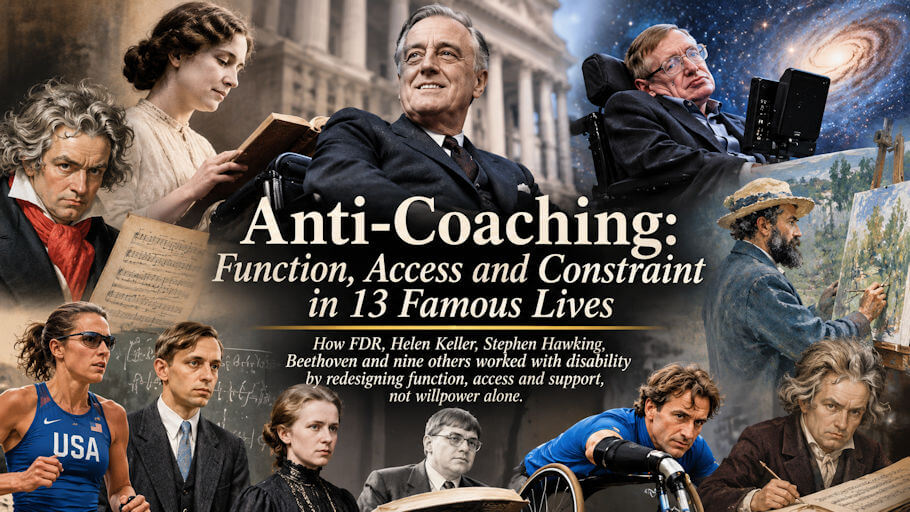
Stories about famous people with disabilities are usually told as stories of willpower: a person meets an obstacle, refuses to give up, and overcomes it. This article takes a different approach. It looks at thirteen lives - from Franklin D. Roosevelt and Helen Keller to Beethoven, John Nash, Oksana Masters and Stephen Hawking - and asks a more practical question. What actually changed in each case, which function was affected, and what arrangements of equipment, assistance, technique, environment and other people made continued work possible? The answers rarely involve a disability disappearing. More often, the person kept working while the condition stayed, because the route to the work was redesigned.
Each profile applies an Anti-Coaching lens. Conventional coaching assumes a stable person who only needs more motivation, discipline or confidence. Anti-Coaching starts by asking what configuration exists now: what the body, senses or mind can currently do, where the real difficulty lies, and whether the task demands what it is assumed to demand. Across sport, science, politics, business, literature, art and music, these histories separate access from capacity, memory from intelligence, mobility from authority and effort from results. They also resist the opposite myth, that disability is a hidden superpower, and keep in view the limits, costs and unequal resources that shaped each life.
Jump to:
- Franklin D. Roosevelt: When Authority Has to Be Re-Engineered
- Oksana Masters: The Body Is Not a Fixed Platform
- Charles Schwab: Building Around Uneven Capacity
- Helen Keller: How Knowledge Enters the System
- Kim Peek: When Memory Is Not Intelligence
- Marla Runyan: Running Without the Full Field
- John Nash: When Reason Cannot Fully Trust Itself
- Claude Monet: When Perception Becomes Unreliable
- Alex Zanardi: Rebuilding the Interface Between Body and Machine
- Lesya Ukrainka: The Architecture of Intellectual Independence
- Vincent van Gogh: What Reproduction Cannot Preserve
- Beethoven: When the Feedback Disappears
- Stephen Hawking Was Not a Motivation Story
Franklin D. Roosevelt: When Authority Has to Be Re-Engineered
"I hope that you will pardon me for this unusual posture of sitting down..." - Franklin D. Roosevelt, address to Congress, March 1, 1945.
Power and the Body
Roosevelt was reporting on the Yalta Conference. Before discussing diplomacy, he explained why he would remain seated: standing meant carrying roughly ten pounds of steel on his legs after a journey of fourteen thousand miles. The apology exposes a requirement that usually passes unnoticed. A president was expected to stand while accounting for decisions whose substance had little to do with standing.
Political authority has a physical presentation. Leaders approach a platform, receive visitors, inspect troops, enter rooms, and face cameras. These movements help make office visible. Their familiarity can obscure the difference between what government requires and what an audience expects governing to look like.
For Roosevelt, that difference required daily practical attention. Getting to a lectern and deciding what to say there were separate problems, although a public appearance joined them together. His career after 1921 depended partly on making the first problem manageable without allowing it to determine his eligibility for the second.
The 1921 Break
In August 1921, at thirty-nine, Roosevelt experienced a severe paralytic illness, diagnosed at the time as poliomyelitis. His own later account describes rapidly worsening weakness, an inability to stand, and a prolonged period of pain and dependence. The enduring loss of function in his lower limbs changed ordinary movement as well as the practical conditions of political life.
He pursued recovery with considerable intensity. Swimming, exercises, medical consultations, and equipment became part of his routine. But he never regained ordinary independent walking. Any account that says he overcame polio and then returned to politics removes the condition under which that return actually occurred.
His letter to physician William Egleston is revealing because it describes particular muscles, different brace weights, and movement in water. Roosevelt monitored what his body could do rather than treating recovery as a single event. The letter also contains hopes that were not fulfilled. A historical account must preserve both his determination to improve and the permanent limits that determination did not eliminate.
Learning a Different Public Function
Roosevelt's return involved learning a demanding form of assisted movement. Braces locked his knees; a cane and another person's arm provided support while he used his upper body and hips to advance. This was neither an ordinary gait nor a gesture accomplished through confidence. It was a practiced physical technique involving equipment and another person.
His 1924 appearance at the Democratic convention, where he nominated Al Smith, helped restore his presence on the national political stage. Yet the meaning of that return is easily distorted. He had not recovered the body with which he had campaigned before his illness. He was learning to appear publicly through a different arrangement of bodily effort and assistance.
The distinction matters because audiences ordinarily see the completed appearance. A speaker reaches the platform and begins; the preparation disappears into the event. In Roosevelt's case, what looked like individual presence depended on coordinated action. The assistance did not deliver the speech for him, but without it, the familiar setting for the speech could become inaccessible.
The Architecture of Movement
The objects preserved in Roosevelt's collections make the work specific. Leg braces stabilized joints that could not support him unaided. Small adapted wheelchairs navigated spaces where larger chairs were awkward. His 1936 Ford Phaeton used hand controls, allowing him to drive without operating pedals with his feet. Each device addressed a different task; none restored the lost function of his legs.
Space mattered just as much. A narrow passage, a stairway, or the approach to a raised platform could interrupt an otherwise feasible engagement. Ramps, handrails, suitable seating, and carefully arranged routes changed what could happen. The route from a vehicle to a speaking position was part of the event's operating requirements, even when it appeared nowhere in the program. A staircase could make an otherwise accessible meeting depend on someone carrying him. Changing the route could remove that particular dependence without changing Roosevelt's body. These were concrete differences in what participation demanded from him and from those assisting him.
Human assistance remained essential. Valets, relatives, aides, and protective staff helped with transfers, dressing, and movement. Their labor should remain visible in the historical explanation. Describing Roosevelt as independently mobile because an audience saw him upright would erase the people who helped produce that appearance.
Nor did every adaptation create independence in the same way. National Park Service research notes that several of his small wheelchairs lacked hand rims and were frequently pushed by others. Compact design could improve access while retaining dependence on assistance. His wealth and office made such help available on a scale unavailable to most people with comparable limitations.
Warm Springs
Roosevelt first visited Warm Springs, Georgia, in 1924, bought the resort property in 1926, and established the nonprofit foundation the following year. He hoped treatment would improve his condition. In water, buoyancy reduced the load his legs had to bear, permitting movements that were difficult or impossible on land. Rehabilitation offered practical possibilities without delivering the independent walking he continued to seek.
Warm Springs also became an institutional environment organized around patients' needs. Archival accounts describe water exercises, instruction in movement, and attention to rest. Buildings needed alteration: ramps and connected walkways made the facilities usable. A place intended for treatment could still obstruct patients if its doors, steps, and facilities remained designed for bodies unlike theirs.
A report by physician LeRoy Hubbard distinguished gains in muscle power from gains in function, observing that functional improvement sometimes exceeded what muscle charts suggested. That distinction belongs at the center of this history. A person could become more capable in daily activities through technique, equipment, and surroundings without equivalent restoration of the impaired muscles.
Patients also exchanged experiences through the Polio Chronicle, discussing independent living and access. Warm Springs was therefore more than the setting for a prominent man's private rehabilitation. It brought practical knowledge into circulation among people facing related difficulties. Its significance should not be reduced to a claim that suffering automatically made Roosevelt a wiser president.
Governing and Performing Authority
Executive work required Roosevelt to receive information, evaluate proposals, negotiate, appoint officials, and authorize action. Limited walking did not inherently remove those capacities. It did affect travel, scheduling, and how encounters were organized. The presidency had to accommodate a real physical constraint without treating that constraint as a universal description of its occupant.
The distinction was never absolute. Politics depends on encounters, and access influences whom a leader meets and what information reaches him. An arrangement that permits a president to work can also make him more dependent on people controlling access. Adaptation therefore involves questions of institutional power as well as physical convenience.
Roosevelt's report on Yalta describes messages arriving from Washington and communications sent during his journey. Government continued through a network of people and channels while the president traveled. This was not authority without a body; it was authority whose operation already extended beyond the body's immediate location.
Such arrangements do not certify the quality of decisions. Roosevelt's policies remain open to historical and moral judgment. The narrower point is that physical assistance and executive responsibility can coexist. A man helped into a room can still hold the authority to make decisions affecting millions, including decisions for which he must be criticized.
The Managed Image
Roosevelt's visual presentation was carefully controlled. Historian Geoffrey C. Ward's account of amateur footage from the 1935 White House Easter Egg Roll supplies an unusually concrete example. Professional cameramen were to record the president once he reached a selected position and stop when he began returning inside. An amateur continued filming the movement that the usual record excluded.
The footage shows Roosevelt supported by bodyguard Gus Gennerich, then holding the railing while greeting the crowd. Gennerich moved out of the camera's view before returning to assist him. The apparently self-contained presidential image had a working arrangement immediately outside its frame.
This was not simply a secret disability successfully concealed from an unsuspecting country. The National Park Service documents public knowledge of his paralysis, coverage of his condition, and fundraising associated with his rehabilitation. Knowing that a president had impaired legs was different from regularly seeing transfers, wheelchairs, and the effort of moving a few steps. Image management controlled that difference.
Reducing these choices to shame would replace historical explanation with an assumption about his private feelings. They operated within expectations that attached vigor and command to bodily performance, alongside press conventions, security practices, and the practical choreography of public events. Roosevelt had political reasons to keep assistance from becoming the dominant interpretation of an appearance.
That explanation does not make the arrangement neutral. Restricting images could preserve his freedom to act while leaving the public convention largely intact: authority continued to appear most recognizable when dependence was kept outside the picture. His individual accommodation challenged exclusion without necessarily dismantling the visual standard that helped produce it.
Anti-Coaching: Authority Is Not Mobility
The Anti-Coaching question concerns the relationship between a damaged function and the task people claim it disqualifies someone from performing. Walking is necessary for some activities. Exercising presidential authority does not require unaided walking in the same direct sense. Linking the two requires an explanation, not an inherited image of what a leader should look like.
Roosevelt's rehabilitation was real work, and its gains mattered. But political participation could not remain indefinitely conditional on full physical restoration. The environment also had to change: transportation, room arrangements, assistance, and presentation. Treating his return as a victory of will alone misidentifies the work that made it possible.
There is an important distinction between helping someone regain a function and requiring that recovery as the price of participation. The first can expand opportunity. The second can exclude a capable person while everyone waits for an outcome that may never occur. Roosevelt's presidency became possible with continuing impairment, rather than after its disappearance.
His experience also makes the distribution of resources impossible to ignore. A president could obtain vehicles, staff, and alterations that another person could not. That difference limits any attempt to turn his biography into an instruction to try harder. The relevant question is which arrangements allowed participation, who could obtain them, and why others were expected to manage without them.
Responsibility survives this analysis. Physical dependence does not exempt a leader from answering for policy, nor does the ability to stand establish sound judgment. A serious assessment must ask whether information is adequate, decisions are defensible, and institutions can challenge mistakes. These demands remain after the route to the lectern has been redesigned.
When the Symbol and the Function Separate
The March 1945 congressional address made the distinction visible. Roosevelt remained seated and explained the physical burden that standing imposed. Congress still had a report to examine, agreements to consider, and future commitments to debate. Removing an exhausting part of the presentation did not remove the substance of the occasion.
His reference to steel braces also brought hidden work into the spoken record. The upright president familiar from public appearances had relied on material supports whose weight the audience did not carry. The alternative posture made that burden explicit without asking listeners to abandon the political questions before them.
Roosevelt's experience offers no simple choice between authentic disability and false authority. His authority was real, his impairment was real, and the arrangements connecting him to public life were real. The managed image selected which parts of that relationship would be visible. Understanding the presidency requires restoring the omitted work without imagining that exposure invalidates the officeholder's agency.
The deeper issue is how institutions respond when their customary symbol no longer fits the person performing the function. They can make conformity the condition of admission, or examine which requirements actually serve the work. In Roosevelt's case, braces, assistance, vehicles, and redesigned spaces helped sustain participation while the old expectation of effortless bodily command remained politically influential.
He never recovered ordinary independent walking. He nevertheless continued to exercise authority through a presidency supported by people, equipment, communication, and institutions. The distinction is precise: someone else could help move the president's body without becoming the author of his decisions.
Oksana Masters: The Body Is Not a Fixed Platform
"I've had to rebuild my body more times than I can count." - Oksana Masters, 2026.
A Body That Kept Changing
Elite sport usually treats the body as a baseline. Training begins with an existing physical platform, measures its capacities, then attempts to increase strength, speed, endurance, coordination, or efficiency. Even injury is often understood as an interruption: repair the athlete, restore the baseline, resume development.
Oksana Masters makes that model difficult to sustain.
She was born in Ukraine in 1989 with extensive congenital limb differences. Accounts from Masters and her publisher describe missing weight-bearing bones in her lower legs, markedly unequal leg length, webbed fingers, absent thumbs, and other anatomical differences. Her hands later underwent reconstructive procedures, and both legs were eventually amputated above the knee - the left at nine, the right at fourteen. Her memoir, The Hard Parts, records years in which medical intervention repeatedly changed the body she had already learned to use.
Chernobyl frequently appears in accounts of that history. Some official and publishing profiles have described prenatal radiation exposure as the cause of her congenital differences. Team USA's current biography is more careful, saying the Chernobyl events were suspected to have played a role. Publicly available evidence does not establish a specific causal chain in Masters's individual case, so that uncertainty should remain visible.
The important professional fact is simpler. Her body was never a stable input into an athletic system. Anatomy changed. Surgery changed it again. Amputation altered weight distribution, mobility, and contact with equipment. Prosthetics created another configuration. Injury later removed one sport from the available set. Different sports then demanded different versions of the same upper body.
Performance had to be recalibrated repeatedly because the platform itself kept moving.
Before Performance
It would be easy to make the medical history consume the athletic one. That would distort the sequence.
Masters spent her first years in Ukrainian orphanages before being adopted by Gay Masters and moving to the United States at seven. Her memoir deals directly with deprivation, abuse, adoption, reconstructive surgery, and the long process of changing her relationship with her own body. Sport entered later. It did not retroactively convert those experiences into useful preparation.
The amputations were themselves different events. Masters has described the first as something she adapted to relatively quickly as a child; the second was much more difficult and involved prolonged medical recovery. By adolescence, prosthetic legs were part of daily mobility, while her hands had also been surgically reconstructed.
This matters because the phrase "disabled athlete" can make a physical configuration sound static. Masters's early life was closer to a sequence of revisions. Every intervention changed leverage, balance, movement, pain, available technique, and the relationship between her body and external devices.
The system that eventually became elite did not begin as a finished adaptive body waiting to discover its sport.
It had to be assembled.
The First Sporting System
Rowing provided the first configuration that made sense.
Masters began rowing as a teenager. In her own accounts, the attraction was not originally medal logic. The boat gave her a way to use physical force differently and, later, a way of processing experiences she could not easily verbalize. In The Hard Parts, the first Paralympic medal is connected back to that earlier discovery of the water: the competitive system grew out of something that had first functioned as a private physical outlet.
Technically, rowing also redistributed the problem. Her Paralympic event used a fixed-seat configuration based heavily on trunk and arms. In London in 2012, Masters and Rob Jones won bronze in the mixed double sculls, the first U.S. Paralympic medal in that rowing classification.
For the first time in the sequence relevant here, body, equipment, and sport aligned at the elite level.
Then that configuration failed.
A severe back injury developed around the 2013 world championship period. Masters has explained that continuing to row would have required a spinal intervention with unacceptable consequences for the rest of her mobility. Rowing had been the sport around which she had constructed her professional identity. The decision was therefore not a technical inconvenience. The activity that had finally fit the body no longer fit it safely.
There was no useful amount of motivation capable of changing that equation.
When One Sport Stops Fitting
This is one of the most important transitions in Masters's career because it contradicts a common performance assumption: that persistence means preserving the original objective in its original form.
Masters did not have a prepared second career. She has said directly that rowing was the only sport she wanted to do and that she had no backup plan when the injury removed it. Soon afterward, she was introduced to cross-country skiing. Fourteen months after learning the sport, she competed at the Sochi 2014 Paralympic Winter Games and won silver and bronze in cross-country skiing.
Cycling entered through another practical problem. Masters initially used handcycling partly while managing her back and partly because it could teach her tactical racing skills that rowing had not required. In rowing, she could largely drive through a short course. Skiing demanded line choice, terrain judgment, and tactical decisions. Handcycling provided speed, endurance, and another environment in which to learn those variables.
The resulting career looks spectacular in retrospect because four sports sit next to the same name: rowing, cross-country skiing, biathlon, and cycling. But the sequence is more interesting than the list.
One professional system became physically untenable. A second exploited some transferable capacity. A third was introduced to develop abilities useful to the second, then became a major competitive discipline in its own right.
This is less a story of unlimited versatility than of repeated system redesign.
Prosthesis, Equipment, Technique
Adaptive sport makes visible something conventional sport often hides: performance never belongs to the body alone.
In Masters's winter events, a carbon-fiber sit-ski has to fit her body precisely enough to transfer force efficiently. In biathlon, the same system has to accommodate skiing, transition into shooting position, hand function, and equipment. In cycling, the handcycle changes the geometry again. The athlete does not simply attach a device to an otherwise unchanged body. Device and body establish a mechanical relationship that determines how force reaches the ground, snow, or wheel.
Prosthetic legs remain part of Masters's wider physical life, but the elite racing systems in which she has achieved most of her medals rely heavily on seated equipment and upper-body propulsion. This shifts the analytical boundary. Where does the athlete end? At the skin? At the point where the torso meets the seat? At the straps? At the carbon frame?
For performance analysis, that distinction is almost useless. Fit determines energy loss. Position determines leverage. Equipment weight, stiffness, and geometry affect speed. Technique determines whether the available body can exploit the machine. Funding affects access to sufficiently specialized equipment in the first place. Masters herself has publicly argued for broader access to adaptive sports equipment because the technology is part of the opportunity to participate and compete.
The machine does not perform for her.
Her body does not perform independently of the machine.
The functional unit is the connection.
Calibration Across Sports
The most revealing evidence comes from Masters's own description of switching between cycling and Nordic skiing.
Both depend heavily on the upper body, which might make them look mechanically compatible. Masters describes almost the opposite. Handcycling is primarily a pushing action; Nordic skiing is dominated by pulling. After a ski season, her lats and back are highly developed. After cycling, shoulders, chest, and arms carry a different load. She has said that for roughly a month during the transition, she can be in excellent condition and still feel as though she has not been training for the new sport.
That is a useful distinction between fitness and fitness-for-function.
An athlete can possess extraordinary cardiovascular capacity and still be mechanically miscalibrated for the next discipline. Training then includes a deliberate loss of one adaptation while another is built. Masters has described having to "de-train" from peak skiing form to return to cycling form.
Biathlon adds another layer because maximal physical output must be interrupted by precision shooting. Injuries introduce still more variation. Before PyeongChang 2018, Masters competed while managing an elbow injury and later underwent multiple operations. In 2021, only around one hundred days before the Tokyo Paralympics, she had surgery to remove a tumor from her femur, then returned to win gold in both the cycling time trial and road race.
That sequence should not be read as evidence that recovery deadlines are optional. It shows the opposite: each disruption changes the available training load, recovery horizon, and risk calculation. At times, the correct target has to shrink. Masters herself has described seasons in which surgery forced her to treat competition as part of rebuilding rather than assume the previous performance baseline still existed.
Anti-Coaching: The Platform Is a Variable
Anti-Coaching is useful here because conventional performance language often begins from an imaginary constant: you.
You have a body. You have a goal. You apply discipline. Results follow.
Masters's career makes the first premise unstable.
The body entering a decision today may not be the body on which yesterday's plan was built. An operation may alter mechanics. Injury can eliminate a movement pattern. A prosthetic changes the interface with the environment. Equipment introduces another variable. Switching sports changes which muscles matter and what counts as efficient technique. Recovery changes available volume. Classification and course design change the external system.
A strategy that ignores those changes can remain psychologically consistent while becoming physically obsolete.
The Anti-Coaching question is therefore not whether the athlete wants the result badly enough. It is: what configuration exists now?
What force can the body currently produce? Through which movement? Into which machine? For how long? What pain or injury changes that answer? What equipment restores usable function? Which former capacity is gone? Which new one has become trainable? Which discipline still fits the architecture?
The same logic explains why leaving rowing was not necessarily a failure of persistence. Continuing could have preserved identity while damaging the wider system required for life and sport. Redesign protected function by abandoning one expression of it.
That is a considerably harder idea than perseverance.
Performance Without a Fixed Baseline
By 2026, Masters had competed at eight Paralympic Games across four sports and accumulated 24 Paralympic medals. At Milano Cortina 2026 alone, she added four golds and a bronze; Team USA lists her career total at 13 gold, seven silver, and four bronze medals.
The numbers are extraordinary. They are not the most analytically interesting part of the career.
The more unusual fact is that the athlete producing those numbers has repeatedly had to discard the assumption that the previous version of her body will remain available. Congenital anatomy, amputations, reconstructive surgery, prosthetics, a career-ending back injury, sport-specific equipment, elbow operations, femur surgery, and continuous transitions between opposing movement patterns have repeatedly changed the platform.
Professional identity survived those changes without requiring the platform to remain fixed.
That does not mean the body is infinitely adaptable. Some functions disappeared permanently. Some medical decisions closed doors. Some injuries reduced available choices. Equipment has limits. Recovery has limits. Training cannot negotiate with every physical condition.
Masters's career is useful precisely because those limits remain present.
The athlete is not a stable object moving through different sports. The athlete is a changing system whose performance depends on maintaining a workable relationship among anatomy, equipment, technique, recovery, and environment.
The baseline moves.
Professional responsibility begins by noticing when it has moved.
Charles Schwab: Building Around Uneven Capacity
"I have been able to recognize my strengths and my deficits and build up around me great people in the deficit area." - Charles Schwab, quoted by the Yale Center for Dyslexia and Creativity.
Reading as a Bottleneck
Charles Schwab could run a business while remaining a slow reader. In a 2003 conversation with schoolchildren, he explained that reading still required deliberate time and effort. He concentrated much of that effort on business material, leaving less room for recreational reading. Professional success had not removed the constraint; it had changed the circumstances in which he managed it.
The distinction matters in work organized around documents. A report may contain a useful argument, but reaching that argument takes time. When reading is slow, a growing pile of reports becomes a scheduling problem as well as a cognitive demand. The person must decide what deserves close attention, what can arrive through another format, and what requires someone else's expertise.
Schwab's school experience included improvised alternatives. In his recollections, illustrated adaptations helped him follow literary classics. Pictures and shorter passages provided another route into the stories. This was a practical response to difficulty, without any guarantee that the difficulty would disappear.
Competence Is Uneven
The executive ideal often combines incompatible expectations. A leader should absorb documents rapidly, remember details, explain clearly, assess people, negotiate, understand operations, and make decisions under uncertainty. Organizations distribute these activities across departments, then sometimes talk about leadership as though one person should perform all of them exceptionally well.
Schwab's case interrupts that assumption. Difficulty with reading can coexist with substantial competence elsewhere. Research discussed by Yale's dyslexia center distinguishes reading ability from broader intellectual ability; neither a slow reading rate nor an impressive career supplies a complete description of someone's cognitive profile.
This does not justify replacing one crude assessment with another. A dyslexic person is not necessarily a gifted strategist, and a fluent reader is not necessarily a superficial thinker. The useful unit of analysis is the actual person performing a particular task under particular conditions. Schwab's own descriptions point toward specialization: learning extensively about investments while acknowledging that his abilities did not extend equally into every other area.
Diagnosis After the Fact
In a letter published in The Wall Street Journal in February 2000, Schwab stated that he was forty-seven before he had a name and diagnosis for his condition. His later interview with David Rubenstein describes his youngest son's diagnosis as the occasion for recognizing familiar difficulties. Experiences he had carried through school acquired an explanation during an already established professional life.
The timing prevents a neat origin story. His business ambitions and early ventures did not begin with an enlightened understanding of dyslexia. He had already developed ways of working before he could accurately name an important source of difficulty. Recognition changed how he interpreted his history; it did not retroactively create his abilities.
His son's experience also made the issue practical in a different way. The question was how a child could receive support while learning, before years of confusion accumulated. Schwab and his wife's subsequent work supporting families belongs to that concern. His adult success did not persuade him that children should simply endure the same uncertainty.
What Business Actually Requires
Reading, analyzing, and deciding are connected activities, but they are distinguishable. Reading provides access to a document. Analysis examines relationships and assumptions. Judgment determines what those findings warrant under real constraints. A decision commits resources, after which somebody must execute it and report what happened. Weakness at one stage does not establish incompetence at every subsequent stage.
The publicly available opening excerpt of Invested gives a useful example of business judgment. Recalling the approach of commission deregulation in 1975, Schwab describes his concern that Merrill Lynch would cut prices and overwhelm his small firm. Learning that it would instead raise fees on smaller transactions changed his assessment of the opportunity.
That account concerns competitors, incentives, and positioning. It also describes debt and uncertainty. It offers no basis for claiming that dyslexia produced the insight. As a founder's retrospective account, it explains how Schwab understood a consequential moment, without turning his interpretation into a complete history of the market.
What matters here is the distinction between acquiring information and recognizing its implications. An organization needs both. It gains little by insisting that they must always happen at the same speed, through the same medium, inside the same person.
Delegation as Architecture
Schwab's statement about hiring around his deficits is unusually useful because it names a concrete action. He sought people with competencies he lacked. That is a different proposition from hoping that confidence will make every task equally manageable. Recruitment changes what the organization can do even when the founder's personal limitations remain.
The organizational implication extends beyond this documented statement. Effective delegation needs a defined task, someone qualified to perform it, sufficient authority, and a route for reporting exceptions. Otherwise, the nominal transfer of work leaves every uncertainty waiting for the same person's approval. The founder remains the constraint, now surrounded by people who cannot proceed.
Consider a hypothetical report containing hundreds of pages of operational evidence. A specialist can examine it and present conclusions, assumptions, and unresolved risks. The decision-maker can then question the analysis and request the relevant underlying material. This arrangement reduces unnecessary duplication while preserving opportunities to discover what the summary omitted.
Delegation becomes dangerous when the summary is the only reality the leader can access. Responsibility requires a way to challenge the person preparing it. Hiring for complementary competence therefore also means accepting that other people may understand part of the business better than its founder and must sometimes be able to contradict him.
Scale Without Universal Competence
The company's history includes the expansion of telephone services, investment in technology, and the development of online trading. These were organizational undertakings. They required capabilities in systems, operations, and customer service that could never be supplied by one individual, regardless of reading speed. Scale depended on coordinating specialized work.
This point limits what the biography can prove. Delegation is a requirement of large organizations generally. There is no need to claim that Schwab invented it because of dyslexia, or that every feature of the company reflected an accommodation for him. His account illustrates an explicit recognition of uneven ability within a broader business process.
A founder can retain responsibility for direction while other people design and operate essential parts of the enterprise. That arrangement still requires scrutiny: whether responsibilities are clear, whether information travels upward accurately, and whether decisions can be corrected. The founder's name on the building answers none of those questions.
Nor does commercial growth certify the quality of every corporate practice. The relevant lesson concerns the distribution of work. It does not require endorsing the company, its products, or every decision associated with its history.
The Dyslexia Superpower Myth
Calling dyslexia a superpower appears generous until the claim is examined. It takes an individual who succeeded, identifies a difficulty he experienced, and recasts that difficulty as the explanation for success. The sequence supplies a satisfying story without establishing causation.
Schwab's life cannot tell us what his career would have been without dyslexia. Nor can a collection of famous entrepreneurs tell us what opportunities were denied to people with similar reading difficulties. A list assembled from successful outcomes leaves out the people who lacked support, capital, authority, or the chance to redesign their work.
There is also a quieter burden in this romanticization. The person struggling with an ordinary task becomes expected to possess an extraordinary compensating talent. Support can start to sound like an investment that must be repaid through exceptional creativity. Someone should be able to need reading assistance without producing a revolutionary business model.
Schwab's own description of persistent slow reading deserves to remain intact. Strategies and colleagues can make work more manageable; that does not transform every cost into a benefit. Respect for his achievements requires neither denying the difficulty nor crediting it with powers the evidence cannot demonstrate.
Anti-Coaching: Do Not Repair the Wrong Function
The Anti-Coaching question begins with the purpose of the work. If the required outcome is a sound decision, why is success being measured through the speed of unaided document reading? Sometimes that speed is necessary. Sometimes it has merely become a customary test of seriousness.
This distinction does not make instruction pointless. Learning to read more effectively can expand independence and opportunity. Schwab himself defended educational accommodations; his story offers no argument for withholding teaching. The question is whether a particular improvement deserves priority over an available change in the way work is organized.
Hours spent trying to make a weak function average have an opportunity cost. For a particular adult in a particular role, those hours may produce more value through deeper subject knowledge, better questions, stronger supervision, or the recruitment of someone whose expertise is missing. That judgment requires examining the work rather than treating every weakness as an unfinished personal project.
There are boundaries. A person cannot delegate away every form of understanding while retaining unquestioned authority. Where a decision carries substantial consequences, the responsible person must understand enough to evaluate advice, recognize uncertainty, and know when further expertise is needed. Accommodation changes the route to that understanding; it does not abolish the requirement.
The same scrutiny should apply below the executive level. A founder may have the authority to hire support that an employee cannot request without risking judgment. An organization that praises its leader's delegation while treating an employee's need for another format as inadequacy has preserved status privilege under the language of competence.
Building Around Asymmetry
Schwab's experience suggests a more precise way to examine capability. Begin with the tasks a role actually contains. Identify where difficulty occurs, which activities require personal execution, and which can be shared. Then establish how the resulting arrangement will preserve quality and responsibility. This is work design with observable consequences.
The test is practical: can the person obtain the information needed, inspect the reasoning offered, and act with a defensible understanding of the consequences? If the arrangement achieves that through discussion, accessible documents, and specialist contributions, insisting on a more exhausting route needs justification. The familiar method is not automatically the more rigorous one, and personal effort is a poor substitute for checking whether the work is actually reliable.
Complementary teams also have costs. They require coordination, and information can be distorted between people. A realistic account must include those risks alongside the gains. The choice is between different arrangements of effort, knowledge, and oversight, each of which can be tested against the work it is supposed to accomplish.
This is where the promise of universal competence becomes expensive. It encourages leaders to conceal difficulty, discourages colleagues from claiming expertise, and turns assistance into a private embarrassment. A more accurate distribution of work allows strengths to matter without pretending that the rest of the person has become uniformly capable.
Schwab did not need to become an equally efficient performer of every operation for an organization to develop around him. He did need other people whose contributions were real, consequential, and beyond his own capacity to reproduce individually. The enduring question is whether a system can recognize that arrangement before exceptional success makes it respectable.
Helen Keller: How Knowledge Enters the System
"My sources of information are as good and reliable as anybody else's." - Helen Keller, "Strike Against War," 1916.
Helen Keller made that claim before an audience being asked to consider her opposition to military preparedness. Editors had suggested that other people were using her to promote unpopular causes. Her answer concerned sources, reading and the ownership of an argument. By then, the child remembered at the water pump was an adult insisting that opponents address what she actually said.
The distinction begins before Anne Sullivan arrived. Keller became deafblind following an illness at nineteen months. In The Story of My Life, she describes recognising people, anticipating routines, inventing gestures and pursuing intentions that others struggled to understand. Sullivan later recorded more than sixty signs already in use. Communication existed, although its reach was restricted by the small circle able to interpret it.
One remembered incident involves a doll without eyes. Keller found beads on her aunt's cape and indicated that they should be sewn onto its face. The episode contains recognition, a perceived discrepancy, a search for materials and a proposed solution. None required an observer to mistake the absence of conventional speech for the absence of an intention.
"Before language" therefore needs qualification. Keller had ways of making meaning before she acquired conventional language through touch. What she lacked was dependable access to the shared symbolic resources through which people explain absent events, exchange complicated ideas and transmit accumulated knowledge. Her frustration belonged to a child with purposes that exceeded her available means of expression.
We cannot reconstruct that childhood as though watching an untouched mind from inside. Keller herself warns that adult recollection mixes early impressions with later imagination. Her account nevertheless gives no grounds for treating limited communication as evidence that nobody was thinking.
The Water Pump Is Not the Whole Story
On April 5, 1887, Sullivan spelled into Keller's hand while water flowed over the other. Keller remembered understanding the connection between the finger movements and the substance. The experience mattered enormously to her. Removing its significance would falsify her account as surely as making it the whole explanation.
Sullivan's letters complicate the familiar sequence. Before the pump episode, she recorded repeated spelling, difficulties distinguishing a container from its contents, and words Keller requested herself. Her March vocabulary list already included water. These observations do not establish that Keller had mastered naming beforehand; they show learning in progress, with imitation, association and understanding difficult to separate.
Sullivan also described spelling the activities of the entire day into Keller's hand. The celebrated moment occurred within that sustained exposure. It was followed by further naming, questioning, reading and the gradual acquisition of more complicated expression. A breakthrough could change the direction of learning without completing the work.
The simplified story makes intellectual life appear to begin on command: a teacher supplies the correct stimulus, and a person becomes available to the world. The letters reveal something less theatrical and more consequential. Keller participated in discovering what this new means of communication could do, while Sullivan repeatedly adjusted how she taught.
Language as Infrastructure
A gesture understood at home can secure a particular response. A shared language permits an explanation that travels beyond the household. It allows someone to ask why an event occurred, distinguish a promise from a prediction, or examine a claim about people she has never met. For Keller, these possibilities required sustained access through touch.
Calling language infrastructure describes its cumulative function. A word learned today becomes available inside tomorrow's explanation. Reading makes another person's reasoning accessible beyond the immediate encounter; writing lets the reader answer. Knowledge can accumulate across exchanges instead of depending entirely on what two people can establish together in the moment.
This does not mean that a fully developed adult intellect was waiting unchanged behind a sealed entrance. Keller's intellectual abilities developed through education, relationships and practice. Access helped that development occur. The distinction between capacity and access matters precisely because an inaccessible environment can obstruct both the expression of existing abilities and the opportunities through which further abilities develop.
There was also a practical difference between receiving a text once and being able to return to it. A book Keller could read herself allowed repetition at her own pace. Material spelled by another person required that person's time and availability. The information might be identical; the conditions for studying it were not.
Anne Sullivan and Mediated Access
Sullivan's contribution was sustained, skilled labour. Her letters show experimentation, attention to Keller's interests and an increasing preference for conversation during ordinary activities over fixed lessons. They also contain the disciplinary assumptions of her period, including a strong emphasis on obedience. Treating her as a flawless rescuer makes it harder to examine the actual relationship.
The work imposed physical costs. In a December 1896 letter to Mrs. William Thaw, Keller explained that none of her required textbooks was available in raised print. Sullivan had to spell them into her hand, and Keller worried about the strain on her teacher's eyes. An educational arrangement celebrated as personal devotion was also compensating for missing accessible materials.
That distinction prevents gratitude from becoming an explanation for everything. Sullivan could interpret, teach and help secure opportunities, but her dedication did not make the surrounding institutions accessible. Too much depended on one relationship. The durability of Keller's education required books, methods, additional teachers and practical resources as well as affection.
Nor should acknowledging this dependence erase Keller's activity. She asked questions, sought words, chose subjects and expressed dissatisfaction. Sullivan's teaching succeeded partly because she responded to a learner whose interests could redirect the lesson. Access was being negotiated between people, with unequal responsibilities and changing possibilities.
From Access to Intellectual Independence
Keller's account of her 1899 entrance examinations makes the distinction painfully concrete. The mathematical Braille notation used for the papers differed from the notation she had practised. She received a sample shortly before the examinations and struggled to learn unfamiliar symbols. During the tests, deciphering the questions consumed time that should have been available for solving them.
Her account includes other difficulties, including insufficient preparation for recording mathematical work on a typewriter. The episode therefore resists a convenient single explanation. Subject knowledge, notation, preparation and the means of producing an answer all affected performance. Any assessment that collapsed those factors into a verdict about intelligence would misunderstand what it had measured.
Keller entered Radcliffe in 1900 and graduated cum laude in 1904. Yet her writing about college is more interesting than the credential alone. She describes the difficulty of taking notes while her hands received lectures, the shortage of accessible books and the pressure of a schedule that left little time for reflection.
The student was already evaluating the institution that evaluated her. She wanted time to think about what she read. Her writing likewise became more than testimony to educational success: autobiography, essays and correspondence allowed her to organise experience, address readers and advance positions for which she expected to be held responsible.
Her literary life extended beyond the childhood autobiography. The World I Live In explored her experience of perception, while Out of the Dark collected social and political writing. These books placed different demands on a reader: understanding how she experienced the world, then considering what she thought should change within it.
The Keller Public Memory Often Removes
The adult Keller joined the Socialist Party in 1909, supported workers' rights and campaigned for women's suffrage. Her political writing connected poverty and working conditions with preventable suffering. This created an awkward problem for admirers comfortable with personal courage: she was asking questions about wages, ownership and power that admiration alone could not answer.
In "How I Became a Socialist," published in 1912, she explained her reading practices. A friend came regularly to spell material into her hand. The friend supplied article titles; Keller chose which pieces to hear and which to omit. She also read socialist publications in German Braille. This is a specific account of intellectual work, including selection, effort and a limited pace.
She addressed the suggestion that Sullivan had simply supplied her politics. Sullivan had recommended H. G. Wells's New Worlds for Old, Keller wrote, but was not herself a socialist. A teacher could introduce a book without determining the reader's conclusions. Keller's account placed disagreement inside the relationship supposedly responsible for her obedience.
Her suffrage advocacy similarly concerned participation in decisions. In a 1916 text preserved in the American Foundation for the Blind's archival presentation, she criticised a state in which men made laws while women lacked political representation. At Carnegie Hall that January, "Strike Against War" opposed military preparedness and urged workers to resist the economic interests she believed it served.
These were arguments open to challenge. Recognising her autonomy requires no agreement with her socialism or her assessment of war. It requires allowing her political claims the same scrutiny as anyone else's. In her reply to the Brooklyn Eagle, she observed that praise for her intelligence had given way to explanations of political error through disability. Her sensory circumstances had become convenient grounds for disqualifying an unwelcome opinion.
Anti-Coaching: Access Is Not Capacity
Within Anti-Coaching, Keller's history exposes a mistake that can occur before any advice is given: deciding that inadequate performance originates inside the person. If a learner cannot obtain the text, interpret its format or communicate an answer under the prescribed conditions, encouragement addresses only a fraction of the situation.
Keller worked intensely. That fact cannot explain away the work required to make information available. A textbook that needed hours of manual spelling did not become independently readable because she wanted an education badly enough. Persistence helped her use the available channels; it could not substitute for creating them.
The practical question is where the difficulty occurs. Does the person understand the material once it arrives? Can she revisit it, ask for clarification and compare explanations? Can she demonstrate knowledge without the assessment introducing an unrelated obstacle? These questions locate responsibilities that a general appeal to confidence leaves unexamined.
Keller's exceptional achievements also offer no fair standard for deciding who deserves support. An access provision does not need to produce a celebrated author to justify its existence. Using her success to demand extraordinary endurance from everyone else would preserve the very conditions her education required so much labour to overcome.
Dependency Without Intellectual Submission
Dependence on another person for information creates real vulnerabilities. The intermediary may select, abbreviate, misunderstand or simply be unavailable. Trust matters, but so do opportunities to request more detail, choose sources and obtain other accounts. Keller's descriptions of her reading show several of these practices operating within an arrangement that remained dependent on human assistance.
Her independence was therefore compatible with influence. Books, teachers and political companions helped shape her thinking, as they do for other readers. What deserves examination is her ability to question, compare and adopt a position, including a position her interlocutor does not share. Requiring thought untouched by assistance would make intellectual independence impossible for almost everyone.
The public response to her politics exposed an unequal standard. Editors routinely relied on correspondents, translators and reports of events they had never witnessed. Keller's reliance on tactile communication was more visible, making it easier to portray mediation as proof of borrowed judgment. The relevant question was whether her reasoning held up, not whether someone else had delivered the words.
This is also why her adult disagreements matter to the childhood story. They show what expanded access made possible beyond successful instruction: a person who could use acquired knowledge to dispute the preferences of the society applauding her education.
What Knowledge Requires to Enter the System
The water pump remains memorable because a relationship between sensation and symbol became intelligible there. But knowledge required much more to enter Keller's life in usable form: repeated exchanges, accessible texts, people willing to explain, time to study, and ways to put her own formulations back into circulation. Each condition affected what she could learn and what others could recognise.
Her history asks us to separate several judgments often made together. Difficulty obtaining information does not establish difficulty understanding it. Assistance in reading does not settle who owns the resulting argument. An impressive achievement does not prove that the conditions under which it was achieved were adequate.
Keller also leaves a demanding account of what access is for. The educated person may become critical, politically inconvenient and dissatisfied with the terms on which inclusion was offered. If access is celebrated only while its recipient remains agreeable, the permission to participate is still conditional. Her adult writing tests whether the audience that admired her acquisition of language was prepared to hear what she chose to say.
Kim Peek: When Memory Is Not Intelligence
"You don't have to be handicapped to be different. Everybody is different." - Kim Peek.
The sentence becomes harder to interpret when placed beside the arrangements of Peek's life. Someone else helped him manage ordinary activities. People who needed no such assistance asked him questions they could not answer themselves. Dependence and expertise occupied the same person, sometimes within the same encounter.
Calling this a contradiction already assumes too much. It assumes that human abilities should rise together, that remembering more should produce greater independence, or that needing help should indicate limited knowledge. Peek exposes the weakness of those assumptions. His life requires several questions where public discussion usually asks one: how intelligent was he?
Before Rain Man
Kim Peek was born in 1951. Family accounts describe early medical advice that anticipated profound incapacity and recommended institutional placement. They also describe reading beginning unusually early, although accounts differ about its precise onset. His brother later recalled that he taught himself to read at approximately three. These are retrospective family observations, not a continuous developmental assessment. They nevertheless establish a childhood poorly represented by the original prognosis.
The error was consequential. A prediction about limited development could determine whether a child received books, attention, education, or opportunities to demonstrate anything unexpected. Once someone is classified as incapable of learning, environments can become organized around that classification.
There is a temptation to reverse the verdict completely: the doctors saw disability, while the family discovered genius. That version preserves the same crude scale. It merely moves Peek to its opposite end.
His subsequent abilities did not make his developmental difficulties imaginary. Nor did those difficulties describe everything happening in his mind. Understanding his childhood requires holding both facts without forcing either to become the explanation for the other.
Memory Without a General Scale
Memory contributes to intelligence. It does not provide a complete measurement of it.
Retaining information, retrieving it when prompted, understanding its implications, and using it under unfamiliar conditions are distinguishable operations. In ordinary conversation they often arrive together, making their separation difficult to notice. Someone supplies an accurate historical detail, and the listener assumes comparable competence in interpreting historical causes.
That inference may be unwarranted.
The title therefore identifies a measurement error. It does not suggest that Peek possessed no intelligence or that everything he said was mechanical repetition. Such claims would require evidence that spectacular demonstrations of recall cannot supply.
Comprehension also needs a specified object. Understanding a musical passage, an instruction, a joke, and another person's intentions makes different demands. A difficulty with abstraction cannot automatically settle all four questions.
Functional independence introduces another problem. Knowing what an activity involves does not ensure that a person can coordinate the movements or organize the sequence required to perform it. Conversely, completing familiar routines offers limited evidence about reasoning in unfamiliar situations.
Peek makes these distinctions unusually visible. They remain relevant wherever an institution turns one observed performance into a general verdict about a person.
A Mind Built Differently
Brain imaging documented the absence of Peek's corpus callosum, a major bundle of fibers connecting the cerebral hemispheres, alongside other structural differences. Darold Treffert's scientific review discusses these findings within the broader literature on savant syndrome. That literature also distinguishes savant abilities from autism: the two are not interchangeable categories.
An anatomical finding can be precise while its explanatory meaning remains uncertain. Identifying an absent structure does not establish the mechanism producing exceptional recall. It leaves questions about development, alternative connections, and the organization of particular tasks.
Researchers who studied Peek explicitly acknowledged the gap between describing his brain and explaining his abilities. Their observations did not establish that the absence of the corpus callosum produced his memory.
Popular explanations often close that gap prematurely. A visible difference becomes a mechanism; the mechanism becomes an origin story; the origin story is repeated as settled science.
Anti-Coaching has no authority to complete this neurological explanation. Its concern here is narrower: how abilities and limitations were distributed, what activities that distribution permitted, and which forms of assistance made participation possible. Explaining how a life functioned is a different undertaking from explaining how its nervous system developed.
What He Could Do
Reports of Peek's public appearances document extensive recall across history, geography, literature, sport, and music. Questions could lead rapidly to related dates, locations, names, or events. An account of a teachers' gathering in 1991 records him answering geographical questions and moving between associated historical details.
These performances involved more than possessing information somewhere in memory. A question had to provide access to the relevant material. The speed and specificity of retrieval were central to what audiences witnessed.
Calendar answers and geographical directions also show why the subject matter matters. A remembered date, a route, and a musical composition have different internal structures. Describing all three as "facts" can conceal the variety of operations involved.
The familiar totals of books memorized or percentages retained add apparent precision without necessarily supplying comparable measurement. Widely repeated estimates should not be mistaken for an independently audited inventory.
A more useful question concerns availability: what could he retrieve, through which prompt, and for what purpose? A collection of information becomes usable through those relationships. Its size alone tells us little about how the person will respond when an unfamiliar problem requires choosing between competing interpretations.
What He Could Not Do Alone
Treffert and Daniel Christensen described substantial difficulties with coordination, everyday activities, and abstraction. Their account specifically noted that Peek could not button his clothes. These limitations coexisted with the abilities attracting scientific and public attention.
Buttoning a shirt is easily dismissed as a minor task because many adults perform it without conscious analysis. For someone unable to complete it, the task introduces another person into the organization of the morning. Its social importance bears little relationship to its intellectual prestige.
This is where descriptions based on impressive demonstrations become inadequate. An audience sees an answer. Daily life requires getting dressed, arriving somewhere, managing transitions, and returning home.
We should not turn each reported difficulty into a retrospective diagnosis of a particular executive function. The available biographies cannot support that precision. They do support the broader conclusion that knowledge and independent execution were markedly separated.
Calling such activities "simple" records the observer's experience. It explains nothing about their difficulty for Peek. Repetition, encouragement, and the possession of relevant information do not guarantee that the necessary motor or organizational capacity will follow.
Fran Peek and Distributed Function
Fran Peek supplied sustained practical assistance and accompaniment. Accounts describe him helping with dressing and personal care, while library visits and public engagements placed his son in contact with information and other people.
"Devoted father" names a relationship but leaves much of its work unspecified. The functional questions are more exacting: who organized the day, managed an engagement, recognized a difficulty, or made continued participation possible?
Viewed this way, their shared activities depended on a distribution of work. Kim supplied the recall. Fran supplied assistance that allowed Kim to be present and participate. Neither contribution can be inferred from the other.
There is also an evidential boundary. A successful appearance cannot demonstrate that Kim could independently arrange the conditions surrounding it. Equally, Fran's involvement does not make Kim's answers borrowed achievements.
This arrangement carries a practical vulnerability: when essential support rests heavily with one person, continuity depends on that person's availability. Describing the relationship only through affection obscures this dependency.
Distributed function is useful here because it identifies where work occurred. It should never turn Fran into an interchangeable device or Kim into the passive recipient of care. Both were people within an arrangement that required continuing labor.
The Man Behind Rain Man
Screenwriter Barry Morrow met Peek in 1984. Their encounter helped inspire the character played by Dustin Hoffman in the 1988 film Rain Man.
The resulting Raymond Babbitt was a fictional construction. His diagnosis, behavior, and narrative circumstances cannot be transferred to Peek as biographical evidence. Contemporary reporting explicitly distinguished Peek from the autistic character.
Cinema supplied a powerful route to public recognition. It also supplied expectations through which the recognized person would subsequently be interpreted. Audiences could arrive already believing they knew what his abilities meant.
A recollection reported from Peek's funeral illustrates a different problem of interpretation. Fran told mourners that, after the premiere, Morrow asked Kim why he had not watched the screen. According to his father, Kim answered: "I watched it with my heart." This is a family recollection reported at the funeral, not a contemporaneous transcript of the premiere.
The remark cannot establish a clinical conclusion about emotional understanding. It does, however, resist the assumption that every meaningful statement by Peek must be interpreted as information retrieval. Making it proof of profound emotional insight would be another overreach. The responsible account preserves the remark and the limits of its provenance together.
When Public Life Changed the System
After the film, requests for appearances expanded. Early reporting describes Fran regulating their frequency and Kim expressing enjoyment of performing. Public participation had become an activity requiring its own boundaries.
Later observations described developments in sociability, humor, and musical performance. Treffert and Christensen documented emerging piano skills and increasingly inventive connections between remembered material. Their account complicates any picture of an adult whose capacities had become permanently fixed.
Several explanations remain possible. More frequent interaction may have supported practice. Familiar formats may have reduced uncertainty. Abilities previously difficult to observe may have become more visible. These possibilities should not be collapsed into a single causal claim.
The evidence does not permit a neat calculation of how much change resulted from exposure, learning, maturation, or changing observation. It certainly does not establish that affection or celebrity removed his disabilities.
For practical purposes, the important consequence is that an assessment has a date. A description that was adequate at one stage may become incomplete later. Support must allow for development without making its continuation conditional on improvement.
Someone should not have to acquire new skills to justify assistance. Equally, receiving assistance should not consign that person to an expectation of permanent sameness.
Anti-Coaching: Capacity Is Not a Single Number
Within Anti-Coaching, the appropriate unit of inquiry is the function under specified conditions.
A qualitative map of Peek would place exceptional retention and rapid recall beside limited everyday independence and motor coordination. It would record extensive domain knowledge, difficulties with abstraction, and social participation that changed over time. Judgment and interpretation would require examination task by task.
This is an analytical map, not a clinical rating instrument.
Its purpose is to prevent one observation from silently answering unrelated questions. Can the person recall the instruction? Understand its purpose? Initiate the activity? Complete the movements? Recognize when circumstances have changed? These questions may produce different answers.
An overall IQ result cannot by itself provide that operational description. This does not require dismissing intelligence testing. It requires keeping the scope of any aggregate score separate from the decisions being made with it. A score alone cannot specify the assistance someone needs tomorrow morning.
The same discipline applies to praise. Exceptional memory does not justify assuming reliable judgment everywhere. Such inflation can expose a person to demands for which the demonstrated ability offers little preparation.
Here the methodological limit is essential. Anti-Coaching can examine the fit between a task, a person, and available support. It cannot explain the biological origin of Peek's abilities, replace individual assessment, or derive an entire person from a functional diagram.
When Dependence and Ability Coexist
Dependence becomes misleading when used as a complete identity. It describes a relationship around a requirement: someone needs another person's assistance to do something. The requirement must remain visible.
Ability needs the same precision. Knowing far more than a supporter in one domain does not eliminate the need for that supporter elsewhere. Accepting help does not transfer ownership of the knowledge to the person providing it.
Institutional decisions often lose these distinctions. A person may be denied access because assistance is required, or denied assistance because a striking ability has been demonstrated. Both decisions make one function stand in for the whole.
There is a further limit to this analysis. A functional map cannot determine someone's human worth. It should improve the decisions surrounding a life, without making that life accountable for an impressive balance of strengths over limitations.
Peek's memory did not repay the cost of his support. No repayment was required. His need for support did not reduce the reality of what he knew.
We misjudge a person when we overlook an ability. We also misjudge a person when we insist that every ability and dependency must resolve into one position on a single scale.
Marla Runyan: Running Without the Full Field
"I can't see the finish line. I cross it." - Marla Runyan, No Finish Line: My Life as I See It.
A Race Without the Full Field
A 1,500-meter race looks simple from outside the track. The distance is fixed. The finish is fixed. At elite level, almost none of the useful information is static.
A runner is constantly reading position, speed, bodies, gaps, lane space, pack movement, contact risk, and the cost of moving outward or staying trapped inside. Much of that arrives visually before it becomes conscious. Marla Runyan entered that system with severe central vision loss caused by Stargardt disease.
The National Eye Institute describes Stargardt disease as a genetic retinal disorder that primarily damages sharp central vision. Runyan was diagnosed around age nine. Her own descriptions reveal the athletic consequences. She could see the track surface, feet, colors and movement through remaining peripheral vision, while faces, race numbers, clocks, scoreboards and the finish line could disappear into the damaged center of her visual field.
That is a different problem from running in darkness. The field was present, but unevenly available.
Runyan eventually became a two-time Paralympian, winning five gold medals and one silver, and a two-time Olympian. In Sydney in 2000 she reached the Olympic 1,500-meter final and finished eighth. Four years later she returned in Athens for the 5,000 meters. Those results place the problem at elite speed. In an Olympic middle-distance race, hesitation has a cost.
What Vision Does in a Race
Central vision is only one component of visual function, but racing exposes how many jobs depend on it. A bib identifies a person. A clock translates effort into pace. A lap counter locates the athlete inside the event. Body detail distinguishes rivals. A visible gap can determine whether a move happens now or waits.
Runyan had access to some of this system and not to other parts.
Before the Sydney Games she explained that she could move through a crowded room and run on tracks, roads and wood-chip trails without assistance because her peripheral vision remained functional. At the same time, she might fail to recognize her own coach from ten feet away. On the track, other runners could register as moving color rather than identifiable people. At the 1999 Pan American Games, where she won the 1,500 meters in a photo finish, she said she could not see the clock and therefore concentrated on competing rather than reading time.
Her visual field did not become more complete because the race became important. The race had to be executed with the information that actually arrived.
The distinction sharpens when the format changes. Track geometry repeats. Road racing adds turns, changing surfaces, mile markers and a field spread across far greater distances.
Runyan's career eventually covered both.
Partial Information Is Still Information
The language of blindness easily creates a false binary: seeing or not seeing. Runyan's own descriptions resist it.
She retained useful peripheral vision. She could see the ground beneath and ahead of her. She could detect motion and colors. In an interview during the Sydney Games she described having a strong sense of the mechanics of runners moving beside or ahead of her. She also mentioned breathing as an available cue. These were information channels she could actually access.
They were also incomplete.
A pack of runners might be legible as movement without being legible as identity. In the 2002 New York City Marathon, Runyan explained that she sometimes could not distinguish men from women at a distance. The separate women's professional start therefore changed the informational problem in a concrete way: when she rejoined a pack on First Avenue, she could count the women and estimate her position. In a mixed field, that calculation would have been much harder.
That detail strips the romance from "adaptation." The missing channel is not recreated; action is reorganized around what remains.
At New York, a cyclist communicated cumulative clock times, warned her about upcoming turns and gave information about the pack. The road itself remained visible enough under her feet to run safely at elite pace. Position farther ahead was less available. Different parts of the same task had different levels of uncertainty.
Incomplete information still supports judgment. It changes what judgment can responsibly claim to know.
Paralympic and Olympic Systems
Runyan's career is often narrated as a transition from the Paralympics to the Olympics, as though one were preliminary and the other represented arrival. Her record makes that hierarchy difficult to defend.
At Barcelona in 1992 she won Paralympic gold in the 100, 200 and 400 meters and the long jump, and also competed in tandem cycling. At Atlanta in 1996 she won the pentathlon and took silver in the shot put. The range is striking: sprinting, jumping, throwing, multisport competition and cycling before her shift toward middle- and long-distance running.
Years later, reflecting on recognition of para-athletes, Runyan put the distinction more directly: "I was no less of an athlete as a Paralympian."
Her Olympic participation belongs beside that record, not above it. Sydney tested her against a different classification system and a different field of competitors. The same body, the same visual condition and much of the same athletic intelligence crossed institutional boundaries while the rules for who surrounded her changed.
Classifications organize competition; they do not contain the whole athlete. Runyan's movement between Paralympic and Olympic systems exposed a mismatch between public labels and professional capacity. "Legally blind" was accurate as a classification. It was too coarse to describe what she could perceive at speed, which events suited her, or how well she could race.
Training What Can Be Trained
Runyan's adaptations were specific to tasks.
As a high jumper, she could pace out the approach, move close enough to locate the bar, then preserve that relation through a measured sequence. In the hurdles, the problem became rhythm. Reporting from her heptathlon years describes eight steps to the first hurdle and three between the rest. The barriers did not need to become sharply visible at a distance if the approach could be converted into repeatable timing.
Middle-distance racing was less stable. The obstacles moved.
Runyan said she used the mechanics of nearby runners and audible breathing as clues, largely instinctively. That did not tell her everything. It gave her enough information to operate inside a pack. Years of training also made track geometry, pacing and bodily effort familiar without requiring continuous visual confirmation from a display.
A hurdle pattern can be rehearsed. The position of eleven other runners cannot. A road course can be studied. A competitor's surge is generated in real time. Pace can be internalized; an official clock remains external.
Elite preparation therefore does two different jobs. It automates what can be stabilized, and it leaves capacity available for what cannot.
The Limits of Adaptation
Successful adaptation is often described as if it eventually erases the original limitation. Runyan's racing does not.
She could not make a distant clock readable by concentrating harder. She could not identify every athlete in a pack through accumulated experience. At some finishes she did not immediately know her placing. In her memoir, the problem is compressed into a brutal pair of sentences: she cannot see the finish line; she crosses it.
The missing information remained missing, creating tactical costs that are easy to underestimate. A runner who cannot identify rivals from a distance may have less certainty about who has moved. A clock that cannot be read removes one external pace check. A finish that cannot be visually resolved changes the relation between acceleration and the visible endpoint. In crowded races, incomplete identification complicates position even when basic collision avoidance remains strong.
Runyan herself rejected assumptions that she was inherently dangerous in a pack. Before Sydney, she pointed out that contact is normal in 1,500-meter racing and said she could maneuver around other athletes. Both statements can be true: she could possess excellent spatial skill while still lacking information other runners had.
Competence does not require pretending the constraint has disappeared.
Anti-Coaching: Performance Under Incomplete Feedback
Anti-Coaching is useful here as a way to separate available capacity from demanded information.
Whether an athlete is sufficiently determined is the wrong question. Determination says little about which inputs exist when a decision must be made.
Runyan's system can be divided more precisely. Some variables were reliable: trained pace, proprioception, track geometry, running mechanics, physiological effort, peripheral movement close to her. Others were weaker or absent: central detail, distant identification, clocks, scoreboards, exact visual information about competitors farther away. External support could sometimes supply a missing input, as in the New York Marathon. In a tactical Olympic 1,500, decisions arrived too quickly for every gap to be externally filled.
The architecture therefore changes from "see, decide, act" into something less clean. Information arrives through several channels with different precision and latency. The athlete must know which channels deserve trust.
That is the Anti-Coaching prism here. Experience does not abolish uncertainty; it can reduce the decisions requiring fresh information. Training converts some choices into learned structure. External systems can restore particular data. Professional judgment operates on the remainder.
There is no motivational solution for an unreadable clock.
There can be a different decision system.
What the Athlete Still Has to Know
Runyan's career matters because the missing visual field never became the whole field of analysis.
She raced with information she could use, information she could obtain indirectly, and information she simply did not have. The proportions changed with the event. Hurdles rewarded repeatable rhythm. Track races compressed bodies into a moving tactical system. Road races stretched the informational environment across miles and could make external assistance useful in ways impossible during a short final.
Through all of them, responsibility for the race remained with the athlete.
That responsibility included knowing more than pace. It meant knowing the reliability of perception itself. Which movement is clear enough to act on? Which opponent can actually be identified? When does an internal sense of effort replace a clock? When does an organizer, guide, cyclist or known course restore information that vision does not provide? Where does uncertainty remain irreducible?
The athlete who understands those boundaries is not operating without feedback. She is operating with feedback of unequal quality.
Runyan once described the world she saw as simply the world she knew. That may be the cleanest way to remove the spectacle from her case. She did not enter each race from an imagined baseline of normal vision and calculate what had been taken away. She trained inside the sensory system she actually possessed.
The full field was never available.
The race still was.
John Nash: When Reason Cannot Fully Trust Itself
"Then gradually I began to intellectually reject some of the delusionally influenced lines of thinking…" - John F. Nash Jr., autobiographical essay for the Nobel Prize, 1994.
The Film Before the Man
My first strong encounter with John Nash was not through game theory, equilibrium, or twentieth-century mathematics. It was through A Beautiful Mind.
The cast hit several points of recognition that had already been with me since adolescence: Russell Crowe (Gladiator), Jennifer Connelly (Requiem for a Dream), and Paul Bettany's Charles, who visually registered for me almost as a double of Matthew Lillard — Cereal from Hackers, the 1995 film with a very young Angelina Jolie. Different actors, obviously, but the association stuck. Hackers had entered my visual memory years earlier, and Bettany kept triggering it.
Years later, separating the film from the man became more interesting than the film itself.
A Beautiful Mind is built to make an invisible problem visible. The viewer sees people and events presented with exactly the same material certainty as everything else on screen. The mechanism gives mental disturbance a cinematic grammar: we accept a reality and later discover that part of it existed only inside the protagonist's experience.
Real Nash did not describe what the film shows. In an interview he explicitly said that he did not see people who were not there. The visual hallucinations were a storytelling mechanism. They allow a camera to represent a disturbance in belief by turning it into visible characters. Powerful cinema; poor historical evidence if taken literally.
So the first Nash I knew was already a model.
The real problem begins when that model is removed.
When Reason Becomes a Variable
Nash's case is difficult because intelligence offers no general guarantee of reliable judgment.
Before the severe disruption of his academic life, he had already produced work that would permanently change several fields. His doctoral research at Princeton developed the equilibrium concept that became central to non-cooperative game theory and later formed part of the basis for the 1994 Nobel Prize in Economic Sciences. His contributions to geometry and nonlinear partial differential equations were regarded by the mathematical community as deeper still; in 2015 the Abel Prize recognized that body of work.
None of those achievements made every conclusion produced by the same mind trustworthy.
We routinely compress cognition into one scale. Someone demonstrates extraordinary reasoning in mathematics, and authority begins leaking outward into our perception of the person as a whole. Yet formal proof, memory, pattern recognition, interpretation of other people, threat detection, confidence, and the assignment of meaning to events are different operations. Their performance does not have to rise and fall together.
Nash could remain capable of mathematical abstraction at a level few people could approach while accepting beliefs about the external world that other observers could not verify.
The problem was not a shortage of intelligence.
Intelligence itself could no longer serve as the final verifier.
The Breakdown of Verification
Nash dated the beginning of his "mental disturbances" to early 1959, while he was on the faculty at MIT. He was diagnosed at the time with paranoid schizophrenia, the diagnostic terminology then used in his records. His Nobel autobiographical account describes leaving MIT, approximately fifty days at McLean Hospital, travel to Europe during which he sought refugee status, and later involuntary hospitalizations in New Jersey.
The unusual ideas were not random noise sitting on top of an otherwise untouched reasoning system. Political significance, coded communications, special identities and connections between apparently unrelated events could become integrated into a coherent personal model.
Coherence made the problem harder.
A model can contain elaborate internal logic and still fail against the world it claims to describe. Intelligence may even increase its complexity. More connections can be generated, more anomalies incorporated, more explanations built around contradictory evidence.
Hospitalization did not produce one decisive correction. Nash later explained that at times he learned to behave in ways that allowed him to leave the hospital while delusional ideas had merely been pushed aside. They could return quickly. During other periods he resumed mathematical work. The movement between these states extended over years.
A clean border between rational and irrational becomes useless here. The same person could reason correctly through a formal mathematical problem, function conventionally for a period, and remain vulnerable to interpretations of reality that would later become untenable.
Verification had become unstable rather than absent.
What Did Not Disappear
Illness severely damaged Nash's professional trajectory. It did not erase the entire architecture that had made him a mathematician.
Years of training remained. So did mathematical memory, formal technique, familiarity with difficult problems, habits of abstraction and a body of work already externalized into papers that other mathematicians could inspect without consulting his mental state.
The chronology sharpens the contrast. Nash's doctoral thesis was famously brief, yet the equilibrium concept it developed became foundational across economics and other fields. Recognition continued accumulating while the person who had produced the work passed through decades of serious illness. The intellectual object and the current condition of its author had separated.
That separation is critical.
A theorem does not inherit the psychiatric condition of the mathematician who produced it. Once written, a proof can be attacked by other minds. Definitions are public. Derivations can be reproduced. An error can be found whether the author feels uncertain or absolutely convinced.
Mathematics contains an external architecture of resistance.
It could not treat Nash's illness. It could reject a mathematical claim.
The distinction is unusually sharp. In one domain Nash operated inside a culture where an idea had to survive formal constraints and other experts. Elsewhere in his experience, a belief could feel connected, meaningful and explanatory without facing an equivalent machinery of verification.
The phrase beautiful mind tends to flatten this structure into one object. The historical record looks messier: preserved competencies, damaged functions, inaccessible periods, accumulated knowledge, unstable interpretations, and earlier outputs that had already become independent of the person who created them.
Professional identity survived in fragments long before conventional professional life returned.
Princeton as an External Environment
Princeton became important without becoming a cure.
Nash arrived there as a graduate student in 1948. Decades later, during years when he was largely outside ordinary academic participation, Fine Hall remained one of the places where he was physically present. In the 1970s he became known around the mathematics department as the "Phantom of Fine Hall": an elusive figure who wandered the building, rarely spoke, and sometimes left unusual writing on blackboards. The mathematicians around him knew the scale of the work he had done even when his current position in that world had become difficult to define.
An institution can preserve continuity without restoring capacity.
Blackboards remained. Offices remained. Seminars, journals, mathematicians and unsolved problems remained. Nash did not have to reconstruct the intellectual environment from zero whenever he approached it. The field retained its own memory outside him.
Princeton's later accounts do not require a romantic claim that tolerance somehow healed him. They describe something quieter: a man who stayed around the department for years, gradually became more socially and intellectually engaged, and eventually returned to recognized research life. From 1995 until his death in 2015, he held the position of senior research mathematician at Princeton.
This differs sharply from the Hawking case. Hawking's external architecture increasingly carried communication between cognition and the world. No colleague or institution could perform an equivalent substitution for Nash's reality testing.
Princeton could preserve territory.
It could not inhabit his mind.
Returning Without a Clean Ending
Nash's later description of improvement is tempting because it sounds like reason correcting itself. In his Nobel autobiography he wrote that he gradually began to "intellectually reject" some delusionally influenced lines of thinking.
Read carelessly, that becomes a perfect story: the mathematician logically disproved his own schizophrenia.
His fuller account does not permit it.
The change stretched across hospitalizations, partial returns, renewed disturbances, withdrawal, aging, changes in treatment and a gradual re-entry into ordinary intellectual life. Nash offered his own explanations for the improvement, including the possibility that age mattered. He also said that he had stopped taking antipsychotic medication long before the later period of relative stability for which he became publicly known. One individual history cannot responsibly be converted into medical advice.
Even the language he used in 1994 retained uncertainty. He wrote that he seemed to be thinking rationally again in the style characteristic of scientists.
The observer remained inside the sentence.
The Nobel Prize recognized work produced largely before the collapse of his early academic career. The 2015 Abel Prize likewise honored foundational mathematics whose origins reached back decades. Later Nash, however, was not merely being carried around as a ceremonial remainder of the young genius. Princeton records describe renewed mathematical activity and regular participation in the department.
There was no cinematic cut from illness to restoration.
There was a long re-entry into a professional world that had continued to exist while his ability to occupy it had changed.
Anti-Coaching: Verification Before Confidence
Anti-Coaching has a narrow role here. It does not explain schizophrenia. It does not diagnose Nash. It has nothing to say about psychiatric treatment.
Its question concerns architecture.
If the mechanism producing judgment can itself become unreliable, where does verification live?
Ordinary decision-making rewards internal coherence. An explanation fits previous beliefs; several observations align; confidence rises; action follows. Under stable conditions this shortcut is often useful. It becomes dangerous when the same system generating the interpretation also controls what counts as evidence against it.
A closed model can become extremely difficult to falsify from inside.
Mathematics offers an unusually clean contrast because it institutionalizes resistance. Proof, counterexample, criticism, formal definitions and other mathematicians put parts of verification outside the individual. Personal conviction may begin an investigation. It cannot certify the theorem.
Most human systems are much dirtier.
A founder can build a model explaining why customers simply fail to understand the product. An analyst can fit new evidence into an old theory until every contradiction becomes additional confirmation. Researchers become attached to hypotheses. Executives can be surrounded by enough filtered information that the organization starts returning their own assumptions to them as evidence.
None of these states is schizophrenia. Treating them as equivalents would be absurd. The useful structural comparison is restricted to one issue: a system that validates its own interpretation requires an external source of friction.
Anti-Coaching usually rejects attempts to solve structural problems by increasing psychological pressure.
Nash adds a more disturbing possibility.
More confidence can itself be the wrong intervention.
When the Observer Is Inside the System
John Nash is frequently reduced to a clean opposition: genius on one side, madness on the other. It is culturally convenient and analytically weak.
His life reveals a harder configuration. The human mind constructs models of reality and then uses itself to inspect those models. Most of the time we behave as though this recursive arrangement is sufficiently reliable. Nash spent years inside circumstances in which it was not.
External systems mattered because the observer could not always remain the final authority over the observation. Mathematics provided formal tests. Princeton preserved a professional environment. Colleagues supplied other minds. Written work preserved earlier cognition in a form that could still be examined when current judgment became unreliable. Time changed the condition in ways that neither Nash nor anyone around him could fully control.
His own later reasoning became part of the return. Making it the sole cause would turn a long, irregular history into mythology.
There is a harsher implication for a culture that treats self-belief as an unconditional virtue.
A powerful mind can generate a powerful error.
Intelligence can increase the sophistication of an explanation without improving its contact with reality. Professional competence can remain genuine while judgment becomes uneven. Identity can survive long periods in which output collapses. An institution can preserve access while remaining incapable of restoring the person using it.
Responsibility under those conditions begins with an unpleasant fact: the person doing the judging may also be one of the unstable variables.
Nash changed mathematics by constructing models of strategic behavior between rational actors. His life leaves a different problem behind, one mathematics cannot close for us.
How do you audit a system when the system performing the audit is also inside the model?
Claude Monet: When Perception Becomes Unreliable
"Colors no longer had the same intensity for me." - Claude Monet, as quoted in Michael F. Marmor's study of his cataracts.
A painter looks at a patch of color, adjusts it and looks again. The second look usually carries authority: it tells him whether the intervention worked. In Monet's late career, the instrument conducting that check was changing. He could still receive an image while having increasing difficulty determining what kind of image his eyes were delivering.
This is a problem of professional judgment before it becomes a story about perseverance. Continuing to work meant making decisions through an input whose reliability could no longer be assumed.
Seeing Is a Professional Instrument
For Monet, seeing involved sustained comparisons. A color acquired its meaning beside another color; a reflection altered with the light; the same subject produced different problems across successive observations.
The Musée de l'Orangerie places the development of his water lily paintings in the late 1890s, well before his documented cataract diagnosis. MoMA likewise traces his ambition for an enveloping installation of large paintings to the end of the nineteenth century. The artistic project had a history before the disease became a major working constraint.
Painting also requires looking at what has already been made. The eye observes the subject, directs an action and evaluates the result. Monet's difficulty reached into all three activities. A change in perception could affect his reading of the garden and his reading of the canvas through which he attempted to answer it.
The comparison with Beethoven therefore needs precision. Beethoven's hearing progressively ceased to supply usable acoustic feedback. Monet's circumstances included substantial loss of sight, but also altered feedback that continued to arrive. An image could remain available without preserving the distinctions on which a particular color decision depended.
When Calibration Begins to Drift
Monet was diagnosed with cataracts in 1912. The condition progressed over the following decade. Cataracts involve clouding of the eye's natural lens; they can reduce clarity, make colors appear faded and change responses to light.
Age-related nuclear cataracts can also yellow and darken the lens, altering the light that reaches the retina. A painter may retain access to a scene while losing dependable discrimination between parts of it.
Calling this a calibration problem is an analytical description of the relationship between perception and work. It does not mean the eye is a simple instrument with a setting that can be restored by instruction. It means an established professional relationship between what is seen and what is done has become uncertain.
Monet's complaints belong to that uncertainty. They record an experienced painter recognizing that something had changed in his ability to judge color. Such testimony is valuable, but remains different from an examination finding. A letter tells us how a difficulty was experienced and described; a clinical record tells us what was observed or measured.
Neither gives complete access to a day's painting. Lighting, the condition of each eye, the stage of treatment and the task itself could all matter.
Color Without Certainty
Selecting a pigment is only the beginning of a color decision. Mixing it, placing it beside another pigment and judging its effect require further distinctions. Knowing which tube is in the hand does not establish how its contents will function on the canvas.
Marmor's study cites Monet's reliance on paint-tube labels and established habit. That supports a limited claim: material identification could sometimes be assisted by information other than the pigment's current appearance. It does not establish a complete system for recovering reliable color judgment.
A label supplies a name. Experience supplies expectations about mixtures and relationships. The final visual evaluation still passes through the affected eye. Repeating the inspection does not necessarily provide independent confirmation when the same difficulty influences each inspection.
This makes professional uncertainty unusually intimate. The painter's own act of checking can produce another version of the problem he is trying to resolve. An adjustment may feel appropriate while leaving him unsure how it will appear to someone else.
That uncertainty does not mean every decision was mistaken. It means the historian cannot treat confidence, continued production or the recognisability of a subject as proof that color perception remained unchanged. The capacities that persist and the distinctions that become unreliable have to be considered separately.
What the Paintings Cannot Diagnose
MoMA describes its Japanese Footbridge, dated approximately 1920–1922, through dense, loose brushwork and unusually strong maroon, rust and orange colors. Those are observations about the surviving object. Turning any one of them into a specific medical symptom would require evidence the canvas cannot provide.
A painting records decisions, materials and revisions. It also belongs to an artistic practice with its own developing ambitions. Its surface cannot independently disclose the visual acuity, lens opacity or subjective color experience present during each stage of making it.
MoMA dates its monumental Water Lilies to 1914–1926 and describes continuous reworking. A canvas developed across years cannot be assigned wholesale to a single clinical moment merely because that moment falls within its date range.
Ophthalmological simulations offer another kind of evidence. Marmor used estimated blur and lens discoloration to model possible appearances. These are reconstructions based on assumptions, rather than recovered views through Monet's eyes.
They can help explain why apparently different colors might become difficult to distinguish. They cannot establish exactly what he intended, noticed or accepted in a particular passage. A useful medical model loses its value when its conditional reconstruction is presented as direct access to an artist's mind.
Treatment, Resistance, Surgery
Monet's reluctance to undergo surgery is documented. His profession depended on the faculty being treated. Intervention offered the possibility of improvement while raising fears about further changes to his vision.
By 1922, Charles Coutela was treating him. Pupil-dilating drops initially brought relief, which Monet described enthusiastically in a letter to the doctor. The benefit did not resolve the underlying problem. Surgery on the right eye followed in January 1923.
The treatment was followed by difficulties, further intervention and attempts to find satisfactory optical correction. Removing the cataract left that eye without its natural lens. Monet needed spectacles and experienced troublesome changes in color perception, including an excessive sense of blue.
James G. Ravin's 1985 investigation drew on letters to Monet's surgeon, surviving spectacles and other historical evidence. It documents continued painting after surgery alongside serious difficulties with color balance and adjustment to cataract glasses.
These distinctions prevent a tidy before-and-after account. Surgery changed the optical conditions; learning to work with those conditions remained another problem. Improved sight in an examination did not automatically settle the painter's judgment of color.
His correspondence records relief, anger and dissatisfaction at different points. Those responses should be read in their treatment chronology. A complaint written during a difficult stage cannot stand as his permanent assessment of the operation.
Working Through Uncertain Perception
Monet continued working during his final years. The monumental water lily project remained an extended undertaking, shaped through revisions and the planned relationship between paintings and their eventual setting. The Orangerie installation opened in 1927, after his death.
Continuity of work does not tell us that the difficulty had disappeared. It tells us that professional activity remained possible in some form. The relevant question is which parts of that activity could still be supported, and under what conditions.
Decades of experience did not vanish with a cataract diagnosis. Monet retained knowledge of materials, familiar subjects and the physical practice of painting. These resources could support decisions when observation became less dependable. They could not guarantee that every remembered relationship would be confirmed by current perception.
Nor does working from experience mean simply reproducing an earlier answer. A familiar pond changes with light, weather and growth; a canvas changes as paint is applied. Memory offers a reference, but the task still contains something new.
The documented use of tube labels illustrates this distinction. External information can strengthen one part of a process without resolving the whole process. Identifying a pigment more securely leaves questions about its mixture, placement and visible effect.
A serious account preserves both the resources and their limits. It does not turn continued production into evidence that the constraints had been overcome.
Anti-Coaching: When the Sensor Is Unreliable
In my Anti-Coaching methodology, Monet's case raises a question about the architecture of judgment: what happens when the faculty used to verify a decision is itself part of the uncertainty?
A professional may possess considerable experience and still receive compromised input. Experience helps interpret information; it does not automatically certify the condition of the channel delivering that information. Stronger conviction can make a decision more forceful without making its basis more reliable.
This changes the purpose of a check. Looking again is useful when another observation adds information. Its usefulness is limited when the same distortion affects both observations. The number of repetitions matters less than whether they introduce a genuinely different basis for assessment.
Monet's treatment history also shows why intervention has to be evaluated through the task it is intended to support. A clinical improvement and satisfactory professional use are related, but they answer different questions. One concerns a measured or observed change; the other concerns what the person can reliably do with it.
A report may still arrive while its source has changed. A measuring device may still produce numbers while drifting out of tolerance. Familiarity with an output can conceal the need to examine how it was generated.
Human perception requires particular care because it carries the immediacy of lived experience. A color does not announce itself as uncertain. It simply appears. The difficulty begins when that appearance is asked to bear more evidential weight than the available checks can support.
A workable response assigns different roles to different kinds of evidence. Material identification can use labels. Medical assessment can investigate the eye. Knowledge of previous work can provide a comparison. Artistic judgment still has to contend with the present appearance. None of these sources should quietly be allowed to answer every question.
Monet's experience cannot be converted into a universal procedure for visual impairment. Individual conditions, treatment, resources and professional demands differ. The transferable question concerns the reliability of the check, not an instruction to persist regardless of its answer.
The Eye, the Work, the Unknown
There is a point beyond which the researcher cannot reconstruct Monet's experience. Medical evidence establishes a disease and aspects of treatment. Letters preserve accounts of difficulty. Paintings preserve work. These records overlap, but they do not become interchangeable.
A warm passage on a canvas cannot tell us exactly how warm it appeared to him. A statement about blue cannot account for every later blue. Even a carefully modeled view remains dependent on assumptions that cannot now be tested against the artist's living perception.
The uncertainty should remain visible in the explanation. Without it, an account can make the cataract responsible for everything distinctive in the late paintings, or make artistic achievement evidence that the cataract scarcely mattered. Both readings exceed what their evidence can establish.
Monet's late work retains its artistic complexity alongside the documented difficulty of making and evaluating it. His medical history helps describe the conditions of that work. It cannot supply a complete account of its invention.
For professional judgment, the enduring problem is the authority granted to an input because it continues to be present. An eye can still deliver an image while leaving a painter unsure of distinctions essential to his work. Continued reception and dependable verification can separate.
What remains is a record of work conducted while that relationship was changing. Its unanswered questions belong to the record, along with the decisions made, the evidence available and the experience that no later observer can fully recover.
Alex Zanardi: Rebuilding the Interface Between Body and Machine
"I could not keep my hand long enough onto the steering wheel to push the radio button and talk to the pit." - Alex Zanardi, BMW M Motorsport interview, 2018.
A radio button seems a minor detail beside the history of a racing driver who underwent bilateral amputation. Yet Zanardi's observation identifies the problem more accurately than a declaration about courage. A hand already occupied with controlling a racing car cannot simply accept another task. Something must move: the button, the sequence of actions, the distribution of work.
His career makes it possible to examine that redistribution in unusual detail. It also requires restraint. The systems he helped rebuild after 2001 cannot explain everything that happened after his second serious accident in 2020.
The Body-Machine System
Before disability entered the public account of his life, Zanardi was already working inside a hybrid system. He competed in Formula 1 and won consecutive CART championships in 1997 and 1998. His profession involved making decisions through a machine at speeds where the quality of an interface had immediate consequences.
A driver does not produce a lap alone. Tires establish contact with the track; suspension transmits and modifies forces; brakes convert a command into deceleration. The driver reads the consequences through movement, resistance, sound and changing grip. Engineers adjust the conditions under which those signals arrive. Professional control emerges from that relationship.
The conventional cockpit makes this arrangement look natural. Feet operate pedals while hands steer and change gears. Familiarity conceals the design decision: particular actions have been assigned to particular limbs. Once trained, the driver can combine them without consciously reconstructing every movement.
Zanardi's later adaptations expose what the standard arrangement hides. Driving skill includes perception, timing and judgment, but it needs a working route into the vehicle. Losing access to the established route creates a different problem from losing every capacity that once traveled through it.
The 2001 Break
On 15 September 2001, Zanardi was catastrophically injured in a CART race at the Lausitzring in Germany. He survived, but both legs were amputated. The bodily arrangement around which he had learned to race was irreversibly altered.
Calling this a setback would conceal the scale of the loss. Rehabilitation could not restore the body that had entered the race. Nor could a familiar cockpit remain familiar simply because its driver retained professional experience. Controls that had previously belonged to an integrated sequence now required another means of activation.
The distinction matters because accounts of his return often make the accident a preliminary scene before success. That ordering encourages readers to treat subsequent achievement as the answer to amputation. It was no such answer. Competition became possible again under changed conditions; the loss remained.
At this point, the practical questions concerned the body he had, the equipment available and the demands of a specific task. Which movements could reliably produce braking pressure? How would he recognize the force being applied? Could the arrangement be repeated under fatigue? These questions required rehabilitation and engineering, with results that could be tested. Enthusiasm could initiate that work, but could not substitute for it.
Re-Engineering Control
Prostheses were part of Zanardi's return to racing, but their role changed as the vehicles and demands changed. In earlier BMW arrangements, he used a prosthesis to operate the brake. Later development moved braking to a hand lever, allowing him to drive without prosthetic legs in the cockpit.
BMW's account of his 2018 DTM testing gives a concrete reason. Sweat inside the prosthesis could affect sensation and make braking more difficult during prolonged running. A device that enabled an action also introduced conditions under which that action became harder to regulate.
Removing it from the driving arrangement was therefore a performance decision. The goal was a reliable connection between intended pressure and the response of the car. Preserving a movement that resembled conventional pedal use was secondary.
For his BMW M8 GTE, prepared for Daytona in 2019, an automatic centrifugal clutch reduced the work assigned to his hands. Throttle and braking controls provided alternative routes for commands that a conventional cockpit assigned to the feet.
Every reassignment created another question. Hands still had to steer, accelerate, brake and operate other controls. His difficulty using the radio belonged to this same problem of competing demands. A successful adaptation needed to work across the whole driving sequence, including the moments when several actions overlapped.
Returning to Motorsport
Zanardi returned to competition in the European Touring Car Championship in 2003. He later won races in the World Touring Car Championship and continued into other forms of racing. These were competitive environments, with opponents, technical regulations and measurable results.
The significance lies partly in what remained demanding. A modified control did not choose a braking point for him. It did not judge the space beside another car or distinguish a tire approaching its limit from one still able to carry more load. Those decisions remained professional work.
Existing experience could support that work, but the new arrangement still had to be learned. An altered control changes the relationship between intention, movement and response. Under pressure, it must become sufficiently dependable for the driver to attend to the race rather than continually attend to the adaptation.
This makes testing essential. A mechanism can function in a workshop and still impose excessive effort over a race distance. It can deliver the required force while giving inadequate information about that force. It can solve one problem and occupy a hand needed elsewhere.
Zanardi's return was made through those distinctions. The car became operable, then competitively operable, through an arrangement developed with engineers and exercised by a driver. The resulting performance belonged to that partnership.
From Engine to Handcycle
Handcycling required another redistribution. In a racing car, the engine supplies propulsion while the driver regulates it. On a handcycle, the athlete's upper body supplies the work transmitted through the cranks and drivetrain. The hands become central to propulsion as well as control.
This was a different athletic task, requiring its own conditioning and technique. Experience of racing lines and competition could be useful, but it could not supply the physiological preparation for sustained handcycling. The body had to be trained for a new pattern of effort.
Zanardi won four gold medals and two silver medals across the London 2012 and Rio 2016 Paralympic Games. Those results established him within another competitive discipline. They also risk obscuring the development that preceded them if presented only as a remarkable change of sport.
Ahead of Rio, the International Paralympic Committee reported that he had adjusted his handcycle to suit his strengths. He also discussed modifying training according to what his aging body could tolerate.
Equipment and training were being revised together. The machine had to suit the available body, while preparation had to develop what that body could sustain. Neither remained fixed merely because an earlier arrangement had worked. The pursuit of performance required attention to limits that changed with use and time.
Performance Is Distributed
A medal is awarded to an athlete, but the performance involves more than the athlete's isolated effort. Position, fit, mechanical efficiency, preparation and opportunities to test all affect what can be produced and repeated.
This does not diminish Zanardi's contribution. It describes the conditions through which his contribution became effective. His judgment mattered in identifying an unsatisfactory arrangement; technical collaboration mattered in changing it; training mattered in making the revised arrangement usable under competition.
The same reasoning applies beyond elite sport. Access to an appropriate device can change whether a task is available at all. Fit and maintenance can change whether it remains available tomorrow. Time to learn can determine whether the equipment becomes useful or stays an expensive object that someone is expected to master immediately.
Zanardi had access to professional engineering and sporting resources that many disabled people cannot obtain. Any account that carries his achievements into a general lesson must carry that condition with it. Otherwise, a story of supported reconstruction becomes an unfair demand addressed to people without comparable support.
Distributed performance also means distributed vulnerability. A poorly placed control, an unsuitable component or an unavailable service can interrupt a function despite the person's continuing skill and intention. The architecture has to be examined wherever the interruption occurs.
The Second System Break
On 19 June 2020, Zanardi was severely injured in a collision with a truck while handcycling in Italy. The injuries included serious head trauma. The account changes here, because public access to his circumstances became limited.
In December 2021, his wife Daniela reported through BMW that he had left hospital and was continuing rehabilitation partly at home, with further specialist care planned. That statement describes a particular moment. It does not establish his condition throughout the years that followed.
Zanardi died on 1 May 2026, aged 59. His family announced his death the following day. The Associated Press reported that the family did not disclose a cause.
These facts must remain separate from assumptions. The accident does not authorize a retrospective diagnosis or a conclusion about the cause of his death. Earlier rehabilitation updates do not establish an undisclosed level of cognitive recovery. Specific details that the family did not make public remain unknown.
His previous returns cannot fill those gaps. They tell us what happened under earlier conditions, with different injuries and available capacities. Treating them as a promise of another return would turn a private medical situation into a public demand. The account must stop where reliable information stops.
Anti-Coaching: Function Is an Architecture
In my Anti-Coaching methodology, Zanardi's history invites a precise question: where was the function located, and what had to change for it to remain possible?
Driving was distributed across a person, a body, prosthetic equipment, a vehicle, controls and learned coordination. Handcycling assembled some of those elements differently. The work assigned to an engine in one system was assigned to the athlete in another. The interface altered, and so did the demands of training.
An unavailable element does not automatically make the entire function unavailable. Another route may be built if the remaining capacities, technology and conditions permit it. Zanardi's racing adaptations provide documented examples of that possibility.
But architecture has limits. Some routes cannot be built. Some require resources that are absent. Others carry costs in fatigue, time or discomfort that make them unsuitable. Identifying a possible adaptation is the beginning of an assessment, not a guarantee that the person can or should use it.
This framework preserves the difference between rebuilding a task and reversing a loss. It also keeps responsibility attached to equipment, services and working conditions rather than placing every outcome on the individual's attitude.
The useful question is concrete: what is preventing the intended action, and which part of the arrangement can responsibly be changed? An answer may involve engineering. It may involve assistance, a different task or acknowledging that no adequate route is presently available.
When the Interface Must Be Rebuilt Again
Zanardi's history contains successful reconstructions and a later injury whose consequences were not fully disclosed. An honest account has to hold both, without forcing them into a single pattern of overcoming.
The achievements before 2020 show how professional function can be rebuilt through specific changes. They do not make a person invulnerable, erase the body's losses or establish a rule for what must follow another injury. The circumstances have to be examined again.
His death closes the possibility of another personal sporting return. It does not close the questions his work leaves for people designing controls, prescribing equipment or organizing access. How much unnecessary effort does an interface impose? Whose body was assumed when the task was designed? What happens when that assumption no longer holds?
Those questions can lead to practical changes without requiring a promise of recovery. They can also reveal circumstances in which care and support matter more than restoring a previous performance.
Zanardi was a person who worked with machines, trained, competed and helped reshape the equipment through which he acted. No result could establish the whole value of his life. What his career offers is a record of particular functions rebuilt under particular conditions, and a reason to take those conditions seriously when another interface fails.
Lesya Ukrainka: The Architecture of Intellectual Independence
"No, I want to laugh through tears. To sing songs amid misfortune. To hope even without hope..." - Lesya Ukrainka, "Contra spem spero!", 2 May 1890.
A Voice I Knew Before I Understood It
I knew Lesya Ukrainka before I had any serious idea of what a writer's working life could contain. I grew up in Ukraine, where her poems and dramas were part of the school curriculum. Some passages were learned by heart. Like many children, I encountered the public figure first: the name, the portrait, the canonical texts, the compressed biography.
Even then, one part of that biography stayed with me. Here was a writer living with severe chronic illness while maintaining an intellectual life of unusual range. What interested me was not the schoolbook formula of courage. It was the tension between physical limitation and intellectual force: work existed through difficulty, around it, and sometimes stopped because of it.
That distinction matters. "Contra spem spero!" is now easy to quote as a statement of optimism. The poem was dated 2 May 1890, during a period when family chronology records that Ukrainka spent roughly two months confined to bed by illness. Its famous contradiction — to hope without hope — belongs to an actual body living under conditions it could not simply think away. The line expresses intention. It does not abolish capacity, pain, treatment, or the fact that some days permit work and others do not.
Decades later, that early cultural layer returned to me in a context I could never have associated with a school anthology.
The Body Sets Terms
Lesya Ukrainka was the pen name of Larysa Kosach-Kvitka, born in 1871. Tuberculosis became part of her life in childhood. Sources documenting her medical history describe bone tuberculosis affecting her left hand, followed by disease in her right hip. She underwent surgery on the hand in Kyiv in 1883; pain and impairment in the leg continued for years, and another major operation took place in Berlin in 1899. Later, signs of renal tuberculosis led to periods of climatic treatment in Egypt.
This history should not be converted into a single narrative of permanent incapacity. Her physical condition changed over time. There were periods of severe pain, restricted movement, treatment, travel and recovery, as well as periods of concentrated work. The correct unit of analysis is therefore not "a sick writer." It is variable capacity.
That variable had practical consequences. Education had to be organized largely at home. Medical treatment affected geography. Travel was sometimes chosen for health rather than professional convenience. Physical effort had a cost that could appear after a period of intense intellectual production. Family support, access to doctors, money for travel, books, correspondence and a highly educated cultural environment all became parts of the conditions under which work could continue.
The body set terms. It did not write the work.
Intellectual Independence
Ukrainka's intellectual world was far wider than the national-canonical image through which many Ukrainians first encounter her. She received most of her education at home, in a family that deliberately protected Ukrainian language and culture at a time when Russian dominated public education. She developed knowledge of major Western European languages as well as Greek, Latin and several Slavic languages, read widely, translated major European authors, and at nineteen wrote a history of the ancient Eastern peoples for her younger sisters.
That breadth matters because cultural independence is sometimes confused with cultural enclosure. Ukrainka's case suggests the opposite. Intellectual independence required access outward: languages, translation, history, European literature, classical sources, correspondence, political thought. Ukrainian was not a wall around that world. It was one of the languages through which she could reorganize it.
Her family environment made this possible without making it effortless. Her mother, the writer Olena Pchilka, shaped early education; her uncle Mykhailo Drahomanov was an important intellectual influence; private study compensated for the formal institutions that illness made difficult to attend. The architecture of independence was therefore paradoxical. It was intellectually autonomous and materially dependent on networks of family, education, books, travel and care.
Independence here does not mean absence of dependency. It means retaining authority over thought while using whatever infrastructure makes thought possible.
Ten Days of The Forest Song
One of the clearest documents of the relationship between work and physical capacity comes from 1911.
Ukrainka wrote the first version of The Forest Song during the summer in Kutaisi. The surviving editorial record states that the draft was produced in roughly ten to twelve days. In a letter to her sister Olha later that year, Ukrainka wrote: "I wrote it very quickly, 10–12 days... but afterward I was ill and for quite a long time ‘came to my senses.'"
The quotation is valuable precisely because it prevents two opposite simplifications. The first would romanticize the speed: genius arrives, the work pours out, physical limits disappear. The second would reduce the work to illness. Neither survives contact with the rest of the letter.
After the initial act of writing came rewriting. Ukrainka explained that copying and revising the drama took far longer than composing the first version, and she complained of pain in her neck and shoulders after completing that work. The published textual history confirms that final revision continued until October 1911.
This separates creative intensity from sustainable capacity. A person may be able to produce extraordinary work over ten or twelve days and still pay for that concentration afterward. The existence of output tells us very little about the cost of producing it.
It also restores editing to the story. The Forest Song was not simply an eruption completed in a burst. There was a draft, then physical recovery, copying, revision and preparation of a text capable of surviving beyond the moment in which it first appeared.
A Work That Outlived Its Context
The Forest Song was written in 1911 and first published in 1912. Ukrainka died in 1913. The work then entered a cultural history she could not control: new readers, performances, editions, political systems, wars, reinterpretations and new media.
This is where cultural memory becomes more interesting than commemoration. A canonical work can be preserved until it becomes inert — respected, quoted and effectively sealed in its historical period. Survival in a stronger sense requires renewed use. New generations have to find another interface through which the work can operate.
That does not mean preserving every element unchanged. Adaptation can alter genre, audience, tone, imagery and even narrative structure. The question is whether the older work remains capable of generating new cultural production rather than existing only as an object of obligation.
More than a century later, The Forest Song did exactly that.
Mavka
During War
The 3D animated feature Mavka. The Forest Song, produced by Animagrad, part of FILM.UA Group, drew on Ukrainka's drama together with Ukrainian mythological traditions. Its Ukrainian theatrical release took place on 2 March 2023. The timing matters because the final stage of production intersected with Russia's full-scale invasion of Ukraine.
FILM.UA described how the production process was reorganized within days of the invasion. Team members were displaced, sheltering from attacks, living in different cities and countries, yet the studio continued the project and completed it at the end of 2022 according to schedule. That fact does not need patriotic inflation. It is already an unusually clear example of cultural production being forced to rebuild its working infrastructure while the work is still unfinished.
The project then moved far beyond the circumstances of its production. In March 2023 FILM.UA reported distribution rights in more than eighty countries; by December, the official project site reported theatrical releases in 148 countries. In 2024, Animagrad (FILM.UA Group) was named Producer of the Year at the Cartoon Movie Tributes for Mavka. The Forest Song.
The sequence is remarkable without becoming mystical. A drama written by a chronically ill Ukrainian author in 1911 became source material for a digital animation pipeline more than a century later; that pipeline was disrupted by war, reorganized across borders, completed, and then distributed internationally.
The work survived because it could change form.
A Personal Return
For me, that continuity became unexpectedly concrete.
On 24 February 2022, Russia began its full-scale invasion of Ukraine. During the first year of the war, my son lived in Portugal. After a long separation, he returned to Ukraine. In one of the first days after his return, we went together to see Mavka. The Forest Song.
I do not need to invent anything about what he felt or what I thought while sitting in the cinema. The structure of the situation is enough.
I had first encountered Lesya Ukrainka as a child through school. Decades later, during a war, her work returned through contemporary Ukrainian 3D animation while I was sitting beside my son after a year of separation.
There was another connection. Lukash, one of the film's principal male characters, was voiced by Artem Pivovarov, a Ukrainian singer, composer and sound producer who is also a long-time friend and client of my digital company, Deep Digital Co. FILM.UA confirms both his role as Lukash and his work as composer and sound producer on the film's song "Language of the Wind."
None of those connections existed when Ukrainka wrote the drama. They did not need to. Cultural continuity does not require the author to predict the future. A work persists by entering contexts unavailable to its creator.
For me, that evening connected childhood education, professional relationships, fatherhood, displacement, war, animation and a text written in 1911. The significance was not nostalgia. It was evidence that cultural memory can remain operational.
Anti-Coaching: Capacity Is Not Motivation
This is the point where Anti-Coaching becomes useful, provided it is kept away from literary explanation.
The methodology cannot explain Ukrainka's talent. It cannot tell us why a specific metaphor works, why The Forest Song possesses its particular dramatic intelligence, or why a line survives for generations. Those are questions of literature, language, history and artistic judgment.
What Anti-Coaching can examine is the configuration that permits or blocks work.
Desire and capacity are different variables. A person may strongly want to work while pain, treatment or exhaustion makes work impossible. On another day, the same person may have sufficient capacity for sustained concentration. The existence of chronic illness therefore makes crude judgments about "discipline" especially unreliable. Output fluctuates because the system itself fluctuates.
Ukrainka's life also shows that capacity is distributed across conditions. Medicine mattered. Geography mattered. Family and education mattered. Languages widened access to information. Correspondence maintained intellectual networks. Money and travel affected treatment. Books allowed self-directed education. Periods of recovery changed what could be attempted next. None of these components created literary intelligence, yet each could alter whether that intelligence had a usable channel into work.
The same distinction applies to Mavka under entirely different circumstances. The problem was no longer one body with unstable capacity. It was a production organization whose people had been dispersed by war. The film could continue only after its working architecture was reorganized. Again, motivation alone describes almost nothing useful about the mechanism.
Anti-Coaching begins by asking a colder question: what is actually possible under the present configuration?
Sometimes the answer changes from day to day.
What Survives Across Generations
When I learned Lesya Ukrainka at school, I inherited a cultural object already removed from the circumstances that produced it. I understood only a fraction of what stood behind it.
Later, the same author returned through another medium, another generation and another historical crisis. The text had not remained untouched. It had moved through theater, education, scholarship, publishing and eventually a global animation industry. Its ability to survive depended partly on preservation and partly on transformation.
That is the larger architecture of intellectual independence. It begins with a person developing enough internal authority to think and write beyond the restrictions of body, institution and immediate environment. It continues through material systems that allow the work to exist at all. After the author is gone, the architecture changes again. Editors, readers, performers, teachers, filmmakers and audiences become the infrastructure.
Chronic illness did not explain Lesya Ukrainka's literature. War did not create the cultural value of The Forest Song. Neither should be romanticized as a productive force.
What matters is more exact: physical capacity can contract while intellectual work remains possible; it can also contract far enough to stop work completely. A text can emerge from one historical configuration and later become active inside another that its author could never have imagined.
The writer's body was finite.
The work acquired other bodies.
Vincent van Gogh: What Reproduction Cannot Preserve
"I want to make drawings that move some people." - Vincent van Gogh to Theo van Gogh, The Hague, on or about 21 July 1882.
The Original Is Not the Image
I had seen Van Gogh hundreds of times before I stood in front of his work at the Albertina in Vienna. Books, catalogues, websites, documentaries, prints, screens: the images were already familiar. The paintings were not.
In front of the originals, familiarity became almost irrelevant. I am an artist myself, largely a graphic artist, and I have spent many years working professionally with visual culture, graphic systems, art direction and the mechanics of how images are built and perceived. I am used to separating composition from execution, image from carrier, effect from technique. With Van Gogh, that separation became difficult.
The surface kept taking control of my attention. Paint sat on the canvas as matter. Its thickness, direction and repeated movement changed the image depending on where I stood and how light struck it. At moments the experience was close, subjectively, to an altered state of perception. The painting stopped behaving like a picture. The surface began to act physically on vision.
That reaction is personal. It is also professionally useful because it exposes a basic problem in reproduction. A digital image can transmit a large amount of information about a painting and still fail to transmit the event of standing before the object.
The Physical Surface
A reproduction preserves many things remarkably well. We can inspect composition, recognize subjects, compare color relationships, study cropping, trace recurring motifs and place works beside one another across collections and continents. Digital access has made serious visual comparison possible at a scale that earlier generations could not have imagined.
Yet an image of a painting and a painting are different objects. Van Gogh's paint has thickness. Brushstrokes have edges. Raised passages catch light and cast minute shadows. A stroke has direction because a hand moved through space to make it. Dense paint can slow the eye down; thinner passages can expose the support or allow neighboring marks to dominate. The same canvas changes as museum lighting, viewing angle and distance change.
Scale also behaves badly in reproduction. On a screen, a small drawing may expand to the size of a large painting while a substantial canvas is compressed into the same rectangle. The interface quietly equalizes objects that were made through different bodily actions and intended to occupy different amounts of physical space.
This does not make reproduction false. It makes reproduction selective. It carries visual information exceptionally well while flattening part of the material system that produced the visual experience. For Van Gogh, that loss is unusually consequential because the mechanics of application are visible. The brushstroke remains present as evidence of movement.
Drawing Like a Wound
His drawings affected me even more strongly than the paintings. As someone whose own practice is closer to graphics, I respond to line before I respond to many other elements. In Van Gogh's drawings I felt a line that could be nervous, abrupt, repetitive, abrasive and physically insistent. My immediate association was unpleasantly concrete: as if someone were trying to express pain by scratching marks into a wall with a nail.
I mean that literally as a description of my own visual response. I am not claiming that Van Gogh was experiencing a specific psychological state while making a particular drawing, and I would not use the appearance of a line as evidence for a retrospective psychiatric diagnosis. A graphic mark can be analyzed formally without being turned into a medical symptom.
The force comes from construction. Lines accumulate, collide, change direction, tighten around forms and break open into fields of repeated marks. A tree, roof, road or figure can become less an outlined object than a concentration of pressure. The hand is visible indirectly through the density and rhythm of the marks.
This is another place where reproduction loses information. High-resolution scans can preserve astonishing detail, yet paper size, tooth, ink absorption, pressure, interruptions in the mark and the physical distance between hand and support still belong to the object. Graphic language exists through contact.
Work Before Myth
The mythology surrounding Van Gogh often makes his work look spontaneous: emotion enters the body and emerges as style. His letters present a much more professional, laborious picture.
In July 1882, while recovering from illness, he wrote to Theo that regular drawing had to resume from morning until evening. In the same letter he described persistent work and unceasing observation as requirements of art, and wrote of repeating a cradle drawing again and again as practice. The famous line about wanting to make drawings that move people sits inside a discussion of labor, study, ambition and technical persistence, rather than a declaration of inspiration.
A month later, his correspondence becomes almost materially procedural. Theo's money arrives; Van Gogh immediately buys paint. He discusses paper, sable brushes, broad strokes, scraping failed passages, starting again, figure studies and the need to learn the "cookery" of painting. He also explains why he had deliberately stayed with drawing: he regarded it as technical preparation against rushing into an expensive medium without sufficient control.
This pattern is consistent with the broader record. He built his own program of study around drawing, anatomy, perspective, artists' manuals, figure work and sustained observation, working through artistic influences instead of waiting for a private visual language to arrive fully formed.
The letters themselves are evidence of that construction. They move constantly between observation and logistics: what paper to buy, which brush produces which line, whether a passage has to be scraped away, how much material remains, what can be afforded, what another artist has taught him, and what must still be learned. This is the language of a working practitioner. Even when Van Gogh writes intensely about feeling, the feeling is repeatedly tied back to technique, repetition and the problem of translating perception into marks.
The individual language matters precisely because it was developed. Recognition after the fact can make style appear inevitable. Practice shows how much had to be constructed before it could become unmistakable.
The Suffering Genius Problem
Van Gogh has become one of culture's most convenient examples of the suffering genius. The story is compact: instability, isolation, poverty, illness, great art, posthumous recognition. It is memorable and structurally dangerous.
Once suffering becomes the explanatory engine, professional development starts disappearing. Technique becomes pathology. Intensity becomes illness made visible. Difficult life conditions are retroactively converted into the source of artistic value.
The record does not justify that simplification. Van Gogh studied, copied, compared, revised, bought specific materials, worried about costs, learned from other artists, changed methods and built technical competence through repeated work. His illness was real, serious and at times disabling. It does not follow that illness explains the intelligence of the work.
There is also an ethical problem in treating breakdown as creative fuel. During severe attacks at Saint-Rémy, Van Gogh could not work and at times was not permitted to work. The very condition that later culture romanticized could interrupt production entirely. Suffering may enter an artist's life; it does not provide a reliable theory of artistic achievement.
When Capacity Is Unstable
This is where Anti-Coaching becomes useful as a diagnostic system rather than an interpretation of art. The relevant question is practical: what happens to professional activity when capacity is unstable while the profession itself remains possible?
Van Gogh's working system contained both internal variability and external infrastructure. Theo was central. He provided regular financial support, received works, tried to sell them and sent materials when Vincent could not obtain good supplies locally. The brothers' arrangement effectively connected production, subsistence, materials and access to the art market.
That infrastructure did not remove instability. There were periods of intense production and periods when work stopped. After crises, work could resume under altered conditions. At Saint-Rémy, the institution itself imposed limits while also providing a setting in which he eventually produced a substantial body of work. Capacity, permission, money, materials, physical environment, support and timing all affected what could be done.
Anti-Coaching, used carefully here, asks us to separate those variables. A person may want to work and still be unable to work. A period of reduced capacity does not erase professional identity. External support can preserve continuity without generating the work itself. Recovery of function may reopen a channel that discipline can then use.
None of this explains Van Gogh's art. It explains some of the conditions under which the art remained possible.
The Limits of Reproduction
There is a contemporary irony in Van Gogh's global visibility. Few artists are reproduced more aggressively. His images exist on posters, mugs, screensavers, clothing, immersive projections and endless digital feeds. The more universally available the image becomes, the easier it is to forget that the original is a resistant physical object.
Reproduction can transmit subject, composition, iconography and a great deal of color information. It can support education, comparison, conservation research and access. It can reveal details the naked eye may miss. What it cannot fully preserve is co-presence with scale, material, changing light and the accumulated evidence of bodily movement on a surface.
This is why I responded to At Eternity's Gate so strongly. Julian Schnabel's 2018 film, with Willem Dafoe as Van Gogh, does not present itself as a forensic biography; Schnabel's own description explicitly acknowledges that the film combines letters, accepted events, hearsay and invented moments. It should therefore be treated as interpretation rather than historical evidence.
What worked for me was its material atmosphere: terrain, clothing, rooms, paint, movement, the sense of a body located inside an environment. Cinema cannot reproduce a painting's objecthood either, but the film understands that perception happens through a body in space. That makes it relevant to the problem even where it cannot solve it.
What Remains in Front of the Original
After the letters, the mythology, the medical history and the machinery of reproduction are stripped away, the object remains. For me, the strongest evidence is still the encounter at the Albertina. I knew the images. I did not know what their surfaces would do to my perception. The paintings forced me to look at direction, thickness and movement as active components rather than technical residue. The drawings hit even harder because their line belonged to a language I understand through my own hand.
A reproduction had taught me what the works looked like. The originals showed me what part of looking had been missing.
That distinction matters beyond Van Gogh. Visual culture increasingly reaches us through interfaces that standardize size, luminosity, distance and texture. We gain extraordinary access and lose certain forms of physical information at the same time. The mistake is to confuse availability with completeness.
Van Gogh wanted to make drawings that moved some people. More than a century later, the phrase is often understood emotionally. Standing before the work, I read it more physically. Movement is embedded in the object: the hand, the stroke, the pressure, the accumulation of material, the path across the surface.
Reproduction can carry the image across the world. The original still retains the body that made it.
Beethoven: When the Feedback Disappears
"I will seize Fate by the throat; it shall certainly not bend and crush me completely." - Ludwig van Beethoven to Franz Gerhard Wegeler, Vienna, 16 November 1801.
A Profession Built Around Sound
There is an obvious paradox in Beethoven's professional life, but it is usually described too quickly. A composer loses his hearing and continues to compose. The story is then compressed into heroic endurance, as though deafness were simply another obstacle placed in front of an unusually determined man.
The more difficult question concerns feedback.
A composer does not work with an abstract idea called music. He works inside a system of expectation and correction. A phrase is imagined, written, played, heard, adjusted, rehearsed, compared with memory, tested against instruments and performers, and reconsidered in relation to the whole. Hearing is therefore more than access to music as an experience. For a working composer and pianist, it is one of the mechanisms by which decisions are checked against external sound.
Beethoven's hearing began deteriorating before he was thirty and continued to decline over many years. In 1801 he told Wegeler that he was already struggling to hear high instrumental and vocal tones at a distance and had difficulty understanding speech. By 1814–15 his right ear was reportedly almost unusable, and Beethoven-Haus notes that according to his pupil Carl Czerny he could no longer hear music by around 1817. The progression was neither instantaneous nor technically simple; for years Beethoven worked through partial, distorted and changing auditory access.
The Loss of Direct Feedback
That distinction matters. "Deafness" can sound like a switch: sound exists, then disappears. Beethoven's professional reality was a moving threshold.
Early in the process, some frequencies and voices became harder to distinguish. Tinnitus and sensitivity to loud sound complicated what remained. He tried medical treatments, ear trumpets and devices intended to concentrate sound from the piano. Their effectiveness is difficult to establish precisely, although contemporary records suggest that some provided temporary help. Eventually direct acoustic verification became severely restricted.
What disappeared with it was not one single capability. Public performance became harder to control. Ensemble balance could no longer be judged in the same way. Spoken rehearsal communication became increasingly difficult. A pianist who cannot reliably hear the instrument loses an immediate correction loop between touch and result. A conductor who cannot monitor the orchestra in real time loses another.
The effects can be observed in the changing boundary of Beethoven's professional roles. He withdrew from public concert life as a pianist before he stopped composing. At the 1824 premiere of the Ninth Symphony he stood at the front, but testimony preserved by Beethoven-Haus indicates that practical direction rested elsewhere and the musicians followed the working conductor rather than Beethoven's movements. The profession did not remain intact. Some functions contracted or became impossible while others continued.
Heiligenstadt
The Heiligenstadt Testament is important because it records the crisis before later culture had converted Beethoven into a monument.
Written to his brothers in October 1802, it describes a man whose hearing loss had begun to damage both social participation and professional identity. Beethoven explains that he withdrew from others because he could not reveal the weakness of the very sense that, in his profession, was expected to be exceptionally developed. He records the humiliation of failing to hear sounds that someone beside him could hear and the isolation produced by trying to conceal the condition.
The document is severe because the loss is not peripheral. Music was his profession, his social position, his method of working and a large part of the structure through which he understood himself. When Beethoven wrote, "Only Art, it was that held me back," the line should not be cleaned into a motivational slogan. It appears inside a document that also records thoughts of ending his life. Art functions there as a remaining obligation and unfinished field of work, not as inspirational decoration.
This is the point at which professional identity becomes structurally relevant without turning the document into a diagnosis. A damaged sensory channel was altering access to society, performance and self-evaluation at the same time.
What Did Not Disappear
Hearing loss did not erase everything that made Beethoven a composer.
Years of musical education remained. So did memory, harmonic and contrapuntal knowledge, formal judgment, instrumental knowledge, notation, accumulated experience with performers, and a highly developed practice of constructing and revising musical material. Thousands of surviving sketches show that composition for Beethoven was not a single act of inner inspiration transferred cleanly onto paper. It was iterative work. Beethoven-Haus regards these sketches as characteristic evidence of his compositional process.
He used large sketchbooks at his desk and smaller notebooks that could travel with him. Surviving pages contain fragments, alternatives, structural experiments, corrections and later-stage passages. On one set of sketches for the Hammerklavier Sonata, for example, Beethoven evaluates alternatives, marks what he considers a better ending and works through the entry of different voices. The paper exposes decision-making that the finished score hides.
This is where a common simplification should be resisted. It is tempting to say that Beethoven could continue because he "heard everything perfectly in his head." That formulation exceeds what the evidence can establish. Experienced musicians can possess powerful auditory imagery, and Beethoven clearly retained an internal musical model strong enough to support complex composition. We cannot reconstruct its exact sensory quality, fidelity or limits from two centuries away.
The more defensible claim is narrower: direct acoustic access deteriorated while a large body of musical knowledge and representational tools remained operational.
Working Without Full Access
Notation becomes especially important under those conditions because it externalizes structure.
A score can preserve relations that do not depend on hearing them at the moment of writing: pitch, duration, harmonic organization, orchestration, entry, development, recurrence. Sketching allows an idea to be compared with an earlier version, expanded, rejected or reorganized. Written music gives thought a stable object against which further thought can operate.
Beethoven's surviving working papers show this process at unusually high resolution. He wrote down musical ideas continuously, developed fragments through multiple stages and retained sketch material that allows researchers to reconstruct the genesis of finished works. Paper did not replace hearing. It provided another channel of control.
Performers provided another, although imperfect, channel. Rehearsal, instrumental expertise, publishers, copyists and trusted musicians formed part of the environment in which a written composition became sounding music. By the late period Beethoven could no longer monitor every result through his own ears, but he was not producing scores into an empty world. His works passed through people capable of reading, playing, questioning and realizing them.
Conversation books, used from 1818 onward, show how much ordinary communication had shifted toward writing. They matter here mainly as evidence of the cost of sensory loss. They did not solve the central compositional problem, and Beethoven generally answered his interlocutors aloud while they wrote their side of the exchange. They were one adaptation among several, not an equivalent of hearing.
The Architecture of Feedback
Anti-Coaching is useful here only if it remains diagnostic.
The question is not how Beethoven "found the strength" to continue. It is which functions inside the professional system were damaged, which survived, which could be redistributed, and which could not be replaced.
Direct auditory monitoring declined. Musical memory remained. Notation remained. Technical knowledge remained. The ability to sketch and revise remained. Other musicians could realize the score. Written communication could partially substitute for conversation. Mechanical devices could amplify some residual sound for a time. Public pianism, spontaneous social exchange and real-time control over performance suffered much more severe losses.
This produces a different model of capacity. Professional competence is rarely one indivisible thing. It is an architecture of perception, memory, tools, learned procedures, external verification and other people. Damage to one element may collapse the whole system, or it may force a redistribution of control across what is left.
The dangerous mistake is to call that redistribution "compensation" as though every loss can be balanced elsewhere. Some feedback vanished permanently. No sketchbook could tell Beethoven exactly how an orchestra sounded in a hall at a given moment. No notation system could restore the social ease of hearing a colleague speak. Adaptation preserved parts of the profession; it did not cancel the disability.
When the Profession Becomes Part of the Constraint
There is a particular cruelty in losing the sensory channel around which one's profession has been built.
A carpenter losing access to touch, a photographer losing vision, a singer losing vocal control or a composer losing hearing faces more than reduced general capacity. The impairment enters the verification system of the craft itself. The person must decide which judgments can still be trusted, which require external confirmation and which activities are no longer responsible to perform in the old way.
Beethoven's career shows this unevenly. He stopped functioning publicly as the pianist he had once been. Conducting became unreliable. Composition continued. The boundary moved inside the profession.
This is where responsibility becomes more interesting than perseverance. Continuing to occupy every previous role would not have proved professional integrity. In some roles the feedback required for control was no longer available. Elsewhere, written systems, accumulated knowledge and collaboration still allowed exacting work to continue.
There is a modest contemporary parallel. Many people now make decisions inside systems where feedback is delayed, partial or distorted: executives working with incomplete data, researchers waiting months for results, designers separated from users, operators responsible for processes they cannot observe directly. None of these conditions is equivalent to deafness. The useful comparison is structural: when feedback weakens, confidence and competence stop being the same thing. The system needs other forms of verification.
What Remains When Feedback Fails
Beethoven's deafness is often treated as evidence that exceptional will can defeat physical limitation. His working life suggests something less comfortable.
Physical limitation won in several domains. He lost access to sounds, conversations, public performance and forms of direct professional control that had once been ordinary to him. There was no inspirational reversal in which determination restored the missing channel.
Yet the disappearance of one feedback system did not erase the entire professional structure built over decades. Knowledge remained encoded in memory, notation, habits of revision, sketches, formal judgment and relationships with other musicians. Those elements did not make hearing unnecessary. They changed what kinds of work were still possible and how responsibility for the result had to be carried.
It is what happens when the world stops returning the information on which your work once depended.
At that point, professional identity cannot answer the problem by itself. The task is to identify what can still be sensed, what can still be represented, what can be checked through another person or system, and where certainty has genuinely disappeared.
Feedback can fail before responsibility does.
Stephen Hawking Was Not a Motivation Story
What one radically constrained life reveals about responsibility, discipline, decision architecture, and the limits of motivation.
"However difficult life may seem, there is always something you can do, and succeed at." - Stephen Hawking
Stephen Hawking's life is often reduced to a story of extraordinary motivation and perseverance. This article examines it through a different framework: what happens when intellectual capacity remains immense while the physical channels for action progressively disappear. Through the Operating in the Dark framework and the Anti-Coaching methodology, the article explores the limits of motivation and discipline, the role of technology and external support in extending human agency, and the emergence of decision architecture as a critical mechanism for operating under irreversible constraint.
Stephen Hawking is almost too easy to turn into a motivational story. A brilliant physicist receives a devastating diagnosis, loses control over much of his body, eventually loses natural speech, and continues working for decades. Compress the biography hard enough and it becomes the familiar formula: adversity, courage, perseverance, achievement. It is inspiring, easily understood, and almost useless as an explanation.
I am interested in a different question. What happens when a human being retains an extraordinary capacity to think while progressively losing the ordinary capacity to act? Hawking's life creates an unusually sharp case for examining a problem that appears in far less extreme forms across leadership, psychology, technology, organizations, and ordinary human life: what remains when circumstances cannot be negotiated with and motivation cannot remove the constraint?
This is where the language of my Operating in the Dark framework begins: responsibility under conditions in which information, resources, options, or control are incomplete. It is also one of the central problems addressed by my Anti-Coaching methodology. The purpose is not to generate a more persuasive reason to act. It is to understand what action remains structurally possible.
The Mind and the Interface
Hawking was diagnosed with motor neuron disease shortly after his twenty-first birthday. His physical capabilities progressively deteriorated while his intellectual work continued. After a severe case of pneumonia and a tracheostomy in the 1980s, he lost his natural speaking voice; for a period, communication could mean selecting letters through eyebrow movements as another person pointed to a spelling card. Computer systems later allowed him to select words and produce synthesized speech, and as his remaining motor control deteriorated, the interface itself had to keep changing.
Consider what that means operationally rather than emotionally. An idea can exist perfectly clearly inside a mind and still be unable to enter the external world. Between thought and consequence sits an interface: hands, speech, movement, tools, other people, machines. For most of us this interface is so abundant that we rarely notice it. We notice it when it breaks.
Hawking makes that interface impossible to ignore. The mind could work on singularities, black holes, space and time while the physical bandwidth connecting that mind with other human beings became extraordinarily narrow. Even conversation could require substantial time; Cambridge physicist Martin Rees recalled that as Hawking's communication became more restricted, sentences could take minutes to construct and he learned to economize with words.
A global mind was operating through an increasingly narrow gate.
That changes the nature of the problem.
Motivation Has a Boundary
Motivation is useful. It can initiate action, increase effort, redirect attention and help someone tolerate temporary difficulty. There is an enormous difference, however, between recognizing motivation as one variable in human behavior and treating it as the universal engine behind sustained performance.
Permanent constraint exposes that difference brutally. Motivation cannot restore a muscle that no longer responds. It cannot transform an inaccessible communication channel into an accessible one, manufacture physical capacity through belief, or make a progressively narrowing interface disappear. At some point, increasing psychological intensity against a structural limitation produces little more than wasted energy.
Hawking himself described how, after his tracheostomy, communicating through a spelling card was difficult enough for conversation, let alone writing a scientific paper. Technology changed the available action space: a computer program allowed him to select words, and later systems connected his remaining movement to a speech synthesizer. This was not abstract resilience. A previously blocked path between cognition and the external world was being reconstructed.
The distinction matters well beyond disability. Organizations frequently treat structural failure as an attitude problem. Leaders demand greater commitment when authority is missing, teams increase effort when information is unavailable, founders push harder when the operating model has stopped scaling, and individuals blame themselves for insufficient motivation while their actual environment makes the expected action unsustainable.
Pressure can increase while agency decreases.
More motivation does not automatically close that gap.
Discipline Is Stronger - and Still Insufficient
Discipline is a more durable concept because it reduces dependence on emotional state. You perform an action because it belongs to an established system rather than because you happen to feel sufficiently inspired. In Operating in the Dark, discipline matters precisely because unstable environments cannot be allowed to dictate every decision.
Yet discipline also has a boundary. It can organize available capacity. It cannot manufacture unavailable capacity.
If an executive lacks critical information, discipline may ensure that a decision is made on schedule, but it cannot make the missing information suddenly exist. If a team carries responsibility without authority, disciplined execution may improve local performance while leaving the structural contradiction untouched. If the physical mechanism required for an action disappears, repeating the instruction more rigorously becomes absurd.
This is where responsibility becomes more demanding than perseverance. Responsibility means confronting the real configuration of the system, including the parts we dislike. It requires distinguishing a difficult action from an impossible one, a temporary bottleneck from a permanent constraint, an emotional resistance from a missing capability.
Discipline asks whether you will continue.
Responsibility eventually asks whether continuing in the same form still makes sense.
When Action Must Be Re-Architected
Hawking's working life became increasingly dependent on an architecture extending beyond his body. Technology replaced functions that had disappeared. Assistants and colleagues became part of the communication environment. Hardware and software mediated the translation of thought into language. When one control mechanism became unusable, another had to be developed around whatever physical capacity remained.
It would be inaccurate to turn this architecture into another story of individual heroism. Hawking did not personally create every technological system, medical intervention or support structure around him. That is precisely the point. Agency does not have to reside entirely inside one body to remain agency; external systems can become part of the mechanism through which an individual continues to produce consequences.
The usual language of independence becomes less useful here. A system can contain profound dependency and still generate extraordinary output. What matters is whether its dependencies are understood, available and connected to the objective.
This is close to what I describe in the Anti-Coaching methodology as intervention at the level of architecture. Instead of asking how to make a person want an outcome more intensely, examine responsibility, authority, information, capacity, constraints and available external resources. Then determine which connections between them still permit action.
Sometimes the correct intervention is psychological.
Sometimes it is technological.
Sometimes it is structural.
Confusing them is expensive.
Decision Architecture Under Constraint
A decision made in abundance can hide weak reasoning. There may be enough money, time, people, mobility, information or alternative routes for several mistakes to remain survivable. Severe constraint removes that protection.
The available decision space contracts. Some paths disappear completely; others become disproportionately valuable because they are among the few that remain. The task changes from selecting the ideal option to identifying which option still preserves movement, information, reversibility or access to the next decision.
This is what I call operating in the dark. Darkness does not necessarily mean ignorance. It means acting when some variable required for comfortable certainty is unavailable and may remain unavailable.
Under those conditions, responsibility cannot be postponed until clarity arrives. Decisions still have consequences. Resources still decay. Windows close. Other actors move. The operator has to separate what is unknown from what is unknowable, what is constrained from what is merely inconvenient, and what must be accepted from what can still be redesigned.
Hawking represents an extreme version of this architecture. The set of physically available actions kept narrowing, while the value of the remaining channels increased. Communication technology was therefore more than convenience; it was infrastructure connecting intellectual capacity to external consequence.
When options approach zero, architecture matters more, not less.
Technology as an Extension of Agency
There is another reason Hawking belongs in a contemporary discussion rather than only in the history of twentieth-century physics. His life makes visible a relationship between human beings and technology that is now becoming central to debates about artificial intelligence, automation, augmentation and the future of work.
Technology is often discussed as a substitute for human capability: the machine performs something the human previously performed. Hawking presents another configuration. Technology can become the interface through which an otherwise inaccessible human capability enters the world.
The distinction has consequences. A speech synthesizer does not explain Hawking's physics; the intellectual work remained his. Yet without an effective communication interface, intellectual capacity could become trapped behind an increasingly severe physical bottleneck. Technology altered the conversion rate between internal capacity and external action.
This same principle appears in less dramatic systems. Software can reduce coordination cost. AI can expand analytical or communicative capacity. Automation can remove low-value operations from a constrained team. A well-designed information system can allow one person to control a process that previously required several layers of translation.
The important question is not whether technology makes humans stronger in some abstract sense.
It is which constraint the technology removes - and what becomes possible after its removal.
The Psychology of an Unchangeable Condition
Behavioral language often assumes that an obstacle can eventually be overcome. Goals are adjusted, habits reinforced, incentives redesigned, beliefs challenged. Much of this is useful when the underlying environment remains sufficiently negotiable.
Some conditions are not negotiable.
That fact changes the psychological problem because endless resistance to an irreversible constraint consumes resources without altering reality. Acceptance in this context is not surrender or passivity. It is informational accuracy: this variable is currently fixed, therefore action must be constructed around it.
The Anti-Coaching methodology begins from that harder ground. Before attempting to increase motivation, it asks what the system actually permits. Before interpreting stalled action as weakness, it examines whether responsibility, authority, information and capacity are aligned. Before demanding perseverance, it asks whether the route being preserved still leads anywhere.
This removes some comforting explanations. It also removes unnecessary shame. A system failing because its architecture is impossible does not become viable because the people inside it are told to believe harder.
Reality does not negotiate with rhetoric.
It does, however, leave constraints to map.
Responsibility Without the Promise of Relief
Much of modern performance culture contains an implicit bargain: endure pressure now and eventually pressure will end. Work harder until the launch. Survive the crisis. Push through the quarter. Recover after the transformation.
Some environments never provide that relief. The crisis mutates instead of ending. One constraint disappears and another replaces it. The temporary operating mode becomes the permanent one.
My Responsibility Series was built around this territory because conventional advice weakens rapidly once instability stops being exceptional. Responsibility under persistent pressure is not the heroic acceptance of unlimited burden. It is the continuous determination of what you control, what you influence, what you must delegate, what requires external capacity, and what reality has already removed from the decision space.
Hawking lived for decades inside a condition that offered no plausible return to an earlier physical baseline. Yet his professional life did not consist of one enormous act of endurance repeated every morning. The surrounding architecture changed as his available capabilities changed. His work continued through successive configurations of human assistance, technology, communication and increasingly scarce physical control.
That is a much more serious model than inspiration.
It requires no mythology.
What Hawking Actually Shows Us
There is a temptation to end here with the familiar lesson that anyone can achieve anything. Hawking's life supports no such claim. Different people possess different capacities, resources, support systems, opportunities and constraints; using an exceptional life to shame ordinary people into greater effort would reproduce exactly the motivational simplification this analysis rejects.
The more useful lesson is narrower and harder. Human agency is not identical to freedom from constraint. Agency can survive inside severe constraint when the remaining possibilities are identified accurately and an architecture is constructed around them.
This applies to a scientist losing physical capabilities, but the underlying principle travels. It applies to an executive operating with incomplete information, a company whose resources have collapsed, a team working under institutional restrictions, a founder whose original model no longer fits reality, and a person facing circumstances that determination alone cannot alter.
The first task is not to become more motivated.
The first task is to stop lying about the system.
Map the constraint. Establish responsibility. Identify remaining capacity. Bring external resources into the architecture where necessary. Protect the channels that still produce consequence. Make the next decision from reality rather than from the version of reality you would prefer to inhabit.
Motivation may return. Discipline may keep the machinery moving. Neither should be asked to perform the work of architecture.
Stephen Hawking spent much of his adult life with fewer physical options than almost anyone reading this article. Yet between an extraordinarily capable mind and the external world, a changing system continued to preserve a path for action. The path became narrower. The output did not become meaningless.
That is the point at which the motivational story ends and the more difficult question begins:
When reality has removed most of your options, can you still recognize the ones it has left?
 Author Credentials: Lexx Che is a Systems Builder, Narrative Architect, author, independent journalist, and researcher with nearly 20 years of professional experience. His work spans more than 1,000 projects across strategy, design, technology, digital ecosystems, organizational transformation, identity, and decision architecture. In medicine and healthcare, he and his teams bring 15 years of experience creating visual identity systems, developing and repositioning brands, building corporate websites, and delivering digital transformations and complex digital ecosystems for private clinics and large healthcare networks. Explore Lexx Che's complete biography for comprehensive insights into his background, expertise, and accomplishments.