Andrea Bianco: The Blind Sculptor of Bolzano, Italy
Author: Ian C. Langtree - View Credentials
Published: 22 Nov 2026
Publication Type: Informative
Table of Contents:
Synopsis - Definition - Overview - FAQs - Insights, Updates - Related Content
Synopsis
This article traces the life and work of Andrea Bianco, a sculptor from Bolzano in northern Italy who was blinded in a 1991 car accident and began sculpting in 2010 after learning online that blind people can work with clay. Drawing on his own records and on published critical reviews, it follows his training in clay in Pietrasanta, in marble in Carrara and Lasa, and in wood under a teacher who learned to instruct through touch and hearing. It examines his slender, armless and faceless female figures, his religious works and his campaign for museum access and art training for blind people, offering a useful account for people with vision loss, seniors, caregivers, art teachers and museum staff who want to understand how a craft can be learned and practiced without sight.
At a Glance
- 1 - Bianco works in five materials: marble, stone, wood, clay and bronze.
- 2 - By the end of 2024 he had held 53 solo exhibitions and joined 32 group shows.
- 3 - In 2019 he exhibited at the Accademia delle Arti del Disegno in Florence, whose statute dates to 1563.
- 4 - He designed two courses for blind artists at the Sacred Art School in Florence. In 2022 he spoke at a UNESCO conference on arts and inclusion.
Topic Definition
- Andrea Bianco
Andrea Bianco is an Italian sculptor, born in Bolzano in 1970, who has been permanently blind since a car accident in 1991 and who creates figurative works in marble, stone, wood, clay and bronze by touch alone. He is best known for elongated female figures without arms and with barely suggested faces, and for his work promoting museum accessibility and art training for blind people.
Overview
Most sculptors step back from a piece to judge it. Andrea Bianco steps closer. Born in Bolzano, in the northern Italian province of South Tyrol, in 1970, he lost his sight in a car accident at the age of 21 and did not begin working with clay until he was 40 [Bianco, n.d.; Bianco, 2026a]. In the years that followed he learned to work in clay, marble, stone, wood and bronze, showed his sculptures in Renaissance palaces and a royal residence, and placed works in museums, churches and private collections in Italy and in Bosnia and Herzegovina [Bianco, 2024; Bianco, 2025].
His story is worth telling carefully, not as a tale of triumph over tragedy but as a case study in how an artistic skill is actually acquired without vision: who taught him, how the teaching had to change, and what kind of art came out of it. It also raises a practical question that reaches far beyond one artist - how museums and art schools can open their doors to people living with blindness and vision loss.
Life Before Sculpture
The 1991 Accident
As a young man, Bianco spent much of his free time at the gym, and after high school he enrolled to study economics in Trento [Bianco, 2026b]. In 1991, at the age of 21, he was seriously injured in a road accident. Doctors gave him little hope of surviving. After numerous operations and long rehabilitation he was back on his feet, but the crushing of his optic nerves had left him permanently blind [Bianco, 2026a; Bianco, 2026b]. As a child he had shown a clear leaning toward art, but for nearly two decades after the accident that interest lay dormant while he built a family life. He is married and the father of four children [Bianco, n.d.; Bianco, 2026a].
His experience sits inside a much larger picture. The World Health Organization estimates that at least 2.2 billion people worldwide have a near or distance vision impairment [World Health Organization, 2026]. Only a small share are totally blind, and fewer still lose their sight suddenly as young adults. For those who do, the loss tends to close off work and pastimes that are assumed to depend on the eyes, and the visual arts have long been counted among them.
The Turning Point of 2010
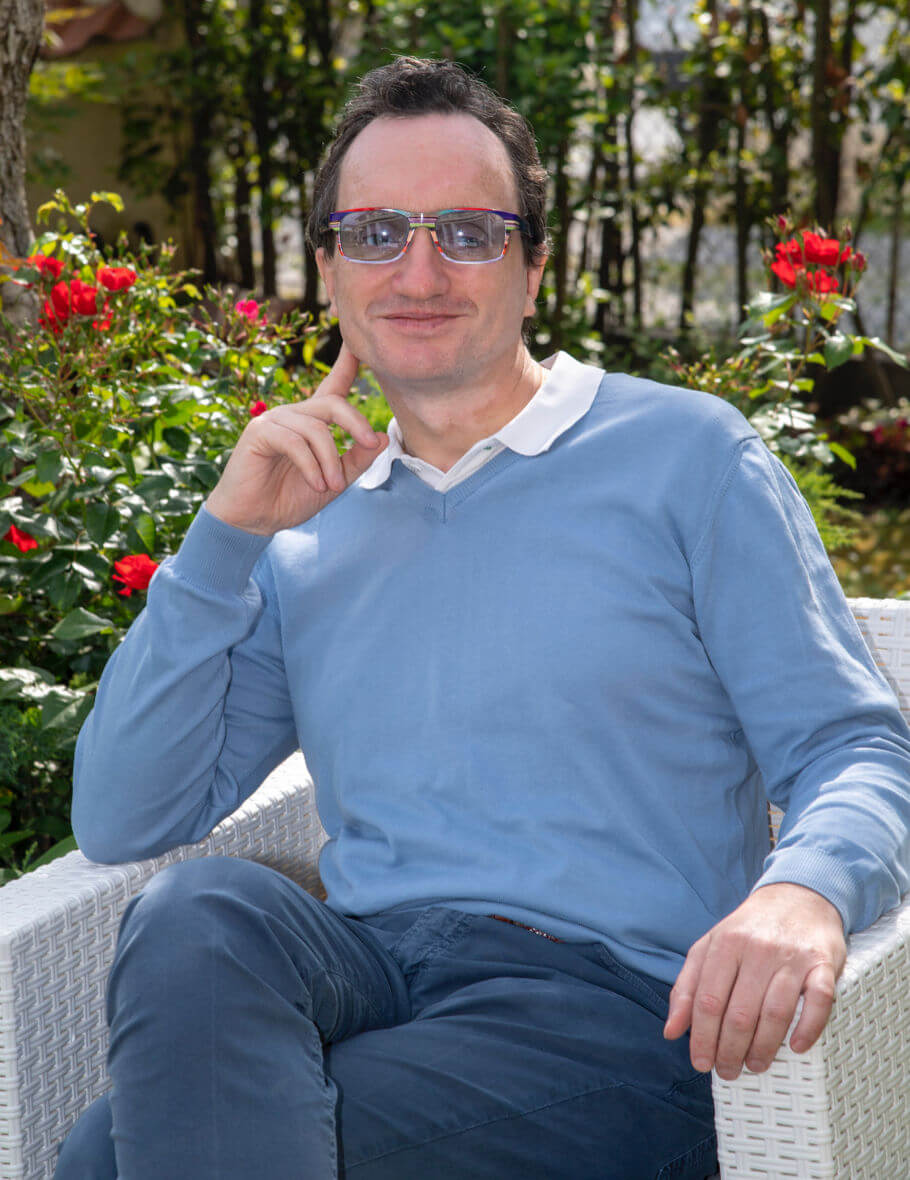
The change came in 2010, when Bianco was 40. While browsing the internet, he learned that blind people can work with clay [Bianco, 2026a]. He has described that moment as a turning point, because it let him pick up the artistic interest he had set aside as a boy. He started with courses in Bolzano, but he felt his skills had stopped growing, so he went looking for places where sculpture is a daily trade rather than a hobby [Bianco, 2026a].
Learning a Craft by Touch
Bianco's training took him through three very different materials over roughly six years, and each one asked something new of his hands. The order matters. He moved from the most forgiving material to the least forgiving, and then to the one nobody wanted to teach him.
Clay in Pietrasanta
He moved his studies to Pietrasanta, in Tuscany, a town where artists from all over the world come to work [Bianco, 2026a]. There he asked a workshop manager whether he had ever worked with a blind person. When the answer was "Never!" Bianco replied, "Good, then let's begin!" and set out, in his words, to absorb every secret like a sponge [Bianco, 2026b]. From 2010 to 2015 he studied ceramic sculpture with the Ceramiche Francesconi workshop, learning techniques, forms, materials, tools, firing and glazing [Bianco, 2025; Bianco, 2026a]. Clay suits a beginner who works by touch. It can be added to as well as taken away, mistakes can be smoothed out, and the fingers receive constant feedback about thickness and curve. Sculptors call this additive approach modeling, in contrast with the subtractive approach of carving, where material can only be removed.
Marble in Carrara and Lasa
Marble is the opposite of clay. Every blow of the chisel is permanent, and a block reveals its flaws only as it is opened. From 2013 to 2016 Bianco trained in marble sculpture in Carrara under Roberto Domina, and he also learned to work marble at Lasa, in South Tyrol [Bianco, 2025; Bianco, 2026a]. As Bianco describes the shift, clay let him model, add, remove and change, while marble forced him to carve away, paying close attention to the masses and picturing the finished work from the first cut [Bianco, 2026b].
Wood and a Willing Teacher
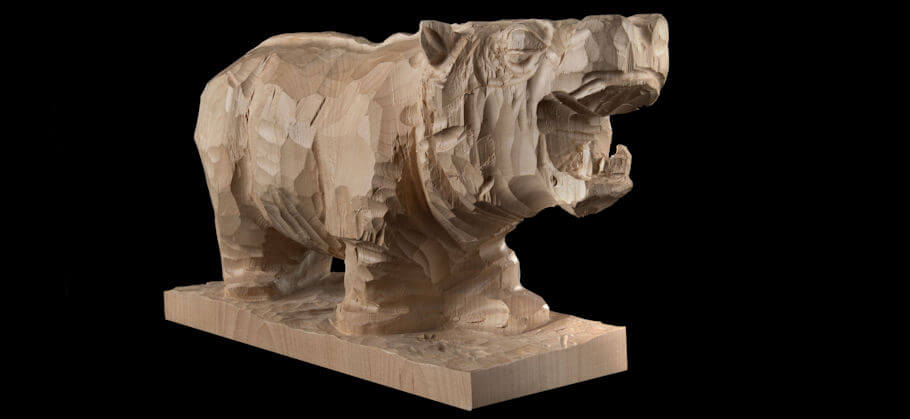
Wood came last and proved the hardest to arrange. No one wanted to teach him, because instructors were afraid he would hurt himself with sharp carving tools [Bianco, 2026a]. The opening came from Nicola Hornaecker, a German sculptor then attending the design university in Bolzano, who offered to help. A colorful figure with a red mohawk, three-quarter-length trousers, suspenders and heavy boots, Hornaecker was the only one willing to take the chance. He expected to teach a few concave and convex shapes and little more [Bianco, 2026b]. Instead the two trained together for three years, from 2013 to 2016. In Bianco's account, he learned how to carve wood, and Hornaecker learned how to teach using only touch and hearing [Bianco, 2025; Bianco, 2026a].
Their method was trial and adjustment. When Bianco struggled to follow an instruction, Hornaecker would close his eyes, put his hands on the block and work through the problem as his student would. Often he concluded that a route that made sense by sight did not work by touch, and that they had to find another way to reach the same result [Bianco, 2026b]. Looking back, Bianco says he had to invent his own training, relying on his willpower and on artisans and artists willing to share what they knew, while many people around him doubted he could succeed [Bianco, 2026b].
The most telling detail of Bianco's training is that the teacher had to change as much as the student. Hornaecker had to turn visual instruction into guided touch and spoken description - a skill most art teachers are never asked to develop.
How a Blind Sculptor Works
Sighted people tend to imagine that a blind sculptor works from a mental picture and checks it the way a sighted artist checks with the eye. The process is closer to what psychologists call haptic perception: building an understanding of shape, size and texture through active, searching touch. The hand moves over a surface, compares one side with the other, measures a distance against the span of the fingers, and returns again and again. A useful comparison is reading Braille rather than print - the information is the same, but it arrives in sequence through the fingertips instead of all at once through the eyes.
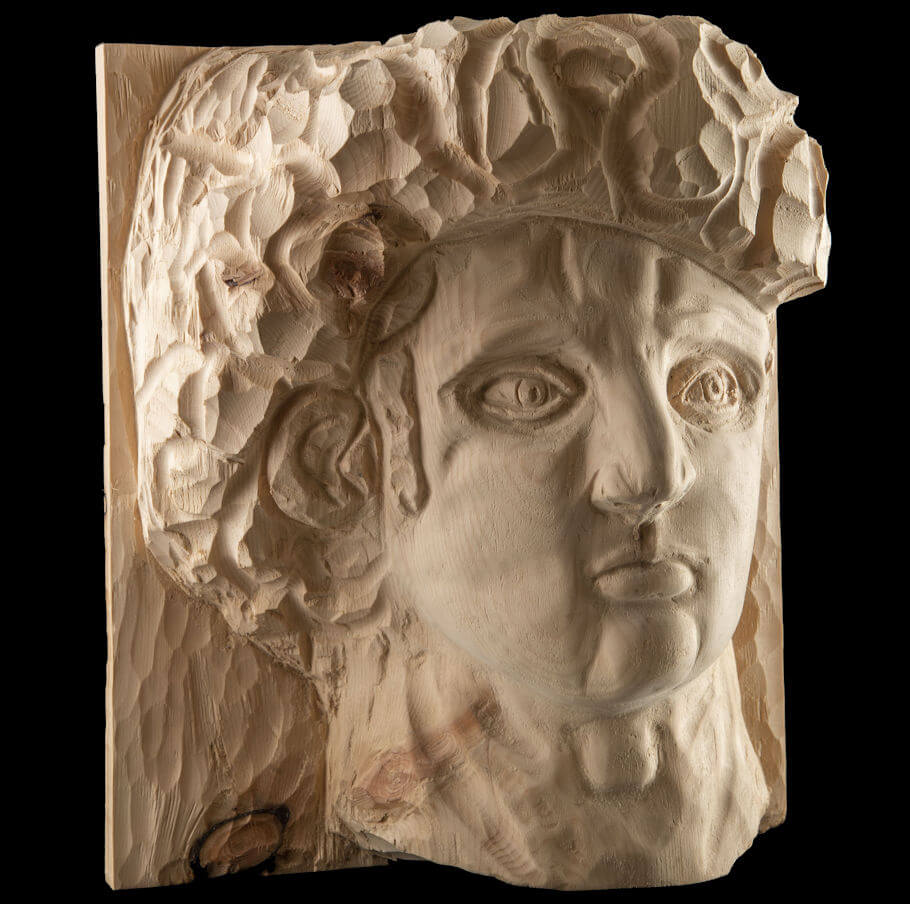
People who have watched Bianco at work describe exactly this kind of deliberate method. The Italian sculptor Jago writes that Bianco reminded him that making sculpture means seeing through touch, and that in Bianco's studio every gesture is studied and every touch reasoned, with nothing left to chance [Jago, n.d.]. Jago also points to the other senses involved: the scent of the woods, the sound of the gouges and the softness of the clay. The critic Antonio G. Mellone notes that in wood Bianco barely shapes the material, using the grain and even the knots as part of the design [Mellone, 2020].
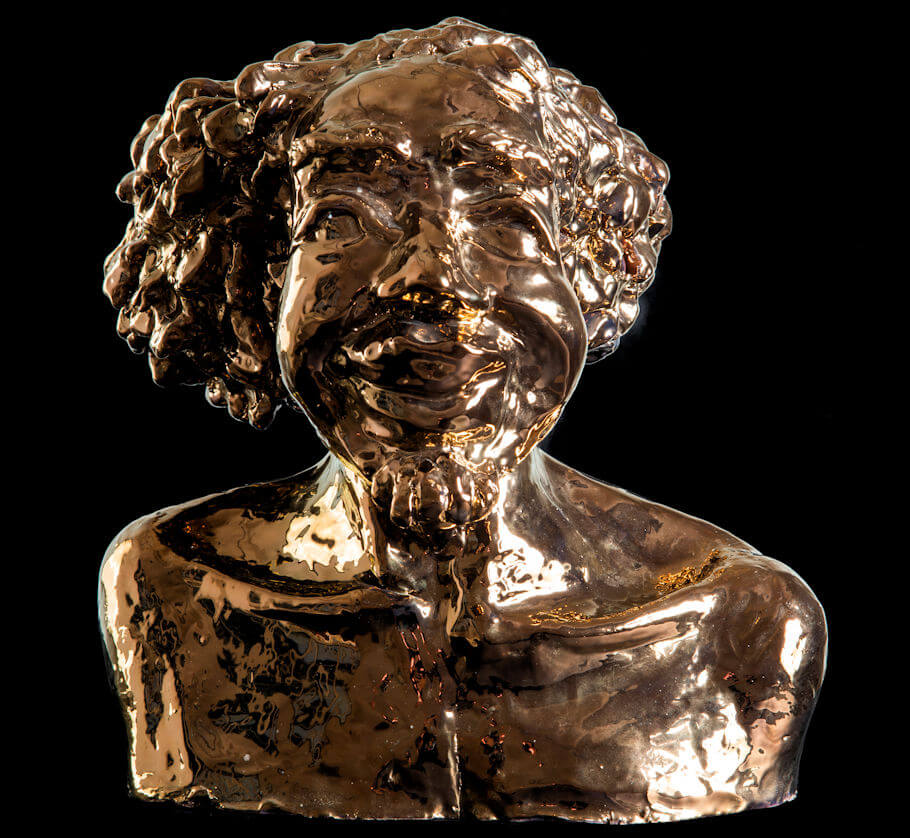
Bianco works in marble, stone, wood, clay and bronze, and he moves between hard and soft materials by choice [Bianco, n.d.]. Some of his figures are gilded, others finished in silver, red or an intense blue, and some wooden pieces are left in their natural state [Mellone, 2020].
The Armless, Faceless Figures
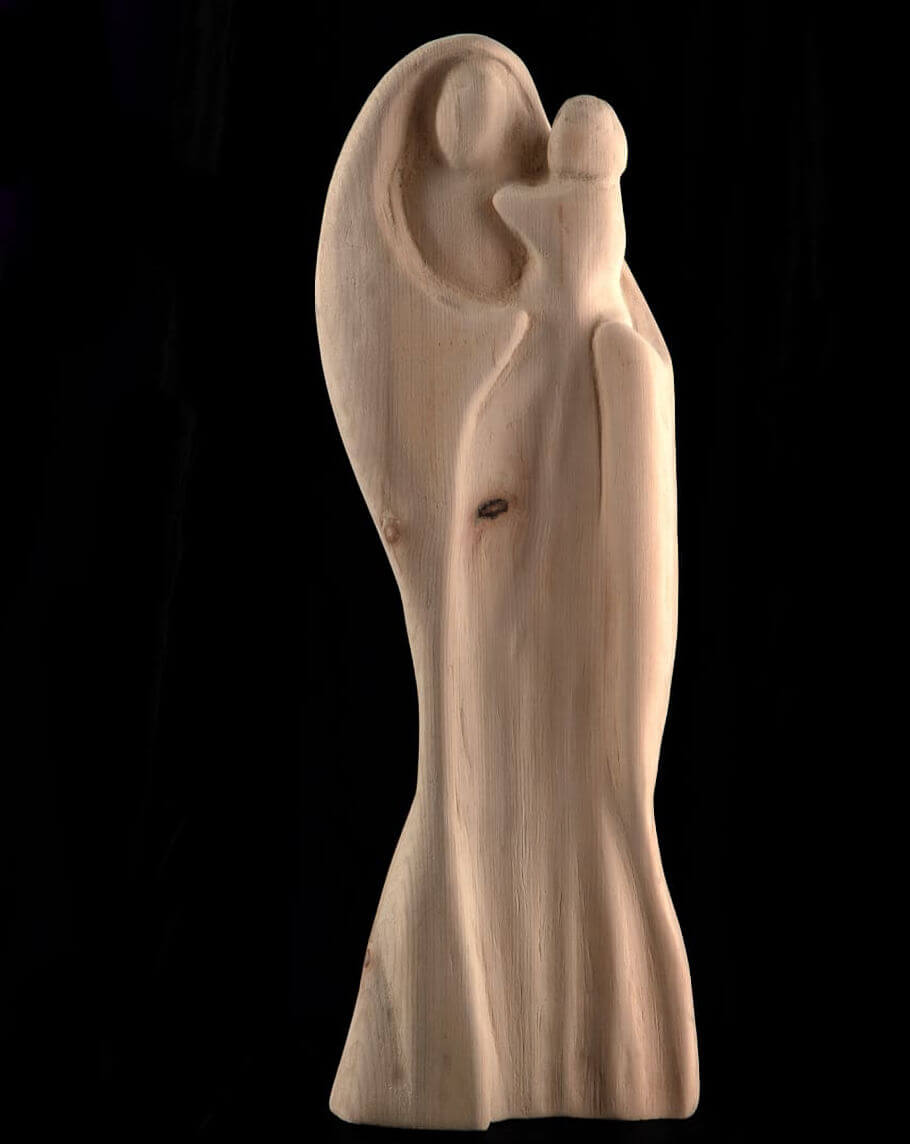
The female figure is the most frequent subject in Bianco's work. His stated aim is not simply to show the outer form of a woman but to suggest an inner world of emotion and delicacy [Bianco, n.d.]. His best-known pieces are tall, slender women with no arms and with faces that are barely suggested or absent altogether. Critics have compared the elongated silhouettes to the thread-thin figures of Alberto Giacometti and to the stylized sculpture of Amedeo Modigliani, while noting that Bianco stops well short of their extremes and keeps the curves of breast, belly and hip readable [Mellone, n.d.; Mellone, 2020].
The missing arms have drawn comment, some of it unkind. Mellone reports that some critics claimed Bianco left the arms out because he could not model them, a charge he rejects. In his reading, the omission is a deliberate formal choice: arms jut into the space around a slender figure and interrupt its upward line, so Bianco removes them. Mellone compares the effect with the Venus de Milo, whose arms were lost by accident, and argues that Bianco does on purpose what time did by chance [Mellone, n.d.; Mellone, 2020].
The faces follow a similar logic. Each small figure carries a woman's name, yet none has a defined face. Mellone sees this as an invitation: the sculpture is an archetype of femininity, and each viewer is free to supply the face of a woman they love or imagine [Mellone, n.d.]. A simple thought experiment shows why this works for an artist who creates by touch. Run a hand over a smooth, faceless head and the mind fills the gap; run it over a detailed face and the hand reads one particular person. Bianco's choice keeps the figure open to everyone.
Bianco's own account points the same way. He says he does not make what the market demands but sculpts what he likes and hopes others will like too, with the aim of expressing the joy of living. He asks viewers to take their time in front of a piece, having noticed that each person reads it differently according to their own sensitivity and life experience [Bianco, 2026b].
Not every work follows the vertical pattern. Mellone describes a white marble reclining nude curled in an almost fetal pose, and wooden monoxyle sculptures, carved from a single block, that reach back toward the earliest roots of sculpture [Mellone, 2020].
Religious Works
Faith runs through much of Bianco's output. Mellone describes him as a practicing believer and discusses a bronze crucifix whose twisted pelvis and legs recall the Cimabue crucifix in the Basilica of Santa Croce in Florence, as well as a wooden crucifix in which the torso, arms and face dominate [Mellone, 2020]. His work Ecce Homo According to the Shroud was covered by the Taiwanese Catholic Weekly, and many of his pieces are placed in religious settings, from the Museum of the Shroud at the Regina Apostolorum Institute in Rome to churches in Bolzano and convents and communities in Medjugorje, Bosnia and Herzegovina [Bianco, 2024].
Exhibitions and Recognition
In 2014 Bianco won the overall prize at the competition L'arte - un cuore che pulsa (Art - a Beating Heart) in Piombino and joined a group show at the Civic Museum of Marble in Carrara; he dates the start of his regular exhibiting to 2016 [Bianco, 2025; Bianco, 2026a]. One early group show at the Free University of Bolzano carried a title that sums up his approach: Toccare per credere, or Touch to Believe [Bianco, 2025].
He prefers solo exhibitions, which he feels let him present his vision more fully [Bianco, n.d.]. By December 31, 2024, he counted 53 solo exhibitions, 2 two-person shows, 32 group exhibitions and 4 art fairs [Bianco, 2024]. His 2026 account gives more than 60 solo exhibitions and more than 35 group shows [Bianco, 2026a].
The venues are notable. In 2019 alone he held solo shows at the Maschio Angioino in Naples, the Palazzo Ducale in Massa, the Fortino Leopoldo I in Forte dei Marmi and Palazzo Grassi in Chioggia [Bianco, 2025]. That same year he exhibited at the Accademia delle Arti del Disegno in Florence, an academy whose statute was approved by Duke Cosimo I de' Medici in 1563, following an idea of the painter and architect Giorgio Vasari [Accademia delle Arti del Disegno, n.d.; Bianco, 2025]. Later solo shows included Villa Bertelli in Forte dei Marmi in 2021 and the monumental complex of Sant'Anna dei Lombardi in Naples in 2023, and he has also shown at the Royal Palace of Caserta [Bianco, 2024; Bianco, 2025]. Group exhibitions took him to the Crypt Gallery in London and Galleria Kass in Innsbruck in 2017 and to the Palazzo Ducale of Sabbioneta in 2019 [Bianco, 2025]. By his own account, in October 2026 he showed a work in Venice during the Biennale [Bianco, 2026a].
Awards and Collections
His achievements and awards include the critics' prize at the 3rd International Michelangelo Buonarroti Prize in Seravezza and the Ugo Guidi Prize, both in 2017, and the Open Catalogue award of the Province of Bolzano in 2021 [Bianco, 2024; Bianco, 2025]. He appears in the Mondadori Modern Art catalog, number 55, and has a personal catalog titled Beyond Appearance [Bianco, 2024].
His works are held at the Royal Palace of Caserta, the Diocesan Museum of Turin, the Pierluigi Gherardi Museum of Sketches in Pietrasanta, the Ugo Guidi Museum in Forte dei Marmi, the Franciscan Museum at the Capuchin Institute of Forte Bravetta in Rome and the Seraphic Institute in Assisi, among other places [Bianco, 2024; Bianco, 2025]. He has appeared on Italian national television, including Rai 1's Uno mattina, and Rai South Tyrol broadcast a documentary about him titled Seeing with the Hands [Bianco, 2024]. He also took part as a witness in a documentary marking the centenary of the Italian Union of the Blind, which was founded in Genoa in 1920 [Bianco, 2024; Unione Italiana dei Ciechi e degli Ipovedenti, n.d.].
Advocacy for Accessible Art
Bianco treats access as part of his work, not a side issue. He focuses on two gaps: museums that are hard for blind visitors to use, and the lack of adequate art training for blind people [Bianco, 2026a]. The first concern dates to 2013, when on a trip to Barcelona he touched a sculpture for the first time. Back home he argued loudly for tactile paths for blind museum visitors; he recalls being called crazy, and notes that many museums have since introduced them [Bianco, 2026b]. For years he has also pressed for a permanent sculpture course for blind people, arguing that ordinary classes rely mainly on sight, while blind students must learn through touch and hearing [Bianco, 2026b].
He has also put that conviction into practice. He created two courses for blind artists at the Sacred Art School in Florence, and he has led workshops at the Royal Palace of Caserta and the Mart museum in Rovereto in 2024 and at Villa Bertelli in Forte dei Marmi and the Gigi Guadagnucci Museum in Carrara in 2021 [Bianco, 2024; Bianco, 2025]. In 2022 he spoke at a UNESCO conference in Florence on arts, inclusion, faith and bioethics, and he has lectured at the Free University of Bozen-Bolzano and at Museion, the city's museum of contemporary art [Bianco, 2024; Bianco, 2025].
Italy already has a well-known model for the kind of accessibility he argues for. The State Tactile Museum Omero in Ancona was founded on May 29, 1993, by the city of Ancona with the support of the Marche region and the Italian Union of the Blind, and in 1999 the Italian Parliament made it a state museum [Museo Tattile Statale Omero, n.d.]. Housed in the Mole Vanvitelliana, it holds around 200 works - copies of classical masterpieces, architectural models, contemporary sculpture and Italian design - that visitors can handle and examine by touch [Museo Tattile Statale Omero, n.d.]. Bianco's sculptures, which writers repeatedly describe as made to be touched, belong naturally in that tradition [Jago, n.d.; Mellone, n.d.].
A tactile museum reverses the usual museum rule. Instead of asking visitors not to touch, it invites them to touch with care - and for a blind visitor, that difference decides whether a sculpture can be experienced at all.
Practical Points for Readers
Bianco's path offers some general lessons for people who lose their sight as adults, for seniors whose vision is fading, and for the families and caregivers who support them.
- Start with forgiving materials. Clay gave Bianco immediate feedback and allowed mistakes to be corrected before he moved on to marble and wood.
- Look for real workshops. His progress picked up when he left beginner courses for places where sculpture is a working trade [Bianco, 2026a].
- Ask instructors to adapt. A teacher willing to explain through touch and speech can open up a craft that others refuse to teach on safety grounds.
- Seek out tactile access. Touch tours, tactile museums and handling collections make art available to people who cannot see it, and visual aids can help with everyday tasks in and around a studio.
Safety around sharp tools and power equipment is a real concern for anyone with low vision. A vision rehabilitation specialist or an orientation and mobility instructor can give advice on setting up a safe workspace for a particular person, and nothing here replaces that individual guidance.
Beyond the Label of Blind Artist
Blind artists are often presented as curiosities, with the disability taking up more space than the work. Bianco's career pushes against that habit, and it places him among other famous disabled people whose reputations rest on what they made. His awards came from competitions open to sighted artists, and the critics who write about him spend most of their words on form, line and material. Mellone sets him in conversation with Giacometti, Modigliani and the sculptors of ancient Greece, and Jago, himself a sculptor, credits Bianco with sharpening his own understanding of what sculpture is [Jago, n.d.; Mellone, 2020].
The bigger lesson is about assumptions. Sculpture is usually taught and displayed as a visual art, behind ropes and glass. Yet a sculpture is an object in three dimensions, and touch reads three dimensions directly. Bianco's work, and the courses he has helped build, suggest that the barrier for blind sculptors has been less about ability than about access - to teachers, to workshops, and to the works of other artists that sighted students take for granted.
Bianco puts it more bluntly. In his view, sculpture needs no pedigree and no able body - only enthusiasm, a willingness to put oneself forward and the wish to move the viewer - and he hopes other blind people will take up sculpture in spite of prejudice and skepticism [Bianco, 2026b].
Frequently Asked Questions
How do blind sculptors judge proportion without seeing?
They rely on touch and measurement. Common methods include comparing one side of a piece with the other by hand, using the span of the fingers or simple calipers to check distances, and returning to the whole form repeatedly to make sure each part fits the rest.
Is total blindness the same as legal blindness?
No. Total blindness means no usable light perception, while legal blindness is a legal or administrative category based on measured visual acuity or field of vision. Many people who are legally blind keep some usable sight.
What is Carrara marble?
Carrara marble is a white or blue-gray marble quarried in the Apuan Alps near the town of Carrara in Tuscany. It has been used for sculpture and building for centuries and remains one of the best-known sculpting stones in the world.
Why do many blind art students begin with clay?
Clay is soft, inexpensive and forgiving. It can be added to or removed, mistakes can be smoothed away, and the hands receive continuous feedback, which makes it a practical first material before harder media such as stone or wood.
Can visitors touch sculptures in ordinary museums?
Most museums do not allow general touching, because skin oils and wear damage surfaces. Many offer touch tours, handling collections, replicas or gloves for blind and partially sighted visitors, so it is worth contacting the museum before a visit.
How can a sighted teacher adapt sculpture lessons for a blind student?
Useful steps include guiding the student's hands over examples, describing each action in clear spoken language, keeping tools in fixed places, and agreeing on safety routines for sharp or powered equipment. Patience and regular feedback from the student matter as much as technique.
What is haptic perception?
Haptic perception is the ability to recognize objects and their shape, size, weight and texture through active touch, combining skin sensation with feedback from the muscles and joints. It is the main way blind people examine three-dimensional objects.
Can people who lose their sight later in life learn a new art form?
Yes. Many adults and seniors with vision loss take up crafts such as pottery, wood carving or textile work. Adapted classes, vision rehabilitation services and blindness organizations can help find suitable courses and tools.
References
- Accademia delle Arti del Disegno. (n.d.). L'Accademia [The Academy]. Florence, Italy: Accademia delle Arti del Disegno.
- Bianco, A. (n.d.). Presentation [Artist presentation document]. Bolzano, Italy.
- Bianco, A. (2024). Artist statement. Bolzano, Italy.
- Bianco, A. (2025). Curriculum vitae: Sculptor Andrea Bianco. Bolzano, Italy.
- Bianco, A. (2026a). About me [Unpublished biographical note]. Bolzano, Italy.
- Bianco, A. (2026b). Personal statement [Unpublished autobiographical statement in English]. Bolzano, Italy.
- Jago. (n.d.). On the work of Andrea Bianco [Artist review].
- Mellone, A. G. (n.d.). Line and light [Art review].
- Mellone, A. G. (2020). Andrea Bianco: The strength of a quiet man [Art review].
- Museo Tattile Statale Omero. (n.d.). The museum. Ancona, Italy: Museo Tattile Statale Omero.
- Unione Italiana dei Ciechi e degli Ipovedenti. (n.d.). Unione Italiana dei Ciechi e degli Ipovedenti ETS-APS [Home page]. Rome, Italy.
- World Health Organization. (2026). Blindness and vision impairment [Fact sheet]. Geneva, Switzerland: World Health Organization.
More on this topic: Art and Artists, Blindness and Vision Loss, Famous Disabled People
Insights, Analysis, and Developments
Editorial Note: Andrea Bianco's career is a reminder that sculpture is an art of three dimensions, and that touch reads three dimensions directly. His prizes, including the critics' prize at the 2017 International Michelangelo Buonarroti Prize, were won in open competition, and his works sit in places as varied as the Royal Palace of Caserta, the Diocesan Museum of Turin and convents in Bosnia and Herzegovina. For blind and partially sighted people, and for those who teach or care for them, his path suggests that the main obstacles to making art are often access to teachers, workshops and touchable collections rather than ability, and Italy's tactile Museo Omero shows how those obstacles can be lowered.
 Author Credentials: Ian C. Langtree is a writer, editor, and the founder and Editor-in-Chief of Disabled World, which he established in 2004 as one of the longest-running independent resources for disability news and information. Over more than two decades, he has written and edited thousands of articles on disability rights, health, accessibility, and assistive technology. Drawing on a global perspective shaped by extensive travel and lived experience, Ian is a committed advocate of the Social Model of Disability, the framework developed by disabled activists in the 1970s that focuses on removing societal barriers rather than on individual impairments. His writing is grounded in that framework and in a lasting commitment to disability rights, accessibility, and social inclusion. To learn more about Ian's background, expertise, and accomplishments, visit his full biography.