Baby Girl Growth Chart: Height & Weight Birth to 11 Months
Author: Ian C. Langtree - View Credentials
Published: 21 Aug 2023 - Updated: 19 Sep 2026
Publication Type: Conversion, Calculation
Table of Contents:
Synopsis - Definition - Overview - FAQs - Insights, Updates - Related Content
Synopsis
This information provides essential reference data for monitoring the physical development of female infants during their first year of life. Drawing from authoritative sources including the World Health Organization, the National Institutes of Health's Gerontology Research Center, and the U.S. Centers for Disease Control and Prevention, the chart presents monthly averages for both weight and length measurements from birth through eleven months. Parents, pediatricians, and caregivers can use these benchmarks to track growth patterns while understanding that healthy babies naturally vary in size and that percentile rankings don't automatically indicate developmental concerns. The resource proves particularly valuable for families managing medical conditions or disabilities where growth monitoring requires closer attention, offering a quick reference tool that helps identify when consultation with healthcare providers might be warranted.
At a Glance
- 1 - Many young infants gain roughly 5 to 7 ounces, about 150 to 200 grams, per week during the first few months. The rate then slows as the year goes on.
- 2 - A loss of up to about 7 to 10 percent of birth weight in the first few days is common, especially with breastfeeding. Most babies regain their birth weight by around two weeks of age.
- 3 - Head circumference is measured at routine visits because it reflects brain growth and can flag conditions that weight and length alone would miss. It is plotted on its own chart and reviewed alongside the other two.
- 4 - To weigh a baby at home, weigh yourself, then weigh yourself holding her, and subtract the difference on the same scale. For length, mark the top of the head and the heel, then measure between the marks.
Topic Definition
- Baby Girl Growth Chart
A baby girl growth chart is a reference table that sets out the average height and weight expected for female infants across their first year, here spanning birth through eleven months. Instead of acting as a strict target every child must hit, it pulls together averages from large population studies so parents, caregivers, and doctors can see roughly where a baby girl sits next to others her age. Its real worth lies in following the overall trend, since healthy babies grow along their own curves shaped by genetics, feeding, activity, and any underlying conditions. Steady weight gain is a reassuring sign that a baby is feeding well, and a chart like this works best as a starting point for tracking development and for guiding a conversation with a pediatrician who can read the numbers against a baby's full health picture.
Overview
Tracking Your Baby Girl's Height and Weight in the First Year
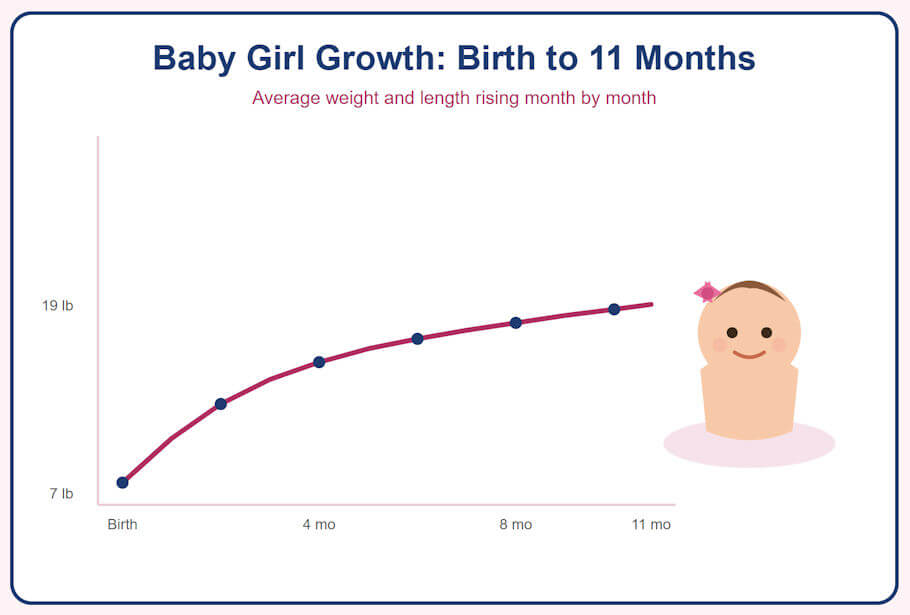
Babies come in all shapes and sizes. If a baby's weight is in a lower - or higher - percentile, this does not necessarily signal a problem with their growth or physical development. A height to weight chart, like the one below, can help you track your baby girls' growth, as steady weight gain is a sign that your baby is healthy and feeding well.
| Age | Weight | Length |
|---|---|---|
| 0 Months | 7.1 lb. (3.23 kg) | 19.3" (49.1 cm) |
| 1 Month | 9.2 lb. (4.19 kg) | 21.1" (53.7 cm) |
| 2 Months | 11.3 lb. (5.13 kg) | 22.5" (57.1 cm) |
| 3 Months | 12.9 lb. (5.85 kg) | 23.5" (59.8 cm) |
| 4 Months | 14.2 lb. (6.42 kg) | 24.4" (62.1 cm) |
| 5 Months | 15.2 lb. (6.90 kg) | 25.2" (64.0 cm) |
| 6 Months | 16.1 lb. (7.30 kg) | 25.9" (65.7 cm) |
| 7 Months | 16.8 lb. (7.64 kg) | 26.5" (67.3 cm) |
| 8 Months | 17.5 lb. (7.95 kg) | 27.1" (68.8 cm) |
| 9 Months | 18.1 lb. (8.23 kg) | 27.6" (70.1 cm) |
| 10 Months | 18.7 lb. (8.48 kg) | 28.1" (71.5 cm) |
| 11 Months | 19.2 lb. (8.72 kg) | 28.7" (72.8 cm) |
Frequently Asked Questions
What is the difference between the WHO growth standards and the CDC growth charts
The WHO standards describe how healthy, breastfed babies in optimal conditions should grow, while the older CDC charts describe how a sample of US children did grow. For this reason the CDC recommends the WHO standards for infants under two years in the United States.
How much weight should a newborn girl gain each week in the first few months
Many young infants gain roughly 5 to 7 ounces, or about 150 to 200 grams, per week during the first few months, then gain more slowly as the year goes on. Your pediatrician will judge gain against her birth weight and feeding pattern rather than a fixed weekly figure.
Is it normal for a baby girl to lose weight in the first days after birth
A loss of up to about 7 to 10 percent of birth weight in the first few days is common, especially with breastfeeding. Most babies regain their birth weight by around two weeks of age, and a slower return is worth mentioning to a health professional.
Why is length measured lying down instead of standing height for babies
Infants cannot stand steadily or straighten fully, so recumbent length taken on a measuring board is far more accurate. Standing height is usually introduced from about two years of age, and it typically reads slightly shorter than recumbent length.
Does head circumference matter as much as height and weight
Head circumference is measured at routine visits because it reflects brain growth and can flag conditions that weight and length alone would miss. It is plotted on its own chart and reviewed alongside the other two measurements.
Can I predict my baby girl's adult height from her first year measurements
First year size is a poor predictor because many infants shift percentiles during the first two years as they settle onto their genetically influenced curve. Estimates based on parental height are more useful, and even those carry a wide margin of error.
How do I measure my baby girl's weight and length accurately at home
For weight, weigh yourself, then weigh yourself holding her, and subtract the difference, ideally on the same scale at the same time of day. For length, lay her on a firm flat surface, mark the top of the head and the heel with her leg gently straightened, then measure between the marks.
What growth signs should prompt a call to the pediatrician
Contact a clinician if she crosses downward through two or more major percentile lines, fails to regain birth weight by about three weeks, has few wet diapers, feeds poorly, or seems unusually lethargic. Any sudden change in a previously steady pattern is also worth checking.
How These Figures Were Derived and Last Verified
Every number in the table above is the median (50th percentile) of a published growth reference, not an average of site visitors or an in-house estimate. The figures come from the WHO Child Growth Standards, which the CDC recommends for children under two years of age in the United States. In each row the imperial and metric values are converted from the source figure in its original unit and rounded consistently, so the two unit systems agree with one another. The complete set of figures was last checked cell by cell against the source data files on 26 July 2026, and matches our full height-to-weight guide for infants through teens.
Source References
- 1 - World Health Organization: Child Growth Standards - overview of the standards used from birth to 23 months.
- 2 - World Health Organization: Weight-for-age - z-score and percentile tables, birth to 5 years.
- 3 - World Health Organization: Length/height-for-age - z-score and percentile tables, birth to 5 years.
- 4 - U.S. Centers for Disease Control and Prevention: WHO growth standards for use in US infants and children birth to 2 years - the basis for using WHO figures below age two.
Other Printable Height to Weight Reference Charts:
Insights, Analysis, and Developments
Editorial Note: Growth charts serve as guides rather than rigid standards, yet they remain one of the most practical tools parents have for understanding their child's development trajectory. While these WHO and CDC-sourced measurements reflect population averages, real-world pediatric care recognizes that thriving infants follow their own unique growth curves. What matters most isn't hitting exact numbers at precise intervals, but rather showing consistent progress over time. For families dealing with medical complexities, chronic conditions, or feeding challenges, these monthly benchmarks become even more significant as they help distinguish between normal variation and patterns that warrant medical attention, making routine check-ups more productive and giving caregivers concrete data to discuss with their healthcare team.
 Author Credentials: Ian C. Langtree is a writer, editor, and the founder and Editor-in-Chief of Disabled World, which he established in 2004 as one of the longest-running independent resources for disability news and information. Over more than two decades, he has written and edited thousands of articles on disability rights, health, accessibility, and assistive technology. Drawing on a global perspective shaped by extensive travel and lived experience, Ian is a committed advocate of the Social Model of Disability, the framework developed by disabled activists in the 1970s that focuses on removing societal barriers rather than on individual impairments. His writing is grounded in that framework and in a lasting commitment to disability rights, accessibility, and social inclusion. To learn more about Ian's background, expertise, and accomplishments, visit his full biography.