Male Toddler Growth Chart: Height and Weight 12-23 Months
Author: Ian C. Langtree - View Credentials
Published: 21 Aug 2023 - Updated: 19 Sep 2026
Publication Type: Conversion, Calculation
Table of Contents:
Synopsis - Definition - Overview - FAQs - Insights, Updates - Related Content
Synopsis
This resource provides reference data for tracking male toddler growth patterns during the crucial 12 to 23-month developmental period. Drawing on authoritative sources including the World Health Organization, National Institutes of Health, and Centers for Disease Control and Prevention, the information presents monthly averages for both weight and height measurements in an accessible, printable format. Parents, caregivers, and healthcare providers can use this data to monitor developmental progress and identify potential growth concerns early. While particularly valuable for families raising children with disabilities or health conditions requiring close developmental monitoring, the chart serves anyone seeking reliable benchmarks for typical toddler growth trajectories. The month-by-month breakdown allows for precise tracking, though the article appropriately notes that individual children develop at varying rates.
At a Glance
- 1 - Standing height reads about a quarter to a half inch shorter than lying length. Growth references note which method applies to avoid an apparent drop that is only a change in technique.
- 2 - Head growth slows markedly after infancy, typically adding around an inch across the whole second year. Pediatricians still measure it because the trend can flag concerns that height and weight alone would miss.
- 3 - Across the 12 to 23 month stretch a boy typically gains about 4 to 6 pounds and grows roughly 2 to 3 inches. This is a noticeably slower pace than the rapid climb of his first year.
- 4 - Most guidance suggests roughly two to three cups of whole milk a day, since too much crowds out iron-rich foods and can contribute to anemia. A dietitian can suggest alternatives for a child with a dairy allergy or lactose intolerance.
Topic Definition
- Male Toddler Growth Chart
A male toddler growth chart is a reference table that sets out the average height and weight expected for boys during the toddler stage, in this case the months from 12 through 23. Instead of laying down a strict target every child must hit, it gathers averages from large population studies so parents, caregivers, and doctors can see roughly where a little boy sits compared to others his age. The growth during this window is steadier and slower than the rapid gains of infancy, which is why watching the overall trend matters far more than matching any single number. Healthy toddlers follow their own individual curves shaped by genetics, nutrition, activity, and any underlying health conditions, so a chart like this works best as a starting point for tracking development and for talking things over with a pediatrician who can weigh a child's measurements against his complete health picture before deciding whether anything needs a closer look.
Overview
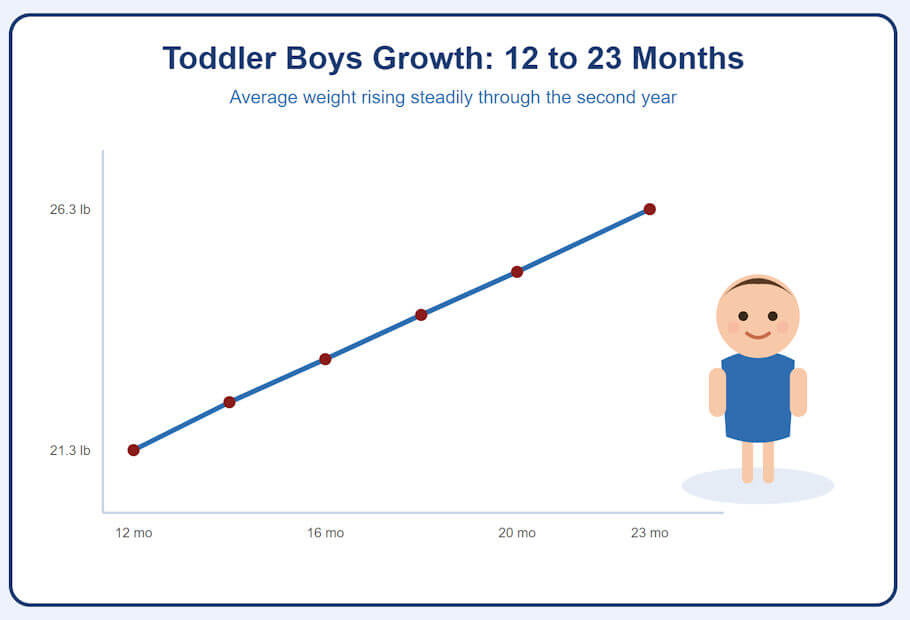
All toddlers grow at different rates. However, the following chart indicates the average growth rate for 1 to 2 year old boys. During this period a male toddlers average weight gain will be about 4 to 6 pounds, with an average height growth of around 2 to 3 inches.
| Age | Weight | Length |
|---|---|---|
| 12 Months | 21.3 lb. (9.65 kg) | 29.8" (75.8 cm) |
| 13 Months | 21.8 lb. (9.87 kg) | 30.3" (76.9 cm) |
| 14 Months | 22.3 lb. (10.10 kg) | 30.7" (78.0 cm) |
| 15 Months | 22.7 lb. (10.31 kg) | 31.2" (79.2 cm) |
| 16 Months | 23.2 lb. (10.52 kg) | 31.6" (80.2 cm) |
| 17 Months | 23.7 lb. (10.73 kg) | 32.0" (81.3 cm) |
| 18 Months | 24.1 lb. (10.94 kg) | 32.4" (82.3 cm) |
| 19 Months | 24.6 lb. (11.14 kg) | 32.8" (83.2 cm) |
| 20 Months | 25.0 lb. (11.35 kg) | 33.1" (84.2 cm) |
| 21 Months | 25.5 lb. (11.55 kg) | 33.5" (85.1 cm) |
| 22 Months | 25.9 lb. (11.75 kg) | 33.9" (86.0 cm) |
| 23 Months | 26.3 lb. (11.95 kg) | 34.2" (86.9 cm) |
Frequently Asked Questions
Why does the chart switch from length to standing height around age two?
Babies and young toddlers are measured lying down, which is called recumbent length, while older children are measured standing. Standing height reads about a quarter to a half inch shorter than lying length, so growth references note which method applies to avoid an apparent drop that is only a change in technique.
What does it mean if my toddler boy sits at the 25th percentile?
It means that out of one hundred boys his age, about twenty five would weigh or measure less and about seventy five more. A lower percentile is not a grade or a problem on its own, since a child who tracks steadily along the same percentile line is generally growing well.
Why do WHO standards apply under age two while CDC charts are used later?
The WHO standards describe how healthy, well nourished children should grow under optimal conditions, which suits the first two years. The CDC charts describe how children in the United States actually grew in reference surveys, and health authorities recommend switching to them from age two onward.
How much should a toddler boy grow in head circumference during this stage?
Head growth slows markedly after infancy, typically adding around an inch across the whole second year. Pediatricians still measure it at checkups because the trend can flag concerns that height and weight alone would miss.
Can teething or a bout of illness stall a toddler boy growth?
Short illnesses, teething discomfort, and reduced eating can pause weight gain for a week or two, and that is expected. Most toddlers show catch up growth once they recover, so the concern is a pattern that persists across several months rather than a single dip.
Should the chart be adjusted for a boy who was born prematurely?
Yes, growth is usually plotted using corrected age, which subtracts the weeks of prematurity from the calendar age. This correction is commonly applied until around age two, after which most children are assessed on actual age.
How much milk should a toddler boy drink during the second year?
Most guidance suggests roughly two to three cups of whole milk a day, with too much crowding out iron rich foods and contributing to anemia. A pediatrician or dietitian can suggest alternatives for a child with a dairy allergy, lactose intolerance, or a feeding difficulty.
Does a toddler boy growth in this window predict his adult height?
Toddler measurements are a weak predictor on their own because many children shift percentile lines during the first two to three years as they settle onto their genetic path. Parental heights and the growth trend after age three give a much better indication of eventual adult stature.
How These Figures Were Derived and Last Verified
Every number in the table above is the median (50th percentile) of a published growth reference, not an average of site visitors or an in-house estimate. The figures come from the WHO Child Growth Standards, which the CDC recommends for children under two years of age in the United States. In each row the imperial and metric values are converted from the source figure in its original unit and rounded consistently, so the two unit systems agree with one another. The complete set of figures was last checked cell by cell against the source data files on 26 July 2026, and matches our full height-to-weight guide for infants through teens.
Source References
- 1 - World Health Organization: Child Growth Standards - overview of the standards used from birth to 23 months.
- 2 - World Health Organization: Weight-for-age - z-score and percentile tables, birth to 5 years.
- 3 - World Health Organization: Length/height-for-age - z-score and percentile tables, birth to 5 years.
- 4 - U.S. Centers for Disease Control and Prevention: WHO growth standards for use in US infants and children birth to 2 years - the basis for using WHO figures below age two.
Other Printable Height to Weight Reference Charts:
Insights, Analysis, and Developments
Editorial Note: Growth charts remain one of the most practical tools in pediatric care, yet their true value lies not in rigid adherence to averages but in spotting patterns over time. While these WHO and CDC-based measurements give parents a useful reference point, they represent population averages across diverse genetic backgrounds and environmental conditions. A child consistently tracking below or above these numbers isn't necessarily cause for alarm - what matters most is their individual growth curve remaining steady and appropriate for their unique constitution. Healthcare providers consider multiple factors beyond raw measurements, including family history, nutrition, activity levels, and overall health markers. For families managing chronic conditions or disabilities, these charts become even more nuanced, as certain medical situations naturally affect growth patterns. The real power of such data comes from informed interpretation rather than anxious comparison.
 Author Credentials: Ian C. Langtree is a writer, editor, and the founder and Editor-in-Chief of Disabled World, which he established in 2004 as one of the longest-running independent resources for disability news and information. Over more than two decades, he has written and edited thousands of articles on disability rights, health, accessibility, and assistive technology. Drawing on a global perspective shaped by extensive travel and lived experience, Ian is a committed advocate of the Social Model of Disability, the framework developed by disabled activists in the 1970s that focuses on removing societal barriers rather than on individual impairments. His writing is grounded in that framework and in a lasting commitment to disability rights, accessibility, and social inclusion. To learn more about Ian's background, expertise, and accomplishments, visit his full biography.