Boys Height Weight Chart Birth to 20 Years Printable
Author: Ian C. Langtree - Writer/Editor for Disabled World (DW)
Published: 21 Aug 2023 - Updated: 19 Sep 2026
Publication Type: Charts, Graphs, Tables
Table of Contents:
Synopsis - Definition - Overview - FAQs - Insights, Updates - Related Content
Synopsis
This resource provides a detailed reference chart for monitoring male growth patterns from infancy through young adulthood. Healthcare providers, parents, and caregivers rely on these standardized measurements to assess whether a child's physical development falls within typical ranges for his age group. The data becomes particularly valuable when tracking boys through adolescence, when growth spurts can create temporary variations from average measurements. Since each boy develops at his own pace, the chart serves as a guideline rather than a rigid standard, helping identify when growth patterns might warrant professional medical evaluation. The printable format makes it practical for home use or clinical settings where quick reference to age-specific height and weight norms is needed.
At a Glance
- 1 - Most boys finish growing in height between about 16 and 18 years, once the growth plates close. Weight and muscle mass can keep changing well after height has settled.
- 2 - A rough parent-height estimate adds the mother's height in inches plus 5 inches to the father's height, then divides by two. The result carries a margin of several inches either way.
- 3 - A bone age study is a single X-ray of the left hand and wrist that shows how far skeletal maturity has progressed versus calendar age. Doctors use it to judge whether a boy still has growth remaining.
- 4 - Well-supervised strength training and sport do not stunt growth, and regular activity supports bone development. Problems arise mainly when intense training combines with inadequate calories, which can delay puberty.
Topic Definition
- Boys Growth Chart
A boys growth chart is a standardized reference tool that maps the average height and weight of male children at each stage of development, from newborns through age twenty. Pediatricians, parents, and caregivers use it to gauge whether a boy's physical development falls within typical ranges for his age, making it easier to see healthy progress or spot changes that may call for a closer look. It works best as a guideline rather than a strict standard, since boys grow at their own pace and adolescent growth spurts can create temporary swings above or below the average. The chart is especially handy during medical visits and for tracking children with disabilities or chronic conditions, where steady monitoring helps healthcare teams separate normal variation from trends that deserve professional evaluation.
Overview
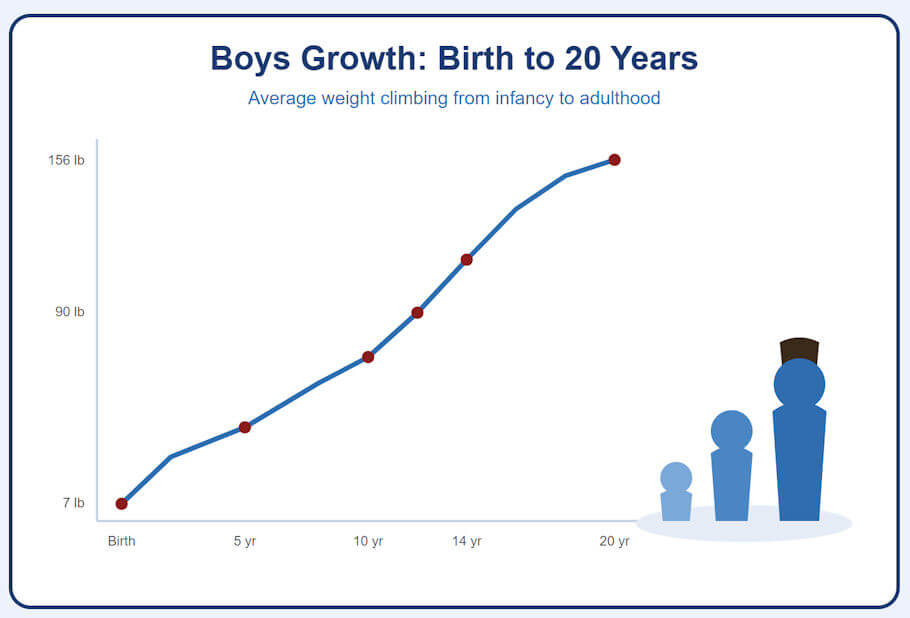
Our printable chart below forms part of our average height to weight chart - babies to teenagers page, and outlines the average weight to height scale for males aged from birth to 20 years old. Normal growth is categorized in a range used by pediatricians to gauge how a child is growing.
| Age | Weight | Length |
|---|---|---|
| Birth | 7.4 lb (3.35 kg) | 19.6" (49.9 cm) |
| 1 Month | 9.9 lb (4.47 kg) | 21.5" (54.7 cm) |
| 2 Months | 12.3 lb (5.57 kg) | 23.0" (58.4 cm) |
| 3 Months | 14.1 lb (6.38 kg) | 24.2" (61.4 cm) |
| 4 Months | 15.4 lb (7.00 kg) | 25.2" (63.9 cm) |
| 5 Months | 16.6 lb (7.51 kg) | 25.9" (65.9 cm) |
| 6 Months | 17.5 lb (7.93 kg) | 26.6" (67.6 cm) |
| 7 Months | 18.3 lb (8.30 kg) | 27.2" (69.2 cm) |
| 8 Months | 19.0 lb (8.62 kg) | 27.8" (70.6 cm) |
| 9 Months | 19.6 lb (8.90 kg) | 28.3" (72.0 cm) |
| 10 Months | 20.2 lb (9.16 kg) | 28.9" (73.3 cm) |
| 11 Months | 20.7 lb (9.41 kg) | 29.3" (74.5 cm) |
| Toddler Boys (12-23 Months) | ||
| Age | Weight | Length |
| 12 Months | 21.3 lb (9.65 kg) | 29.8" (75.8 cm) |
| 13 Months | 21.8 lb (9.87 kg) | 30.3" (76.9 cm) |
| 14 Months | 22.3 lb (10.10 kg) | 30.7" (78.0 cm) |
| 15 Months | 22.7 lb (10.31 kg) | 31.2" (79.2 cm) |
| 16 Months | 23.2 lb (10.52 kg) | 31.6" (80.2 cm) |
| 17 Months | 23.7 lb (10.73 kg) | 32.0" (81.3 cm) |
| 18 Months | 24.1 lb (10.94 kg) | 32.4" (82.3 cm) |
| 19 Months | 24.6 lb (11.14 kg) | 32.8" (83.2 cm) |
| 20 Months | 25.0 lb (11.35 kg) | 33.1" (84.2 cm) |
| 21 Months | 25.5 lb (11.55 kg) | 33.5" (85.1 cm) |
| 22 Months | 25.9 lb (11.75 kg) | 33.9" (86.0 cm) |
| 23 Months | 26.3 lb (11.95 kg) | 34.2" (86.9 cm) |
| Boys Ages 2-12 | ||
| Age | Weight | Height |
| 2 Years | 28.1 lb (12.75 kg) | 34.2" (86.9 cm) |
| 3 Years | 31.8 lb (14.42 kg) | 37.5" (95.3 cm) |
| 4 Years | 36.0 lb (16.33 kg) | 40.4" (102.6 cm) |
| 5 Years | 40.8 lb (18.51 kg) | 43.0" (109.2 cm) |
| 6 Years | 45.8 lb (20.77 kg) | 45.5" (115.6 cm) |
| 7 Years | 51.1 lb (23.18 kg) | 48.0" (121.9 cm) |
| 8 Years | 56.8 lb (25.76 kg) | 50.4" (128.0 cm) |
| 9 Years | 63.2 lb (28.67 kg) | 52.7" (133.9 cm) |
| 10 Years | 70.7 lb (32.07 kg) | 54.7" (138.9 cm) |
| 11 Years | 79.5 lb (36.06 kg) | 56.6" (143.8 cm) |
| 12 Years | 89.7 lb (40.69 kg) | 58.8" (149.4 cm) |
| Teenage Boys (13-20 Years) | ||
| Age | Weight | Height |
| 13 Years | 101.0 lb (45.81 kg) | 61.6" (156.5 cm) |
| 14 Years | 112.9 lb (51.21 kg) | 64.6" (164.1 cm) |
| 15 Years | 124.5 lb (56.47 kg) | 67.0" (170.2 cm) |
| 16 Years | 134.7 lb (61.10 kg) | 68.4" (173.7 cm) |
| 17 Years | 142.6 lb (64.68 kg) | 69.0" (175.3 cm) |
| 18 Years | 148.3 lb (67.27 kg) | 69.4" (176.3 cm) |
| 19 Years | 152.5 lb (69.17 kg) | 69.5" (176.5 cm) |
| 20 Years | 155.6 lb (70.58 kg) | 69.6" (176.8 cm) |
Notes: The teenage figures are reference medians (the 50th percentile of the CDC growth charts), not measured averages of young people today. Actual measured averages in the United States run higher, particularly at the older ages, so the 20-year row should be read as the middle of the reference distribution rather than as the typical weight or height of a 20-year-old.
Weight rises by roughly 2 pounds between the 23-month row and the 2-year row. This is not a growth spurt — it is the point where the reference source changes, from the WHO Child Growth Standards (used from birth to 23 months) to the CDC growth charts (used from 2 to 20 years). The two references were built from different populations, so their medians do not align exactly at the join. The step is left in place rather than smoothed, because adjusting the figures would mean departing from the published standards.
Frequently Asked Questions
At what age do boys usually stop growing taller
Most boys finish growing in height between about 16 and 18 years, once the growth plates in the long bones close, though some continue slowly into their late teens. Weight and muscle mass can keep changing well after height has settled.
Can I estimate my son's adult height from his parents heights
A common rough method adds the mother's height in inches plus 5 inches to the father's height, then divides by two. The result carries a margin of several inches either way, so a doctor reading his growth curve and bone age gives a better estimate.
What is a bone age X-ray and why might a doctor order one
A bone age study is a single X-ray of the left hand and wrist that shows how far skeletal maturity has progressed compared with calendar age. Doctors use it to judge whether a short or unusually tall boy still has growth remaining and to help sort constitutional delay from a medical cause.
Is it normal for a boy to be much shorter than his classmates before puberty
Many boys are late bloomers with constitutional delay of growth and puberty, tracking below average for years and then catching up during a later spurt. It is worth evaluating if he crosses downward through percentile lines, shows no pubertal changes by about 14, or has other symptoms.
How is BMI used for boys and why is it age adjusted
Body composition changes a lot with age, so a boy's BMI is compared with other boys the same age using BMI-for-age percentiles rather than the fixed adult cutoffs. BMI also cannot separate muscle from fat, so an athletic teenager may score high without excess body fat.
Do sports, weight training, or heavy training stunt a boy's growth
Well-supervised strength training and sport do not stunt growth, and regular activity supports bone development. Problems arise mainly when intense training combines with inadequate calories, which can delay puberty and slow the growth rate.
Does sleep affect how much a boy grows
Growth hormone is released in pulses that peak during deep sleep, so chronic short sleep can work against normal growth. School-age boys generally need about 9 to 12 hours a night and teenagers about 8 to 10.
Why does the chart list length for babies but height for older boys
Babies and toddlers are measured lying down because they cannot stand straight, while children from about two years are measured standing. Recumbent length reads slightly longer than standing height, which is one reason the two sections of a chart are labeled differently.
How These Figures Were Derived and Last Verified
Every number in the table above is the median (50th percentile) of a published growth reference, not an average of site visitors or an in-house estimate. Figures from birth through 23 months come from the WHO Child Growth Standards, which the CDC recommends for children under two years of age in the United States. Figures from 2 through 20 years come from the CDC 2000 clinical growth charts, taken from the published weight-for-age and stature-for-age percentile data files. In each row the imperial and metric values are converted from the source figure in its original unit and rounded consistently, so the two unit systems agree with one another. The complete set of figures was last checked cell by cell against the source data files on 26 July 2026, and matches our full height-to-weight guide for infants through teens.
Source References
- 1 - World Health Organization: Child Growth Standards - overview of the standards used from birth to 23 months.
- 2 - World Health Organization: Weight-for-age - z-score and percentile tables, birth to 5 years.
- 3 - World Health Organization: Length/height-for-age - z-score and percentile tables, birth to 5 years.
- 4 - U.S. Centers for Disease Control and Prevention: WHO growth standards for use in US infants and children birth to 2 years - the basis for using WHO figures below age two.
- 5 - U.S. Centers for Disease Control and Prevention: Growth Charts - main resource page.
- 6 - U.S. Centers for Disease Control and Prevention: Percentile Data Files with LMS Values - the weight-for-age and stature-for-age files used for ages 2 to 20 years.
Other Printable Height to Weight Reference Charts:
Insights, Analysis, and Developments
Editorial Note: While these measurements represent statistical averages derived from large population studies, parents should remember that healthy boys come in many different sizes and shapes. A child who falls outside these ranges isn't necessarily facing a health concern, especially if he's growing consistently along his own curve. What matters most is steady progress over time rather than matching a specific number at a given age. Still, significant deviations or sudden changes in growth patterns deserve attention from a pediatrician, who can evaluate the whole picture of a child's health, family genetics, nutrition, and overall development. This chart works best as one tool among many for understanding how a boy is growing, not as a definitive measure of his health or potential.
 Author Credentials: Ian is the founder and Editor-in-Chief of Disabled World, a leading resource for news and information on disability issues. With a global perspective shaped by years of travel and lived experience, Ian is a committed proponent of the Social Model of Disability, a transformative framework developed by disabled activists in the 1970s that emphasizes dismantling societal barriers rather than focusing solely on individual impairments. His work reflects a deep commitment to disability rights, accessibility, and social inclusion. To learn more about Ian's background, expertise, and accomplishments, visit his full biography.