Girls Height to Weight Chart From 2-12 Years
Author: Ian C. Langtree - View Credentials
Published: 21 Aug 2023 - Updated: 19 Sep 2026
Publication Type: Conversion, Calculation
Table of Contents:
Synopsis - Definition - Overview - FAQs - Insights, Updates - Related Content
Synopsis
This information provides a practical reference tool for parents, caregivers, and healthcare providers monitoring the physical development of young girls. Drawing from data compiled by the World Health Organization, National Institutes of Health, and Centers for Disease Control and Prevention, the chart presents age-specific averages that help families understand typical growth patterns while recognizing that healthy children develop at individual rates. The resource proves particularly valuable for families managing health conditions or disabilities where growth monitoring plays a role in overall care planning, offering an accessible format that can be discussed with pediatricians during routine checkups. Rather than serving as diagnostic criteria, these figures function as baseline comparisons that support informed conversations about child health and development.
At a Glance
- 1 - Breast development before age 8 or a first period before about age 9 is generally described as precocious puberty and is worth a medical review. Early puberty can shorten the total growing period.
- 2 - When a girl uses a wheelchair, standing height cannot be taken, so clinicians estimate stature using arm span, knee height, or segmental length. Reduced muscle mass can also shift weight readings.
- 3 - Poorly controlled chronic illness, malabsorption such as celiac disease, and long-term oral steroid use can all slow childhood growth. Most children resume a normal pace once the underlying condition is managed.
- 4 - Toddlers generally need about 11 to 14 hours of sleep including naps, preschoolers 10 to 13 hours, and school-age children roughly 9 to 12 hours a night. Growth hormone is released mainly during deep sleep.
Topic Definition
- Girls Height to Weight Chart
A girls height to weight chart is a reference table that sets out the typical height and weight expected for female children at each age, here covering the years from age two through twelve. Rather than handing down a single "right" figure, it offers averages gathered from large population studies so parents, caregivers, and doctors can see roughly where a child sits compared to her peers. The point is to track the overall pattern of growth rather than fixate on any one measurement, because healthy girls develop on their own timelines - some grow tall early and round out later, others do the opposite, and many weave back and forth across the averages. Used sensibly, a chart like this is a starting point for conversations with a pediatrician, who can weigh a girl's numbers against her family history, her individual trajectory, and her broader health before deciding whether anything actually needs a closer look.
Overview
How Girls Grow Between the Preschool and Preteen Years
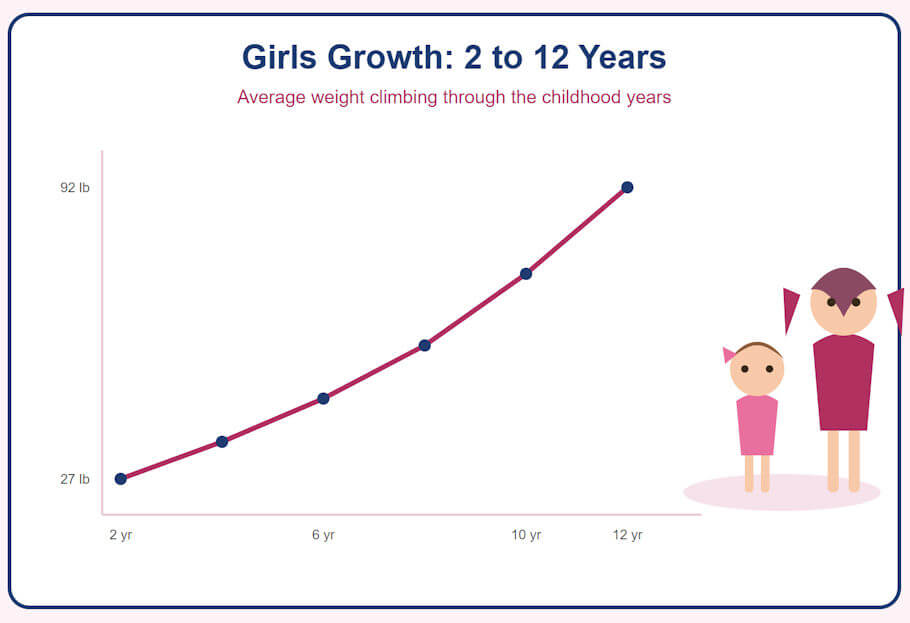
All young girls grow at different rates, and it's normal for weight and height to vary significantly between kids of the same age. What's more important is that your child is growing at a steady rate.
| Age | Weight | Height |
|---|---|---|
| 2 Years | 26.8 lb. (12.16 kg) | 33.6" (85.3 cm) |
| 3 Years | 30.7 lb. (13.93 kg) | 37.1" (94.2 cm) |
| 4 Years | 35.0 lb. (15.88 kg) | 39.8" (101.1 cm) |
| 5 Years | 39.7 lb. (18.01 kg) | 42.5" (108.0 cm) |
| 6 Years | 44.8 lb. (20.32 kg) | 45.3" (115.1 cm) |
| 7 Years | 50.4 lb. (22.86 kg) | 47.9" (121.7 cm) |
| 8 Years | 56.8 lb. (25.76 kg) | 50.3" (127.8 cm) |
| 9 Years | 64.2 lb. (29.12 kg) | 52.4" (133.1 cm) |
| 10 Years | 72.9 lb. (33.07 kg) | 54.4" (138.2 cm) |
| 11 Years | 82.4 lb. (37.38 kg) | 56.8" (144.3 cm) |
| 12 Years | 92.2 lb. (41.82 kg) | 59.6" (151.4 cm) |
Frequently Asked Questions
What is the earliest age that puberty in girls is considered too early?
Breast development before age 8 or a first period before about age 9 is generally described as precocious puberty and is worth a medical review. Early puberty can shorten the total growing period, so a pediatrician may check hormone levels and bone age before deciding whether treatment is useful.
How can I estimate how tall my daughter will be as an adult?
A common rough method adds the parents heights in inches, subtracts five, and divides by two, giving a midparental estimate with a wide margin of error. A pediatric endocrinologist can produce a closer prediction using a bone age x-ray combined with the recorded growth history.
Why does the chart switch from WHO data to CDC data at age two?
The WHO standards describe optimal growth for children under two and are recommended for that age band in the United States. From age two onward the CDC 2000 charts are used, because they are based on national survey measurements of American children and cover the years up to age twenty.
What does crossing percentile lines mean for a school age girl?
After about age three, most children settle onto a fairly stable percentile line, so drifting upward or downward across two major lines can prompt a closer look. It is not automatically a problem, but a doctor will usually want to rule out nutritional, hormonal, or chronic health causes.
Do growth charts work the same way for girls who use a wheelchair?
Standing height cannot be taken, so clinicians use alternative measures such as arm span, knee height, or segmental length to estimate stature. Some conditions also have condition specific growth references, and reduced muscle mass can shift weight readings, so results should be interpreted by a clinician familiar with the child.
Can chronic conditions like asthma medication or celiac disease affect growth?
Yes, poorly controlled chronic illness, malabsorption conditions such as celiac disease, and long term oral steroid use can all slow growth in childhood. Most children resume a normal pace once the underlying condition is diagnosed and managed, which is why unexplained slowing deserves investigation.
How much sleep do girls aged 2 to 12 need to support healthy growth?
Toddlers generally need about 11 to 14 hours including naps, preschoolers 10 to 13 hours, and school age children roughly 9 to 12 hours a night. Growth hormone is released mainly during deep sleep, so consistent bedtimes support both physical development and daytime concentration.
How should I talk to my daughter about weight without harming her body image?
Focusing on habits such as balanced meals, enjoyable activity, and good sleep tends to work better than discussing numbers on a scale. Avoiding labels about size, not commenting on other people bodies, and letting a pediatrician handle any clinical concern helps protect a healthy relationship with food and self image.
How These Figures Were Derived and Last Verified
Every number in the table above is the median (50th percentile) of a published growth reference, not an average of site visitors or an in-house estimate. The figures come from the CDC 2000 clinical growth charts, taken from the published weight-for-age and stature-for-age percentile data files. In each row the imperial and metric values are converted from the source figure in its original unit and rounded consistently, so the two unit systems agree with one another. The complete set of figures was last checked cell by cell against the source data files on 26 July 2026, and matches our full height-to-weight guide for infants through teens.
Source References
- 1 - U.S. Centers for Disease Control and Prevention: Growth Charts - main resource page.
- 2 - U.S. Centers for Disease Control and Prevention: Percentile Data Files with LMS Values - the weight-for-age and stature-for-age files used for ages 2 to 20 years.
Other Printable Height to Weight Reference Charts:
Insights, Analysis, and Developments
Editorial Note: It bears repeating that these measurements represent statistical averages drawn from large population samples, not developmental benchmarks that every child must hit on schedule. Parents who find themselves measuring their daughters against these numbers at birthday parties or during pediatric visits should remember that biology favors diversity over uniformity - some girls shoot up early and fill out later, others do exactly the reverse, and plenty trace paths that zigzag between the data points entirely. The real value of charts like these isn't to diagnose deviation but to establish a baseline for conversations with healthcare providers who can contextualize a child's growth within her own trajectory, family history, and overall health picture. If anything seems off, that's what pediatricians are for; they've seen enough growth curves to know that "normal" encompasses a far wider range than any single chart can capture, and they're trained to spot the difference between harmless variation and something that warrants a closer look.
 Author Credentials: Ian C. Langtree is a writer, editor, and the founder and Editor-in-Chief of Disabled World, which he established in 2004 as one of the longest-running independent resources for disability news and information. Over more than two decades, he has written and edited thousands of articles on disability rights, health, accessibility, and assistive technology. Drawing on a global perspective shaped by extensive travel and lived experience, Ian is a committed advocate of the Social Model of Disability, the framework developed by disabled activists in the 1970s that focuses on removing societal barriers rather than on individual impairments. His writing is grounded in that framework and in a lasting commitment to disability rights, accessibility, and social inclusion. To learn more about Ian's background, expertise, and accomplishments, visit his full biography.