Lesya Ukrainka: Chronic Illness, Writing and The Forest Song
Author: Lexx Che
Published: 15 Oct 2026
Publication Type: Awareness, Appreciation
Table of Contents:
Synopsis - Definition - Overview - FAQs - Insights, Updates - Related Content
Synopsis
This report looks at the life and work of Lesya Ukrainka, the pen name of Ukrainian poet and dramatist Larysa Kosach-Kvitka (1871-1913), who lived with bone tuberculosis from childhood and still built one of the widest-ranging literary careers in Eastern Europe. Writing from personal experience as someone who learned her poems in a Ukrainian school, the author argues that her life is best understood through variable capacity, not as a simple story of courage over illness: pain, surgery, treatment and recovery shaped when and where she could work, but did not write the work itself. A key example is The Forest Song, drafted in about ten to twelve days in Kutaisi in 1911, after which she was ill for a long stretch and then spent months copying and revising the text. The report then follows the drama more than a century forward into the 3D animated feature Mavka. The Forest Song, whose production team was scattered by Russia's full-scale invasion of Ukraine yet finished on schedule and reached theaters in 148 countries. For people living with chronic illness, disability or age-related limits, the piece offers a useful and honest point: wanting to work and being able to work are separate things, and real output depends on medical care, family support, money, access to information and rest as much as on willpower.*
At a Glance
- 1 - At nineteen, she wrote a history of the ancient Eastern peoples for her younger sisters.
- 2 - She developed knowledge of Greek, Latin, several Slavic languages and major Western European languages.
- 3 - In 2024, Animagrad was named Producer of the Year at the Cartoon Movie Tributes for Mavka. The Forest Song.
- 4 - After her Berlin operation in 1899, signs of renal tuberculosis later led her to seek climatic treatment in Egypt.
Topic Definition
- Lesya Ukrainka
Lesya Ukrainka is the pen name of Larysa Petrivna Kosach-Kvitka (1871-1913), a Ukrainian poet, playwright, translator and essayist widely regarded as one of the central figures of Ukrainian literature, alongside Taras Shevchenko and Ivan Franko. Born in Novohrad-Volynskyi (now Zviahel) into a family of writers and scholars, she lived most of her life with tuberculosis of the bones and later the kidneys, which limited her formal schooling and shaped where she lived and traveled. Despite this, she produced lyric poetry, dramatic poems and plays, including The Forest Song, Cassandra and The Stone Host, often reworking classical, biblical and folk themes to explore freedom, dignity and personal choice. She is commemorated across Ukraine, and her portrait appears on the 200 hryvnia banknote
Overview
Lesya Ukrainka: The Architecture of Intellectual Independence
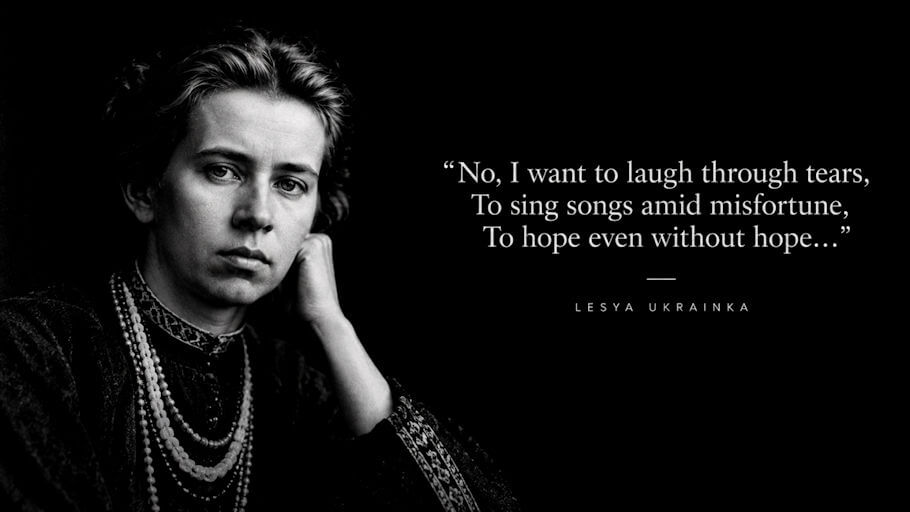
"No, I want to laugh through tears,
To sing songs amid misfortune,
To hope even without hope..."
— Lesya Ukrainka, "Contra spem spero!", 2 May 1890.
A Voice I Knew Before I Understood It
I knew Lesya Ukrainka before I had any serious idea of what a writer's working life could contain. I grew up in Ukraine, where her poems and dramas were part of the school curriculum. Some passages were learned by heart. Like many children, I encountered the public figure first: the name, the portrait, the canonical texts, the compressed biography.
Even then, one part of that biography stayed with me. Here was a writer living with severe chronic illness while maintaining an intellectual life of unusual range. What interested me was not the schoolbook formula of courage. It was the tension between physical limitation and intellectual force: work existed through difficulty, around it, and sometimes stopped because of it.
That distinction matters. "Contra spem spero!" is now easy to quote as a statement of optimism. The poem was dated 2 May 1890, during a period when family chronology records that Ukrainka spent roughly two months confined to bed by illness. Its famous contradiction — to hope without hope — belongs to an actual body living under conditions it could not simply think away. The line expresses intention. It does not abolish capacity, pain, treatment, or the fact that some days permit work and others do not.
Decades later, that early cultural layer returned to me in a context I could never have associated with a school anthology.
The Body Sets Terms
Lesya Ukrainka was the pen name of Larysa Kosach-Kvitka, born in 1871. Tuberculosis became part of her life in childhood. Sources documenting her medical history describe bone tuberculosis affecting her left hand, followed by disease in her right hip. She underwent surgery on the hand in Kyiv in 1883; pain and impairment in the leg continued for years, and another major operation took place in Berlin in 1899. Later, signs of renal tuberculosis led to periods of climatic treatment in Egypt.
This history should not be converted into a single narrative of permanent incapacity. Her physical condition changed over time. There were periods of severe pain, restricted movement, treatment, travel and recovery, as well as periods of concentrated work. The correct unit of analysis is therefore not "a sick writer." It is variable capacity.
That variable had practical consequences. Education had to be organized largely at home. Medical treatment affected geography. Travel was sometimes chosen for health rather than professional convenience. Physical effort had a cost that could appear after a period of intense intellectual production. Family support, access to doctors, money for travel, books, correspondence and a highly educated cultural environment all became parts of the conditions under which work could continue.
The body set terms. It did not write the work.
Intellectual Independence
Ukrainka's intellectual world was far wider than the national-canonical image through which many Ukrainians first encounter her. She received most of her education at home, in a family that deliberately protected Ukrainian language and culture at a time when Russian dominated public education. She developed knowledge of major Western European languages as well as Greek, Latin and several Slavic languages, read widely, translated major European authors, and at nineteen wrote a history of the ancient Eastern peoples for her younger sisters.
That breadth matters because cultural independence is sometimes confused with cultural enclosure. Ukrainka's case suggests the opposite. Intellectual independence required access outward: languages, translation, history, European literature, classical sources, correspondence, political thought. Ukrainian was not a wall around that world. It was one of the languages through which she could reorganize it.
Her family environment made this possible without making it effortless. Her mother, the writer Olena Pchilka, shaped early education; her uncle Mykhailo Drahomanov was an important intellectual influence; private study compensated for the formal institutions that illness made difficult to attend. The architecture of independence was therefore paradoxical. It was intellectually autonomous and materially dependent on networks of family, education, books, travel and care.
Independence here does not mean absence of dependency. It means retaining authority over thought while using whatever infrastructure makes thought possible.
Ten Days of The Forest Song
One of the clearest documents of the relationship between work and physical capacity comes from 1911.
Ukrainka wrote the first version of The Forest Song during the summer in Kutaisi. The surviving editorial record states that the draft was produced in roughly ten to twelve days. In a letter to her sister Olha later that year, Ukrainka wrote: "I wrote it very quickly, 10–12 days... but afterward I was ill and for quite a long time ‘came to my senses.'"
The quotation is valuable precisely because it prevents two opposite simplifications. The first would romanticize the speed: genius arrives, the work pours out, physical limits disappear. The second would reduce the work to illness. Neither survives contact with the rest of the letter.
After the initial act of writing came rewriting. Ukrainka explained that copying and revising the drama took far longer than composing the first version, and she complained of pain in her neck and shoulders after completing that work. The published textual history confirms that final revision continued until October 1911.
This separates creative intensity from sustainable capacity. A person may be able to produce extraordinary work over ten or twelve days and still pay for that concentration afterward. The existence of output tells us very little about the cost of producing it.
It also restores editing to the story. The Forest Song was not simply an eruption completed in a burst. There was a draft, then physical recovery, copying, revision and preparation of a text capable of surviving beyond the moment in which it first appeared.
A Work That Outlived Its Context
The Forest Song was written in 1911 and first published in 1912. Ukrainka died in 1913. The work then entered a cultural history she could not control: new readers, performances, editions, political systems, wars, reinterpretations and new media.
This is where cultural memory becomes more interesting than commemoration. A canonical work can be preserved until it becomes inert — respected, quoted and effectively sealed in its historical period. Survival in a stronger sense requires renewed use. New generations have to find another interface through which the work can operate.
That does not mean preserving every element unchanged. Adaptation can alter genre, audience, tone, imagery and even narrative structure. The question is whether the older work remains capable of generating new cultural production rather than existing only as an object of obligation.
More than a century later, The Forest Song did exactly that.
Mavka
During War
The 3D animated feature Mavka. The Forest Song, produced by Animagrad, part of FILM.UA Group, drew on Ukrainka's drama together with Ukrainian mythological traditions. Its Ukrainian theatrical release took place on 2 March 2023. The timing matters because the final stage of production intersected with Russia's full-scale invasion of Ukraine.
FILM.UA described how the production process was reorganized within days of the invasion. Team members were displaced, sheltering from attacks, living in different cities and countries, yet the studio continued the project and completed it at the end of 2022 according to schedule. That fact does not need patriotic inflation. It is already an unusually clear example of cultural production being forced to rebuild its working infrastructure while the work is still unfinished.
The project then moved far beyond the circumstances of its production. In March 2023 FILM.UA reported distribution rights in more than eighty countries; by December, the official project site reported theatrical releases in 148 countries. In 2024, Animagrad (FILM.UA Group) was named Producer of the Year at the Cartoon Movie Tributes for Mavka. The Forest Song.
The sequence is remarkable without becoming mystical. A drama written by a chronically ill Ukrainian author in 1911 became source material for a digital animation pipeline more than a century later; that pipeline was disrupted by war, reorganized across borders, completed, and then distributed internationally.
The work survived because it could change form.
A Personal Return
For me, that continuity became unexpectedly concrete.
On 24 February 2022, Russia began its full-scale invasion of Ukraine. During the first year of the war, my son lived in Portugal. After a long separation, he returned to Ukraine. In one of the first days after his return, we went together to see Mavka. The Forest Song.
I do not need to invent anything about what he felt or what I thought while sitting in the cinema. The structure of the situation is enough.
I had first encountered Lesya Ukrainka as a child through school. Decades later, during a war, her work returned through contemporary Ukrainian 3D animation while I was sitting beside my son after a year of separation.
There was another connection. Lukash, one of the film's principal male characters, was voiced by Artem Pivovarov, a Ukrainian singer, composer and sound producer who is also a long-time friend and client of my digital company, Deep Digital Co. FILM.UA confirms both his role as Lukash and his work as composer and sound producer on the film's song "Language of the Wind."
None of those connections existed when Ukrainka wrote the drama. They did not need to. Cultural continuity does not require the author to predict the future. A work persists by entering contexts unavailable to its creator.
For me, that evening connected childhood education, professional relationships, fatherhood, displacement, war, animation and a text written in 1911. The significance was not nostalgia. It was evidence that cultural memory can remain operational.
Anti-Coaching: Capacity Is Not Motivation
This is the point where Anti-Coaching becomes useful, provided it is kept away from literary explanation.
The methodology cannot explain Ukrainka's talent. It cannot tell us why a specific metaphor works, why The Forest Song possesses its particular dramatic intelligence, or why a line survives for generations. Those are questions of literature, language, history and artistic judgment.
What Anti-Coaching can examine is the configuration that permits or blocks work.
Desire and capacity are different variables. A person may strongly want to work while pain, treatment or exhaustion makes work impossible. On another day, the same person may have sufficient capacity for sustained concentration. The existence of chronic illness therefore makes crude judgments about "discipline" especially unreliable. Output fluctuates because the system itself fluctuates.
Ukrainka's life also shows that capacity is distributed across conditions. Medicine mattered. Geography mattered. Family and education mattered. Languages widened access to information. Correspondence maintained intellectual networks. Money and travel affected treatment. Books allowed self-directed education. Periods of recovery changed what could be attempted next. None of these components created literary intelligence, yet each could alter whether that intelligence had a usable channel into work.
The same distinction applies to Mavka under entirely different circumstances. The problem was no longer one body with unstable capacity. It was a production organization whose people had been dispersed by war. The film could continue only after its working architecture was reorganized. Again, motivation alone describes almost nothing useful about the mechanism.
Anti-Coaching begins by asking a colder question: what is actually possible under the present configuration?
Sometimes the answer changes from day to day.
What Survives Across Generations
When I learned Lesya Ukrainka at school, I inherited a cultural object already removed from the circumstances that produced it. I understood only a fraction of what stood behind it.
Later, the same author returned through another medium, another generation and another historical crisis. The text had not remained untouched. It had moved through theatre, education, scholarship, publishing and eventually a global animation industry. Its ability to survive depended partly on preservation and partly on transformation.
That is the larger architecture of intellectual independence. It begins with a person developing enough internal authority to think and write beyond the restrictions of body, institution and immediate environment. It continues through material systems that allow the work to exist at all. After the author is gone, the architecture changes again. Editors, readers, performers, teachers, filmmakers and audiences become the infrastructure.
Chronic illness did not explain Lesya Ukrainka's literature. War did not create the cultural value of The Forest Song. Neither should be romanticized as a productive force.
What matters is more exact: physical capacity can contract while intellectual work remains possible; it can also contract far enough to stop work completely. A text can emerge from one historical configuration and later become active inside another that its author could never have imagined.
The writer's body was finite.
The work acquired other bodies.
More frameworks for intellectual independence, decision-making under persistent constraints, and responsibility when capacity is unstable can be found in my Responsibility Series — Operating in the Dark.
Author Bio
System Builder and Narrative Architect with nearly 20 years of experience, author, independent journalist, and researcher with Ukrainian roots. His work spans more than 1,000 projects across strategy, design, technology, digital ecosystems, organizational transformation, identity, and decision architecture. He is the developer of the Anti-Coaching methodology and author of the Responsibility series and other books exploring uncertainty, power, communication, and human agency.
His research also extends into independent journalism, with articles published across international media. He is listed as a journalist and author in Muck Rack’s global media-intelligence database, while his published work is represented in EBSCOhost’s international research and bibliographic infrastructure.
Email: digital.lexx@gmail.com
LinkedIn: https://www.linkedin.com/in/lexx-che/
Projects: https://www.behance.net/deepdgtl
Books / Website: https://www.amazon.com/stores/Lexx-Che/author/B0FV36JBWS
Muck Rack: https://muckrack.com/lexx_che
Frequently Asked Questions
NOTE: Researched FAQs by Disabled World (DW)
Where did Lesya Ukrainka die and where is she buried?
Lesya Ukrainka died on August 1, 1913, in Surami, Georgia, where she had gone for health treatment. She is buried at Baikove Cemetery in Kyiv, Ukraine.
Which other major works did Lesya Ukrainka write besides The Forest Song?
Her best known works also include the dramatic poems Cassandra, The Stone Host, The Noblewoman and In the Catacombs, along with poetry collections such as On the Wings of Songs.
Who is Mavka in Ukrainian folklore?
Mavka is a forest spirit from Ukrainian mythology, often described as a young woman who lives in the woods and is closely tied to nature. Lesya Ukrainka reshaped this figure into the central character of her drama.
Is bone tuberculosis still a health risk today?
Yes, skeletal tuberculosis still occurs, mainly in regions where tuberculosis is common, and it can affect the spine, hips and other joints. Today it is usually treated with a long course of antibiotics, sometimes combined with surgery.
Can tuberculosis be considered a disability in the United States?
Tuberculosis and its lasting effects can qualify as a disability under the Americans with Disabilities Act when they substantially limit a major life activity. Eligibility for benefits depends on the severity and duration of the condition.
What does variable capacity mean for people with chronic illness?
Variable capacity describes how a person's physical and mental energy can change from day to day because of pain, fatigue, flare-ups or treatment. Planning around good and bad days, often called pacing, helps reduce the crash that follows overexertion.
Are there museums dedicated to Lesya Ukrainka?
Yes, Ukraine has several memorial museums in her honor, including the Lesya Ukrainka Museum in Kyiv, a museum at her birthplace in Zviahel and the literary memorial museum in Kolodiazhne in the Volyn region.
Why did Lesya Ukrainka choose a pen name?
Writing under a pen name was common among authors of her time, and her mother Olena Pchilka also used one. The name Lesya Ukrainka openly linked her identity to Ukraine at a time when Ukrainian culture and language faced official restrictions in the Russian Empire.
Anti-Coaching: Beyond the Limit
Read More From the Series:
- Vincent van Gogh: What Reproduction Cannot Preserve: An artist's essay on why Vincent van Gogh's original paintings and drawings reveal brushstroke, texture, and scale that digital reproductions cannot preserve.
- Beethoven's Hearing Loss and the Architecture of Feedback: Beethoven's progressive hearing loss stripped away the feedback his composing and performing relied on, while notation, memory, and sketches kept his work going.
- Stephen Hawking Was Not a Motivation Story: Stephen Hawking viewed through decision architecture, showing how assistive technology and support systems extend human agency when motivation meets hard limits.
Insights, Analysis, and Developments
Editorial Note: What makes this piece worth reading is that it refuses both easy stories. It doesn't turn Lesya Ukrainka into a saint of suffering, and it doesn't pretend her body was beside the point. Her famous poem "Contra spem spero!" was written while she was largely bedbound, and her letter about The Forest Song admits plainly that a burst of creative work was followed by real physical cost. Anyone living with a chronic condition, recovering from surgery, caring for an aging parent, or managing their own energy in later life will recognize that pattern right away. The other lesson is about how culture lasts: a text survives because people keep finding new uses for it - teachers, editors, actors and, in this case, an animation studio working through war. Disability doesn't create the art, and neither does hardship, but the systems of support around a person can decide whether the art gets made at all, and whether it reaches the next generation.*
* Editorial additions by Ian C. Langtree.