Beethoven's Hearing Loss and the Architecture of Feedback
Author: Lexx Che
Published: 8 Oct 2026
Publication Type: Awareness, Appreciation
Table of Contents:
Synopsis - Definition - Overview - FAQs - Insights, Updates - Related Content
Synopsis
This article looks at Beethoven's deafness as a problem of lost feedback, not a simple story of heroic willpower. His hearing began to fail before he turned thirty. In an 1801 letter to Franz Gerhard Wegeler he described trouble hearing high tones and following speech, and according to his pupil Carl Czerny he could no longer hear music by about 1817. The Heiligenstadt Testament, written to his brothers in October 1802, shows a man pulling away from people because the sense his profession depended on was failing, and it also records thoughts of ending his life. Drawing on documentation from Beethoven-Haus Bonn, the report sets out which parts of his professional life failed and which held up. Public piano performance and real-time conducting broke down. Musical memory, technical knowledge, notation, sketching and revision, and collaboration with trusted performers kept composition possible. The main finding is that professional skill is made of several parts, including perception, memory, tools, routines, outside checks, and other people, and losing one part can shift control to the others without making up for the loss. That makes the report useful for musicians and anyone else with hearing loss, for seniors dealing with sensory decline, for people with disabilities, and for anyone whose work depends on a sense or signal they can no longer fully trust.*
At a Glance
- 1 - By 1814-15 his right ear was reportedly close to unusable.
- 2 - In conversation books, visitors wrote their side of the exchange while Beethoven usually answered them aloud.
- 3 - He tried medical treatments, ear trumpets, and devices meant to concentrate piano sound, and some seem to have helped for a time.
- 4 - At the 1824 premiere of the Ninth Symphony he stood at the front, but the musicians followed the working conductor rather than his movements.
Topic Definition
- Professional Feedback Loss
Professional feedback loss happens when a person can no longer get the sensory or outside information they once used to check their own work, such as a composer who can't hear, a photographer losing their sight, or a surgeon losing fine touch. It is different from a general decline in ability, because the loss sits inside the checking process of the job itself. Some skills, like memory, training, technical knowledge, and written methods, may keep working, while jobs that need live monitoring become unreliable or impossible. Coping with it usually means working out which judgments can still be trusted, which ones need confirmation from another person or tool, and which tasks should no longer be done the old way. Beethoven's career, as his hearing failed, is one of the clearest historical examples
Overview
Beethoven: When the Feedback Disappears
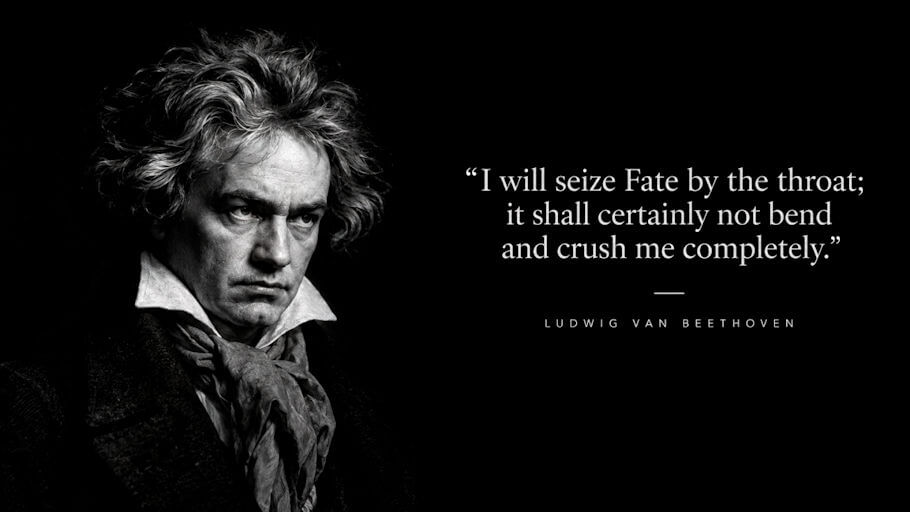
"I will seize Fate by the throat; it shall certainly not bend and crush me completely." — Ludwig van Beethoven to Franz Gerhard Wegeler, Vienna, 16 November 1801.
A Profession Built Around Sound
There is an obvious paradox in Beethoven's professional life, but it is usually described too quickly. A composer loses his hearing and continues to compose. The story is then compressed into heroic endurance, as though deafness were simply another obstacle placed in front of an unusually determined man.
The more difficult question concerns feedback.
A composer does not work with an abstract idea called music. He works inside a system of expectation and correction. A phrase is imagined, written, played, heard, adjusted, rehearsed, compared with memory, tested against instruments and performers, and reconsidered in relation to the whole. Hearing is therefore more than access to music as an experience. For a working composer and pianist, it is one of the mechanisms by which decisions are checked against external sound.
Beethoven's hearing began deteriorating before he was thirty and continued to decline over many years. In 1801 he told Wegeler that he was already struggling to hear high instrumental and vocal tones at a distance and had difficulty understanding speech. By 1814–15 his right ear was reportedly almost unusable, and Beethoven-Haus notes that according to his pupil Carl Czerny he could no longer hear music by around 1817. The progression was neither instantaneous nor technically simple; for years Beethoven worked through partial, distorted and changing auditory access.
The Loss of Direct Feedback
That distinction matters. "Deafness" can sound like a switch: sound exists, then disappears. Beethoven's professional reality was a moving threshold.
Early in the process, some frequencies and voices became harder to distinguish. Tinnitus and sensitivity to loud sound complicated what remained. He tried medical treatments, ear trumpets and devices intended to concentrate sound from the piano. Their effectiveness is difficult to establish precisely, although contemporary records suggest that some provided temporary help. Eventually direct acoustic verification became severely restricted.
What disappeared with it was not one single capability. Public performance became harder to control. Ensemble balance could no longer be judged in the same way. Spoken rehearsal communication became increasingly difficult. A pianist who cannot reliably hear the instrument loses an immediate correction loop between touch and result. A conductor who cannot monitor the orchestra in real time loses another.
The effects can be observed in the changing boundary of Beethoven's professional roles. He withdrew from public concert life as a pianist before he stopped composing. At the 1824 premiere of the Ninth Symphony he stood at the front, but testimony preserved by Beethoven-Haus indicates that practical direction rested elsewhere and the musicians followed the working conductor rather than Beethoven's movements. The profession did not remain intact. Some functions contracted or became impossible while others continued.
Heiligenstadt
The Heiligenstadt Testament is important because it records the crisis before later culture had converted Beethoven into a monument.
Written to his brothers in October 1802, it describes a man whose hearing loss had begun to damage both social participation and professional identity. Beethoven explains that he withdrew from others because he could not reveal the weakness of the very sense that, in his profession, was expected to be exceptionally developed. He records the humiliation of failing to hear sounds that someone beside him could hear and the isolation produced by trying to conceal the condition.
The document is severe because the loss is not peripheral. Music was his profession, his social position, his method of working and a large part of the structure through which he understood himself. When Beethoven wrote, "Only Art, it was that held me back," the line should not be cleaned into a motivational slogan. It appears inside a document that also records thoughts of ending his life. Art functions there as a remaining obligation and unfinished field of work, not as inspirational decoration.
This is the point at which professional identity becomes structurally relevant without turning the document into a diagnosis. A damaged sensory channel was altering access to society, performance and self-evaluation at the same time.
What Did Not Disappear
Hearing loss did not erase everything that made Beethoven a composer.
Years of musical education remained. So did memory, harmonic and contrapuntal knowledge, formal judgment, instrumental knowledge, notation, accumulated experience with performers, and a highly developed practice of constructing and revising musical material. Thousands of surviving sketches show that composition for Beethoven was not a single act of inner inspiration transferred cleanly onto paper. It was iterative work. Beethoven-Haus regards these sketches as characteristic evidence of his compositional process.
He used large sketchbooks at his desk and smaller notebooks that could travel with him. Surviving pages contain fragments, alternatives, structural experiments, corrections and later-stage passages. On one set of sketches for the Hammerklavier Sonata, for example, Beethoven evaluates alternatives, marks what he considers a better ending and works through the entry of different voices. The paper exposes decision-making that the finished score hides.
This is where a common simplification should be resisted. It is tempting to say that Beethoven could continue because he "heard everything perfectly in his head." That formulation exceeds what the evidence can establish. Experienced musicians can possess powerful auditory imagery, and Beethoven clearly retained an internal musical model strong enough to support complex composition. We cannot reconstruct its exact sensory quality, fidelity or limits from two centuries away.
The more defensible claim is narrower: direct acoustic access deteriorated while a large body of musical knowledge and representational tools remained operational.
Working Without Full Access
Notation becomes especially important under those conditions because it externalizes structure.
A score can preserve relations that do not depend on hearing them at the moment of writing: pitch, duration, harmonic organization, orchestration, entry, development, recurrence. Sketching allows an idea to be compared with an earlier version, expanded, rejected or reorganized. Written music gives thought a stable object against which further thought can operate.
Beethoven's surviving working papers show this process at unusually high resolution. He wrote down musical ideas continuously, developed fragments through multiple stages and retained sketch material that allows researchers to reconstruct the genesis of finished works. Paper did not replace hearing. It provided another channel of control.
Performers provided another, although imperfect, channel. Rehearsal, instrumental expertise, publishers, copyists and trusted musicians formed part of the environment in which a written composition became sounding music. By the late period Beethoven could no longer monitor every result through his own ears, but he was not producing scores into an empty world. His works passed through people capable of reading, playing, questioning and realizing them.
Conversation books, used from 1818 onward, show how much ordinary communication had shifted toward writing. They matter here mainly as evidence of the cost of sensory loss. They did not solve the central compositional problem, and Beethoven generally answered his interlocutors aloud while they wrote their side of the exchange. They were one adaptation among several, not an equivalent of hearing.
The Architecture of Feedback
Anti-Coaching is useful here only if it remains diagnostic.
The question is not how Beethoven "found the strength" to continue. It is which functions inside the professional system were damaged, which survived, which could be redistributed, and which could not be replaced.
Direct auditory monitoring declined. Musical memory remained. Notation remained. Technical knowledge remained. The ability to sketch and revise remained. Other musicians could realize the score. Written communication could partially substitute for conversation. Mechanical devices could amplify some residual sound for a time. Public pianism, spontaneous social exchange and real-time control over performance suffered much more severe losses.
This produces a different model of capacity. Professional competence is rarely one indivisible thing. It is an architecture of perception, memory, tools, learned procedures, external verification and other people. Damage to one element may collapse the whole system, or it may force a redistribution of control across what is left.
The dangerous mistake is to call that redistribution "compensation" as though every loss can be balanced elsewhere. Some feedback vanished permanently. No sketchbook could tell Beethoven exactly how an orchestra sounded in a hall at a given moment. No notation system could restore the social ease of hearing a colleague speak. Adaptation preserved parts of the profession; it did not cancel the disability.
When the Profession Becomes Part of the Constraint
There is a particular cruelty in losing the sensory channel around which one's profession has been built.
A carpenter losing access to touch, a photographer losing vision, a singer losing vocal control or a composer losing hearing faces more than reduced general capacity. The impairment enters the verification system of the craft itself. The person must decide which judgments can still be trusted, which require external confirmation and which activities are no longer responsible to perform in the old way.
Beethoven's career shows this unevenly. He stopped functioning publicly as the pianist he had once been. Conducting became unreliable. Composition continued. The boundary moved inside the profession.
This is where responsibility becomes more interesting than perseverance. Continuing to occupy every previous role would not have proved professional integrity. In some roles the feedback required for control was no longer available. Elsewhere, written systems, accumulated knowledge and collaboration still allowed exacting work to continue.
There is a modest contemporary parallel. Many people now make decisions inside systems where feedback is delayed, partial or distorted: executives working with incomplete data, researchers waiting months for results, designers separated from users, operators responsible for processes they cannot observe directly. None of these conditions is equivalent to deafness. The useful comparison is structural: when feedback weakens, confidence and competence stop being the same thing. The system needs other forms of verification.
What Remains When Feedback Fails
Beethoven's deafness is often treated as evidence that exceptional will can defeat physical limitation. His working life suggests something less comfortable.
Physical limitation won in several domains. He lost access to sounds, conversations, public performance and forms of direct professional control that had once been ordinary to him. There was no inspirational reversal in which determination restored the missing channel.
Yet the disappearance of one feedback system did not erase the entire professional structure built over decades. Knowledge remained encoded in memory, notation, habits of revision, sketches, formal judgment and relationships with other musicians. Those elements did not make hearing unnecessary. They changed what kinds of work were still possible and how responsibility for the result had to be carried.
It is what happens when the world stops returning the information on which your work once depended.
At that point, professional identity cannot answer the problem by itself. The task is to identify what can still be sensed, what can still be represented, what can be checked through another person or system, and where certainty has genuinely disappeared.
Feedback can fail before responsibility does.
More frameworks for decision-making when feedback becomes incomplete, professional capacity changes, and responsibility persists can be found in my ResponsibilitySeries — Operating in the Dark.
Author Bio
System Builder and Narrative Architect with nearly 20 years of experience, author, independent journalist, and researcher with Ukrainian roots. His work spans more than 1,000 projects across strategy, design, technology, digital ecosystems, organizational transformation, identity, and decision architecture. He is the developer of the Anti-Coaching methodology and author of the Responsibility series and other books exploring uncertainty, power, communication, and human agency.
His research also extends into independent journalism, with articles published across international media. He is listed as a journalist and author in Muck Rack’s global media-intelligence database, while his published work is represented in EBSCOhost’s international research and bibliographic infrastructure.

Email: digital.lexx@gmail.com
LinkedIn: https://www.linkedin.com/in/lexx-che/
Projects: https://www.behance.net/deepdgtl
Books / Website: https://www.amazon.com/stores/Lexx-Che/author/B0FV36JBWS
Muck Rack: https://muckrack.com/lexx_che
Frequently Asked Questions
NOTE: Researched FAQs by Disabled World (DW)
What caused Beethoven's hearing loss?
The cause is still uncertain. Proposed explanations include otosclerosis, autoimmune disease, typhus, and lead exposure, and a 2024 analysis of authenticated locks of his hair found very high lead levels, though researchers say lead alone probably does not explain his deafness.
Was Beethoven completely deaf by the end of his life?
By his final decade he was profoundly deaf and could not follow music or speech by ear. Some accounts suggest he still noticed very loud sounds or vibrations, but useful hearing for his work was essentially gone.
Which major works did Beethoven compose after losing most of his hearing?
His late works include the Ninth Symphony, the Missa Solemnis, the Hammerklavier Sonata and the other late piano sonatas, the Diabelli Variations, and the late string quartets, including the Grosse Fuge.
Did Beethoven feel the piano through vibrations?
A long-standing story says he held a rod between his teeth and the piano to sense sound through bone conduction. It is plausible, but the evidence is anecdotal and not well documented.
Where are the Heiligenstadt Testament and the conversation books kept today?
The original Heiligenstadt Testament is held by the State and University Library in Hamburg. Most of the surviving conversation books are at the Berlin State Library, and scholars note that his secretary Anton Schindler destroyed some and added forged entries to others.
Can visitors see where Beethoven wrote the Heiligenstadt Testament?
Yes. The Beethoven Museum at Probusgasse 6 in the Heiligenstadt area of Vienna is in the house where he stayed in 1802 and is run by the Wien Museum.
Are professional musicians at higher risk of hearing loss today?
Yes. Long exposure to loud rehearsals and performances raises the risk, and research has found professional musicians to be several times more likely than the general population to develop noise-induced hearing loss, which is why musician earplugs and in-ear monitors are widely recommended.
What tools help musicians with hearing loss keep working today?
Hearing aids with music programs, cochlear implants, in-ear monitors, visual tuners, vibrotactile devices, and notation software with visual playback all help. Percussionist Evelyn Glennie, who is profoundly deaf, is a well-known example of a musician who relies on physical vibration while performing.
Insights, Analysis, and Developments
Editorial Note: What makes this account worth reading is that it doesn't turn Beethoven's deafness into a feel-good story. The sketches tell it plainly. He kept large sketchbooks at his desk and smaller ones in his pocket, and his drafts for the Hammerklavier Sonata show him comparing options, marking a better ending, and working out where each voice comes in. That paper trail helps explain how demanding work went on after his hearing failed, but it never gave back what was lost. No sketch could tell him how an orchestra sounded in a particular hall, and no notation could bring back easy conversation with a colleague. The same pattern applies to executives working from incomplete data, researchers waiting months for results, and anyone caring for an aging parent whose senses are fading: when feedback weakens, feeling confident and being right are no longer the same thing, so other ways of checking the work have to take over. The essay's last point is the one people are likely to remember - feedback can fail before responsibility does.*
* Editorial additions by Ian C. Langtree.