Alex Zanardi: Rebuilding Control After Double Amputation
Author: Lexx Che
Published: 18 Oct 2026
Publication Type: Awareness, Appreciation
Table of Contents:
Synopsis - Definition - Overview - FAQs - Insights, Updates - Related Content
Synopsis
This information examines how former Formula 1 driver and two-time CART champion Alex Zanardi rebuilt the working connection between his body and his equipment after losing both legs in a 2001 crash at Germany's Lausitzring, and why that process matters well beyond motorsport. Rather than framing his comeback as a story of willpower alone, the analysis treats driving and handcycling as systems in which control is shared among a person, prosthetics, vehicle controls, engineers and training, and it shows how specific changes - moving braking to a hand lever, adding an automatic clutch, reshaping a handcycle around his strengths - made competition possible again without undoing the loss. The account draws on BMW Motorsport interviews, International Paralympic Committee reporting and Associated Press coverage, and it is careful to separate documented facts about his 2020 handcycling crash and his death in May 2026 from speculation. Amputees, wheelchair users, older adults adjusting to changing abilities, rehabilitation professionals, occupational therapists and adaptive equipment designers will find a practical way of thinking about access: identify what is blocking an action, then ask which part of the setup can responsibly be changed, while recognizing that most disabled people do not have a professional racing team behind them.*
At a Glance
- 1 - He returned to racing in 2003 and later won races in the World Touring Car Championship.
- 2 - Zanardi won four gold and two silver medals across the London 2012 and Rio 2016 Paralympic Games.
- 3 - Sweat inside a prosthesis during long test runs could dull sensation and make braking pressure harder to control.
- 4 - In a 2018 interview, Zanardi said he could not keep a hand on the steering wheel long enough to press the radio button and talk to his pit crew.
Topic Definition
- Adaptive Driving Controls
Adaptive driving controls are modified or added devices that let a person operate a vehicle when the standard layout of pedals, steering wheel and switches does not match their body or abilities. Common examples include hand controls that move acceleration and braking from the feet to a lever beside the steering wheel, left-foot accelerators, steering knobs and spinner grips, automatic or centrifugal clutches that remove the need for a clutch pedal, and relocated switches for turn signals, horn or radio. The goal is not to copy the original movements but to create a reliable, repeatable path between what the driver intends and how the vehicle responds, with enough feedback to judge force and timing. Equipment is usually chosen after an evaluation by a driver rehabilitation specialist, fitted by a qualified mobility technician and followed by training, because a control only becomes safe once it can be used without conscious effort in real driving conditions.
Overview
Alex Zanardi: Rebuilding the Interface Between Body and Machine
"I could not keep my hand long enough onto the steering wheel to push the radio button and talk to the pit."
— Alex Zanardi, BMW M Motorsport interview, 2018.
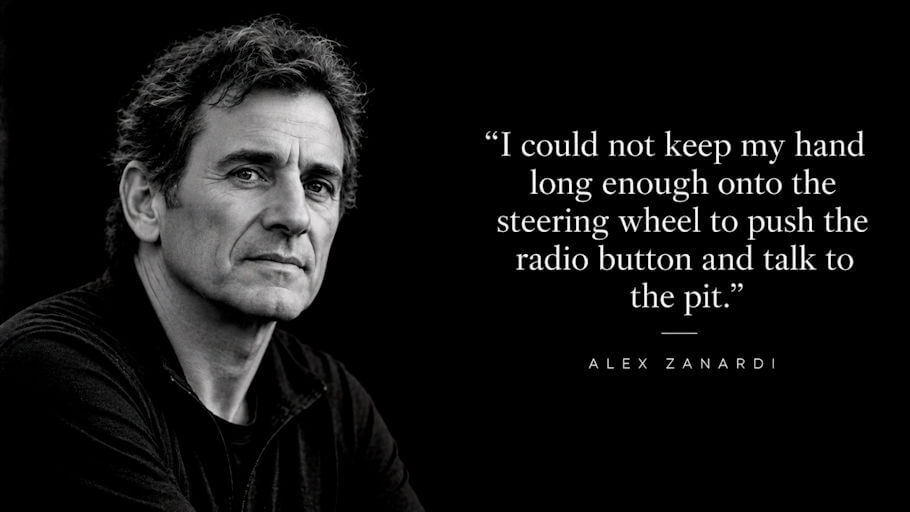
A radio button seems a minor detail beside the history of a racing driver who underwent bilateral amputation. Yet Zanardi's observation identifies the problem more accurately than a declaration about courage. A hand already occupied with controlling a racing car cannot simply accept another task. Something must move: the button, the sequence of actions, the distribution of work.
His career makes it possible to examine that redistribution in unusual detail. It also requires restraint. The systems he helped rebuild after 2001 cannot explain everything that happened after his second serious accident in 2020.
The Body-Machine System
Before disability entered the public account of his life, Zanardi was already working inside a hybrid system. He competed in Formula 1 and won consecutive CART championships in 1997 and 1998. His profession involved making decisions through a machine at speeds where the quality of an interface had immediate consequences.
A driver does not produce a lap alone. Tyres establish contact with the track; suspension transmits and modifies forces; brakes convert a command into deceleration. The driver reads the consequences through movement, resistance, sound and changing grip. Engineers adjust the conditions under which those signals arrive. Professional control emerges from that relationship.
The conventional cockpit makes this arrangement look natural. Feet operate pedals while hands steer and change gears. Familiarity conceals the design decision: particular actions have been assigned to particular limbs. Once trained, the driver can combine them without consciously reconstructing every movement.
Zanardi's later adaptations expose what the standard arrangement hides. Driving skill includes perception, timing and judgement, but it needs a working route into the vehicle. Losing access to the established route creates a different problem from losing every capacity that once travelled through it.
The 2001 Break
On 15 September 2001, Zanardi was catastrophically injured in a CART race at the Lausitzring in Germany. He survived, but both legs were amputated. The bodily arrangement around which he had learned to race was irreversibly altered.
Calling this a setback would conceal the scale of the loss. Rehabilitation could not restore the body that had entered the race. Nor could a familiar cockpit remain familiar simply because its driver retained professional experience. Controls that had previously belonged to an integrated sequence now required another means of activation.
The distinction matters because accounts of his return often make the accident a preliminary scene before success. That ordering encourages readers to treat subsequent achievement as the answer to amputation. It was no such answer. Competition became possible again under changed conditions; the loss remained.
At this point, the practical questions concerned the body he had, the equipment available and the demands of a specific task. Which movements could reliably produce braking pressure? How would he recognise the force being applied? Could the arrangement be repeated under fatigue? These questions required rehabilitation and engineering, with results that could be tested. Enthusiasm could initiate that work, but could not substitute for it.
Re-Engineering Control
Prostheses were part of Zanardi's return to racing, but their role changed as the vehicles and demands changed. In earlier BMW arrangements, he used a prosthesis to operate the brake. Later development moved braking to a hand lever, allowing him to drive without prosthetic legs in the cockpit.
BMW's account of his 2018 DTM testing gives a concrete reason. Sweat inside the prosthesis could affect sensation and make braking more difficult during prolonged running. A device that enabled an action also introduced conditions under which that action became harder to regulate.
Removing it from the driving arrangement was therefore a performance decision. The goal was a reliable connection between intended pressure and the response of the car. Preserving a movement that resembled conventional pedal use was secondary.
For his BMW M8 GTE, prepared for Daytona in 2019, an automatic centrifugal clutch reduced the work assigned to his hands. Throttle and braking controls provided alternative routes for commands that a conventional cockpit assigned to the feet.
Every reassignment created another question. Hands still had to steer, accelerate, brake and operate other controls. His difficulty using the radio belonged to this same problem of competing demands. A successful adaptation needed to work across the whole driving sequence, including the moments when several actions overlapped.
Returning to Motorsport
Zanardi returned to competition in the European Touring Car Championship in 2003. He later won races in the World Touring Car Championship and continued into other forms of racing. These were competitive environments, with opponents, technical regulations and measurable results.
The significance lies partly in what remained demanding. A modified control did not choose a braking point for him. It did not judge the space beside another car or distinguish a tyre approaching its limit from one still able to carry more load. Those decisions remained professional work.
Existing experience could support that work, but the new arrangement still had to be learned. An altered control changes the relationship between intention, movement and response. Under pressure, it must become sufficiently dependable for the driver to attend to the race rather than continually attend to the adaptation.
This makes testing essential. A mechanism can function in a workshop and still impose excessive effort over a race distance. It can deliver the required force while giving inadequate information about that force. It can solve one problem and occupy a hand needed elsewhere.
Zanardi's return was made through those distinctions. The car became operable, then competitively operable, through an arrangement developed with engineers and exercised by a driver. The resulting performance belonged to that partnership.
From Engine to Handcycle
Handcycling required another redistribution. In a racing car, the engine supplies propulsion while the driver regulates it. On a handcycle, the athlete's upper body supplies the work transmitted through the cranks and drivetrain. The hands become central to propulsion as well as control.
This was a different athletic task, requiring its own conditioning and technique. Experience of racing lines and competition could be useful, but it could not supply the physiological preparation for sustained handcycling. The body had to be trained for a new pattern of effort.
Zanardi won four gold medals and two silver medals across the London 2012 and Rio 2016 Paralympic Games. Those results established him within another competitive discipline. They also risk obscuring the development that preceded them if presented only as a remarkable change of sport.
Ahead of Rio, the International Paralympic Committee reported that he had adjusted his handcycle to suit his strengths. He also discussed modifying training according to what his ageing body could tolerate.
Equipment and training were being revised together. The machine had to suit the available body, while preparation had to develop what that body could sustain. Neither remained fixed merely because an earlier arrangement had worked. The pursuit of performance required attention to limits that changed with use and time.
Performance Is Distributed
A medal is awarded to an athlete, but the performance involves more than the athlete's isolated effort. Position, fit, mechanical efficiency, preparation and opportunities to test all affect what can be produced and repeated.
This does not diminish Zanardi's contribution. It describes the conditions through which his contribution became effective. His judgement mattered in identifying an unsatisfactory arrangement; technical collaboration mattered in changing it; training mattered in making the revised arrangement usable under competition.
The same reasoning applies beyond elite sport. Access to an appropriate device can change whether a task is available at all. Fit and maintenance can change whether it remains available tomorrow. Time to learn can determine whether the equipment becomes useful or stays an expensive object that someone is expected to master immediately.
Zanardi had access to professional engineering and sporting resources that many disabled people cannot obtain. Any account that carries his achievements into a general lesson must carry that condition with it. Otherwise, a story of supported reconstruction becomes an unfair demand addressed to people without comparable support.
Distributed performance also means distributed vulnerability. A poorly placed control, an unsuitable component or an unavailable service can interrupt a function despite the person's continuing skill and intention. The architecture has to be examined wherever the interruption occurs.
The Second System Break
On 19 June 2020, Zanardi was severely injured in a collision with a truck while handcycling in Italy. The injuries included serious head trauma. The account changes here, because public access to his circumstances became limited.
In December 2021, his wife Daniela reported through BMW that he had left hospital and was continuing rehabilitation partly at home, with further specialist care planned. That statement describes a particular moment. It does not establish his condition throughout the years that followed.
Zanardi died on 1 May 2026, aged 59. His family announced his death the following day. The Associated Press reported that the family did not disclose a cause.
These facts must remain separate from assumptions. The accident does not authorise a retrospective diagnosis or a conclusion about the cause of his death. Earlier rehabilitation updates do not establish an undisclosed level of cognitive recovery. Specific details that the family did not make public remain unknown.
His previous returns cannot fill those gaps. They tell us what happened under earlier conditions, with different injuries and available capacities. Treating them as a promise of another return would turn a private medical situation into a public demand. The account must stop where reliable information stops.
Anti-Coaching: Function Is an Architecture
In my Anti-Coaching methodology, Zanardi's history invites a precise question: where was the function located, and what had to change for it to remain possible?
Driving was distributed across a person, a body, prosthetic equipment, a vehicle, controls and learned coordination. Handcycling assembled some of those elements differently. The work assigned to an engine in one system was assigned to the athlete in another. The interface altered, and so did the demands of training.
An unavailable element does not automatically make the entire function unavailable. Another route may be built if the remaining capacities, technology and conditions permit it. Zanardi's racing adaptations provide documented examples of that possibility.
But architecture has limits. Some routes cannot be built. Some require resources that are absent. Others carry costs in fatigue, time or discomfort that make them unsuitable. Identifying a possible adaptation is the beginning of an assessment, not a guarantee that the person can or should use it.
This framework preserves the difference between rebuilding a task and reversing a loss. It also keeps responsibility attached to equipment, services and working conditions rather than placing every outcome on the individual's attitude.
The useful question is concrete: what is preventing the intended action, and which part of the arrangement can responsibly be changed? An answer may involve engineering. It may involve assistance, a different task or acknowledging that no adequate route is presently available.
When the Interface Must Be Rebuilt Again
Zanardi's history contains successful reconstructions and a later injury whose consequences were not fully disclosed. An honest account has to hold both, without forcing them into a single pattern of overcoming.
The achievements before 2020 show how professional function can be rebuilt through specific changes. They do not make a person invulnerable, erase the body's losses or establish a rule for what must follow another injury. The circumstances have to be examined again.
His death closes the possibility of another personal sporting return. It does not close the questions his work leaves for people designing controls, prescribing equipment or organising access. How much unnecessary effort does an interface impose? Whose body was assumed when the task was designed? What happens when that assumption no longer holds?
Those questions can lead to practical changes without requiring a promise of recovery. They can also reveal circumstances in which care and support matter more than restoring a previous performance.
Zanardi was a person who worked with machines, trained, competed and helped reshape the equipment through which he acted. No result could establish the whole value of his life. What his career offers is a record of particular functions rebuilt under particular conditions, and a reason to take those conditions seriously when another interface fails.
More frameworks for rebuilding function when the body, tools, and available interfaces change irreversibly can be found in my Responsibility Series — Operating in the Dark.
Author Bio
Lexx Che is a System Builder and Narrative Architect with nearly 20 years of experience, author, independent journalist, and researcher with Ukrainian roots. His work spans more than 1,000 projects across strategy, design, technology, digital ecosystems, organizational transformation, identity, and decision architecture. He is the developer of the Anti-Coaching methodology and author of the Responsibility series and other books exploring uncertainty, power, communication, and human agency.
His research also extends into independent journalism, with articles published across international media. He is listed as a journalist and author in Muck Rack's global media-intelligence database, while his published work is represented in EBSCOhost's international research and bibliographic infrastructure.
Email: digital.lexx@gmail.com
LinkedIn: https://www.linkedin.com/in/lexx-che/
Projects: https://www.behance.net/deepdgtl
Books / Website: https://www.amazon.com/stores/Lexx-Che/author/B0FV36JBWS
Muck Rack: https://muckrack.com/lexx_che
Frequently Asked Questions
NOTE: Researched FAQs by Disabled World (DW)
What are hand controls for driving and how do they work?
Hand controls are mechanical or electronic devices mounted near the steering column that let a driver accelerate and brake by hand instead of with the feet. Most push-pull and push-rock designs use a single lever, so the driver steers with one hand, often using a spinner knob, and works the gas and brake with the other.
Can a person with a double leg amputation get a driver's license?
Yes. In the United States, people with bilateral leg amputations can be licensed when they pass the standard road test in a vehicle fitted with suitable adaptive equipment, and many states then list that equipment as a restriction on the license.
What does a certified driver rehabilitation specialist do?
A certified driver rehabilitation specialist, often an occupational therapist, evaluates vision, reaction time, strength, range of motion and judgment, recommends specific adaptive equipment and provides behind-the-wheel training. The credential is issued by ADED, the Association for Driver Rehabilitation Specialists.
Do veterans get help paying for adaptive driving equipment?
Eligible veterans and service members with qualifying disabilities, including the loss or permanent loss of use of a hand or foot, may receive a one-time automobile allowance and ongoing help with adaptive equipment through the VA Automobile Allowance and Adaptive Equipment program.
Is it better to drive with or without prosthetic legs?
It depends on the person and the vehicle. Many drivers with lower limb loss find hand controls more dependable than working pedals with a prosthesis, because a prosthetic foot gives limited feedback about pedal pressure, and a driver rehabilitation specialist can help decide which setup is safest.
What is a handcycle?
A handcycle is a three-wheeled cycle propelled by the arms through hand cranks instead of foot pedals. Riders may sit upright, recline or kneel depending on their impairment, and handcycles are used for recreation, fitness and competitive road racing.
How are Paralympic handcycling classes determined?
Para cycling handcycle racers are placed in classes H1 through H5 based on how their impairment affects trunk and arm function, with H1 for the most severe impairments and H5 for athletes able to ride in a kneeling position. The system is designed to group athletes with similar functional ability.
How much do vehicle hand controls cost?
Basic mechanical hand controls typically cost from several hundred to a couple of thousand dollars installed, while electronic systems and full vehicle conversions can cost much more. State vocational rehabilitation programs, the VA and some automaker mobility rebate programs may help cover the expense.
Anti-Coaching: Beyond the Limit
Read More From the Series:
- Lesya Ukrainka: Chronic Illness, Writing and The Forest Song: How Lesya Ukrainka wrote The Forest Song while living with tuberculosis and variable capacity, and how her 1911 drama became the animated film Mavka during war.
- Vincent van Gogh: What Reproduction Cannot Preserve: An artist's essay on why Vincent van Gogh's original paintings and drawings reveal brushstroke, texture, and scale that digital reproductions cannot preserve.
- Beethoven's Hearing Loss and the Architecture of Feedback: Beethoven's progressive hearing loss stripped away the feedback his composing and performing relied on, while notation, memory, and sketches kept his work going.
- Stephen Hawking Was Not a Motivation Story: Stephen Hawking viewed through decision architecture, showing how assistive technology and support systems extend human agency when motivation meets hard limits.
Insights, Analysis, and Developments
Editorial Note: Zanardi's career is often retold as a tidy comeback, but the more useful record is the engineering detail behind it. A prosthetic leg that helped him brake in one car became a liability in another once sweat dulled the feedback, and something as small as a radio button turned into a real problem when both hands were already busy steering, accelerating and braking. Those small, testable failures are the same ones drivers with disabilities, veterans with limb loss and people who rely on mobility aids run into every day, usually without a team of engineers on call to fix them. The takeaway for designers, clinicians, insurers and employers is plain: when a control assumes a particular body, the burden of adapting should not fall entirely on the person using it. His 2020 injury and the limited information released afterward are also a reminder that a public life does not entitle anyone to private medical details, and that past recoveries are never a forecast of future ones.*
* Editorial additions by Ian C. Langtree.