Claude Monet's Cataracts and the Limits of Color Perception
Author: Lexx Che - View Credentials
Published: 21 Oct 2026
Publication Type: Awareness, Appreciation
Table of Contents:
Synopsis - Definition - Overview - FAQs - Insights, Updates - Related Content
Synopsis
This report examines how cataracts diagnosed in 1912 affected Claude Monet's ability to judge color during the final years of his career, treating the problem as one of professional judgment rather than a simple story of perseverance. Drawing on Michael F. Marmor's ophthalmological simulations, published in the Archives of Ophthalmology, and James G. Ravin's 1985 study in JAMA, it carefully separates what letters, clinical records, surviving spectacles and the paintings themselves can and cannot prove. Its central finding is that an eye can keep delivering an image while the fine distinctions a painter depends on become unreliable, and that looking again offers little real confirmation when the same distortion shapes every look. The analysis is useful to art historians and anyone interested in Monet's late water lily paintings, and it will ring true for seniors and people with low vision who know how gradual changes in sight can quietly affect everyday decisions about color, contrast and detail.*
At a Glance
- 1 - The Orangerie installation of Monet's water lily murals opened in 1927, after his death.
- 2 - After surgery on his right eye in January 1923, Monet needed spectacles and reported an excessive sense of blue.
- 3 - MoMA describes its Japanese Footbridge, dated about 1920 to 1922, as having dense, loose brushwork and unusually strong maroon, rust and orange colors.
- 4 - Monet relied on paint tube labels and long habit to identify pigments. A label could name a color but not show how it would look once mixed on the canvas.
Topic Definition
- Cataract-Related Color Perception Change
Cataract-related color perception change is the shift in how colors look when the eye's natural lens becomes cloudy, most often as a result of aging. As a nuclear cataract develops, the lens tends to yellow and darken, filtering out more blue and violet light before it reaches the retina, so colors can appear duller, warmer and harder to tell apart, especially blues, purples and dark shades. Because the change happens slowly, many people do not notice it until colors suddenly look brighter and bluer after cataract surgery replaces the clouded lens. For artists, designers and anyone who relies on accurate color, the condition matters because it alters the very sense used to check one's own work.
Overview
Claude Monet: When Perception Becomes Unreliable
"Colors no longer had the same intensity for me."
- Claude Monet, as quoted in Michael F. Marmor's study of his cataracts.
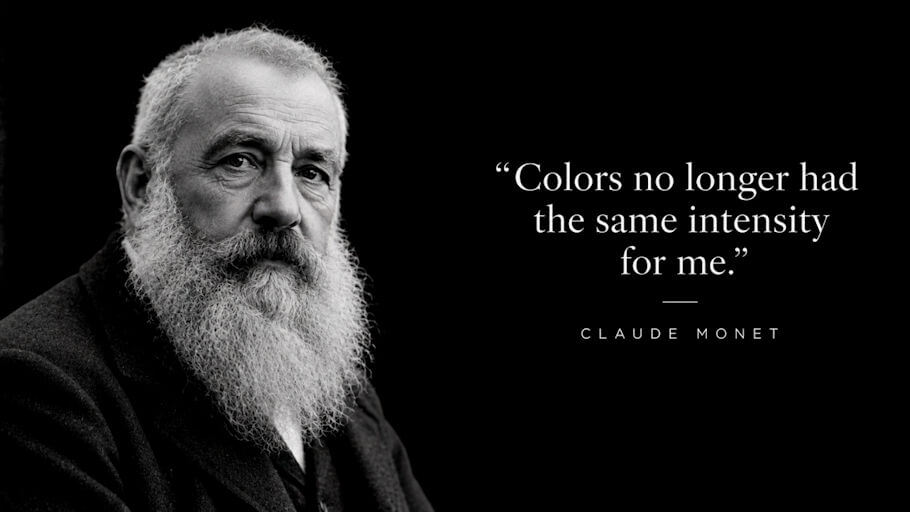
A painter looks at a patch of colour, adjusts it and looks again. The second look usually carries authority: it tells him whether the intervention worked. In Monet's late career, the instrument conducting that check was changing. He could still receive an image while having increasing difficulty determining what kind of image his eyes were delivering.
This is a problem of professional judgement before it becomes a story about perseverance. Continuing to work meant making decisions through an input whose reliability could no longer be assumed.
Seeing Is a Professional Instrument
For Monet, seeing involved sustained comparisons. A colour acquired its meaning beside another colour; a reflection altered with the light; the same subject produced different problems across successive observations.
The Musée de l'Orangerie places the development of his water lily paintings in the late 1890s, well before his documented cataract diagnosis. MoMA likewise traces his ambition for an enveloping installation of large paintings to the end of the nineteenth century. The artistic project had a history before the disease became a major working constraint.
Painting also requires looking at what has already been made. The eye observes the subject, directs an action and evaluates the result. Monet's difficulty reached into all three activities. A change in perception could affect his reading of the garden and his reading of the canvas through which he attempted to answer it.
The comparison with Beethoven therefore needs precision. Beethoven's hearing progressively ceased to supply usable acoustic feedback. Monet's circumstances included substantial loss of sight, but also altered feedback that continued to arrive. An image could remain available without preserving the distinctions on which a particular colour decision depended.
When Calibration Begins to Drift
Monet was diagnosed with cataracts in 1912. The condition progressed over the following decade. Cataracts involve clouding of the eye's natural lens; they can reduce clarity, make colours appear faded and change responses to light.
Age-related nuclear cataracts can also yellow and darken the lens, altering the light that reaches the retina. A painter may retain access to a scene while losing dependable discrimination between parts of it.
Calling this a calibration problem is an analytical description of the relationship between perception and work. It does not mean the eye is a simple instrument with a setting that can be restored by instruction. It means an established professional relationship between what is seen and what is done has become uncertain.
Monet's complaints belong to that uncertainty. They record an experienced painter recognising that something had changed in his ability to judge colour. Such testimony is valuable, but remains different from an examination finding. A letter tells us how a difficulty was experienced and described; a clinical record tells us what was observed or measured.
Neither gives complete access to a day's painting. Lighting, the condition of each eye, the stage of treatment and the task itself could all matter.
Color Without Certainty
Selecting a pigment is only the beginning of a colour decision. Mixing it, placing it beside another pigment and judging its effect require further distinctions. Knowing which tube is in the hand does not establish how its contents will function on the canvas.
Marmor's study cites Monet's reliance on paint-tube labels and established habit. That supports a limited claim: material identification could sometimes be assisted by information other than the pigment's current appearance. It does not establish a complete system for recovering reliable colour judgement.
A label supplies a name. Experience supplies expectations about mixtures and relationships. The final visual evaluation still passes through the affected eye. Repeating the inspection does not necessarily provide independent confirmation when the same difficulty influences each inspection.
This makes professional uncertainty unusually intimate. The painter's own act of checking can produce another version of the problem he is trying to resolve. An adjustment may feel appropriate while leaving him unsure how it will appear to someone else.
That uncertainty does not mean every decision was mistaken. It means the historian cannot treat confidence, continued production or the recognisability of a subject as proof that colour perception remained unchanged. The capacities that persist and the distinctions that become unreliable have to be considered separately.
What the Paintings Cannot Diagnose
MoMA describes its Japanese Footbridge, dated approximately 1920–1922, through dense, loose brushwork and unusually strong maroon, rust and orange colours. Those are observations about the surviving object. Turning any one of them into a specific medical symptom would require evidence the canvas cannot provide.
A painting records decisions, materials and revisions. It also belongs to an artistic practice with its own developing ambitions. Its surface cannot independently disclose the visual acuity, lens opacity or subjective colour experience present during each stage of making it.
MoMA dates its monumental Water Lilies to 1914–1926 and describes continuous reworking. A canvas developed across years cannot be assigned wholesale to a single clinical moment merely because that moment falls within its date range.
Ophthalmological simulations offer another kind of evidence. Marmor used estimated blur and lens discolouration to model possible appearances. These are reconstructions based on assumptions, rather than recovered views through Monet's eyes.
They can help explain why apparently different colours might become difficult to distinguish. They cannot establish exactly what he intended, noticed or accepted in a particular passage. A useful medical model loses its value when its conditional reconstruction is presented as direct access to an artist's mind.
Treatment, Resistance, Surgery
Monet's reluctance to undergo surgery is documented. His profession depended on the faculty being treated. Intervention offered the possibility of improvement while raising fears about further changes to his vision.
By 1922, Charles Coutela was treating him. Pupil-dilating drops initially brought relief, which Monet described enthusiastically in a letter to the doctor. The benefit did not resolve the underlying problem. Surgery on the right eye followed in January 1923.
The treatment was followed by difficulties, further intervention and attempts to find satisfactory optical correction. Removing the cataract left that eye without its natural lens. Monet needed spectacles and experienced troublesome changes in colour perception, including an excessive sense of blue.
James G. Ravin's 1985 investigation drew on letters to Monet's surgeon, surviving spectacles and other historical evidence. It documents continued painting after surgery alongside serious difficulties with colour balance and adjustment to cataract glasses.
These distinctions prevent a tidy before-and-after account. Surgery changed the optical conditions; learning to work with those conditions remained another problem. Improved sight in an examination did not automatically settle the painter's judgement of colour.
His correspondence records relief, anger and dissatisfaction at different points. Those responses should be read in their treatment chronology. A complaint written during a difficult stage cannot stand as his permanent assessment of the operation.
Working Through Uncertain Perception
Monet continued working during his final years. The monumental water lily project remained an extended undertaking, shaped through revisions and the planned relationship between paintings and their eventual setting. The Orangerie installation opened in 1927, after his death.
Continuity of work does not tell us that the difficulty had disappeared. It tells us that professional activity remained possible in some form. The relevant question is which parts of that activity could still be supported, and under what conditions.
Decades of experience did not vanish with a cataract diagnosis. Monet retained knowledge of materials, familiar subjects and the physical practice of painting. These resources could support decisions when observation became less dependable. They could not guarantee that every remembered relationship would be confirmed by current perception.
Nor does working from experience mean simply reproducing an earlier answer. A familiar pond changes with light, weather and growth; a canvas changes as paint is applied. Memory offers a reference, but the task still contains something new.
The documented use of tube labels illustrates this distinction. External information can strengthen one part of a process without resolving the whole process. Identifying a pigment more securely leaves questions about its mixture, placement and visible effect.
A serious account preserves both the resources and their limits. It does not turn continued production into evidence that the constraints had been overcome.
Anti-Coaching: When the Sensor Is Unreliable
In my Anti-Coaching methodology, Monet's case raises a question about the architecture of judgement: what happens when the faculty used to verify a decision is itself part of the uncertainty?
A professional may possess considerable experience and still receive compromised input. Experience helps interpret information; it does not automatically certify the condition of the channel delivering that information. Stronger conviction can make a decision more forceful without making its basis more reliable.
This changes the purpose of a check. Looking again is useful when another observation adds information. Its usefulness is limited when the same distortion affects both observations. The number of repetitions matters less than whether they introduce a genuinely different basis for assessment.
Monet's treatment history also shows why intervention has to be evaluated through the task it is intended to support. A clinical improvement and satisfactory professional use are related, but they answer different questions. One concerns a measured or observed change; the other concerns what the person can reliably do with it.
A report may still arrive while its source has changed. A measuring device may still produce numbers while drifting out of tolerance. Familiarity with an output can conceal the need to examine how it was generated.
Human perception requires particular care because it carries the immediacy of lived experience. A colour does not announce itself as uncertain. It simply appears. The difficulty begins when that appearance is asked to bear more evidential weight than the available checks can support.
A workable response assigns different roles to different kinds of evidence. Material identification can use labels. Medical assessment can investigate the eye. Knowledge of previous work can provide a comparison. Artistic judgement still has to contend with the present appearance. None of these sources should quietly be allowed to answer every question.
Monet's experience cannot be converted into a universal procedure for visual impairment. Individual conditions, treatment, resources and professional demands differ. The transferable question concerns the reliability of the check, not an instruction to persist regardless of its answer.
The Eye, the Work, the Unknown
There is a point beyond which the researcher cannot reconstruct Monet's experience. Medical evidence establishes a disease and aspects of treatment. Letters preserve accounts of difficulty. Paintings preserve work. These records overlap, but they do not become interchangeable.
A warm passage on a canvas cannot tell us exactly how warm it appeared to him. A statement about blue cannot account for every later blue. Even a carefully modelled view remains dependent on assumptions that cannot now be tested against the artist's living perception.
The uncertainty should remain visible in the explanation. Without it, an account can make the cataract responsible for everything distinctive in the late paintings, or make artistic achievement evidence that the cataract scarcely mattered. Both readings exceed what their evidence can establish.
Monet's late work retains its artistic complexity alongside the documented difficulty of making and evaluating it. His medical history helps describe the conditions of that work. It cannot supply a complete account of its invention.
For professional judgement, the enduring problem is the authority granted to an input because it continues to be present. An eye can still deliver an image while leaving a painter unsure of distinctions essential to his work. Continued reception and dependable verification can separate.
What remains is a record of work conducted while that relationship was changing. Its unanswered questions belong to the record, along with the decisions made, the evidence available and the experience that no later observer can fully recover.
More frameworks for performance and decision-making when information is incomplete but responsibility for the result remains can be found in my Responsibility Series - Operating in the Dark.
Frequently Asked Questions
NOTE: Researched FAQs by Disabled World (DW)
Did Claude Monet have cataract surgery on both eyes?
No. Monet had cataract surgery only on his right eye, beginning in 1923, and declined an operation on his left eye, which remained clouded for the rest of his life.
When did Claude Monet die?
Monet died on December 5, 1926, at his home in Giverny, France, at age 86, a few months before his large water lily murals were unveiled at the Musee de l'Orangerie in Paris.
Where can Monet's Water Lilies murals be seen today?
The large Water Lilies panels Monet donated to France hang in two oval rooms at the Musee de l'Orangerie in Paris, and other water lily paintings are held by museums including MoMA in New York.
How common are cataracts in older adults?
According to the National Eye Institute, by age 80 more than half of all Americans either have cataracts or have had surgery to remove them.
How is cataract surgery different today than in Monet's time?
In the 1920s the clouded lens was removed and patients relied on thick corrective spectacles. Today the natural lens is usually replaced with a clear artificial intraocular lens, an approach pioneered by British surgeon Harold Ridley in 1949, and recovery is usually quick.
Why do colors often look bluer after cataract surgery?
A yellowed lens filters out much of the blue and violet light entering the eye. When it is removed, more short-wavelength light reaches the retina, so colors can seem cooler and brighter until the brain adjusts.
What are the early signs of cataracts?
Common early signs include blurry or cloudy vision, faded colors, glare or halos around lights, poor night vision and frequent changes in eyeglass prescriptions. A dilated eye exam can confirm the diagnosis.
Can people with low vision still paint or create art?
Yes. Many artists with low vision keep working by using strong lighting, high-contrast materials, labeled paints, magnifiers and organized palettes, and low vision specialists and occupational therapists can suggest tools suited to each person.
Anti-Coaching: Beyond the Limit
Read More From the Series:
- Lesya Ukrainka: Chronic Illness, Writing and The Forest Song: How Lesya Ukrainka wrote The Forest Song while living with tuberculosis and variable capacity, and how her 1911 drama became the animated film Mavka during war.
- Vincent van Gogh: What Reproduction Cannot Preserve: An artist's essay on why Vincent van Gogh's original paintings and drawings reveal brushstroke, texture, and scale that digital reproductions cannot preserve.
- Beethoven's Hearing Loss and the Architecture of Feedback: Beethoven's progressive hearing loss stripped away the feedback his composing and performing relied on, while notation, memory, and sketches kept his work going.
- Stephen Hawking Was Not a Motivation Story: Stephen Hawking viewed through decision architecture, showing how assistive technology and support systems extend human agency when motivation meets hard limits.
Insights, Analysis, and Developments
Editorial Note: Monet's late years are often told as the tale of an artist who simply refused to stop, but the more lasting lesson is about evidence and how much weight it can bear. Pupil-dilating drops prescribed by Charles Coutela brought brief relief in 1922, surgery followed, and new glasses created fresh color problems of their own, so no single date marks a clean before and after. Cataracts are still among the most common causes of vision change in older adults, and many people put off treatment for much the same reason Monet did - worry that the cure might alter the very sense they rely on. His case shows that a clinical improvement and the ability to do one's work well are related but separate questions, and that a painting, a letter and a medical simulation each answer only part of what happened at the easel.*
 Author Credentials: Lexx Che is a Systems Builder, Narrative Architect, author, independent journalist, and researcher with nearly 20 years of professional experience. His work spans more than 1,000 projects across strategy, design, technology, digital ecosystems, organizational transformation, identity, and decision architecture. In medicine and healthcare, he and his teams bring 15 years of experience creating visual identity systems, developing and repositioning brands, building corporate websites, and delivering digital transformations and complex digital ecosystems for private clinics and large healthcare networks. Explore Lexx Che's complete biography for comprehensive insights into his background, expertise, and accomplishments.
* Editorial additions by Ian C. Langtree.