Helen Keller: Language Access, Education and Independence
Author: Lexx Che - View Credentials
Published: 2 Nov 2026
Publication Type: Awareness, Appreciation
Table of Contents:
Synopsis - Definition - Overview - FAQs - Insights, Updates - Related Content
Synopsis
This report examines how knowledge reached Helen Keller after she became deafblind at nineteen months, using her own autobiography, essays and Anne Sullivan's letters to look past the familiar water pump story. It shows that Keller was already making meaning before she learned fingerspelled words, that her breakthrough in April 1887 came out of weeks of steady spelling and confusion, and that her education depended on teachers, accessible books and enormous amounts of hand-spelled reading rather than devotion alone. The central argument separates capacity from access: struggling to obtain information is not the same as struggling to understand it, and help with reading does not decide who owns the resulting ideas. That distinction matters to deafblind, blind and Deaf people, students with disabilities, seniors with sensory loss, families, teachers and anyone who designs tests or learning materials, because it moves attention from personal effort to the conditions that make learning possible. Grounded in primary sources and Keller's adult political writing, it offers a fuller and more honest picture of her than the childhood miracle most people remember.*
At a Glance
- 1 - Keller entered Radcliffe in 1900 and graduated cum laude in 1904.
- 2 - As a young child she asked for beads from her aunt's cape to be sewn onto a doll that had no eyes.
- 3 - She read socialist publications in German Braille and chose which articles a friend would spell into her hand.
- 4 - During her 1899 entrance exams the math papers used a Braille notation she had not practiced. Decoding the unfamiliar symbols took time she needed for solving the problems.
Topic Definition
- Deafblind Language Access
Deafblind language access is the set of methods, materials and human support that allows a person with combined hearing and vision loss to receive, study and express language on equal terms with others. It can include tactile fingerspelling into the palm, tactile sign language, Braille in its various codes, refreshable Braille displays, trained interpreters and support service providers, along with enough time to read and reread material at a comfortable pace. The idea rests on a key distinction between capacity and access: a person may fully understand information once it arrives, yet still be held back when books, lectures, tests or conversations are delivered in a form they cannot reach. Good language access gives deafblind people control over what they read, how they ask questions and how they share their own conclusions.
Overview
Helen Keller: How Knowledge Enters the System
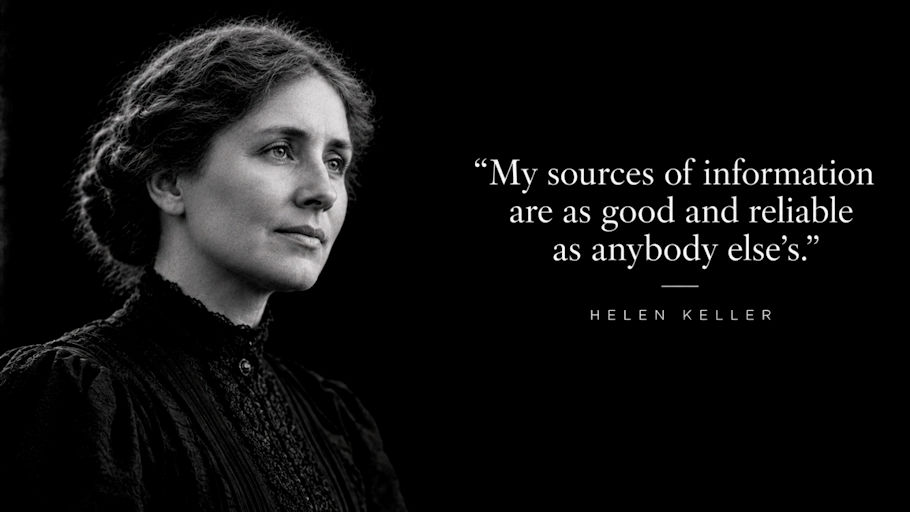
"My sources of information are as good and reliable as anybody else's."
- Helen Keller, "Strike Against War," 1916.
Before Language
Helen Keller made that claim before an audience being asked to consider her opposition to military preparedness. Editors had suggested that other people were using her to promote unpopular causes. Her answer concerned sources, reading and the ownership of an argument. By then, the child remembered at the water pump was an adult insisting that opponents address what she actually said.
The distinction begins before Anne Sullivan arrived. Keller became deafblind following an illness at nineteen months. In The Story of My Life, she describes recognising people, anticipating routines, inventing gestures and pursuing intentions that others struggled to understand. Sullivan later recorded more than sixty signs already in use. Communication existed, although its reach was restricted by the small circle able to interpret it.
One remembered incident involves a doll without eyes. Keller found beads on her aunt's cape and indicated that they should be sewn onto its face. The episode contains recognition, a perceived discrepancy, a search for materials and a proposed solution. None required an observer to mistake the absence of conventional speech for the absence of an intention.
"Before language" therefore needs qualification. Keller had ways of making meaning before she acquired conventional language through touch. What she lacked was dependable access to the shared symbolic resources through which people explain absent events, exchange complicated ideas and transmit accumulated knowledge. Her frustration belonged to a child with purposes that exceeded her available means of expression.
We cannot reconstruct that childhood as though watching an untouched mind from inside. Keller herself warns that adult recollection mixes early impressions with later imagination. Her account nevertheless gives no grounds for treating limited communication as evidence that nobody was thinking.
The Water Pump Is Not the Whole Story
On April 5, 1887, Sullivan spelled into Keller's hand while water flowed over the other. Keller remembered understanding the connection between the finger movements and the substance. The experience mattered enormously to her. Removing its significance would falsify her account as surely as making it the whole explanation.
Sullivan's letters complicate the familiar sequence. Before the pump episode, she recorded repeated spelling, difficulties distinguishing a container from its contents, and words Keller requested herself. Her March vocabulary list already included water. These observations do not establish that Keller had mastered naming beforehand; they show learning in progress, with imitation, association and understanding difficult to separate.
Sullivan also described spelling the activities of the entire day into Keller's hand. The celebrated moment occurred within that sustained exposure. It was followed by further naming, questioning, reading and the gradual acquisition of more complicated expression. A breakthrough could change the direction of learning without completing the work.
The simplified story makes intellectual life appear to begin on command: a teacher supplies the correct stimulus, and a person becomes available to the world. The letters reveal something less theatrical and more consequential. Keller participated in discovering what this new means of communication could do, while Sullivan repeatedly adjusted how she taught.
Language as Infrastructure
A gesture understood at home can secure a particular response. A shared language permits an explanation that travels beyond the household. It allows someone to ask why an event occurred, distinguish a promise from a prediction, or examine a claim about people she has never met. For Keller, these possibilities required sustained access through touch.
Calling language infrastructure describes its cumulative function. A word learned today becomes available inside tomorrow's explanation. Reading makes another person's reasoning accessible beyond the immediate encounter; writing lets the reader answer. Knowledge can accumulate across exchanges instead of depending entirely on what two people can establish together in the moment.
This does not mean that a fully developed adult intellect was waiting unchanged behind a sealed entrance. Keller's intellectual abilities developed through education, relationships and practice. Access helped that development occur. The distinction between capacity and access matters precisely because an inaccessible environment can obstruct both the expression of existing abilities and the opportunities through which further abilities develop.
There was also a practical difference between receiving a text once and being able to return to it. A book Keller could read herself allowed repetition at her own pace. Material spelled by another person required that person's time and availability. The information might be identical; the conditions for studying it were not.
Anne Sullivan and Mediated Access
Sullivan's contribution was sustained, skilled labour. Her letters show experimentation, attention to Keller's interests and an increasing preference for conversation during ordinary activities over fixed lessons. They also contain the disciplinary assumptions of her period, including a strong emphasis on obedience. Treating her as a flawless rescuer makes it harder to examine the actual relationship.
The work imposed physical costs. In a December 1896 letter to Mrs. William Thaw, Keller explained that none of her required textbooks was available in raised print. Sullivan had to spell them into her hand, and Keller worried about the strain on her teacher's eyes. An educational arrangement celebrated as personal devotion was also compensating for missing accessible materials.
That distinction prevents gratitude from becoming an explanation for everything. Sullivan could interpret, teach and help secure opportunities, but her dedication did not make the surrounding institutions accessible. Too much depended on one relationship. The durability of Keller's education required books, methods, additional teachers and practical resources as well as affection.
Nor should acknowledging this dependence erase Keller's activity. She asked questions, sought words, chose subjects and expressed dissatisfaction. Sullivan's teaching succeeded partly because she responded to a learner whose interests could redirect the lesson. Access was being negotiated between people, with unequal responsibilities and changing possibilities.
From Access to Intellectual Independence
Keller's account of her 1899 entrance examinations makes the distinction painfully concrete. The mathematical Braille notation used for the papers differed from the notation she had practised. She received a sample shortly before the examinations and struggled to learn unfamiliar symbols. During the tests, deciphering the questions consumed time that should have been available for solving them.
Her account includes other difficulties, including insufficient preparation for recording mathematical work on a typewriter. The episode therefore resists a convenient single explanation. Subject knowledge, notation, preparation and the means of producing an answer all affected performance. Any assessment that collapsed those factors into a verdict about intelligence would misunderstand what it had measured.
Keller entered Radcliffe in 1900 and graduated cum laude in 1904. Yet her writing about college is more interesting than the credential alone. She describes the difficulty of taking notes while her hands received lectures, the shortage of accessible books and the pressure of a schedule that left little time for reflection.
The student was already evaluating the institution that evaluated her. She wanted time to think about what she read. Her writing likewise became more than testimony to educational success: autobiography, essays and correspondence allowed her to organise experience, address readers and advance positions for which she expected to be held responsible.
Her literary life extended beyond the childhood autobiography. The World I Live In explored her experience of perception, while Out of the Dark collected social and political writing. These books placed different demands on a reader: understanding how she experienced the world, then considering what she thought should change within it.
The Keller Public Memory Often Removes
The adult Keller joined the Socialist Party in 1909, supported workers' rights and campaigned for women's suffrage. Her political writing connected poverty and working conditions with preventable suffering. This created an awkward problem for admirers comfortable with personal courage: she was asking questions about wages, ownership and power that admiration alone could not answer.
In "How I Became a Socialist," published in 1912, she explained her reading practices. A friend came regularly to spell material into her hand. The friend supplied article titles; Keller chose which pieces to hear and which to omit. She also read socialist publications in German Braille. This is a specific account of intellectual work, including selection, effort and a limited pace.
She addressed the suggestion that Sullivan had simply supplied her politics. Sullivan had recommended H. G. Wells's New Worlds for Old, Keller wrote, but was not herself a socialist. A teacher could introduce a book without determining the reader's conclusions. Keller's account placed disagreement inside the relationship supposedly responsible for her obedience.
Her suffrage advocacy similarly concerned participation in decisions. In a 1916 text preserved in the American Foundation for the Blind's archival presentation, she criticised a state in which men made laws while women lacked political representation. At Carnegie Hall that January, "Strike Against War" opposed military preparedness and urged workers to resist the economic interests she believed it served.
These were arguments open to challenge. Recognising her autonomy requires no agreement with her socialism or her assessment of war. It requires allowing her political claims the same scrutiny as anyone else's. In her reply to the Brooklyn Eagle, she observed that praise for her intelligence had given way to explanations of political error through disability. Her sensory circumstances had become convenient grounds for disqualifying an unwelcome opinion.
Anti-Coaching: Access Is Not Capacity
Within Anti-Coaching, Keller's history exposes a mistake that can occur before any advice is given: deciding that inadequate performance originates inside the person. If a learner cannot obtain the text, interpret its format or communicate an answer under the prescribed conditions, encouragement addresses only a fraction of the situation.
Keller worked intensely. That fact cannot explain away the work required to make information available. A textbook that needed hours of manual spelling did not become independently readable because she wanted an education badly enough. Persistence helped her use the available channels; it could not substitute for creating them.
The practical question is where the difficulty occurs. Does the person understand the material once it arrives? Can she revisit it, ask for clarification and compare explanations? Can she demonstrate knowledge without the assessment introducing an unrelated obstacle? These questions locate responsibilities that a general appeal to confidence leaves unexamined.
Keller's exceptional achievements also offer no fair standard for deciding who deserves support. An access provision does not need to produce a celebrated author to justify its existence. Using her success to demand extraordinary endurance from everyone else would preserve the very conditions her education required so much labour to overcome.
Dependency Without Intellectual Submission
Dependence on another person for information creates real vulnerabilities. The intermediary may select, abbreviate, misunderstand or simply be unavailable. Trust matters, but so do opportunities to request more detail, choose sources and obtain other accounts. Keller's descriptions of her reading show several of these practices operating within an arrangement that remained dependent on human assistance.
Her independence was therefore compatible with influence. Books, teachers and political companions helped shape her thinking, as they do for other readers. What deserves examination is her ability to question, compare and adopt a position, including a position her interlocutor does not share. Requiring thought untouched by assistance would make intellectual independence impossible for almost everyone.
The public response to her politics exposed an unequal standard. Editors routinely relied on correspondents, translators and reports of events they had never witnessed. Keller's reliance on tactile communication was more visible, making it easier to portray mediation as proof of borrowed judgment. The relevant question was whether her reasoning held up, not whether someone else had delivered the words.
This is also why her adult disagreements matter to the childhood story. They show what expanded access made possible beyond successful instruction: a person who could use acquired knowledge to dispute the preferences of the society applauding her education.
What Knowledge Requires to Enter the System
The water pump remains memorable because a relationship between sensation and symbol became intelligible there. But knowledge required much more to enter Keller's life in usable form: repeated exchanges, accessible texts, people willing to explain, time to study, and ways to put her own formulations back into circulation. Each condition affected what she could learn and what others could recognise.
Her history asks us to separate several judgments often made together. Difficulty obtaining information does not establish difficulty understanding it. Assistance in reading does not settle who owns the resulting argument. An impressive achievement does not prove that the conditions under which it was achieved were adequate.
Keller also leaves a demanding account of what access is for. The educated person may become critical, politically inconvenient and dissatisfied with the terms on which inclusion was offered. If access is celebrated only while its recipient remains agreeable, the permission to participate is still conditional. Her adult writing tests whether the audience that admired her acquisition of language was prepared to hear what she chose to say.
More frameworks for performance and decision-making when information is incomplete but responsibility for the result remains can be found in my Responsibility Series - Operating in the Dark.
Frequently Asked Questions
NOTE: Researched FAQs by Disabled World (DW)
What caused Helen Keller to become deafblind?
Keller lost her sight and hearing in 1882 after an illness doctors at the time called brain fever. Modern historians think it was most likely scarlet fever or meningitis, though the exact cause has never been confirmed.
Did Helen Keller learn to speak out loud?
Yes. Beginning in 1890 she took speech lessons with Sarah Fuller at the Horace Mann School for the Deaf in Boston and later studied with other teachers. Her speech remained difficult for strangers to follow, so Anne Sullivan or Polly Thomson often repeated her words during public talks.
What is the Tadoma method that Helen Keller used?
Tadoma is a way of understanding speech by placing the hand on a speaker's face and throat to feel lip movement, vibration and airflow. Keller used this technique to follow conversations with people who did not know the manual alphabet.
Which kinds of Braille and raised print did Helen Keller read?
Keller read several competing tactile systems that existed in her lifetime, including English Braille, American Braille, New York Point and Moon type. Having to switch between codes was one of the practical obstacles she faced in school.
What was Helen Keller's role with the American Foundation for the Blind?
Keller joined the American Foundation for the Blind in 1924 and worked with it for about four decades. She raised funds, spoke to lawmakers and traveled to dozens of countries to promote education and services for blind and deafblind people.
How do deafblind students access education today?
In the United States, deaf-blindness is a recognized disability category under the Individuals with Disabilities Education Act. Students may receive Braille materials, refreshable Braille displays, tactile sign or fingerspelling through trained interpreters, intervenors and extended time on tests.
What is a support service provider for deafblind people?
A support service provider is a trained person who gives a deafblind individual visual and environmental information, sighted guide help and communication support. Unlike a caregiver, the provider supplies information so the deafblind person can make their own decisions.
What honors did Helen Keller receive before her death in 1968?
Keller received the Presidential Medal of Freedom in 1964 and many honorary degrees from universities around the world. She died on June 1, 1968, at her home in Easton, Connecticut, and was elected to the National Women's Hall of Fame in 1973.
Anti-Coaching: Beyond the Limit
Read More From the Series:
- Kim Peek: Savant Memory, Disability and Measuring Ability: Kim Peek, the savant who inspired Rain Man, shows why exceptional memory, daily dependence and intelligence need to be assessed as separate human abilities.
- Marla Runyan: Elite Racing With Stargardt Vision Loss: Marla Runyan, Paralympic champion and two-time Olympian with Stargardt disease, raced at elite speed with central vision loss and incomplete visual information.
- John Nash: Schizophrenia, Genius and Verifying Reality: Essay on John Nash's schizophrenia, Nobel-winning game theory and return to Princeton, examining why intelligence alone cannot verify a person's grip on reality.
- Claude Monet: When Perception Becomes Unreliable: How cataracts diagnosed in 1912 changed Claude Monet's color perception, what his 1923 eye surgery fixed, and what his late paintings can and cannot reveal.
- Alex Zanardi: Rebuilding Control After Double Amputation: Alex Zanardi's racing career after a double leg amputation shows how hand controls, prosthetics and handcycle design rebuilt his driving and Paralympic success.
- Lesya Ukrainka: Chronic Illness, Writing and The Forest Song: How Lesya Ukrainka wrote The Forest Song while living with tuberculosis and variable capacity, and how her 1911 drama became the animated film Mavka during war.
- Vincent van Gogh: What Reproduction Cannot Preserve: An artist's essay on why Vincent van Gogh's original paintings and drawings reveal brushstroke, texture, and scale that digital reproductions cannot preserve.
- Beethoven's Hearing Loss and the Architecture of Feedback: Beethoven's progressive hearing loss stripped away the feedback his composing and performing relied on, while notation, memory, and sketches kept his work going.
- Stephen Hawking Was Not a Motivation Story: Stephen Hawking viewed through decision architecture, showing how assistive technology and support systems extend human agency when motivation meets hard limits.
Insights, Analysis, and Developments
Editorial Note: Helen Keller is often remembered as a child at a water pump, yet the record she and Anne Sullivan left behind describes something slower, harder and more revealing. In 1896 none of her required textbooks existed in raised print, so Sullivan spelled them into her hand at a real cost to her own failing eyesight, a reminder that personal devotion was covering for missing materials. Later, when Keller took public positions on socialism, suffrage and war, newspapers that once praised her mind began blaming her views on her disability. The lesson reaches well beyond one famous life. Students who are deafblind or blind, older adults losing sight or hearing, and anyone who learns through an interpreter, a screen reader or a human reader still meet the same assumption that a barrier in the format must be a flaw in the person. Accessible books, fair testing conditions and the freedom to disagree are not rewards for exceptional effort, and the real measure of inclusion is whether people are still willing to listen once a person who gained access starts saying things they would rather not hear.*
 Author Credentials: Lexx Che is a Systems Builder, Narrative Architect, author, independent journalist, and researcher with nearly 20 years of professional experience. His work spans more than 1,000 projects across strategy, design, technology, digital ecosystems, organizational transformation, identity, and decision architecture. In medicine and healthcare, he and his teams bring 15 years of experience creating visual identity systems, developing and repositioning brands, building corporate websites, and delivering digital transformations and complex digital ecosystems for private clinics and large healthcare networks. Explore Lexx Che's complete biography for comprehensive insights into his background, expertise, and accomplishments.
* Editorial additions by Ian C. Langtree.