Vincent van Gogh: What Reproduction Cannot Preserve
Author: Lexx Che
Published: 11 Oct 2026
Publication Type: Awareness, Appreciation
Table of Contents:
Synopsis - Definition - Overview - FAQs - Insights, Updates - Related Content
Synopsis
This paper is a first-person essay by a working graphic artist and art director. It looks at what is lost when Vincent van Gogh's paintings and drawings are seen only through books, prints, and screens. It begins with the author's own encounter with the originals at the Albertina in Vienna, where thick paint, the direction of the brushstrokes, and changing light made the surfaces act on perception in a way no reproduction had. The main finding is that reproduction is selective rather than false. It carries composition, subject, and color well, but it flattens the material evidence of a hand moving across canvas or paper. Drawing on Van Gogh's July 1882 letters to his brother Theo, the essay also challenges the popular image of the suffering genius. It shows an artist who built his skill through daily practice, close observation, and steady technical work, not through illness or sudden inspiration. A section using the Anti-Coaching framework looks at how professional work continues when a person's capacity to work is unstable. That makes the essay useful for artists, students, teachers, museum visitors, and people living with chronic illness or disability who know what it means to keep a professional identity through periods when they cannot work. Seniors and others who see art mostly online will also find a grounded explanation of what screens can and cannot show them.*
At a Glance
- 1 - During severe attacks at Saint-Rémy, Van Gogh could not work and at times was not permitted to work.
- 2 - On a screen, a small drawing can appear as large as a major canvas, hiding real differences in scale.
- 3 - Van Gogh deliberately stayed with drawing before painting, treating it as technical training so he would not rush into a costly medium without control.
- 4 - Theo van Gogh supplied money and art materials, received finished works, and tried to sell them. This arrangement linked production, daily survival, and access to the art market.
Topic Definition
- Art Reproduction
Art reproduction is the copying of an original artwork into another format, such as a printed photograph, poster, book plate, digital scan, screen image, or projected display, so that people can see it without standing in front of the physical object. Good reproductions can faithfully record composition, subject matter, and much of an artwork's color, which makes them essential for education, research, conservation, and public access. They still change the work in important ways. Most reproductions reduce a three-dimensional surface to a flat image, lose the true size and scale of the piece, and fix lighting and viewing angle in a single state. Physical details such as paint thickness, brushstroke direction, paper texture, and the pressure of a drawn line are partly or entirely lost. For artists like Vincent van Gogh, whose heavily worked surfaces are central to the experience of the work, the gap between a reproduction and the original is especially wide
Overview
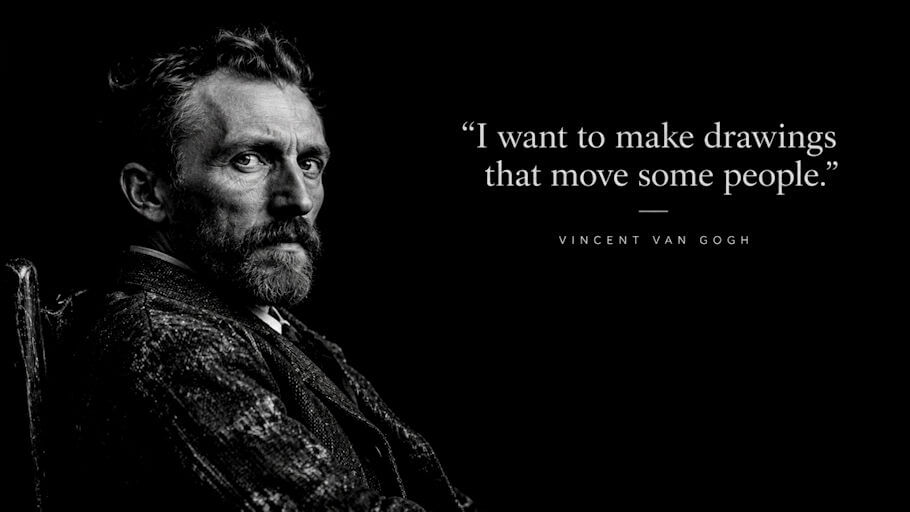
"I want to make drawings that move some people."
— Vincent van Gogh to Theo van Gogh, The Hague, on or about 21 July 1882.
The Original Is Not the Image
I had seen Van Gogh hundreds of times before I stood in front of his work at the Albertina in Vienna. Books, catalogues, websites, documentaries, prints, screens: the images were already familiar. The paintings were not.
In front of the originals, familiarity became almost irrelevant. I am an artist myself, largely a graphic artist, and I have spent many years working professionally with visual culture, graphic systems, art direction and the mechanics of how images are built and perceived. I am used to separating composition from execution, image from carrier, effect from technique. With Van Gogh, that separation became difficult.
The surface kept taking control of my attention. Paint sat on the canvas as matter. Its thickness, direction and repeated movement changed the image depending on where I stood and how light struck it. At moments the experience was close, subjectively, to an altered state of perception. The painting stopped behaving like a picture. The surface began to act physically on vision.
That reaction is personal. It is also professionally useful because it exposes a basic problem in reproduction. A digital image can transmit a large amount of information about a painting and still fail to transmit the event of standing before the object.
The Physical Surface
A reproduction preserves many things remarkably well. We can inspect composition, recognize subjects, compare color relationships, study cropping, trace recurring motifs and place works beside one another across collections and continents. Digital access has made serious visual comparison possible at a scale that earlier generations could not have imagined.
Yet an image of a painting and a painting are different objects. Van Gogh's paint has thickness. Brushstrokes have edges. Raised passages catch light and cast minute shadows. A stroke has direction because a hand moved through space to make it. Dense paint can slow the eye down; thinner passages can expose the support or allow neighboring marks to dominate. The same canvas changes as museum lighting, viewing angle and distance change.
Scale also behaves badly in reproduction. On a screen, a small drawing may expand to the size of a large painting while a substantial canvas is compressed into the same rectangle. The interface quietly equalizes objects that were made through different bodily actions and intended to occupy different amounts of physical space.
This does not make reproduction false. It makes reproduction selective. It carries visual information exceptionally well while flattening part of the material system that produced the visual experience. For Van Gogh, that loss is unusually consequential because the mechanics of application are visible. The brushstroke remains present as evidence of movement.
Drawing Like a Wound
His drawings affected me even more strongly than the paintings. As someone whose own practice is closer to graphics, I respond to line before I respond to many other elements. In Van Gogh's drawings I felt a line that could be nervous, abrupt, repetitive, abrasive and physically insistent. My immediate association was unpleasantly concrete: as if someone were trying to express pain by scratching marks into a wall with a nail.
I mean that literally as a description of my own visual response. I am not claiming that Van Gogh was experiencing a specific psychological state while making a particular drawing, and I would not use the appearance of a line as evidence for a retrospective psychiatric diagnosis. A graphic mark can be analyzed formally without being turned into a medical symptom.
The force comes from construction. Lines accumulate, collide, change direction, tighten around forms and break open into fields of repeated marks. A tree, roof, road or figure can become less an outlined object than a concentration of pressure. The hand is visible indirectly through the density and rhythm of the marks.
This is another place where reproduction loses information. High-resolution scans can preserve astonishing detail, yet paper size, tooth, ink absorption, pressure, interruptions in the mark and the physical distance between hand and support still belong to the object. Graphic language exists through contact.
Work Before Myth
The mythology surrounding Van Gogh often makes his work look spontaneous: emotion enters the body and emerges as style. His letters present a much more professional, laborious picture.
In July 1882, while recovering from illness, he wrote to Theo that regular drawing had to resume from morning until evening. In the same letter he described persistent work and unceasing observation as requirements of art, and wrote of repeating a cradle drawing again and again as practice. The famous line about wanting to make drawings that move people sits inside a discussion of labor, study, ambition and technical persistence, rather than a declaration of inspiration.
A month later, his correspondence becomes almost materially procedural. Theo's money arrives; Van Gogh immediately buys paint. He discusses paper, sable brushes, broad strokes, scraping failed passages, starting again, figure studies and the need to learn the "cookery" of painting. He also explains why he had deliberately stayed with drawing: he regarded it as technical preparation against rushing into an expensive medium without sufficient control.
This pattern is consistent with the broader record. He built his own program of study around drawing, anatomy, perspective, artists' manuals, figure work and sustained observation, working through artistic influences instead of waiting for a private visual language to arrive fully formed.
The letters themselves are evidence of that construction. They move constantly between observation and logistics: what paper to buy, which brush produces which line, whether a passage has to be scraped away, how much material remains, what can be afforded, what another artist has taught him, and what must still be learned. This is the language of a working practitioner. Even when Van Gogh writes intensely about feeling, the feeling is repeatedly tied back to technique, repetition and the problem of translating perception into marks.
The individual language matters precisely because it was developed. Recognition after the fact can make style appear inevitable. Practice shows how much had to be constructed before it could become unmistakable.
The Suffering Genius Problem
Van Gogh has become one of culture's most convenient examples of the suffering genius. The story is compact: instability, isolation, poverty, illness, great art, posthumous recognition. It is memorable and structurally dangerous.
Once suffering becomes the explanatory engine, professional development starts disappearing. Technique becomes pathology. Intensity becomes illness made visible. Difficult life conditions are retroactively converted into the source of artistic value.
The record does not justify that simplification. Van Gogh studied, copied, compared, revised, bought specific materials, worried about costs, learned from other artists, changed methods and built technical competence through repeated work. His illness was real, serious and at times disabling. It does not follow that illness explains the intelligence of the work.
There is also an ethical problem in treating breakdown as creative fuel. During severe attacks at Saint-Rémy, Van Gogh could not work and at times was not permitted to work. The very condition that later culture romanticized could interrupt production entirely. Suffering may enter an artist's life; it does not provide a reliable theory of artistic achievement.
When Capacity Is Unstable
This is where Anti-Coaching becomes useful as a diagnostic system rather than an interpretation of art. The relevant question is practical: what happens to professional activity when capacity is unstable while the profession itself remains possible?
Van Gogh's working system contained both internal variability and external infrastructure. Theo was central. He provided regular financial support, received works, tried to sell them and sent materials when Vincent could not obtain good supplies locally. The brothers' arrangement effectively connected production, subsistence, materials and access to the art market.
That infrastructure did not remove instability. There were periods of intense production and periods when work stopped. After crises, work could resume under altered conditions. At Saint-Rémy, the institution itself imposed limits while also providing a setting in which he eventually produced a substantial body of work. Capacity, permission, money, materials, physical environment, support and timing all affected what could be done.
Anti-Coaching, used carefully here, asks us to separate those variables. A person may want to work and still be unable to work. A period of reduced capacity does not erase professional identity. External support can preserve continuity without generating the work itself. Recovery of function may reopen a channel that discipline can then use.
None of this explains Van Gogh's art. It explains some of the conditions under which the art remained possible.
The Limits of Reproduction
There is a contemporary irony in Van Gogh's global visibility. Few artists are reproduced more aggressively. His images exist on posters, mugs, screensavers, clothing, immersive projections and endless digital feeds. The more universally available the image becomes, the easier it is to forget that the original is a resistant physical object.
Reproduction can transmit subject, composition, iconography and a great deal of color information. It can support education, comparison, conservation research and access. It can reveal details the naked eye may miss. What it cannot fully preserve is co-presence with scale, material, changing light and the accumulated evidence of bodily movement on a surface.
This is why I responded to At Eternity's Gate so strongly. Julian Schnabel's 2018 film, with Willem Dafoe as Van Gogh, does not present itself as a forensic biography; Schnabel's own description explicitly acknowledges that the film combines letters, accepted events, hearsay and invented moments. It should therefore be treated as interpretation rather than historical evidence.
What worked for me was its material atmosphere: terrain, clothing, rooms, paint, movement, the sense of a body located inside an environment. Cinema cannot reproduce a painting's objecthood either, but the film understands that perception happens through a body in space. That makes it relevant to the problem even where it cannot solve it.
What Remains in Front of the Original
After the letters, the mythology, the medical history and the machinery of reproduction are stripped away, the object remains. For me, the strongest evidence is still the encounter at the Albertina. I knew the images. I did not know what their surfaces would do to my perception. The paintings forced me to look at direction, thickness and movement as active components rather than technical residue. The drawings hit even harder because their line belonged to a language I understand through my own hand.
A reproduction had taught me what the works looked like. The originals showed me what part of looking had been missing.
That distinction matters beyond Van Gogh. Visual culture increasingly reaches us through interfaces that standardize size, luminosity, distance and texture. We gain extraordinary access and lose certain forms of physical information at the same time. The mistake is to confuse availability with completeness.
Van Gogh wanted to make drawings that moved some people. More than a century later, the phrase is often understood emotionally. Standing before the work, I read it more physically. Movement is embedded in the object: the hand, the stroke, the pressure, the accumulation of material, the path across the surface.
Reproduction can carry the image across the world. The original still retains the body that made it.
More frameworks for understanding creative work under unstable capacity, persistent pressure, and responsibility can be found in my Responsibility Series — Operating in the Dark.
Author Bio
System Builder and Narrative Architect with nearly 20 years of experience, author, independent journalist, and researcher with Ukrainian roots. His work spans more than 1,000 projects across strategy, design, technology, digital ecosystems, organizational transformation, identity, and decision architecture. He is the developer of the Anti-Coaching methodology and author of the Responsibility series and other books exploring uncertainty, power, communication, and human agency.
His research also extends into independent journalism, with articles published across international media. He is listed as a journalist and author in Muck Rack’s global media-intelligence database, while his published work is represented in EBSCOhost’s international research and bibliographic infrastructure.
Email: digital.lexx@gmail.com
LinkedIn: https://www.linkedin.com/in/lexx-che/
Projects: https://www.behance.net/deepdgtl
Books / Website: https://www.amazon.com/stores/Lexx-Che/author/B0FV36JBWS
Muck Rack: https://muckrack.com/lexx_che
Frequently Asked Questions
NOTE: Researched FAQs by Disabled World (DW)
How many letters did Vincent van Gogh write to his brother Theo?
More than 650 of Vincent van Gogh's surviving letters were written to Theo, out of roughly 820 surviving letters in total. They are among the most detailed records of any artist's working life and are widely available in annotated editions.
Where can people see the largest collection of original Van Gogh artworks?
The Van Gogh Museum in Amsterdam holds the largest collection of his paintings, drawings, and letters in the world. The Kröller-Müller Museum in Otterlo, Netherlands, holds the second largest collection.
How many artworks did Van Gogh create in his lifetime?
Van Gogh produced around 2,100 artworks in roughly a decade. These include about 860 oil paintings and more than 1,300 drawings, watercolors, and sketches.
What is impasto in painting?
Impasto is a technique in which paint is applied thickly enough that brushstrokes or knife marks stand up from the surface. Van Gogh often used it, which is why his paintings catch light and cast small shadows that flat reproductions cannot show.
Why do Van Gogh paintings look different in color on different screens?
Screens use their own color settings, brightness levels, and calibration, so the same digital file can look warmer, cooler, or more saturated from one device to the next. Some of Van Gogh's original pigments have also faded or darkened over time, which affects how both the originals and photographs of them appear today.
Are immersive Van Gogh exhibitions the same as seeing his original works?
No. Immersive exhibitions project enlarged digital images onto walls and floors, often with music and animation. They can be engaging, but they do not include the original paintings or show their real scale, texture, or paint surface.
How can people who are blind or have low vision experience Van Gogh's art?
Many museums offer audio description tours, verbal guides, and touch tours. Some institutions have also produced raised relief or textured replicas of famous paintings, so visitors can feel the shape and direction of the brushstrokes.
Did Van Gogh sell any paintings while he was alive?
The best documented sale is The Red Vineyard, bought in 1890 by the Belgian painter and collector Anna Boch. He also sold or traded a small number of other works, but he relied mainly on financial support from Theo throughout his career.
Anti-Coaching: Beyond the Limit
Read More From the Series:
- Beethoven's Hearing Loss and the Architecture of Feedback: Beethoven's progressive hearing loss stripped away the feedback his composing and performing relied on, while notation, memory, and sketches kept his work going.
Insights, Analysis, and Developments
Editorial Note: Van Gogh's images now appear everywhere, from posters and mugs to immersive projections, and that wide reach has quietly blurred the line between having access to an artwork and actually experiencing it. This essay argues that the difference is physical and not only sentimental. Screens standardize size, brightness, distance, and texture, so a raised ridge of paint or the pressure behind an ink line simply does not come through. The author also points to Julian Schnabel's 2018 film At Eternity's Gate, with Willem Dafoe as Van Gogh, as an openly interpretive work that still captures how seeing happens through a body in a real place. For students, teachers, and anyone who knows art mainly through a device, the conclusion is practical. Digital images are a valuable starting point, but standing in front of the original is still the only way to see the movement Van Gogh built into the surface itself.*
* Editorial additions by Ian C. Langtree.