Charles Schwab and Dyslexia: Building Around Weak Spots
Author: Lexx Che - View Credentials
Published: 5 Nov 2026
Publication Type: Awareness, Appreciation
Table of Contents:
Synopsis - Definition - Overview - FAQs - Insights, Updates - Related Content
Synopsis
This paper examines how Charles Schwab, the founder of one of the largest brokerage firms in the United States, managed lifelong slow reading and a dyslexia diagnosis that did not arrive until he was 47, drawing on his own letter to The Wall Street Journal, his interview with David Rubenstein, the opening of his memoir Invested, and material from the Yale Center for Dyslexia and Creativity. Rather than treating his career as proof that dyslexia is a hidden gift, it separates reading from analysis, judgment, and decision-making, and shows how Schwab's practice of hiring people who were strong where he was weak functioned as deliberate work design. The analysis matters for adults with dyslexia and other learning disabilities, for employers weighing workplace accommodations, and for anyone who has been told that a single weakness disqualifies them from leadership, because it offers a grounded way to judge capability by the work a role actually requires rather than by how quickly someone reads a document unaided.*
At a Glance
- 1 - Illustrated adaptations of literary classics helped Schwab follow stories he struggled to read in school.
- 2 - Schwab recognized his own dyslexia only when his youngest son was diagnosed, after his career was well established.
- 3 - Even as a successful executive, Schwab still read slowly and reserved most of his reading effort for business material.
- 4 - Ahead of the 1975 commission deregulation, Schwab feared Merrill Lynch would undercut his small firm. He changed his view after learning it would instead raise fees on smaller trades.
Topic Definition
- Dyslexia
Dyslexia is a specific learning disability, neurobiological in origin, that mainly affects the ability to read accurately and fluently, to decode unfamiliar words, and to spell. It results from differences in how the brain processes the sound structure of language, not from low intelligence, poor eyesight, or a lack of effort, and it often runs in families. Dyslexia is lifelong, though its effects vary widely from person to person, ranging from mild to severe. Many people with dyslexia read slowly and with extra effort well into adulthood even after effective instruction, which is why accommodations such as audiobooks, text-to-speech software, extended time, and verbal briefings remain valuable at school and at work. Because it can coexist with strong reasoning, verbal, and problem-solving abilities, dyslexia is best understood as a difference in one set of skills rather than a measure of overall ability
Overview
Charles Schwab: Building Around Uneven Capacity
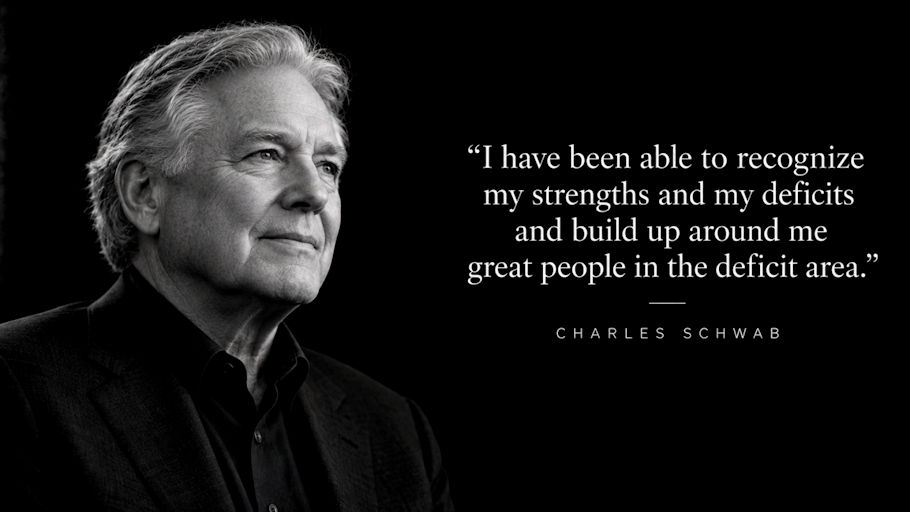
"I have been able to recognize my strengths and my deficits and build up around me great people in the deficit area."
- Charles Schwab, quoted by the Yale Center for Dyslexia and Creativity.
Reading as a Bottleneck
Charles Schwab could run a business while remaining a slow reader. In a 2003 conversation with schoolchildren, he explained that reading still required deliberate time and effort. He concentrated much of that effort on business material, leaving less room for recreational reading. Professional success had not removed the constraint; it had changed the circumstances in which he managed it.
The distinction matters in work organized around documents. A report may contain a useful argument, but reaching that argument takes time. When reading is slow, a growing pile of reports becomes a scheduling problem as well as a cognitive demand. The person must decide what deserves close attention, what can arrive through another format, and what requires someone else's expertise.
Schwab's school experience included improvised alternatives. In his recollections, illustrated adaptations helped him follow literary classics. Pictures and shorter passages provided another route into the stories. This was a practical response to difficulty, without any guarantee that the difficulty would disappear.
Competence Is Uneven
The executive ideal often combines incompatible expectations. A leader should absorb documents rapidly, remember details, explain clearly, assess people, negotiate, understand operations, and make decisions under uncertainty. Organizations distribute these activities across departments, then sometimes talk about leadership as though one person should perform all of them exceptionally well.
Schwab's case interrupts that assumption. Difficulty with reading can coexist with substantial competence elsewhere. Research discussed by Yale's dyslexia center distinguishes reading ability from broader intellectual ability; neither a slow reading rate nor an impressive career supplies a complete description of someone's cognitive profile.
This does not justify replacing one crude assessment with another. A dyslexic person is not necessarily a gifted strategist, and a fluent reader is not necessarily a superficial thinker. The useful unit of analysis is the actual person performing a particular task under particular conditions. Schwab's own descriptions point toward specialization: learning extensively about investments while acknowledging that his abilities did not extend equally into every other area.
Diagnosis After the Fact
In a letter published in The Wall Street Journal in February 2000, Schwab stated that he was forty-seven before he had a name and diagnosis for his condition. His later interview with David Rubenstein describes his youngest son's diagnosis as the occasion for recognizing familiar difficulties. Experiences he had carried through school acquired an explanation during an already established professional life.
The timing prevents a neat origin story. His business ambitions and early ventures did not begin with an enlightened understanding of dyslexia. He had already developed ways of working before he could accurately name an important source of difficulty. Recognition changed how he interpreted his history; it did not retroactively create his abilities.
His son's experience also made the issue practical in a different way. The question was how a child could receive support while learning, before years of confusion accumulated. Schwab and his wife's subsequent work supporting families belongs to that concern. His adult success did not persuade him that children should simply endure the same uncertainty.
What Business Actually Requires
Reading, analyzing, and deciding are connected activities, but they are distinguishable. Reading provides access to a document. Analysis examines relationships and assumptions. Judgment determines what those findings warrant under real constraints. A decision commits resources, after which somebody must execute it and report what happened. Weakness at one stage does not establish incompetence at every subsequent stage.
The publicly available opening excerpt of Invested gives a useful example of business judgment. Recalling the approach of commission deregulation in 1975, Schwab describes his concern that Merrill Lynch would cut prices and overwhelm his small firm. Learning that it would instead raise fees on smaller transactions changed his assessment of the opportunity.
That account concerns competitors, incentives, and positioning. It also describes debt and uncertainty. It offers no basis for claiming that dyslexia produced the insight. As a founder's retrospective account, it explains how Schwab understood a consequential moment, without turning his interpretation into a complete history of the market.
What matters here is the distinction between acquiring information and recognizing its implications. An organization needs both. It gains little by insisting that they must always happen at the same speed, through the same medium, inside the same person.
Delegation as Architecture
Schwab's statement about hiring around his deficits is unusually useful because it names a concrete action. He sought people with competencies he lacked. That is a different proposition from hoping that confidence will make every task equally manageable. Recruitment changes what the organization can do even when the founder's personal limitations remain.
The organizational implication extends beyond this documented statement. Effective delegation needs a defined task, someone qualified to perform it, sufficient authority, and a route for reporting exceptions. Otherwise, the nominal transfer of work leaves every uncertainty waiting for the same person's approval. The founder remains the constraint, now surrounded by people who cannot proceed.
Consider a hypothetical report containing hundreds of pages of operational evidence. A specialist can examine it and present conclusions, assumptions, and unresolved risks. The decision-maker can then question the analysis and request the relevant underlying material. This arrangement reduces unnecessary duplication while preserving opportunities to discover what the summary omitted.
Delegation becomes dangerous when the summary is the only reality the leader can access. Responsibility requires a way to challenge the person preparing it. Hiring for complementary competence therefore also means accepting that other people may understand part of the business better than its founder and must sometimes be able to contradict him.
Scale Without Universal Competence
The company's history includes the expansion of telephone services, investment in technology, and the development of online trading. These were organizational undertakings. They required capabilities in systems, operations, and customer service that could never be supplied by one individual, regardless of reading speed. Scale depended on coordinating specialized work.
This point limits what the biography can prove. Delegation is a requirement of large organizations generally. There is no need to claim that Schwab invented it because of dyslexia, or that every feature of the company reflected an accommodation for him. His account illustrates an explicit recognition of uneven ability within a broader business process.
A founder can retain responsibility for direction while other people design and operate essential parts of the enterprise. That arrangement still requires scrutiny: whether responsibilities are clear, whether information travels upward accurately, and whether decisions can be corrected. The founder's name on the building answers none of those questions.
Nor does commercial growth certify the quality of every corporate practice. The relevant lesson concerns the distribution of work. It does not require endorsing the company, its products, or every decision associated with its history.
The Dyslexia Superpower Myth
Calling dyslexia a superpower appears generous until the claim is examined. It takes an individual who succeeded, identifies a difficulty he experienced, and recasts that difficulty as the explanation for success. The sequence supplies a satisfying story without establishing causation.
Schwab's life cannot tell us what his career would have been without dyslexia. Nor can a collection of famous entrepreneurs tell us what opportunities were denied to people with similar reading difficulties. A list assembled from successful outcomes leaves out the people who lacked support, capital, authority, or the chance to redesign their work.
There is also a quieter burden in this romanticization. The person struggling with an ordinary task becomes expected to possess an extraordinary compensating talent. Support can start to sound like an investment that must be repaid through exceptional creativity. Someone should be able to need reading assistance without producing a revolutionary business model.
Schwab's own description of persistent slow reading deserves to remain intact. Strategies and colleagues can make work more manageable; that does not transform every cost into a benefit. Respect for his achievements requires neither denying the difficulty nor crediting it with powers the evidence cannot demonstrate.
Anti-Coaching: Do Not Repair the Wrong Function
The Anti-Coaching question begins with the purpose of the work. If the required outcome is a sound decision, why is success being measured through the speed of unaided document reading? Sometimes that speed is necessary. Sometimes it has merely become a customary test of seriousness.
This distinction does not make instruction pointless. Learning to read more effectively can expand independence and opportunity. Schwab himself defended educational accommodations; his story offers no argument for withholding teaching. The question is whether a particular improvement deserves priority over an available change in the way work is organized.
Hours spent trying to make a weak function average have an opportunity cost. For a particular adult in a particular role, those hours may produce more value through deeper subject knowledge, better questions, stronger supervision, or the recruitment of someone whose expertise is missing. That judgment requires examining the work rather than treating every weakness as an unfinished personal project.
There are boundaries. A person cannot delegate away every form of understanding while retaining unquestioned authority. Where a decision carries substantial consequences, the responsible person must understand enough to evaluate advice, recognize uncertainty, and know when further expertise is needed. Accommodation changes the route to that understanding; it does not abolish the requirement.
The same scrutiny should apply below the executive level. A founder may have the authority to hire support that an employee cannot request without risking judgment. An organization that praises its leader's delegation while treating an employee's need for another format as inadequacy has preserved status privilege under the language of competence.
Building Around Asymmetry
Schwab's experience suggests a more precise way to examine capability. Begin with the tasks a role actually contains. Identify where difficulty occurs, which activities require personal execution, and which can be shared. Then establish how the resulting arrangement will preserve quality and responsibility. This is work design with observable consequences.
The test is practical: can the person obtain the information needed, inspect the reasoning offered, and act with a defensible understanding of the consequences? If the arrangement achieves that through discussion, accessible documents, and specialist contributions, insisting on a more exhausting route needs justification. The familiar method is not automatically the more rigorous one, and personal effort is a poor substitute for checking whether the work is actually reliable.
Complementary teams also have costs. They require coordination, and information can be distorted between people. A realistic account must include those risks alongside the gains. The choice is between different arrangements of effort, knowledge, and oversight, each of which can be tested against the work it is supposed to accomplish.
This is where the promise of universal competence becomes expensive. It encourages leaders to conceal difficulty, discourages colleagues from claiming expertise, and turns assistance into a private embarrassment. A more accurate distribution of work allows strengths to matter without pretending that the rest of the person has become uniformly capable.
Schwab did not need to become an equally efficient performer of every operation for an organization to develop around him. He did need other people whose contributions were real, consequential, and beyond his own capacity to reproduce individually. The enduring question is whether a system can recognize that arrangement before exceptional success makes it respectable.
More frameworks for performance and decision-making when information is incomplete but responsibility for the result remains can be found in my Responsibility Series - Operating in the Dark.
Frequently Asked Questions
NOTE: Researched FAQs by Disabled World (DW)
What is the Charles and Helen Schwab Foundation known for in the learning disability field?
Charles Schwab and his wife Helen created a family foundation that funded Schwab Learning, a long running resource for parents of children with learning and attention differences, and later served as a founding partner of Understood, a free nonprofit resource for families and adults who learn and think differently.
How common is dyslexia?
Dyslexia is the most common learning disability. The International Dyslexia Association estimates that around 15 to 20 percent of the population shows some symptoms of dyslexia, such as slow reading, poor spelling, or mixing up similar words.
Is dyslexia hereditary?
Dyslexia tends to run in families, and having a parent or sibling with dyslexia raises a child's likelihood of having it. This is why a child's diagnosis sometimes leads a parent to recognize the same lifelong reading difficulties in themselves.
Can adults be tested for dyslexia?
Yes. Adults can be evaluated by a licensed psychologist, neuropsychologist, or other qualified specialist who assesses reading, spelling, language processing, and cognitive skills. An adult diagnosis can explain past struggles and support requests for workplace or college accommodations.
Is dyslexia covered under the Americans with Disabilities Act?
Dyslexia can qualify as a disability under the ADA when it substantially limits a major life activity such as reading or learning. Covered employees and students may request reasonable accommodations, and employers and schools are expected to engage in a good faith process to provide them.
What workplace accommodations help employees with dyslexia?
Common accommodations include text-to-speech and speech-to-text software, audio versions of documents, written instructions paired with verbal explanations, extra time for reading heavy tasks, spell check tools, and quiet workspaces. Many of these cost little or nothing to provide.
What are early signs of dyslexia in children?
Early signs can include delayed speech, trouble learning letter names and sounds, difficulty rhyming, and struggles connecting letters to sounds when starting to read. Older children may read slowly, avoid reading aloud, and spell the same word several different ways.
Does reading instruction still help people with dyslexia?
Yes. Structured literacy instruction that teaches phonics and the sound structure of language systematically and explicitly helps many people with dyslexia read more accurately. Instruction works best when started early, though teens and adults can also improve with the right support.
References
- Schwab, C. R. (2000, February 14). The 'Invisible' Disability [Letter to the editor]. The Wall Street Journal. Reprinted by the Yale Center for Dyslexia and Creativity. https://dyslexia.yale.edu/the-invisible-disability/
- Yale Center for Dyslexia and Creativity. Charles Schwab, Founder of The Charles Schwab Corporation. https://dyslexia.yale.edu/story/charles-schwab/
- Pitt, T. (2003, November 10). Charles Schwab didn't let dyslexia stop him. USA Today. http://www.usatoday.com/money/companies/management/2003-11-10-schwab_x.htm
- Rubenstein, D. (2020, February 19). How Charles Schwab Became the Face of His Company. The David Rubenstein Show: Peer to Peer Conversations. Bloomberg. https://www.bloomberg.com/news/videos/2020-02-19/how-charles-schwab-became-the-face-of-his-company-video
- Schwab, C. (2019). Invested: Changing Forever the Way Americans Invest - Book excerpt. Charles Schwab and Co., Inc. https://content.schwab.com/invested/excerpt.html
- Johnston, T. (1999, March/April). Charles Schwab's Secret Struggle. Stanford Magazine. https://stanfordmag.org/contents/charles-schwab-s-secret-struggle
Anti-Coaching: Beyond the Limit
Read More From the Series:
- Helen Keller: Language Access, Education and Independence: Helen Keller's path from childhood gestures to Radcliffe and socialist writing shows how access to language, books and teaching shaped her independent thought.
- Kim Peek: Savant Memory, Disability and Measuring Ability: Kim Peek, the savant who inspired Rain Man, shows why exceptional memory, daily dependence and intelligence need to be assessed as separate human abilities.
- Marla Runyan: Elite Racing With Stargardt Vision Loss: Marla Runyan, Paralympic champion and two-time Olympian with Stargardt disease, raced at elite speed with central vision loss and incomplete visual information.
- John Nash: Schizophrenia, Genius and Verifying Reality: Essay on John Nash's schizophrenia, Nobel-winning game theory and return to Princeton, examining why intelligence alone cannot verify a person's grip on reality.
- Claude Monet: When Perception Becomes Unreliable: How cataracts diagnosed in 1912 changed Claude Monet's color perception, what his 1923 eye surgery fixed, and what his late paintings can and cannot reveal.
- Alex Zanardi: Rebuilding Control After Double Amputation: Alex Zanardi's racing career after a double leg amputation shows how hand controls, prosthetics and handcycle design rebuilt his driving and Paralympic success.
- Lesya Ukrainka: Chronic Illness, Writing and The Forest Song: How Lesya Ukrainka wrote The Forest Song while living with tuberculosis and variable capacity, and how her 1911 drama became the animated film Mavka during war.
- Vincent van Gogh: What Reproduction Cannot Preserve: An artist's essay on why Vincent van Gogh's original paintings and drawings reveal brushstroke, texture, and scale that digital reproductions cannot preserve.
- Beethoven's Hearing Loss and the Architecture of Feedback: Beethoven's progressive hearing loss stripped away the feedback his composing and performing relied on, while notation, memory, and sketches kept his work going.
- Stephen Hawking Was Not a Motivation Story: Stephen Hawking viewed through decision architecture, showing how assistive technology and support systems extend human agency when motivation meets hard limits.
Insights, Analysis, and Developments
Editorial Note: What makes Charles Schwab's story useful is not that he succeeded despite dyslexia, or because of it, but that he was candid about what stayed hard and practical about what to do next. He never claimed his slow reading went away, and he did not need it to. By separating the act of reading from the work of judging and deciding, and by surrounding himself with people whose strengths filled his gaps, he showed that competence can be organized rather than carried by one person alone. That lesson reaches well beyond the executive suite. Students waiting for an evaluation, employees hesitant to ask for an audio version of a report, and older adults whose reading has slowed with age all face the same question his career raises: whether the systems around them judge the outcome of the work or merely the route taken to reach it. A workplace that answers that question fairly, for everyone and not only for founders with the authority to hire help, is one where uneven ability becomes an ordinary part of how good work gets done.*
 Author Credentials: Lexx Che is a Systems Builder, Narrative Architect, author, independent journalist, and researcher with nearly 20 years of professional experience. His work spans more than 1,000 projects across strategy, design, technology, digital ecosystems, organizational transformation, identity, and decision architecture. In medicine and healthcare, he and his teams bring 15 years of experience creating visual identity systems, developing and repositioning brands, building corporate websites, and delivering digital transformations and complex digital ecosystems for private clinics and large healthcare networks. Explore Lexx Che's complete biography for comprehensive insights into his background, expertise, and accomplishments.
* Editorial additions by Ian C. Langtree.