John Nash: Schizophrenia, Genius and Verifying Reality
Author: Lexx Che - View Credentials
Published: 24 Oct 2026
Publication Type: Awareness, Appreciation
Table of Contents:
Synopsis - Definition - Overview - FAQs - Insights, Updates - Related Content
Synopsis
This paper examines the life of mathematician John F. Nash Jr., separating the real history from the version shown in A Beautiful Mind, whose visual hallucinations were a cinematic device rather than an account of what Nash experienced. Drawing on his autobiographical essay for the Nobel Prize, it traces how his mental disturbances began in early 1959 while he was on the MIT faculty, when he was diagnosed with what was then called paranoid schizophrenia. The central argument is that extraordinary intelligence offers no guarantee of reliable judgment, because the same mind that produced foundational work in game theory could also build coherent but untenable beliefs about the world. The author contrasts that with mathematics, where proofs are public and can be checked by others regardless of the author's mental state, and with Princeton, which preserved a professional environment without being able to cure him. The piece is useful for readers living with mental illness, families, caregivers and anyone interested in how judgment, identity and professional ability can survive in pieces through long periods of serious illness, and it avoids turning one person's recovery into a simple story or medical advice.*
At a Glance
- 1 - In the 1970s, Nash was known around Princeton's mathematics department as the Phantom of Fine Hall.
- 2 - After leaving MIT, Nash spent about 50 days at McLean Hospital and later traveled to Europe, where he sought refugee status.
- 3 - Nash said he had stopped taking antipsychotic medication long before his later period of stability, though one personal history cannot serve as medical advice.
- 4 - The 2015 Abel Prize honored Nash's work in geometry and nonlinear partial differential equations, which many mathematicians regard as deeper than his game theory.
Topic Definition
- John Forbes Nash Jr.
John Forbes Nash Jr. (1928-2015) was an American mathematician whose doctoral work at Princeton introduced the Nash equilibrium, a concept that became central to non-cooperative game theory and is now used across economics, political science, biology and computer science. He also made major contributions to differential geometry and nonlinear partial differential equations. Nash shared the 1994 Nobel Memorial Prize in Economic Sciences with John Harsanyi and Reinhard Selten, and in 2015 he shared the Abel Prize with Louis Nirenberg. From 1959 onward he lived with schizophrenia, which disrupted his career for decades before a gradual return to research at Princeton. His life became widely known through Sylvia Nasar's 1998 biography and the 2001 film adaptation, A Beautiful Mind. Nash and his wife Alicia died in a car accident in New Jersey in May 2015, days after he received the Abel Prize in Norway.
Overview
John Nash: When Reason Cannot Fully Trust Itself
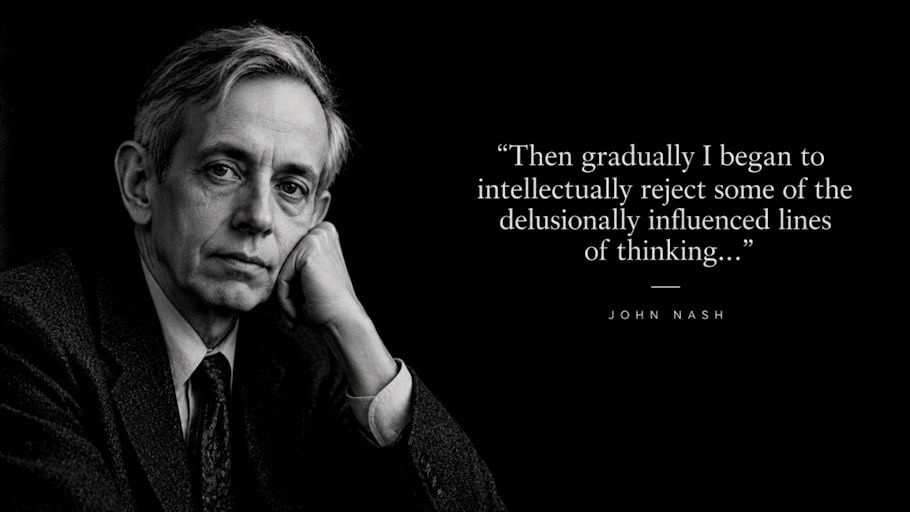
"Then gradually I began to intellectually reject some of the delusionally influenced lines of thinking…"
- John F. Nash Jr., autobiographical essay for the Nobel Prize, 1994.
The Film Before the Man
My first strong encounter with John Nash was not through game theory, equilibrium, or twentieth-century mathematics. It was through A Beautiful Mind.
The cast hit several points of recognition that had already been with me since adolescence: Russell Crowe (Gladiator), Jennifer Connelly (Requiem for a Dream), and Paul Bettany's Charles, who visually registered for me almost as a double of Matthew Lillard — Cereal from Hackers, the 1995 film with a very young Angelina Jolie. Different actors, obviously, but the association stuck. Hackers had entered my visual memory years earlier, and Bettany kept triggering it.
Years later, separating the film from the man became more interesting than the film itself.
A Beautiful Mind is built to make an invisible problem visible. The viewer sees people and events presented with exactly the same material certainty as everything else on screen. The mechanism gives mental disturbance a cinematic grammar: we accept a reality and later discover that part of it existed only inside the protagonist's experience.
Real Nash did not describe what the film shows. In an interview he explicitly said that he did not see people who were not there. The visual hallucinations were a storytelling mechanism. They allow a camera to represent a disturbance in belief by turning it into visible characters. Powerful cinema; poor historical evidence if taken literally.
So the first Nash I knew was already a model.
The real problem begins when that model is removed.
When Reason Becomes a Variable
Nash's case is difficult because intelligence offers no general guarantee of reliable judgment.
Before the severe disruption of his academic life, he had already produced work that would permanently change several fields. His doctoral research at Princeton developed the equilibrium concept that became central to non-cooperative game theory and later formed part of the basis for the 1994 Nobel Prize in Economic Sciences. His contributions to geometry and nonlinear partial differential equations were regarded by the mathematical community as deeper still; in 2015 the Abel Prize recognized that body of work.
None of those achievements made every conclusion produced by the same mind trustworthy.
We routinely compress cognition into one scale. Someone demonstrates extraordinary reasoning in mathematics, and authority begins leaking outward into our perception of the person as a whole. Yet formal proof, memory, pattern recognition, interpretation of other people, threat detection, confidence, and the assignment of meaning to events are different operations. Their performance does not have to rise and fall together.
Nash could remain capable of mathematical abstraction at a level few people could approach while accepting beliefs about the external world that other observers could not verify.
The problem was not a shortage of intelligence.
Intelligence itself could no longer serve as the final verifier.
The Breakdown of Verification
Nash dated the beginning of his "mental disturbances" to early 1959, while he was on the faculty at MIT. He was diagnosed at the time with paranoid schizophrenia, the diagnostic terminology then used in his records. His Nobel autobiographical account describes leaving MIT, approximately fifty days at McLean Hospital, travel to Europe during which he sought refugee status, and later involuntary hospitalizations in New Jersey.
The unusual ideas were not random noise sitting on top of an otherwise untouched reasoning system. Political significance, coded communications, special identities and connections between apparently unrelated events could become integrated into a coherent personal model.
Coherence made the problem harder.
A model can contain elaborate internal logic and still fail against the world it claims to describe. Intelligence may even increase its complexity. More connections can be generated, more anomalies incorporated, more explanations built around contradictory evidence.
Hospitalization did not produce one decisive correction. Nash later explained that at times he learned to behave in ways that allowed him to leave the hospital while delusional ideas had merely been pushed aside. They could return quickly. During other periods he resumed mathematical work. The movement between these states extended over years.
A clean border between rational and irrational becomes useless here. The same person could reason correctly through a formal mathematical problem, function conventionally for a period, and remain vulnerable to interpretations of reality that would later become untenable.
Verification had become unstable rather than absent.
What Did Not Disappear
Illness severely damaged Nash's professional trajectory. It did not erase the entire architecture that had made him a mathematician.
Years of training remained. So did mathematical memory, formal technique, familiarity with difficult problems, habits of abstraction and a body of work already externalized into papers that other mathematicians could inspect without consulting his mental state.
The chronology sharpens the contrast. Nash's doctoral thesis was famously brief, yet the equilibrium concept it developed became foundational across economics and other fields. Recognition continued accumulating while the person who had produced the work passed through decades of serious illness. The intellectual object and the current condition of its author had separated.
That separation is critical.
A theorem does not inherit the psychiatric condition of the mathematician who produced it. Once written, a proof can be attacked by other minds. Definitions are public. Derivations can be reproduced. An error can be found whether the author feels uncertain or absolutely convinced.
Mathematics contains an external architecture of resistance.
It could not treat Nash's illness. It could reject a mathematical claim.
The distinction is unusually sharp. In one domain Nash operated inside a culture where an idea had to survive formal constraints and other experts. Elsewhere in his experience, a belief could feel connected, meaningful and explanatory without facing an equivalent machinery of verification.
The phrase beautiful mind tends to flatten this structure into one object. The historical record looks messier: preserved competencies, damaged functions, inaccessible periods, accumulated knowledge, unstable interpretations, and earlier outputs that had already become independent of the person who created them.
Professional identity survived in fragments long before conventional professional life returned.
Princeton as an External Environment
Princeton became important without becoming a cure.
Nash arrived there as a graduate student in 1948. Decades later, during years when he was largely outside ordinary academic participation, Fine Hall remained one of the places where he was physically present. In the 1970s he became known around the mathematics department as the "Phantom of Fine Hall": an elusive figure who wandered the building, rarely spoke, and sometimes left unusual writing on blackboards. The mathematicians around him knew the scale of the work he had done even when his current position in that world had become difficult to define.
An institution can preserve continuity without restoring capacity.
Blackboards remained. Offices remained. Seminars, journals, mathematicians and unsolved problems remained. Nash did not have to reconstruct the intellectual environment from zero whenever he approached it. The field retained its own memory outside him.
Princeton's later accounts do not require a romantic claim that tolerance somehow healed him. They describe something quieter: a man who stayed around the department for years, gradually became more socially and intellectually engaged, and eventually returned to recognized research life. From 1995 until his death in 2015, he held the position of senior research mathematician at Princeton.
This differs sharply from the Hawking case. Hawking's external architecture increasingly carried communication between cognition and the world. No colleague or institution could perform an equivalent substitution for Nash's reality testing.
Princeton could preserve territory.
It could not inhabit his mind.
Returning Without a Clean Ending
Nash's later description of improvement is tempting because it sounds like reason correcting itself. In his Nobel autobiography he wrote that he gradually began to "intellectually reject" some delusionally influenced lines of thinking.
Read carelessly, that becomes a perfect story: the mathematician logically disproved his own schizophrenia.
His fuller account does not permit it.
The change stretched across hospitalizations, partial returns, renewed disturbances, withdrawal, aging, changes in treatment and a gradual re-entry into ordinary intellectual life. Nash offered his own explanations for the improvement, including the possibility that age mattered. He also said that he had stopped taking antipsychotic medication long before the later period of relative stability for which he became publicly known. One individual history cannot responsibly be converted into medical advice.
Even the language he used in 1994 retained uncertainty. He wrote that he seemed to be thinking rationally again in the style characteristic of scientists.
The observer remained inside the sentence.
The Nobel Prize recognized work produced largely before the collapse of his early academic career. The 2015 Abel Prize likewise honored foundational mathematics whose origins reached back decades. Later Nash, however, was not merely being carried around as a ceremonial remainder of the young genius. Princeton records describe renewed mathematical activity and regular participation in the department.
There was no cinematic cut from illness to restoration.
There was a long re-entry into a professional world that had continued to exist while his ability to occupy it had changed.
Anti-Coaching: Verification Before Confidence
Anti-Coaching has a narrow role here. It does not explain schizophrenia. It does not diagnose Nash. It has nothing to say about psychiatric treatment.
Its question concerns architecture.
If the mechanism producing judgment can itself become unreliable, where does verification live?
Ordinary decision-making rewards internal coherence. An explanation fits previous beliefs; several observations align; confidence rises; action follows. Under stable conditions this shortcut is often useful. It becomes dangerous when the same system generating the interpretation also controls what counts as evidence against it.
A closed model can become extremely difficult to falsify from inside.
Mathematics offers an unusually clean contrast because it institutionalizes resistance. Proof, counterexample, criticism, formal definitions and other mathematicians put parts of verification outside the individual. Personal conviction may begin an investigation. It cannot certify the theorem.
Most human systems are much dirtier.
A founder can build a model explaining why customers simply fail to understand the product. An analyst can fit new evidence into an old theory until every contradiction becomes additional confirmation. Researchers become attached to hypotheses. Executives can be surrounded by enough filtered information that the organization starts returning their own assumptions to them as evidence.
None of these states is schizophrenia. Treating them as equivalents would be absurd. The useful structural comparison is restricted to one issue: a system that validates its own interpretation requires an external source of friction.
Anti-Coaching usually rejects attempts to solve structural problems by increasing psychological pressure.
Nash adds a more disturbing possibility.
More confidence can itself be the wrong intervention.
When the Observer Is Inside the System
John Nash is frequently reduced to a clean opposition: genius on one side, madness on the other. It is culturally convenient and analytically weak.
His life reveals a harder configuration. The human mind constructs models of reality and then uses itself to inspect those models. Most of the time we behave as though this recursive arrangement is sufficiently reliable. Nash spent years inside circumstances in which it was not.
External systems mattered because the observer could not always remain the final authority over the observation. Mathematics provided formal tests. Princeton preserved a professional environment. Colleagues supplied other minds. Written work preserved earlier cognition in a form that could still be examined when current judgment became unreliable. Time changed the condition in ways that neither Nash nor anyone around him could fully control.
His own later reasoning became part of the return. Making it the sole cause would turn a long, irregular history into mythology.
There is a harsher implication for a culture that treats self-belief as an unconditional virtue.
A powerful mind can generate a powerful error.
Intelligence can increase the sophistication of an explanation without improving its contact with reality. Professional competence can remain genuine while judgment becomes uneven. Identity can survive long periods in which output collapses. An institution can preserve access while remaining incapable of restoring the person using it.
Responsibility under those conditions begins with an unpleasant fact: the person doing the judging may also be one of the unstable variables.
Nash changed mathematics by constructing models of strategic behavior between rational actors. His life leaves a different problem behind, one mathematics cannot close for us.
How do you audit a system when the system performing the audit is also inside the model?
More frameworks for performance and decision-making when information is incomplete but responsibility for the result remains can be found in my Responsibility Series - Operating in the Dark.
Frequently Asked Questions
NOTE: Researched FAQs by Disabled World (DW)
What is a Nash equilibrium in simple terms?
A Nash equilibrium is a situation in a game or negotiation where no player can do better by changing their own strategy alone, as long as everyone else keeps theirs the same. It is used to predict outcomes in economics, auctions, traffic planning, evolutionary biology and international relations.
Who shared the 1994 Nobel Prize in Economic Sciences with John Nash?
Nash shared the 1994 prize with John Harsanyi of the University of California, Berkeley and Reinhard Selten of the University of Bonn for their pioneering analysis of equilibria in non-cooperative game theory.
How did John Nash die?
John Nash and his wife Alicia died on May 23, 2015, when the taxi they were riding in crashed on the New Jersey Turnpike. They were returning from Norway, where Nash had just received the Abel Prize.
Was A Beautiful Mind based on a book?
Yes. The 2001 film was loosely adapted from the 1998 biography A Beautiful Mind by journalist Sylvia Nasar, which was a finalist for the Pulitzer Prize. The film took many liberties with the facts of his life and illness.
What is the difference between a delusion and a hallucination?
A hallucination is a sensory experience of something that is not there, such as hearing voices or seeing figures. A delusion is a firmly held false belief that persists despite clear evidence against it. Nash described his illness mainly in terms of delusional thinking and hearing voices rather than seeing people.
Can symptoms of schizophrenia lessen with age?
Some people with schizophrenia experience a reduction in symptoms such as delusions and hallucinations as they get older, and many achieve meaningful recovery. Outcomes vary widely from person to person, and decisions about treatment should always be made with a qualified health professional.
What does reality testing mean in psychology?
Reality testing is the ability to tell the difference between internal thoughts, feelings and perceptions and what is actually happening in the outside world. Conditions such as psychosis can impair this ability, which is why feedback from trusted people and clinicians can be so important.
Is high intelligence linked to schizophrenia?
Research has not shown that high intelligence causes schizophrenia, and the condition occurs across all levels of ability. Some studies have explored links between creativity and mental illness, but the evidence is mixed and cases like Nash are notable partly because they are uncommon.
Anti-Coaching: Beyond the Limit
Read More From the Series:
- Alex Zanardi: Rebuilding Control After Double Amputation: Alex Zanardi's racing career after a double leg amputation shows how hand controls, prosthetics and handcycle design rebuilt his driving and Paralympic success.
- Lesya Ukrainka: Chronic Illness, Writing and The Forest Song: How Lesya Ukrainka wrote The Forest Song while living with tuberculosis and variable capacity, and how her 1911 drama became the animated film Mavka during war.
- Vincent van Gogh: What Reproduction Cannot Preserve: An artist's essay on why Vincent van Gogh's original paintings and drawings reveal brushstroke, texture, and scale that digital reproductions cannot preserve.
- Beethoven's Hearing Loss and the Architecture of Feedback: Beethoven's progressive hearing loss stripped away the feedback his composing and performing relied on, while notation, memory, and sketches kept his work going.
- Stephen Hawking Was Not a Motivation Story: Stephen Hawking viewed through decision architecture, showing how assistive technology and support systems extend human agency when motivation meets hard limits.
Insights, Analysis, and Developments
Editorial Note: Nash's story is usually told as genius against madness, but the more honest lesson is about where checking happens. A theorem he wrote in his twenties could be tested by anyone with the training to read it, while his beliefs about coded messages and hidden connections had no such outside test, and that gap explains a great deal about how one person could be brilliant and badly mistaken at the same time. For people living with schizophrenia or other conditions that affect perception and belief, and for the families who support them, the takeaway is that outside reference points - trusted people, stable surroundings, written records and time - can matter as much as personal effort. The same principle reaches well beyond psychiatry: any person or organization that relies only on its own confidence to judge its own conclusions is missing a safeguard, and Nash's long, uneven return to working life shows how slowly and quietly real recovery can unfold.*
 Author Credentials: Lexx Che is a Systems Builder, Narrative Architect, author, independent journalist, and researcher with nearly 20 years of professional experience. His work spans more than 1,000 projects across strategy, design, technology, digital ecosystems, organizational transformation, identity, and decision architecture. In medicine and healthcare, he and his teams bring 15 years of experience creating visual identity systems, developing and repositioning brands, building corporate websites, and delivering digital transformations and complex digital ecosystems for private clinics and large healthcare networks. Explore Lexx Che's complete biography for comprehensive insights into his background, expertise, and accomplishments.
* Editorial additions by Ian C. Langtree.