Marla Runyan: Elite Racing With Stargardt Vision Loss
Author: Lexx Che - View Credentials
Published: 27 Oct 2026
Publication Type: Awareness, Appreciation
Table of Contents:
Synopsis - Definition - Overview - FAQs - Insights, Updates - Related Content
Synopsis
This paper examines how Marla Runyan, diagnosed with Stargardt disease at about age nine, competed at the highest levels of track and road racing while missing much of her sharp central vision. She became a two-time Paralympian with five gold medals and one silver, and a two-time Olympian who reached the 1,500-meter final at Sydney in 2000 and finished eighth. The central argument is that “legally blind” is too broad a label to describe what an athlete can actually perceive at speed. Runyan kept useful peripheral vision for the track surface, motion, color and nearby runners, yet often could not read clocks, identify rivals or see the finish line. Drawing on her own interviews and memoir, along with the National Eye Institute's description of the condition, the piece uses the author's Anti-Coaching framework to separate the information an athlete can rely on from the information she simply does not have. It offers a grounded way to think about performance and decision-making with a visual impairment, and it will interest athletes, coaches, people living with low vision or macular disease, and seniors adjusting to central vision loss.*
At a Glance
- 1 - She won the 1,500 meters at the 1999 Pan American Games in a photo finish without being able to see the clock.
- 2 - As a heptathlete, she ran the hurdles by rhythm, taking eight steps to the first barrier and three between the rest.
- 3 - At the 2002 New York City Marathon, the separate women's start let her count runners in the pack to estimate her position.
- 4 - At Barcelona in 1992 she won Paralympic gold in the 100, 200 and 400 meters and the long jump, then took pentathlon gold in Atlanta in 1996.
Topic Definition
- Stargardt Disease
Stargardt disease is the most common inherited form of juvenile macular degeneration, a genetic eye disorder that damages the macula - the small central area of the retina responsible for the sharp, detailed vision used for reading, recognizing faces and seeing fine detail. Most cases are caused by mutations in the ABCA4 gene and are inherited in an autosomal recessive pattern, meaning a child must receive an altered copy of the gene from each parent. These mutations allow fatty waste deposits called lipofuscin to build up in retinal cells, gradually destroying the light-sensitive photoreceptors. Symptoms usually begin in childhood or adolescence with blurry or distorted central vision, slow adjustment to dim light and reduced color perception, while peripheral (side) vision is typically preserved. The condition affects roughly 1 in 8,000 to 10,000 people. There is currently no approved cure, although gene therapies and drug treatments are being studied in clinical trials, and low vision aids, magnification and vision rehabilitation help many people remain independent.
Overview
Marla Runyan: Running Without the Full Field
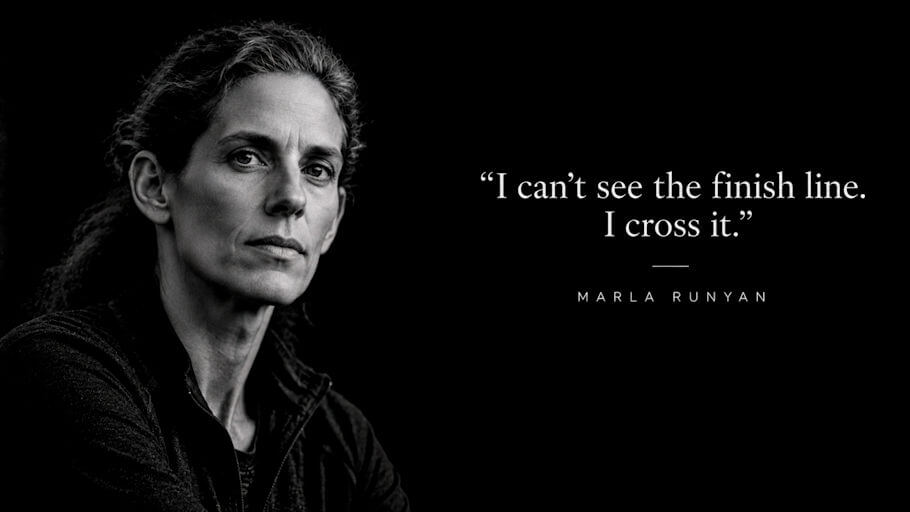
"I can't see the finish line. I cross it."
- Marla Runyan, No Finish Line: My Life as I See It.
A Race Without the Full Field
A 1,500-meter race looks simple from outside the track. The distance is fixed. The finish is fixed. At elite level, almost none of the useful information is static.
A runner is constantly reading position, speed, bodies, gaps, lane space, pack movement, contact risk, and the cost of moving outward or staying trapped inside. Much of that arrives visually before it becomes conscious. Marla Runyan entered that system with severe central vision loss caused by Stargardt disease.
The National Eye Institute describes Stargardt disease as a genetic retinal disorder that primarily damages sharp central vision. Runyan was diagnosed around age nine. Her own descriptions reveal the athletic consequences. She could see the track surface, feet, colors and movement through remaining peripheral vision, while faces, race numbers, clocks, scoreboards and the finish line could disappear into the damaged center of her visual field.
That is a different problem from running in darkness. The field was present, but unevenly available.
Runyan eventually became a two-time Paralympian, winning five gold medals and one silver, and a two-time Olympian. In Sydney in 2000 she reached the Olympic 1,500-meter final and finished eighth. Four years later she returned in Athens for the 5,000 meters. Those results place the problem at elite speed. In an Olympic middle-distance race, hesitation has a cost.
What Vision Does in a Race
Central vision is only one component of visual function, but racing exposes how many jobs depend on it. A bib identifies a person. A clock translates effort into pace. A lap counter locates the athlete inside the event. Body detail distinguishes rivals. A visible gap can determine whether a move happens now or waits.
Runyan had access to some of this system and not to other parts.
Before the Sydney Games she explained that she could move through a crowded room and run on tracks, roads and wood-chip trails without assistance because her peripheral vision remained functional. At the same time, she might fail to recognize her own coach from ten feet away. On the track, other runners could register as moving color rather than identifiable people. At the 1999 Pan American Games, where she won the 1,500 meters in a photo finish, she said she could not see the clock and therefore concentrated on competing rather than reading time.
Her visual field did not become more complete because the race became important. The race had to be executed with the information that actually arrived.
The distinction sharpens when the format changes. Track geometry repeats. Road racing adds turns, changing surfaces, mile markers and a field spread across far greater distances.
Runyan's career eventually covered both.
Partial Information Is Still Information
The language of blindness easily creates a false binary: seeing or not seeing. Runyan's own descriptions resist it.
She retained useful peripheral vision. She could see the ground beneath and ahead of her. She could detect motion and colors. In an interview during the Sydney Games she described having a strong sense of the mechanics of runners moving beside or ahead of her. She also mentioned breathing as an available cue. These were information channels she could actually access.
They were also incomplete.
A pack of runners might be legible as movement without being legible as identity. In the 2002 New York City Marathon, Runyan explained that she sometimes could not distinguish men from women at a distance. The separate women's professional start therefore changed the informational problem in a concrete way: when she rejoined a pack on First Avenue, she could count the women and estimate her position. In a mixed field, that calculation would have been much harder.
That detail strips the romance from "adaptation." The missing channel is not recreated; action is reorganized around what remains.
At New York, a cyclist communicated cumulative clock times, warned her about upcoming turns and gave information about the pack. The road itself remained visible enough under her feet to run safely at elite pace. Position farther ahead was less available. Different parts of the same task had different levels of uncertainty.
Incomplete information still supports judgment. It changes what judgment can responsibly claim to know.
Paralympic and Olympic Systems
Runyan's career is often narrated as a transition from the Paralympics to the Olympics, as though one were preliminary and the other represented arrival. Her record makes that hierarchy difficult to defend.
At Barcelona in 1992 she won Paralympic gold in the 100, 200 and 400 meters and the long jump, and also competed in tandem cycling. At Atlanta in 1996 she won the pentathlon and took silver in the shot put. The range is striking: sprinting, jumping, throwing, multisport competition and cycling before her shift toward middle- and long-distance running.
Years later, reflecting on recognition of para-athletes, Runyan put the distinction more directly: "I was no less of an athlete as a Paralympian."
Her Olympic participation belongs beside that record, not above it. Sydney tested her against a different classification system and a different field of competitors. The same body, the same visual condition and much of the same athletic intelligence crossed institutional boundaries while the rules for who surrounded her changed.
Classifications organize competition; they do not contain the whole athlete. Runyan's movement between Paralympic and Olympic systems exposed a mismatch between public labels and professional capacity. "Legally blind" was accurate as a classification. It was too coarse to describe what she could perceive at speed, which events suited her, or how well she could race.
Training What Can Be Trained
Runyan's adaptations were specific to tasks.
As a high jumper, she could pace out the approach, move close enough to locate the bar, then preserve that relation through a measured sequence. In the hurdles, the problem became rhythm. Reporting from her heptathlon years describes eight steps to the first hurdle and three between the rest. The barriers did not need to become sharply visible at a distance if the approach could be converted into repeatable timing.
Middle-distance racing was less stable. The obstacles moved.
Runyan said she used the mechanics of nearby runners and audible breathing as clues, largely instinctively. That did not tell her everything. It gave her enough information to operate inside a pack. Years of training also made track geometry, pacing and bodily effort familiar without requiring continuous visual confirmation from a display.
A hurdle pattern can be rehearsed. The position of eleven other runners cannot. A road course can be studied. A competitor's surge is generated in real time. Pace can be internalized; an official clock remains external.
Elite preparation therefore does two different jobs. It automates what can be stabilized, and it leaves capacity available for what cannot.
The Limits of Adaptation
Successful adaptation is often described as if it eventually erases the original limitation. Runyan's racing does not.
She could not make a distant clock readable by concentrating harder. She could not identify every athlete in a pack through accumulated experience. At some finishes she did not immediately know her placing. In her memoir, the problem is compressed into a brutal pair of sentences: she cannot see the finish line; she crosses it.
The missing information remained missing, creating tactical costs that are easy to underestimate. A runner who cannot identify rivals from a distance may have less certainty about who has moved. A clock that cannot be read removes one external pace check. A finish that cannot be visually resolved changes the relation between acceleration and the visible endpoint. In crowded races, incomplete identification complicates position even when basic collision avoidance remains strong.
Runyan herself rejected assumptions that she was inherently dangerous in a pack. Before Sydney, she pointed out that contact is normal in 1,500-meter racing and said she could maneuver around other athletes. Both statements can be true: she could possess excellent spatial skill while still lacking information other runners had.
Competence does not require pretending the constraint has disappeared.
Anti-Coaching: Performance Under Incomplete Feedback
Anti-Coaching is useful here as a way to separate available capacity from demanded information.
Whether an athlete is sufficiently determined is the wrong question. Determination says little about which inputs exist when a decision must be made.
Runyan's system can be divided more precisely. Some variables were reliable: trained pace, proprioception, track geometry, running mechanics, physiological effort, peripheral movement close to her. Others were weaker or absent: central detail, distant identification, clocks, scoreboards, exact visual information about competitors farther away. External support could sometimes supply a missing input, as in the New York Marathon. In a tactical Olympic 1,500, decisions arrived too quickly for every gap to be externally filled.
The architecture therefore changes from "see, decide, act" into something less clean. Information arrives through several channels with different precision and latency. The athlete must know which channels deserve trust.
That is the Anti-Coaching prism here. Experience does not abolish uncertainty; it can reduce the decisions requiring fresh information. Training converts some choices into learned structure. External systems can restore particular data. Professional judgment operates on the remainder.
There is no motivational solution for an unreadable clock.
There can be a different decision system.
What the Athlete Still Has to Know
Runyan's career matters because the missing visual field never became the whole field of analysis.
She raced with information she could use, information she could obtain indirectly, and information she simply did not have. The proportions changed with the event. Hurdles rewarded repeatable rhythm. Track races compressed bodies into a moving tactical system. Road races stretched the informational environment across miles and could make external assistance useful in ways impossible during a short final.
Through all of them, responsibility for the race remained with the athlete.
That responsibility included knowing more than pace. It meant knowing the reliability of perception itself. Which movement is clear enough to act on? Which opponent can actually be identified? When does an internal sense of effort replace a clock? When does an organizer, guide, cyclist or known course restore information that vision does not provide? Where does uncertainty remain irreducible?
The athlete who understands those boundaries is not operating without feedback. She is operating with feedback of unequal quality.
Runyan once described the world she saw as simply the world she knew. That may be the cleanest way to remove the spectacle from her case. She did not enter each race from an imagined baseline of normal vision and calculate what had been taken away. She trained inside the sensory system she actually possessed.
The full field was never available.
The race still was.
More frameworks for performance and decision-making when information is incomplete but responsibility for the result remains can be found in my Responsibility Series - Operating in the Dark.
Frequently Asked Questions
NOTE: Researched FAQs by Disabled World (DW)
How did Marla Runyan do in her marathon debut?
Runyan made her marathon debut at the 2002 New York City Marathon and finished fourth among women in 2 hours, 27 minutes and 10 seconds, making her the top American finisher that year.
Is Stargardt disease inherited?
Yes. Most cases are caused by mutations in the ABCA4 gene and follow an autosomal recessive pattern, so a person must inherit an altered gene from both parents. Parents who each carry one copy usually have normal vision themselves.
Does Stargardt disease cause total blindness?
Total blindness is rare. The disease mainly destroys central vision, while peripheral vision is usually preserved, so most people keep enough side vision to move around independently even when reading and face recognition become difficult.
What does legally blind mean in the United States?
A person is considered legally blind when their best corrected visual acuity is 20/200 or worse in the better eye, or when their visual field is 20 degrees or less. Many legally blind people still have some usable vision.
How are visually impaired runners classified in Paralympic athletics?
Track athletes with vision impairment compete in classes T11, T12 and T13. T11 covers the most severe loss and requires running with a guide while wearing blackened glasses, T12 athletes may choose to use a guide, and T13 covers the least severe eligible impairment.
How do guide runners help blind athletes compete?
A guide runs alongside the athlete, usually connected by a short tether, and gives verbal cues about direction, turns, pace and other runners. Guides may not pull or push the athlete, and the athlete must cross the finish line before the guide to avoid disqualification.
Is there a treatment for Stargardt disease?
There is no approved cure yet, but gene therapies and several drug treatments are being tested in clinical trials. Eye doctors often advise avoiding high dose vitamin A supplements, wearing UV protective sunglasses, and using low vision aids and rehabilitation services.
Can people with Stargardt disease drive?
It depends on how much central vision remains and on local licensing rules. Many people drive early on, but as visual acuity declines most no longer meet standard driving requirements, although some regions allow restricted licenses with bioptic telescopes.
Anti-Coaching: Beyond the Limit
Read More From the Series:
- John Nash: Schizophrenia, Genius and Verifying Reality: Essay on John Nash's schizophrenia, Nobel-winning game theory and return to Princeton, examining why intelligence alone cannot verify a person's grip on reality.
- Claude Monet: When Perception Becomes Unreliable: How cataracts diagnosed in 1912 changed Claude Monet's color perception, what his 1923 eye surgery fixed, and what his late paintings can and cannot reveal.
- Alex Zanardi: Rebuilding Control After Double Amputation: Alex Zanardi's racing career after a double leg amputation shows how hand controls, prosthetics and handcycle design rebuilt his driving and Paralympic success.
- Lesya Ukrainka: Chronic Illness, Writing and The Forest Song: How Lesya Ukrainka wrote The Forest Song while living with tuberculosis and variable capacity, and how her 1911 drama became the animated film Mavka during war.
- Vincent van Gogh: What Reproduction Cannot Preserve: An artist's essay on why Vincent van Gogh's original paintings and drawings reveal brushstroke, texture, and scale that digital reproductions cannot preserve.
- Beethoven's Hearing Loss and the Architecture of Feedback: Beethoven's progressive hearing loss stripped away the feedback his composing and performing relied on, while notation, memory, and sketches kept his work going.
- Stephen Hawking Was Not a Motivation Story: Stephen Hawking viewed through decision architecture, showing how assistive technology and support systems extend human agency when motivation meets hard limits.
Insights, Analysis, and Developments
Editorial Note: Runyan's story is often told as a tale of overcoming, but the more useful lesson is quieter: she never pretended the gaps in her vision had closed. She sorted each race into what she could trust - trained pace, body awareness, the ground at her feet, the movement of runners beside her - and what had to come from somewhere else, whether a cyclist calling out splits in New York or the fixed rhythm of a hurdle approach. That way of working reaches well beyond athletics. People with macular degeneration, glaucoma or other partial sight loss make the same kind of judgment every day at crosswalks, in grocery aisles and on the job, deciding which cues are reliable and when to ask for help. Her career also undercuts the habit of ranking Paralympic achievement below Olympic success, since the same athlete with the same eyes excelled in both. For coaches, employers and families, the practical takeaway is that supporting someone with low vision starts with understanding what information they actually receive, not with assumptions about what blindness means.*
 Author Credentials: Lexx Che is a Systems Builder, Narrative Architect, author, independent journalist, and researcher with nearly 20 years of professional experience. His work spans more than 1,000 projects across strategy, design, technology, digital ecosystems, organizational transformation, identity, and decision architecture. In medicine and healthcare, he and his teams bring 15 years of experience creating visual identity systems, developing and repositioning brands, building corporate websites, and delivering digital transformations and complex digital ecosystems for private clinics and large healthcare networks. Explore Lexx Che's complete biography for comprehensive insights into his background, expertise, and accomplishments.
* Editorial additions by Ian C. Langtree.