Oksana Masters: Adapting Performance to a Changing Body
Author: Lexx Che - View Credentials
Published: 8 Nov 2026
Publication Type: Awareness, Appreciation
Table of Contents:
Synopsis - Definition - Overview - FAQs - Insights, Updates - Related Content
Synopsis
This report examines the athletic career of Oksana Masters, the Ukrainian-born American Paralympian whose body was repeatedly changed by congenital limb differences, reconstructive hand surgery, and above-knee amputations of both legs before she ever reached elite sport. Drawing on her memoir The Hard Parts, Team USA records, and her own public accounts, it traces how she moved from a London 2012 rowing bronze to winter and summer medals after a back injury ended her rowing career, and it treats the shifting relationship between anatomy, equipment, technique, and recovery as the real subject of performance. The analysis is careful with disputed claims, noting that a Chernobyl link to her birth differences is suspected rather than proven, and it offers a useful way for athletes, coaches, people with disabilities, and seniors managing physical change to think about adapting goals when the body itself no longer matches yesterday's plan.*
At a Glance
- 1 - Masters was adopted by Gay Masters and moved to the United States at age seven.
- 2 - Handcycling is mainly a pushing action, while Nordic skiing is dominated by pulling.
- 3 - She learned cross-country skiing just 14 months before winning silver and bronze at Sochi 2014.
- 4 - About 100 days before the Tokyo Paralympics, she had a tumor removed from her femur. She then won gold in both the cycling time trial and road race.
Topic Definition
- Adaptive Sport Performance
Adaptive sport performance is the level of athletic output a person with a disability achieves through the combined working of their body, specialized equipment, technique, and training, rather than through physical capacity alone. In sports such as sit-skiing, para biathlon, handcycling, and para rowing, the athlete and the device form a single mechanical system, so seat fit, frame geometry, strapping, and equipment weight directly affect how force is transferred and how much energy is lost. Because impairments, surgeries, injuries, and prosthetics can change that system over time, adaptive performance is regularly reassessed and retrained, and it is supported by classification rules that group athletes by functional ability so competition stays fair.
Overview
Oksana Masters: The Body Is Not a Fixed Platform
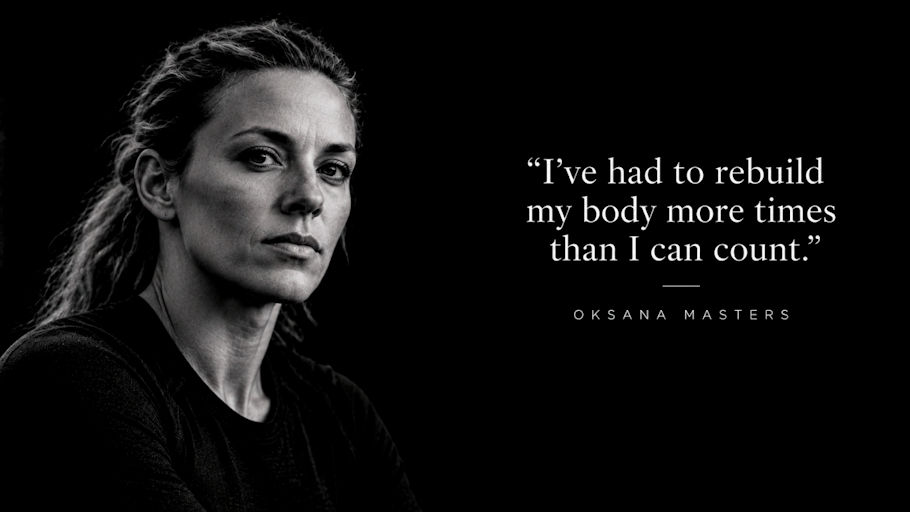
"I've had to rebuild my body more times than I can count."
- Oksana Masters, 2026.
A Body That Kept Changing
Elite sport usually treats the body as a baseline. Training begins with an existing physical platform, measures its capacities, then attempts to increase strength, speed, endurance, coordination, or efficiency. Even injury is often understood as an interruption: repair the athlete, restore the baseline, resume development.
Oksana Masters makes that model difficult to sustain.
She was born in Ukraine in 1989 with extensive congenital limb differences. Accounts from Masters and her publisher describe missing weight-bearing bones in her lower legs, markedly unequal leg length, webbed fingers, absent thumbs, and other anatomical differences. Her hands later underwent reconstructive procedures, and both legs were eventually amputated above the knee - the left at nine, the right at fourteen. Her memoir, The Hard Parts, records years in which medical intervention repeatedly changed the body she had already learned to use.
Chernobyl frequently appears in accounts of that history. Some official and publishing profiles have described prenatal radiation exposure as the cause of her congenital differences. Team USA's current biography is more careful, saying the Chernobyl events were suspected to have played a role. Publicly available evidence does not establish a specific causal chain in Masters's individual case, so that uncertainty should remain visible.
The important professional fact is simpler. Her body was never a stable input into an athletic system. Anatomy changed. Surgery changed it again. Amputation altered weight distribution, mobility, and contact with equipment. Prosthetics created another configuration. Injury later removed one sport from the available set. Different sports then demanded different versions of the same upper body.
Performance had to be recalibrated repeatedly because the platform itself kept moving.
Before Performance
It would be easy to make the medical history consume the athletic one. That would distort the sequence.
Masters spent her first years in Ukrainian orphanages before being adopted by Gay Masters and moving to the United States at seven. Her memoir deals directly with deprivation, abuse, adoption, reconstructive surgery, and the long process of changing her relationship with her own body. Sport entered later. It did not retroactively convert those experiences into useful preparation.
The amputations were themselves different events. Masters has described the first as something she adapted to relatively quickly as a child; the second was much more difficult and involved prolonged medical recovery. By adolescence, prosthetic legs were part of daily mobility, while her hands had also been surgically reconstructed.
This matters because the phrase "disabled athlete" can make a physical configuration sound static. Masters's early life was closer to a sequence of revisions. Every intervention changed leverage, balance, movement, pain, available technique, and the relationship between her body and external devices.
The system that eventually became elite did not begin as a finished adaptive body waiting to discover its sport.
It had to be assembled.
The First Sporting System
Rowing provided the first configuration that made sense.
Masters began rowing as a teenager. In her own accounts, the attraction was not originally medal logic. The boat gave her a way to use physical force differently and, later, a way of processing experiences she could not easily verbalize. In The Hard Parts, the first Paralympic medal is connected back to that earlier discovery of the water: the competitive system grew out of something that had first functioned as a private physical outlet.
Technically, rowing also redistributed the problem. Her Paralympic event used a fixed-seat configuration based heavily on trunk and arms. In London in 2012, Masters and Rob Jones won bronze in the mixed double sculls, the first U.S. Paralympic medal in that rowing classification.
For the first time in the sequence relevant here, body, equipment, and sport aligned at the elite level.
Then that configuration failed.
A severe back injury developed around the 2013 world championship period. Masters has explained that continuing to row would have required a spinal intervention with unacceptable consequences for the rest of her mobility. Rowing had been the sport around which she had constructed her professional identity. The decision was therefore not a technical inconvenience. The activity that had finally fit the body no longer fit it safely.
There was no useful amount of motivation capable of changing that equation.
When One Sport Stops Fitting
This is one of the most important transitions in Masters's career because it contradicts a common performance assumption: that persistence means preserving the original objective in its original form.
Masters did not have a prepared second career. She has said directly that rowing was the only sport she wanted to do and that she had no backup plan when the injury removed it. Soon afterward, she was introduced to cross-country skiing. Fourteen months after learning the sport, she competed at the Sochi 2014 Paralympic Winter Games and won silver and bronze in cross-country skiing.
Cycling entered through another practical problem. Masters initially used handcycling partly while managing her back and partly because it could teach her tactical racing skills that rowing had not required. In rowing, she could largely drive through a short course. Skiing demanded line choice, terrain judgment, and tactical decisions. Handcycling provided speed, endurance, and another environment in which to learn those variables.
The resulting career looks spectacular in retrospect because four sports sit next to the same name: rowing, cross-country skiing, biathlon, and cycling. But the sequence is more interesting than the list.
One professional system became physically untenable. A second exploited some transferable capacity. A third was introduced to develop abilities useful to the second, then became a major competitive discipline in its own right.
This is less a story of unlimited versatility than of repeated system redesign.
Prosthesis, Equipment, Technique
Adaptive sport makes visible something conventional sport often hides: performance never belongs to the body alone.
In Masters's winter events, a carbon-fiber sit-ski has to fit her body precisely enough to transfer force efficiently. In biathlon, the same system has to accommodate skiing, transition into shooting position, hand function, and equipment. In cycling, the handcycle changes the geometry again. The athlete does not simply attach a device to an otherwise unchanged body. Device and body establish a mechanical relationship that determines how force reaches the ground, snow, or wheel.
Prosthetic legs remain part of Masters's wider physical life, but the elite racing systems in which she has achieved most of her medals rely heavily on seated equipment and upper-body propulsion. This shifts the analytical boundary. Where does the athlete end? At the skin? At the point where the torso meets the seat? At the straps? At the carbon frame?
For performance analysis, that distinction is almost useless. Fit determines energy loss. Position determines leverage. Equipment weight, stiffness, and geometry affect speed. Technique determines whether the available body can exploit the machine. Funding affects access to sufficiently specialized equipment in the first place. Masters herself has publicly argued for broader access to adaptive sports equipment because the technology is part of the opportunity to participate and compete.
The machine does not perform for her.
Her body does not perform independently of the machine.
The functional unit is the connection.
Calibration Across Sports
The most revealing evidence comes from Masters's own description of switching between cycling and Nordic skiing.
Both depend heavily on the upper body, which might make them look mechanically compatible. Masters describes almost the opposite. Handcycling is primarily a pushing action; Nordic skiing is dominated by pulling. After a ski season, her lats and back are highly developed. After cycling, shoulders, chest, and arms carry a different load. She has said that for roughly a month during the transition, she can be in excellent condition and still feel as though she has not been training for the new sport.
That is a useful distinction between fitness and fitness-for-function.
An athlete can possess extraordinary cardiovascular capacity and still be mechanically miscalibrated for the next discipline. Training then includes a deliberate loss of one adaptation while another is built. Masters has described having to "de-train" from peak skiing form to return to cycling form.
Biathlon adds another layer because maximal physical output must be interrupted by precision shooting. Injuries introduce still more variation. Before PyeongChang 2018, Masters competed while managing an elbow injury and later underwent multiple operations. In 2021, only around one hundred days before the Tokyo Paralympics, she had surgery to remove a tumor from her femur, then returned to win gold in both the cycling time trial and road race.
That sequence should not be read as evidence that recovery deadlines are optional. It shows the opposite: each disruption changes the available training load, recovery horizon, and risk calculation. At times, the correct target has to shrink. Masters herself has described seasons in which surgery forced her to treat competition as part of rebuilding rather than assume the previous performance baseline still existed.
Anti-Coaching: The Platform Is a Variable
Anti-Coaching is useful here because conventional performance language often begins from an imaginary constant: you.
You have a body. You have a goal. You apply discipline. Results follow.
Masters's career makes the first premise unstable.
The body entering a decision today may not be the body on which yesterday's plan was built. An operation may alter mechanics. Injury can eliminate a movement pattern. A prosthetic changes the interface with the environment. Equipment introduces another variable. Switching sports changes which muscles matter and what counts as efficient technique. Recovery changes available volume. Classification and course design change the external system.
A strategy that ignores those changes can remain psychologically consistent while becoming physically obsolete.
The Anti-Coaching question is therefore not whether the athlete wants the result badly enough. It is: what configuration exists now?
What force can the body currently produce? Through which movement? Into which machine? For how long? What pain or injury changes that answer? What equipment restores usable function? Which former capacity is gone? Which new one has become trainable? Which discipline still fits the architecture?
The same logic explains why leaving rowing was not necessarily a failure of persistence. Continuing could have preserved identity while damaging the wider system required for life and sport. Redesign protected function by abandoning one expression of it.
That is a considerably harder idea than perseverance.
Performance Without a Fixed Baseline
By 2026, Masters had competed at eight Paralympic Games across four sports and accumulated 24 Paralympic medals. At Milano Cortina 2026 alone, she added four golds and a bronze; Team USA lists her career total at 13 gold, seven silver, and four bronze medals.
The numbers are extraordinary. They are not the most analytically interesting part of the career.
The more unusual fact is that the athlete producing those numbers has repeatedly had to discard the assumption that the previous version of her body will remain available. Congenital anatomy, amputations, reconstructive surgery, prosthetics, a career-ending back injury, sport-specific equipment, elbow operations, femur surgery, and continuous transitions between opposing movement patterns have repeatedly changed the platform.
Professional identity survived those changes without requiring the platform to remain fixed.
That does not mean the body is infinitely adaptable. Some functions disappeared permanently. Some medical decisions closed doors. Some injuries reduced available choices. Equipment has limits. Recovery has limits. Training cannot negotiate with every physical condition.
Masters's career is useful precisely because those limits remain present.
The athlete is not a stable object moving through different sports. The athlete is a changing system whose performance depends on maintaining a workable relationship among anatomy, equipment, technique, recovery, and environment.
The baseline moves.
Professional responsibility begins by noticing when it has moved.
More frameworks for performance and decision-making when information is incomplete but responsibility for the result remains can be found in my Responsibility Series - Operating in the Dark.
Frequently Asked Questions
NOTE: Researched FAQs by Disabled World (DW)
What is a sit-ski in para Nordic skiing?
A sit-ski is a molded seat mounted on a frame above a pair of cross-country skis. Athletes with lower limb impairments sit in it and propel themselves with poles using their arms, shoulders, and trunk.
How are para Nordic skiing athletes classified?
Athletes compete in standing, sitting, or vision impaired categories. A percentage factor system adjusts each finish time so athletes with different levels of impairment can race fairly in the same event.
What is the H5 handcycling class?
H5 is a road cycling class for athletes who race in a kneeling position on the handcycle. They can use their trunk as well as their arms to drive the cranks, and the class often includes athletes with leg amputations or other lower limb impairments.
How does shooting work in para biathlon?
Para biathletes fire air rifles at targets 10 meters away, and each miss adds a penalty loop or a time penalty depending on the race format. Sitting athletes shoot from a supported seated position, while athletes with vision impairment use acoustic rifles that guide aim through sound.
What is the trunk and arms rowing class called today?
World Rowing renamed the trunk and arms class PR2. It covers rowers who have functional use of the trunk and arms but limited or no use of their legs during the stroke.
How can disabled athletes get help paying for adaptive sports equipment?
Grant programs from groups such as the Challenged Athletes Foundation, local adaptive sports clubs, and national Paralympic sport programs often help cover costs. Many clubs also lend or rent equipment so beginners can try a sport before buying.
Can a person start a Paralympic sport as a teenager or adult?
Yes. Many Paralympians take up their sport in their teens or later, and adaptive sports programs regularly welcome beginners of all ages, including people with a recently acquired disability.
What is the difference between general fitness and sport-specific fitness?
General fitness covers broad qualities such as heart and lung capacity and overall strength. Sport-specific fitness means the muscles, movement patterns, and skills have been trained for the exact demands of one event, which is why a fit athlete can still feel unprepared when switching sports.
Anti-Coaching: Beyond the Limit
Read More From the Series:
- Charles Schwab and Dyslexia: Building Around Weak Spots: How Charles Schwab, diagnosed with dyslexia at 47, built a business by hiring for his deficits, and why the dyslexia superpower story overlooks the real lessons.
- Helen Keller: Language Access, Education and Independence: Helen Keller's path from childhood gestures to Radcliffe and socialist writing shows how access to language, books and teaching shaped her independent thought.
- Kim Peek: Savant Memory, Disability and Measuring Ability: Kim Peek, the savant who inspired Rain Man, shows why exceptional memory, daily dependence and intelligence need to be assessed as separate human abilities.
- Marla Runyan: Elite Racing With Stargardt Vision Loss: Marla Runyan, Paralympic champion and two-time Olympian with Stargardt disease, raced at elite speed with central vision loss and incomplete visual information.
- John Nash: Schizophrenia, Genius and Verifying Reality: Essay on John Nash's schizophrenia, Nobel-winning game theory and return to Princeton, examining why intelligence alone cannot verify a person's grip on reality.
- Claude Monet: When Perception Becomes Unreliable: How cataracts diagnosed in 1912 changed Claude Monet's color perception, what his 1923 eye surgery fixed, and what his late paintings can and cannot reveal.
- Alex Zanardi: Rebuilding Control After Double Amputation: Alex Zanardi's racing career after a double leg amputation shows how hand controls, prosthetics and handcycle design rebuilt his driving and Paralympic success.
- Lesya Ukrainka: Chronic Illness, Writing and The Forest Song: How Lesya Ukrainka wrote The Forest Song while living with tuberculosis and variable capacity, and how her 1911 drama became the animated film Mavka during war.
- Vincent van Gogh: What Reproduction Cannot Preserve: An artist's essay on why Vincent van Gogh's original paintings and drawings reveal brushstroke, texture, and scale that digital reproductions cannot preserve.
- Beethoven's Hearing Loss and the Architecture of Feedback: Beethoven's progressive hearing loss stripped away the feedback his composing and performing relied on, while notation, memory, and sketches kept his work going.
- Stephen Hawking Was Not a Motivation Story: Stephen Hawking viewed through decision architecture, showing how assistive technology and support systems extend human agency when motivation meets hard limits.
Insights, Analysis, and Developments
Editorial Note: What stands out in Masters's record is not the medal count, impressive as 24 Paralympic medals across eight Games and four sports may be, but the honesty about limits that runs underneath it. Leaving rowing was a decision to protect long-term mobility rather than a failure of will, and her month-long struggle to retrain muscles when switching between skiing and cycling shows that peak fitness in one discipline does not carry automatically into another. For disabled athletes, older adults dealing with surgery or joint changes, and the coaches and clinicians who work with them, the lesson is practical: plans should be built around the body that exists today, with equipment fit and recovery treated as part of the performance itself, and goals adjusted without shame when the baseline shifts.*
 Author Credentials: Lexx Che is a Systems Builder, Narrative Architect, author, independent journalist, and researcher with nearly 20 years of professional experience. His work spans more than 1,000 projects across strategy, design, technology, digital ecosystems, organizational transformation, identity, and decision architecture. In medicine and healthcare, he and his teams bring 15 years of experience creating visual identity systems, developing and repositioning brands, building corporate websites, and delivering digital transformations and complex digital ecosystems for private clinics and large healthcare networks. Explore Lexx Che's complete biography for comprehensive insights into his background, expertise, and accomplishments.
* Editorial additions by Ian C. Langtree.