Franklin D. Roosevelt: Polio, Disability and Presidency
Author: Lexx Che - View Credentials
Published: 11 Nov 2026
Publication Type: Awareness, Appreciation
Table of Contents:
Synopsis - Definition - Overview - FAQs - Insights, Updates - Related Content
Synopsis
This paper examines how Franklin D. Roosevelt returned to public life and later held the presidency after a paralytic illness in August 1921, diagnosed at the time as poliomyelitis, left him permanently unable to walk without support. Drawing on his own letters, his March 1, 1945 address to Congress, National Park Service research, Warm Springs archival records and historian Geoffrey C. Ward's account of rare amateur film, it shows that his political comeback rested on practiced technique, steel leg braces, adapted wheelchairs, altered buildings and the steady labor of aides and family rather than on willpower alone. The central finding is that executive authority and unaided walking are two different things, and that much of the work of keeping them apart was deliberately kept out of public view. For people with disabilities, seniors, caregivers, employers and historians, the analysis offers a grounded way to ask which requirements a role truly demands, and who has access to the support that makes full participation possible.*
At a Glance
- 1 - Several of his small wheelchairs lacked hand rims, so others often had to push them, according to National Park Service research.
- 2 - Warm Springs physician LeRoy Hubbard found that gains in daily function sometimes outpaced what muscle strength charts predicted.
- 3 - He first visited Warm Springs, Georgia, in 1924, bought the resort property in 1926 and set up a nonprofit foundation there in 1927.
- 4 - His 1936 Ford Phaeton was fitted with hand controls, letting him drive without using the pedals, and it remains part of his preserved collections.
Topic Definition
- FDR's Disability
Franklin D. Roosevelt's disability was a lasting paralysis of both legs that began in August 1921, when he was 39, after an acute illness diagnosed at the time as poliomyelitis - some researchers have since proposed Guillain-Barre syndrome as an alternative explanation. He was unable to stand or walk without help for the rest of his life, moving in public with locked steel leg braces, a cane and the arm of an aide, and using compact wheelchairs in private. He served as Governor of New York and then as the 32nd President of the United States from 1933 until his death in 1945, while the press and his staff largely kept images of his wheelchair and assisted transfers out of public view.
Overview
Franklin D. Roosevelt: When Authority Has to Be Re-Engineered
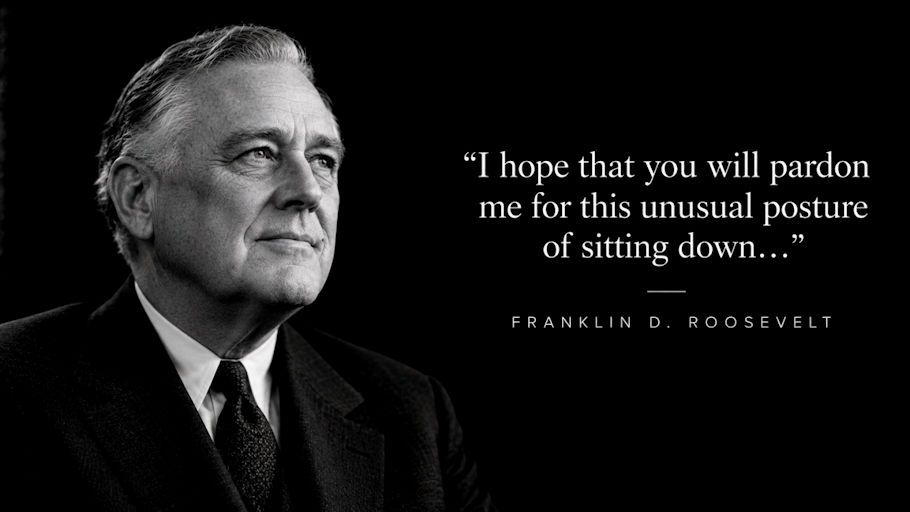
"I hope that you will pardon me for this unusual posture of sitting down..."
- Franklin D. Roosevelt, address to Congress, March 1, 1945.
Power and the Body
Roosevelt was reporting on the Yalta Conference. Before discussing diplomacy, he explained why he would remain seated: standing meant carrying roughly ten pounds of steel on his legs after a journey of fourteen thousand miles. The apology exposes a requirement that usually passes unnoticed. A president was expected to stand while accounting for decisions whose substance had little to do with standing.
Political authority has a physical presentation. Leaders approach a platform, receive visitors, inspect troops, enter rooms, and face cameras. These movements help make office visible. Their familiarity can obscure the difference between what government requires and what an audience expects governing to look like.
For Roosevelt, that difference required daily practical attention. Getting to a lectern and deciding what to say there were separate problems, although a public appearance joined them together. His career after 1921 depended partly on making the first problem manageable without allowing it to determine his eligibility for the second.
The 1921 Break
In August 1921, at thirty-nine, Roosevelt experienced a severe paralytic illness, diagnosed at the time as poliomyelitis. His own later account describes rapidly worsening weakness, an inability to stand, and a prolonged period of pain and dependence. The enduring loss of function in his lower limbs changed ordinary movement as well as the practical conditions of political life.
He pursued recovery with considerable intensity. Swimming, exercises, medical consultations, and equipment became part of his routine. But he never regained ordinary independent walking. Any account that says he overcame polio and then returned to politics removes the condition under which that return actually occurred.
His letter to physician William Egleston is revealing because it describes particular muscles, different brace weights, and movement in water. Roosevelt monitored what his body could do rather than treating recovery as a single event. The letter also contains hopes that were not fulfilled. A historical account must preserve both his determination to improve and the permanent limits that determination did not eliminate.
Learning a Different Public Function
Roosevelt's return involved learning a demanding form of assisted movement. Braces locked his knees; a cane and another person's arm provided support while he used his upper body and hips to advance. This was neither an ordinary gait nor a gesture accomplished through confidence. It was a practiced physical technique involving equipment and another person.
His 1924 appearance at the Democratic convention, where he nominated Al Smith, helped restore his presence on the national political stage. Yet the meaning of that return is easily distorted. He had not recovered the body with which he had campaigned before his illness. He was learning to appear publicly through a different arrangement of bodily effort and assistance.
The distinction matters because audiences ordinarily see the completed appearance. A speaker reaches the platform and begins; the preparation disappears into the event. In Roosevelt's case, what looked like individual presence depended on coordinated action. The assistance did not deliver the speech for him, but without it, the familiar setting for the speech could become inaccessible.
The Architecture of Movement
The objects preserved in Roosevelt's collections make the work specific. Leg braces stabilized joints that could not support him unaided. Small adapted wheelchairs navigated spaces where larger chairs were awkward. His 1936 Ford Phaeton used hand controls, allowing him to drive without operating pedals with his feet. Each device addressed a different task; none restored the lost function of his legs.
Space mattered just as much. A narrow passage, a stairway, or the approach to a raised platform could interrupt an otherwise feasible engagement. Ramps, handrails, suitable seating, and carefully arranged routes changed what could happen. The route from a vehicle to a speaking position was part of the event's operating requirements, even when it appeared nowhere in the program. A staircase could make an otherwise accessible meeting depend on someone carrying him. Changing the route could remove that particular dependence without changing Roosevelt's body. These were concrete differences in what participation demanded from him and from those assisting him.
Human assistance remained essential. Valets, relatives, aides, and protective staff helped with transfers, dressing, and movement. Their labor should remain visible in the historical explanation. Describing Roosevelt as independently mobile because an audience saw him upright would erase the people who helped produce that appearance.
Nor did every adaptation create independence in the same way. National Park Service research notes that several of his small wheelchairs lacked hand rims and were frequently pushed by others. Compact design could improve access while retaining dependence on assistance. His wealth and office made such help available on a scale unavailable to most people with comparable limitations.
Warm Springs
Roosevelt first visited Warm Springs, Georgia, in 1924, bought the resort property in 1926, and established the nonprofit foundation the following year. He hoped treatment would improve his condition. In water, buoyancy reduced the load his legs had to bear, permitting movements that were difficult or impossible on land. Rehabilitation offered practical possibilities without delivering the independent walking he continued to seek.
Warm Springs also became an institutional environment organized around patients' needs. Archival accounts describe water exercises, instruction in movement, and attention to rest. Buildings needed alteration: ramps and connected walkways made the facilities usable. A place intended for treatment could still obstruct patients if its doors, steps, and facilities remained designed for bodies unlike theirs.
A report by physician LeRoy Hubbard distinguished gains in muscle power from gains in function, observing that functional improvement sometimes exceeded what muscle charts suggested. That distinction belongs at the center of this history. A person could become more capable in daily activities through technique, equipment, and surroundings without equivalent restoration of the impaired muscles.
Patients also exchanged experiences through the Polio Chronicle, discussing independent living and access. Warm Springs was therefore more than the setting for a prominent man's private rehabilitation. It brought practical knowledge into circulation among people facing related difficulties. Its significance should not be reduced to a claim that suffering automatically made Roosevelt a wiser president.
Governing and Performing Authority
Executive work required Roosevelt to receive information, evaluate proposals, negotiate, appoint officials, and authorize action. Limited walking did not inherently remove those capacities. It did affect travel, scheduling, and how encounters were organized. The presidency had to accommodate a real physical constraint without treating that constraint as a universal description of its occupant.
The distinction was never absolute. Politics depends on encounters, and access influences whom a leader meets and what information reaches him. An arrangement that permits a president to work can also make him more dependent on people controlling access. Adaptation therefore involves questions of institutional power as well as physical convenience.
Roosevelt's report on Yalta describes messages arriving from Washington and communications sent during his journey. Government continued through a network of people and channels while the president traveled. This was not authority without a body; it was authority whose operation already extended beyond the body's immediate location.
Such arrangements do not certify the quality of decisions. Roosevelt's policies remain open to historical and moral judgment. The narrower point is that physical assistance and executive responsibility can coexist. A man helped into a room can still hold the authority to make decisions affecting millions, including decisions for which he must be criticized.
The Managed Image
Roosevelt's visual presentation was carefully controlled. Historian Geoffrey C. Ward's account of amateur footage from the 1935 White House Easter Egg Roll supplies an unusually concrete example. Professional cameramen were to record the president once he reached a selected position and stop when he began returning inside. An amateur continued filming the movement that the usual record excluded.
The footage shows Roosevelt supported by bodyguard Gus Gennerich, then holding the railing while greeting the crowd. Gennerich moved out of the camera's view before returning to assist him. The apparently self-contained presidential image had a working arrangement immediately outside its frame.
This was not simply a secret disability successfully concealed from an unsuspecting country. The National Park Service documents public knowledge of his paralysis, coverage of his condition, and fundraising associated with his rehabilitation. Knowing that a president had impaired legs was different from regularly seeing transfers, wheelchairs, and the effort of moving a few steps. Image management controlled that difference.
Reducing these choices to shame would replace historical explanation with an assumption about his private feelings. They operated within expectations that attached vigor and command to bodily performance, alongside press conventions, security practices, and the practical choreography of public events. Roosevelt had political reasons to keep assistance from becoming the dominant interpretation of an appearance.
That explanation does not make the arrangement neutral. Restricting images could preserve his freedom to act while leaving the public convention largely intact: authority continued to appear most recognizable when dependence was kept outside the picture. His individual accommodation challenged exclusion without necessarily dismantling the visual standard that helped produce it.
Anti-Coaching: Authority Is Not Mobility
The Anti-Coaching question concerns the relationship between a damaged function and the task people claim it disqualifies someone from performing. Walking is necessary for some activities. Exercising presidential authority does not require unaided walking in the same direct sense. Linking the two requires an explanation, not an inherited image of what a leader should look like.
Roosevelt's rehabilitation was real work, and its gains mattered. But political participation could not remain indefinitely conditional on full physical restoration. The environment also had to change: transportation, room arrangements, assistance, and presentation. Treating his return as a victory of will alone misidentifies the work that made it possible.
There is an important distinction between helping someone regain a function and requiring that recovery as the price of participation. The first can expand opportunity. The second can exclude a capable person while everyone waits for an outcome that may never occur. Roosevelt's presidency became possible with continuing impairment, rather than after its disappearance.
His experience also makes the distribution of resources impossible to ignore. A president could obtain vehicles, staff, and alterations that another person could not. That difference limits any attempt to turn his biography into an instruction to try harder. The relevant question is which arrangements allowed participation, who could obtain them, and why others were expected to manage without them.
Responsibility survives this analysis. Physical dependence does not exempt a leader from answering for policy, nor does the ability to stand establish sound judgment. A serious assessment must ask whether information is adequate, decisions are defensible, and institutions can challenge mistakes. These demands remain after the route to the lectern has been redesigned.
When the Symbol and the Function Separate
The March 1945 congressional address made the distinction visible. Roosevelt remained seated and explained the physical burden that standing imposed. Congress still had a report to examine, agreements to consider, and future commitments to debate. Removing an exhausting part of the presentation did not remove the substance of the occasion.
His reference to steel braces also brought hidden work into the spoken record. The upright president familiar from public appearances had relied on material supports whose weight the audience did not carry. The alternative posture made that burden explicit without asking listeners to abandon the political questions before them.
Roosevelt's experience offers no simple choice between authentic disability and false authority. His authority was real, his impairment was real, and the arrangements connecting him to public life were real. The managed image selected which parts of that relationship would be visible. Understanding the presidency requires restoring the omitted work without imagining that exposure invalidates the officeholder's agency.
The deeper issue is how institutions respond when their customary symbol no longer fits the person performing the function. They can make conformity the condition of admission, or examine which requirements actually serve the work. In Roosevelt's case, braces, assistance, vehicles, and redesigned spaces helped sustain participation while the old expectation of effortless bodily command remained politically influential.
He never recovered ordinary independent walking. He nevertheless continued to exercise authority through a presidency supported by people, equipment, communication, and institutions. The distinction is precise: someone else could help move the president's body without becoming the author of his decisions.
More frameworks for performance and decision-making when information is incomplete but responsibility for the result remains can be found in my Responsibility Series - Operating in the Dark.
Frequently Asked Questions
NOTE: Researched FAQs by Disabled World (DW)
Did Franklin D. Roosevelt actually have polio?
Doctors diagnosed polio in 1921, and that remains the standard account. A 2003 study in the Journal of Medical Biography argued that his symptoms fit Guillain-Barre syndrome better, but with no lab tests from the time, the cause cannot be confirmed either way.
Is there a statue of FDR in a wheelchair?
Yes. After campaigning by disability advocates, a bronze statue showing Roosevelt seated in a wheelchair was added to the entrance of the Franklin Delano Roosevelt Memorial in Washington, D.C., in 2001, four years after the memorial opened.
Are there any photographs of FDR in his wheelchair?
Very few are known. The best-known is a 1941 photograph taken by his cousin Margaret Suckley at his Hyde Park retreat, showing him seated in his wheelchair with his dog Fala and a young family friend.
What was Roosevelt's link to the March of Dimes?
In 1938 Roosevelt founded the National Foundation for Infantile Paralysis, which became known as the March of Dimes. Its fundraising paid for the research and 1954 field trials that led to the Salk polio vaccine being licensed in 1955.
Where and when did Franklin D. Roosevelt die?
He died on April 12, 1945, at his cottage in Warm Springs, Georgia, from a cerebral hemorrhage. His death came about six weeks after he addressed Congress seated to report on the Yalta Conference.
Can people visit Roosevelt's home at Warm Springs today?
Yes. The cottage he built there, known as the Little White House, is now a Georgia state historic site with a museum that displays his hand-controlled car, braces, wheelchair and other personal items.
How long was FDR president?
Roosevelt was elected four times and served from March 1933 until his death in April 1945, just over 12 years. He is the longest-serving president in U.S. history, and the 22nd Amendment now limits presidents to two elected terms.
What is post-polio syndrome?
Post-polio syndrome is a condition that can appear 15 years or more after the original polio infection, bringing new muscle weakness, fatigue and joint pain. It is not contagious, and treatment focuses on managing symptoms and conserving energy.
References
- Berish, A. (n.d.). FDR and polio. Franklin D. Roosevelt Presidential Library and Museum.
- National Park Service. (n.d.). A fresh look at FDR's wheelchairs on International Wheelchair Day. Home of Franklin D. Roosevelt National Historic Site.
- National Park Service. (n.d.). FDR and the history of disability. Home of Franklin D. Roosevelt National Historic Site.
- Ward, G. C. (1989). A first-class temperament: The emergence of Franklin Roosevelt. Harper and Row.
Anti-Coaching: Beyond the Limit
Read More From the Series:
- Helen Keller: Language Access, Education and Independence: Helen Keller's path from childhood gestures to Radcliffe and socialist writing shows how access to language, books and teaching shaped her independent thought.
- Kim Peek: Savant Memory, Disability and Measuring Ability: Kim Peek, the savant who inspired Rain Man, shows why exceptional memory, daily dependence and intelligence need to be assessed as separate human abilities.
- Marla Runyan: Elite Racing With Stargardt Vision Loss: Marla Runyan, Paralympic champion and two-time Olympian with Stargardt disease, raced at elite speed with central vision loss and incomplete visual information.
- John Nash: Schizophrenia, Genius and Verifying Reality: Essay on John Nash's schizophrenia, Nobel-winning game theory and return to Princeton, examining why intelligence alone cannot verify a person's grip on reality.
- Claude Monet: When Perception Becomes Unreliable: How cataracts diagnosed in 1912 changed Claude Monet's color perception, what his 1923 eye surgery fixed, and what his late paintings can and cannot reveal.
- Alex Zanardi: Rebuilding Control After Double Amputation: Alex Zanardi's racing career after a double leg amputation shows how hand controls, prosthetics and handcycle design rebuilt his driving and Paralympic success.
- Lesya Ukrainka: Chronic Illness, Writing and The Forest Song: How Lesya Ukrainka wrote The Forest Song while living with tuberculosis and variable capacity, and how her 1911 drama became the animated film Mavka during war.
- Vincent van Gogh: What Reproduction Cannot Preserve: An artist's essay on why Vincent van Gogh's original paintings and drawings reveal brushstroke, texture, and scale that digital reproductions cannot preserve.
- Beethoven's Hearing Loss and the Architecture of Feedback: Beethoven's progressive hearing loss stripped away the feedback his composing and performing relied on, while notation, memory, and sketches kept his work going.
- Stephen Hawking Was Not a Motivation Story: Stephen Hawking viewed through decision architecture, showing how assistive technology and support systems extend human agency when motivation meets hard limits.
Insights, Analysis, and Developments
Editorial Note: Roosevelt's story is often told as a tale of a man who beat polio, but the record points somewhere more useful. He never walked independently again, yet he won four presidential elections and led the country through the Depression and most of the Second World War, which says a great deal about how little the core work of leadership depends on legs. What made it possible was a mix of equipment, ramps, rerouted entrances and people willing to lift, steady and push, along with money and status that few disabled Americans of his era could match. That gap still matters today for anyone weighing workplace accommodations, accessible public spaces or the assumption that a leader must look physically commanding, since the real question is not whether someone can perform the old ritual of standing at a podium, but whether the setting has been arranged so their judgment can be put to work and held to account.*
 Author Credentials: Lexx Che is a Systems Builder, Narrative Architect, author, independent journalist, and researcher with nearly 20 years of professional experience. His work spans more than 1,000 projects across strategy, design, technology, digital ecosystems, organizational transformation, identity, and decision architecture. In medicine and healthcare, he and his teams bring 15 years of experience creating visual identity systems, developing and repositioning brands, building corporate websites, and delivering digital transformations and complex digital ecosystems for private clinics and large healthcare networks. Explore Lexx Che's complete biography for comprehensive insights into his background, expertise, and accomplishments.
* Editorial additions by Ian C. Langtree.